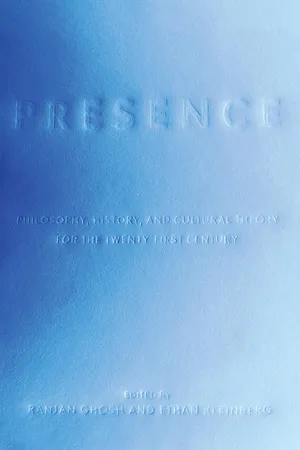
The philosophy of "presence" seeks to challenge current understandings of meaning and understanding. One can trace its origins back to Vico, Dilthey, and Heidegger, though its more immediate exponents include Jean-Luc Nancy, Hans Ulrich Gumbrecht, and such contemporary philosophers of history as Frank Ankersmit and Eelco Runia. The theoretical paradigm of presence conveys how the past is literally with us in the present in significant and material ways: Things we cannot touch nonetheless touch us. This makes presence a post-linguistic or post-discursive theory that challenges current understandings of "meaning" and "interpretation." Presence provides an overview of the concept and surveys both its weaknesses and its possible uses.In this book, Ethan Kleinberg and Ranjan Ghosh bring together an interdisciplinary group of contributors to explore the possibilities and limitations of presence from a variety of perspectives—history, sociology, literature, cultural theory, media studies, photography, memory, and political theory. The book features critical engagements with the presence paradigm within intellectual history, literary criticism, and the philosophy of history. In three original case studies, presence illuminates the relationships among photography, the past, memory, and the Other. What these diverse but overlapping essays have in common is a shared commitment to investigate the attempt to reconnect meaning with something "real" and to push the paradigm of presence beyond its current uses. The volume is thus an important intervention in the most fundamental debates within the humanities today.Contributors: Bill Ashcroft, University of New South Wales; Mark Bevir, University of California, Berkeley; Susan A. Crane, University of Arizona; Ranjan Ghosh, University of North Bengal; Suman Gupta, Open University Ethan Kleinberg, Wesleyan University; John Michael, University of Rochester; Vincent P. Pecora, University of Utah; Roger I. Simon.
eBook - ePub
Presence
Philosophy, History, and Cultural Theory for the Twenty-First Century
- 232 pages
- English
- ePUB (mobile friendly)
- Available on iOS & Android
eBook - ePub
Presence
Philosophy, History, and Cultural Theory for the Twenty-First Century
About this book
Information
Subtopic
HistoriographyIndex
History1
PRESENCE IN ABSENTIA
The past is never dead. It’s not even past.
WILLIAM FAULKNER, Requiemfor a Nun
If we were not perfectly convinced that Hamlet’s Father died before the play began, there would be nothing more remarkable in his taking a stroll at night, in an easterly wind, upon his own ramparts, than there would be in any other middle-age gentleman rashly turning out after dark in a breezy spot—say Saint Paul’s Churchyard for instance—literally to astonish his son’s weak mind.
CHARLES DICKENS, A Christmas Carol
“Marley was dead: to begin with.”1 So opens Dickens’s classic tale of Christmas redemption, and it is with the ghost of Jacob Marley that I want to begin this exploration of the concept of “presence” in relation to the project of history. Dickens’s point is that if time were not out of joint, if Marley was not dead and we were not absolutely sure of his ghostly, spectral, and immaterial nature, then “nothing wonderful” could come of the story. To be sure, Marley is not the only ghost in Dickens’s A Christmas Carol but the other three have a strikingly different nature. For Dickens, Marley is the only ghost whose death concerns us because he is the only ghost who is out of time. This is to say that unlike the ghost of Marley, the Ghosts of Christmas Past, Present, and Future appear to be well jointed in terms of our classic understanding of temporality. The past precedes the present, which is followed by the future, and each is announced by the ordered sounding of the clock. But while these three Ghosts are bound by this temporal structure they too are each distinct. Not unlike the past itself, the Ghost of Christmas Past is a figure that “fluctuated in its distinctness: being now a thing with one arm, now with one leg, now with twenty legs, now a pair of legs without a head, now a head without a body: of which dissolving parts, no outline would be visible in the dense gloom wherein they melted away. And in the very wonder of this, it would be itself again; distinct and clear as ever.” In the gloom the Ghost of Christmas Past emits a “bright clear jet of light” from the crown of its head though it also possesses a “great extinguisher of a cap.”2 The futural Ghost of Christmas Yet to Come is a figure shrouded in a “deep black garment which concealed its head, its face, its form” and whose “mysterious presence filled him [Scrooge] with a solemn dread.”3 By contrast, the Ghost of Christmas Present is a gregarious fellow, a “jolly Giant, glorious to see” seated before a “mighty blaze that roared up the chimney” upon a “kind of throne” made up of “turkeys, geese, game, poultry, brawn, great joints of meat, sucking-pigs, long wreaths of sausages, mince pies, plum puddings, barrels of oysters, red-hot chestnuts, cherry cheeked apples, juicy oranges, immense twelfth-cakes, and seething bowls of punch, that made the chamber dim with their delicious steam.”4 And here we should think about the way Hans Gumbrecht differentiates “presence effects” from “meaning effects” in that “presence effects appeal exclusively to the senses.”5 A more sensuous or welcoming figure could not be imagined: “‘Come in!’ exclaimed the Ghost. ‘Come in! and know me better, man!’”
Thus even beyond the material comfort one receives in his presence, there seems more to be gained from the Ghost of Christmas Present than from the others. The past is gone and the future is yet to come. It is only in the present that one can actually do things; that one can change in ways that of course cannot rectify the past but that can serve the future. This is precisely what happens to Scrooge and in this light one can certainly see the attraction of a focus on presence and the present: on a philosophy of history that eschews the endless turning over of the past or fruitless speculation on the future in favor of an emphasis on actual things that are present here and now. In the words of Eelco Runia, “‘Presence,’ in my view, is ‘being in touch’—either literally or figuratively—with people, things, events, and feelings that made you into the person you are.”6 Thus “before” and “after” meet in the very real place of the present, safe from the brackish ontological waters of the past and the uncertainty and anxiety of the future.7 One might say that the present “is what it is” and in this respect the present distinguishes itself from the past and the future because it positions itself as a category of space and not time.8 As such the interpretive paradigm of “presence” takes priority over the other temporal modes because it investigates the place where a “whisper of life” is “breathed into what has become routine and clichéd—it is fully realizing things instead of just taking them for granted.”9 It is a place of change and a place of redemption or so it appears.10 This certainly seems to be the case for Scrooge who “fully realized things” that he had previously “taken for granted” that fine Christmas morning. For Scrooge as for thinkers such as Frank Ankersmit, Michael Bentley, Ewa Domanska, Hans Gumbrecht, and Eelco Runia the present is where they want to be and the present of “presence” is a place of experience and unmediated contact with material things freed from the ambivalence and multiplicity of recollection, interpretation, and narration embodied in the shape shifting Ghost of Christmas Past and protected from the deathly specter (or specter of inevitable death) of the future embodied in the Ghost of Christmas Yet to Come. Thus one can understand Scrooge’s compulsion to retreat to the inviting chamber of the present and away from the specters of death and absence that haunt both his past and future, but on what is our current compulsion for “presence” predicated?11
The Return of the Real
For Eelco Runia, the publication of Hayden White’s Metahistory was a watershed moment that led to a “process in which the philosophy of history was emptied of reflection on what had actually happened in the past…and inaugurated the heyday of ‘metahistoriography.’”12 Runia laments the ways that the historical profession became obsessed with the construction of narratives about the past at the expense of losing touch with the past itself. Gumbrecht and Ankersmit expand this critique by enlarging the field to include other figures and movements of the “linguistic turn.” Gumbrecht tells us that he has
grown weary of this intellectual one-way traffic as it has been based on and upheld by a certain narrow and yet totalizing understanding of hermeneutics. I also have long experienced the absolutism of all post-linguistic turn varieties of philosophy as intellectually limiting, and I have not found much consolation in what I want to characterize as the “linguistic existentialism” of deconstruction, that is the sustained complaint and melancholia (in its endless variations) about the alleged incapacity of language to refer to the things of the world.13
Thus, Gumbrecht believes that the current emphasis on the production of meaning via language that dominates higher academia, the “culture of interpretation” as he calls it, has led to “intellectual relativism” and our estrangement from the past.14 This is to say that the quest to understand how historical “meaning” is constructed led to a subsequent assault on meaning that has rendered it virtually meaningless. “In the last three or four decades—philosophers of history have tried to purge their discipline of attempts to establish meaning.”15 Runia, Gumbrecht, and Ankersmit all seek to move beyond this climate of constructivism and to return to what is real. Ankersmit describes a shift “away from language toward experience” and attempts to reclaim “meaning” from the clutches of language and representationalism.16 To Ankersmit’s mind, “philosophy of history, in the last half century, has predominantly been an attempt to translate the success of philosophy of language to historical writing” but “‘Theory’ and meaning no longer travel in the same direction; meaning has now found a new and more promising traveling companion in experience.”17 All three call for a turn away from the seemingly endless interpretations manufactured by “theory” and a return to a relationship with the past predicated on our unmediated access to actual things that we can feel and touch and that bring us into contact with the past. “Rather than having to think, always and endlessly, what else there could be, we sometimes seem to connect with a layer in our existence that simply wants the things of the world close to our skin.”18 In the same vein, Domanska states: “I am trying to rethink the material aspects of traces of the past in a context other than semiotics, discourse theory, or representation theory, and to focus the analysis of those traces on an aspect that is marginalized or neglected by traditional notions of the source. That is, I mean to focus on the materiality or thingness of the trace rather than on its textuality and content.”19 In this sense, the paradigm of presence is an explicit rejection of discursive theory and can be seen as part of a larger backlash against postmodernism and the perceived dominance of language.20 It is an attempt to reconnect “meaning” with something “real.” The most obvious targets are thinkers such as Jacques Derrida, Richard Rorty, Hayden White, and those historical theorists who have advocated a constructivist or deconstructive approach to the study of history via the investigation into language (“textuality and content”).21 But it is also indicative of a larger social unease about secularism, proceduralism, and a social contract that is no longer guaranteed by either God or a fixed “human nature.” If all there is “language all the way down,” then there is nothing to assure the validity of the contract. I have argued elsewhere that as “we grow less and less confident in humankind’s ability to provide a moral or ethical scaffold to guide us, we are left searching for a new authority to validate that which humankind has surveyed and measured.”22 This desire for stability has become all the more acute in the wake of September 11, 2001.23 The rise of “presence” as a category of historical reflection in its more and less sublime incarnations is a direct response to this growing unease that seeks to grab the past and hold it in the present to help us divine guidance for the future. This is what Runia describes as his “focus not on the past but on the present, not on history as what is irremediably gone, but on history as an ongoing process” and the basis for his claim that “the concept of presence is a convenient way to put an edge on the issue of how exactly the past can be said to exist.”24
“Presence” is a movement away from a constructed past and toward a past that actually exists. But it would be a mistake to assume that it is a return to the positivism or realism that characterized the philosophy of history before the “linguistic turn.” Ankersmit puts it this way: “It is certainly distressing that the liberation of philosophy from the narrow straights of transcendentalism that we may find in their [Derrida, Hans-Georg Gadamer, Rorty] writings did change so desperately little that it left the world of history, of representation, of our experience of art, music, and of the more existential aspects of the condition humaine as unexplained and devoid of philosophical interest as had been the case in the heyday of logical positivism.”25 Indeed, in some ways it is the failures of these earlier movements that allowed for the ascendancy of the later ones. But this is because “in the philosophy of history we have long been led astray by the phenomenon of ‘meaning’—first by pursuing it, then by forswearing it.”26 “Presence” is presented as a counter to meaning but also as a response to the attack on meaning exemplified in Whitean representationalism, Derridean deconstruction, Gadamerian hermeneutics, and Rortian contructivism wherein meaning is conserved as a category that is essential for understanding and communication, but demotes its status in terms of our relation to the past. Runia states:
I take the position that, on consideration, it is not meaning we want, but something else, something that is just as fundamental, something that outside the philosophy of history, in society at large, is pursued with a vehemence quite like the vehemence with which we—within the discipline—believe only meaning can be pursued. For it is, I think, not a need for meaning that manifests itself in the enthusiasm for remembrance, in the desire for monuments, in the fascination for memory. My thesis is that what is pursued in the Vietnam Veterans Memorial, in having a diamond made “from the carbon of your loved one as a memorial to their unique life,” in the reading of names on that anniversary of the attack on the World Trade Center, in the craze for reunions, and in a host of comparable phenomena, is not “meaning” but “presence.”27
For Runia, “presence—being in touch with reality—is just as basic as meaning” but our quest for “meaning” has been misguided because it is actually a response to our desire for “presence.”28 So presence offers a return to the real that can in tu...
Table of contents
- Prologue
- 1. Presence in Absentia
- 2. Be Here Now
- 3. Meaning, Truth, and Phenomenology
- 4. Of Photographs, Puns, and Presence
- 5. The Public Rendition of Images Médusées
- 6. The Presence of Immigrants, or Why Mexicans and Arabs Look Alike
- 7. Transcultural Presence
- 8. “It Disturbs Me with a Presence”
- 9. The Presence and Conceptualization of Contemporary Protesting Crowds
- Epilogue
- Notes
- Contributors
Trusted by 375,005 students
Access to over 1.5 million titles for a fair monthly price.
Study more efficiently using our study tools.
Frequently asked questions
Yes, you can cancel anytime from the Subscription tab in your account settings on the Perlego website. Your subscription will stay active until the end of your current billing period. Learn how to cancel your subscription
No, books cannot be downloaded as external files, such as PDFs, for use outside of Perlego. However, you can download books within the Perlego app for offline reading on mobile or tablet. Learn how to download books offline
Perlego offers two plans: Essential and Complete
- Essential is ideal for learners and professionals who enjoy exploring a wide range of subjects. Access the Essential Library with 800,000+ trusted titles and best-sellers across business, personal growth, and the humanities. Includes unlimited reading time and Standard Read Aloud voice.
- Complete: Perfect for advanced learners and researchers needing full, unrestricted access. Unlock 1.5M+ books across hundreds of subjects, including academic and specialized titles. The Complete Plan also includes advanced features like Premium Read Aloud and Research Assistant.
We are an online textbook subscription service, where you can get access to an entire online library for less than the price of a single book per month. With over 1.5 million books across 990+ topics, we’ve got you covered! Learn about our mission
Look out for the read-aloud symbol on your next book to see if you can listen to it. The read-aloud tool reads text aloud for you, highlighting the text as it is being read. You can pause it, speed it up and slow it down. Learn more about Read Aloud
Yes! You can use the Perlego app on both iOS and Android devices to read anytime, anywhere — even offline. Perfect for commutes or when you’re on the go.
Please note we cannot support devices running on iOS 13 and Android 7 or earlier. Learn more about using the app
Please note we cannot support devices running on iOS 13 and Android 7 or earlier. Learn more about using the app
Yes, you can access Presence by Ranjan Ghosh, Ethan Kleinberg, Ranjan Ghosh,Ethan Kleinberg in PDF and/or ePUB format, as well as other popular books in History & Historiography. We have over 1.5 million books available in our catalogue for you to explore.