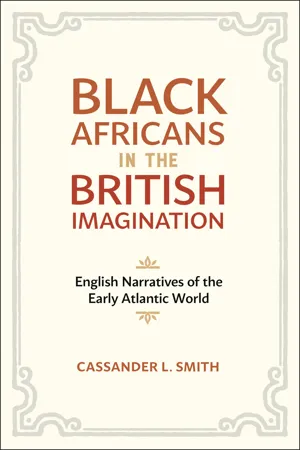
As Spain and England vied for dominance of the Atlantic world during the sixteenth and seventeenth centuries, mounting political and religious tensions between the two empires raised a troubling specter for contemporary British writers attempting to justify early English imperial efforts. Specifically, these writers focused on encounters with black Africans throughout the Atlantic world, attempting to use these points of contact to articulate and defend England's global ambitions. In Black Africans in the British Imagination, Cassander L. Smith investigates how the physical presence of black Africans both enabled and disrupted English literary responses to Spanish imperialism. By examining the extent to which this population helped to shape early English narratives, from political pamphlets to travelogues, Smith offers new perspectives on the literary, social, and political impact of black Africans in the early Atlantic world.With detailed analysis of the earliest English-language accounts from the Atlantic world, including writings by Sir Francis Drake, Sir Walter Ralegh, and Richard Ligon, Smith approaches contact narratives from the perspective of black Africans, recovering figures often relegated to the margins. This interdisciplinary study explores understandings of race and cross-cultural interaction and revises notions of whiteness, blackness, and indigeneity. Smith reveals the extent to which contact with black Africans impeded English efforts to stigmatize the Spanish empire as villainous and to malign Spain's administration of its colonies. In addition, her study illustrates how black presences influenced the narrative choices of European (and later Euro-American) writers, providing a more nuanced understanding of black Africans' role in contemporary literary productions of the region.
In this first chapter, I discuss early English encounters with West Africa, examining the significance of those encounters in terms of how English travelers articulated their experiences later in the Americas. The discussion centers on the travel accounts of William Towerson and John Hawkins. Towerson was a sea merchant who made three profitable trade voyages to Guinea in 1555, 1556, and 1558.Virtually obscure in 1555, he was four years into a seven-year apprenticeship with a London skinner, Miles Mording, when he assumed the role of sea captain.1 He proved himself a capable trader and seaman as he returned from each of his three voyages with profitable cargos. Scholars seldom discuss Towerson’s voyages within the context of early American and Atlantic studies, presumably because the travels occur as a bilateral move between England and West Africa. In addition, Towerson did not participate, at least directly, in the Atlantic slave trade. Rather, his expeditions were significant, as J. D. Alsop notes, because they transformed the Guinea trade into a “profitable sector of England’s developing long-distance commerce.”2
Towerson was emblematic of what Alsop calls a new kind of London elite, one comprised of men born of modest means who were lured to London, where they secured apprenticeships. Those apprenticeships gave them access to maritime trade from which they built their fortunes financially and socially. Towerson, Alsop argues, “provides an informative illustration of the rise of an exceedingly obscure individual through participation in the West African trade of the 1550s and his subsequent integration into an Elizabethan commercial elite heavily involved in overseas trade and exploration.”3 Alsop points to the commercial and social consequences of Towerson’s early Guinea voyages. I emphasize the cultural, specifically literary, consequences.
Towerson’s voyages are unique in that he left behind three full narratives detailing each of his expeditions. The English undertook a number of voyages to West Africa in the second half of the sixteenth century. For most of those voyages we are left with only fragments and truncated secondhand accounts, the majority of which Richard Hakluyt cobbled together in his Principal Navigations.4 Towerson’s narratives, by contrast, provide an especially rich quantity of material from which to examine the rhetorical features of early accounts of English voyages to Guinea.5 Specifically, Towerson’s narratives are shaped by political and commercial imperatives to validate English overseas trade in a region where Portugal had already claimed a monopoly. To avoid charges of piracy, Towerson insisted he conducted trade with sovereign Guinea nations who were not subject to Portuguese rule. What is more, he claimed that those nations welcomed trade with the English as the Portuguese were an oppressive presence in the region. He attempted to build trade alliances with Guineans by positioning himself as a liberator. He promised them exotic wares—and protection.
In his interactions with prospective Guinea traders, some of whom are especially adept at manipulating international trade politics, Towerson discovers what Drake will learn twenty years later in Panama—the difficulty of representing as oppressed people with a clear sense of autonomy and political ambitions of their own. This difficulty creates a series of ruptures in Towerson’s narratives. Those ruptures matter because they provide textual traces or circumstantial evidence that suggests black Africans actively engaged Europeans on the coast of Guinea, their actions directly affecting the shape of Towerson’s narratives. Also, through those ruptures we see more clearly the vital but contested role black Africans played in an English imperial imagination that sought to justify England’s overseas conduct through moralizing and liberatory paradigms.
In short, the mediated presences of black Africans in Towerson’s narrative disrupt a victim/tyrant binary through which Towerson attempts to portray the Portuguese. This disruption, in turn, challenges Towerson’s own self-image as a more benevolent European force, denying him the justificatory language that would sanctify English trade in Guinea. Towerson’s ventures—and the narratives they produced—helped to set the rhetorical stage for English-black African interactions later in the Americas, providing an early illustration of how the material presences of black Africans challenged the representational strategies English writers deployed to articulate national and imperial identities.
A decade after Towerson’s voyages, John Hawkins employed a similar rhetorical strategy in his pamphlet “A True Declaration of the Troublesome Voyage,” the account of his third slaving expedition to Guinea and the Caribbean. Hawkins was the second son of William Hawkins, who was one of the first English traders to participate in an Atlantic triangular trade when he stopped along the Sestos River in Guinea in the 1530s to trade English goods for ivory en route to trading destinations along the east coast of South America. John Hawkins undertook three Atlantic voyages in the 1560s. Like his predecessors, Hawkins saw Guinea as a region brimming with resources—not gold, spices, and ivory but people whom he could enslave. He captured black Africans along the Melegueta Coast, mostly in Sierra Leone, then sold them to buyers in the Spanish-controlled Caribbean. While all three voyages effectively initiated England’s entrance into the Atlantic slave trade (although it would still be several decades before the English participated fully), the most significant was the third voyage because it produced political and rhetorical consequences that aided in the deterioration of English-Spanish relations in the Americas and produced a series of narratives designed to stir English Hispanophobia.
Like Towerson, Hawkins embodies a liberatory persona in the descriptions of his interactions with Guineans. On that third voyage, he was approached by a Guinean king in present-day Sierra Leone seeking an alliance to protect his town from a neighboring enemy. Hawkins supplied resources, manpower, and eventually his own martial strength to liberate the king and his subjects. For his troubles, Hawkins expected to secure a cache of slaves taken from among the prisoners of war. According to Hawkins, the king deceived him by stealing away in the dead of night with the entire lot of prisoners, leaving Hawkins with nothing. This deception mirrored Hawkins’s interactions with a Spanish viceroy weeks later at the Spanish port of San Juan de Ulúa in Mexico. After the men agreed to share the port, Hawkins claimed that the viceroy reneged on the agreement, attacking Hawkins’s ships and destroying his fleet. Hawkins and only a fraction of his men survived.
In the account Hawkins writes of his ordeal, he mediates the perfidy of the Spanish viceroy through his interactions with the Guinean king, and his text replaces the anti-Portuguese sentiment of Towerson’s narratives with an anti-Spanish one. As part of this book’s larger project, Hawkins’s narrative matters for three reasons. First, it works in conjunction with Towerson’s narrative to illustrate that black Africans very early on played a key role in how England sought to articulate its overseas enterprises. Whereas Towerson’s narratives, though, are marked by certain narrative disruptions, Hawkins’s text does not reflect the same kind of narrative dissonance. He avoids the potentially disruptive effect of black African presences by fictionalizing key material details of his encounters in Guinea. As I will discuss shortly, Hawkins changes the facts when constructing his narrative to ensure that the plot more closely aligns with his rhetorical aims, a strategic move that itself illustrates the ways in which the material presences of black Africans worked in tandem with English writers’ literary imaginations to produce texts. Second, Hawkins’s narrative illustrates the ways in which English encounters with sub-Saharan Africa affected how English writers articulated their experiences specifically in the Americas. Third, the narrative stands as a rhetorical transition between Towerson and Drake, an early formulation of those representational patterns that Drake (and others) will adopt several years later in New Spain—where the material presences of black Africans will undermine Drake’s self-construction and his articulation of England’s imperial project. Together, Towerson’s and Hawkins’s narratives illuminate those patterns of interaction and representation—created through early Guinea-English encounters—that black Africans later challenge in the Americas.
Imagining Africa: Towerson’s Travel and Literary Predecessors
I begin the discussion here with Towerson’s narratives by examining first those travel accounts of his predecessors to contextualize his rhetorical strategies. Then I discuss the political and social landscape of Guinea in the 1550s before providing a close-reading of Towerson’s texts. In 1555, the English scientist and translator Richard Eden published a collection of travel narratives designed to herald the overseas achievements of Spain and encourage the English to pursue their own overseas agenda.6 The collection, titled Decades of the Newe Worlde or West India, highlighted Spanish activity in South America and the Caribbean and early English voyages to the northeast—Muscovy (Russia) and Cathay (China).7 At the end of his collection, Eden added two accounts of Englishmen’s travels in 1553 and 1554 to the Guinea region of West Africa. The narratives provide readers with two of the earliest English eyewitness accounts of the region and are reprinted in 1589 in Hakluyt’s massive Principal Navigations. For Eden (and Hakluyt), the voyages are vital accomplishments, illustrative of the breadth of England’s commercial activity and overseas travel. Both voyages come on the heels of successful trading expeditions to Barbary in North Africa in 1551 and 1552 and are part of England’s efforts to expand its trade reaches into faraway locales such as the Mediterranean, East Indies, and Russia.8 In fact, shortly after initiating travel and trade to West Africa and in the same year that Eden published his collection, the English formed the Muscovy Company. Not incidentally, some of the same London investors backed trade ventures to both Russia and Guinea.9
The first of those Guinea voyages departed England in 1553 with two ships and a pinnace under the leadership of Thomas Wyndham, who had led the voyages to Barbary in the two years prior.10 Accompanying Wyndham as second in command, or “petycapitaine,” was Antonio Anes Pinteado, a Portuguese ex-patriot with experience of the West African coastline.11 The venture suffered several disasters. Due to poor leadership (Pinteado and Wyndham bickered constantly) and illness, a voyage that began with 140 sailors returned with barely forty men. The voyage did manage to yield valuable commodities, including 150 pounds of gold and tons of pepper. The profits prompted a second voyage the next year under the leadership of merchant and investor John Lok. After some twenty weeks, Lok returned to England with a bounty of African goods, including gold, spices, and ivory. In the wake of this second voyage, Eden catalogued the commodities gained as “foure hundredth pounde weyght and odde of golde of xxii carrattes and one grayne in finenesse. Also xxxvi buttes of graynes: and abowt two hundredth and fiftie elephantes teethe of all quantities.”12
Equally important as the material gains, those first two voyages revived for English readers classical ideas about the continent of Africa and its inhabitants. Eden’s account of Lok’s voyage, in particular, has been a popular go-to text for scholars seeking to understand early English attitudes toward black Africans.13 He bookends his narrative of Lok’s voyage with historical and proto-ethnographic descriptions of Africa and Africans. He describes the continent, the sub-Saharan region in particular, as a land of monstrous races (cannibals and headless men), anomalous geographic features, such as water spouts that originate in the sky and fall into the sea, and lascivious women, who “contracte no matrimonie, neyther have respect to chastitie.”14 He continues, “Many thynges more owre men sawe and consydered in this vyage worthy to bee noted wherof I have thought good to put sum in memory that the reader maye aswell take pleasure in the varietie of thynges as knowleage of the hystorye.”15
Eden’s narratives of those first English voyages inform later English travelers’ thoughts and accounts, including those of Towerson, who mimics Eden’s monstrosity rhetoric. He notes, for example, that along the St. Vincent River, on the Melegueta Coast the people “race” their skin “with divers works,” and the “men and women goe so alike, that one cannot know a man from a woman but by their breastes, which in the most part be very foule and long, hanging downe low like the udder of a goate” (367).16 Farther along the St. Vincent, he encounters another town of people where he describes the inhabitants as “wilde and idle,” and women’s breasts are “exceeding long” so that “some of them will lay the same upon the ground and lie downe by them” (369).17 The observations appear neutral, detached conclusions about foreign, exotic cultures, but those observations are far from inconsequential. They point to an emerging racial discourse that will in time transform with the growth of the Atlantic slave trade from considerations of cultural practices and mores to considerations of bodily difference.18
Both Towerson and Eden perpetuate these monstrous images from medieval travel predecessors, such as Leo Africanus and John Mandeville, who regale readers with stories about monstrous races that reside at the edges of the habitable world.19 The link between the foreign and the monstrous dates back to the classical period when thinkers such as Pliny the Elder, who in “Book Seven” of his Natural History, cataloged a series of monstrous races that occupied faraway nations, mostly in Asia and Africa.20
Importantly, the racial rhetoric in Towerson’s narratives is complicated by a greater political expediency that demands he represent the humanity, as opposed to a presumed monstrosity, of black Africans. To refute Portuguese claims that he is a pirate, Towerson legitimizes his trade by humanizing Guinea communities as self-governing trade partners struggling to conduct trade under the yoke of a Portuguese tyrant. Consider, for example, his description of an encounter in the town of Hanta (or Ahanta) on that second voyage. The residents of the town complain to Towerson “that there were five Portugall shippes at the Castle and one pinnasse, and that the Portugals did much harme to their Countrey, and that they lived in feare of them, and we told them againe, that we would defend them from the Portugals whereof they were very glad” (399). He makes similar promises to residents in Shama several days later. He writes:
Then wee departed and went to Shamma [sic] and went into the river with five boates well appointed with men and ordinance, and with our noises of trumpets and drummes, for we thought here to have found some Portugals but there were none: so wee sent our Negros on shore, and after them went divers of us, and were very well received, and the people were very glad of our Negros, specially one of their brothers wives, and one of their aunts, which received them with much joy and so did all the rest of the people, as if they had bene their naturall brethren: we comforted the captaine and told him that hee should not feare the Portugals, for wee would defend him from them: whereupon we caused our boats to shoote off their bases and harquebusses, and caused our men to come on shore with their long bowes and they shot before the captaine, which he, with all the rest of the people, wondred much at, specially to see them shoot so farre as they did, and assayed to draw their bows but could not. When it grew to be late, we departed to our ships, for we looked every houre for the Portugals (399).
Towerson’s articulation of this scene at Shama is striking. An emotional energy pervades the moment as Towerson’s black African mediators reunite with the inhabitants of the town. The joyous reunion exists alongside the town leader’s fears of a Portuguese attack. The English, too, are anxious, even as they descend on the town like guardian angels. Notably, the emotional energy gives way to a display of cultural supremacy when Towerson demonstrates English technology, specifically weaponry, which the town leader and “all the rest of the people wondred much at.”21 Here, Towerson shows rather than merely tells the people at Shama that he can defend them against the Portuguese, that he is in fact a great liberator. Throughout the second narrative, especially, Towerson portrays himself as enjoying a warm reception on the coast. He regales readers with examples of people who risk life and limb to trade and interact with him. One man is so eager to trade with the English that he braves rough seas to get to the English ship, but, according to Towerson, “the land-wash went so sore that it overthrew his boat” (397). The man drowns. At another town, Towerson claims, the town’s leader greets him at sea with tears of joy. Towerson writes that the man “seemed to be the gladdest man alive, and so did all the companie that knew mee” (404). In contrast to the Portuguese, Towerson’s presence does not evoke fear, anxiety, and hostility among Guineans. Rather, he appears a great comforter to the people, ushering in joy and excitement wherever he goes. Moments like this aid in representing English commercial activity abroad in more humane, ethical terms. This will become a more urgent imperative when the English expand across the Atlantic and seek to define themselves in opposition not to Portugal but to Spain.
On the Ground: The Social and Political Logistics of Guinea-English Trade
By the time Towerson arrived on the Guinea coast in 1555, African towns had been trading with the Portuguese for nearly a century.22 The Portuguese, in fact, had set up a fort along the coast, São Jorge da Mina, or El Mina for short. The French had been in the region since the 1530s. As they navigated the waterways, then, Towerson and his crews were on constant guard for competing French a...
Table of contents
Cover
Title Page
Copyright Page
Contents
Acknowledgments
Introduction Black Africans, a Black Legend, and Challenges of Representation
Chapter 1. Points of Origin: English Voyages to Guinea
Chapter 2. Reconstructing the Ethiop: Sir Francis Drake and the Cimarrones of Panama
Chapter 3. Alliances Real and Imagined: Thomas Gage and Black African Collaboration in New Spain
Chapter 4. Consuming Beauty: Richard Ligon, Black African Women, and a Reciprocity of Power
Chapter 5. Locating Africa in the Americas: George Best, Sir Walter Ralegh, and the Quandaries of Racial Representation
Afterword Beyond the Mediation
Notes
Index
Trusted by 375,005 students
Access to over 1.5 million titles for a fair monthly price.
Study more efficiently using our study tools.
Frequently asked questions
Yes, you can cancel anytime from the Subscription tab in your account settings on the Perlego website. Your subscription will stay active until the end of your current billing period. Learn how to cancel your subscription
No, books cannot be downloaded as external files, such as PDFs, for use outside of Perlego. However, you can download books within the Perlego app for offline reading on mobile or tablet. Learn how to download books offline
We are an online textbook subscription service, where you can get access to an entire online library for less than the price of a single book per month. With over 1.5 million books across 990+ topics, we’ve got you covered! Learn about our mission
Look out for the read-aloud symbol on your next book to see if you can listen to it. The read-aloud tool reads text aloud for you, highlighting the text as it is being read. You can pause it, speed it up and slow it down. Learn more about Read Aloud
Yes! You can use the Perlego app on both iOS and Android devices to read anytime, anywhere — even offline. Perfect for commutes or when you’re on the go. Please note we cannot support devices running on iOS 13 and Android 7 or earlier. Learn more about using the app
Yes, you can access Black Africans in the British Imagination by Cassander L. Smith in PDF and/or ePUB format, as well as other popular books in Literatura & Crítica literaria latinoamericana y caribeña. We have over 1.5 million books available in our catalogue for you to explore.