These firsthand accounts of US and Soviet scientists communicating across the Iron Curtain offer "a stunning portrait of Cold War scientific cooperation" (
Physics Today).
For sixty years, scientists from the United States and the Soviet Union participated in state-organized programs of collaboration. But what really happened in these programs? What did the participants and governments hope to achieve? And how did these programs weather the bumpiest years of political turbulence?
From Pugwash to Putin provides accounts from sixty-three insiders who participated in these programs, including interviews with scientists, program managers, and current or former government officials.
In their own words, these participants discuss how and why they engaged in cooperative science, what their initial expectations were, and what lessons they learned. They tell stories of gravitational waves, classified chalkboards, phantom scientists, AIDS propaganda, and gunfire at meteorological stations, illustrating the tensions and benefits of this collaborative work.
From the first scientific exchanges of the Cold War through the years following the fall of the Soviet Union, Gerson S. Sher provides a sweeping and critical history of what happens when science is used as a foreign policy tool. Sher, a former manager of these cooperative programs, provides a detailed and critical assessment of what worked, what didn't, and why it matters.
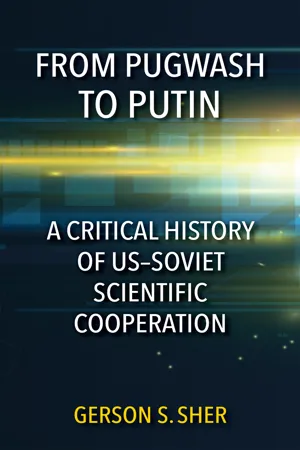
eBook - ePub
From Pugwash to Putin
A Critical History of US-Soviet Scientific Cooperation
- 308 pages
- English
- ePUB (mobile friendly)
- Available on iOS & Android
eBook - ePub
About this book
Information
Topic
StoriaSubtopic
Organizzazioni intergovernativePART I
THE TIMELINE
1
THE DEEP COLD WAR AND THE EXCHANGE PROGRAMS
The Spirit of Pugwash, the Thaw, and Sputnik
The story of scientific cooperation between the United States and the former Soviet Union begins not with a program but rather with an understanding: that scientists from the two postwar superpowers who developed the most destructive weapons in human history had a responsibility to see that these very weapons were not used to destroy humanity. This understanding became known as the “Spirit of Pugwash,” named for a village in Nova Scotia, Canada, where magnate Cyrus Eaton kept his summer home. There, twenty-two prominent scientists from the United States, the Soviet Union, and eight other countries (Japan, the United Kingdom, Canada, Australia, Austria, China, France, and Poland) gathered in 1957 to discuss the threat to humanity posed by the advent of nuclear weapons.1 Such a conference had been urged in 1955 in what came to be known as the Russell-Einstein Manifesto, eleven of whose twelve signatories were Nobel Laureates, including Bertrand Russell and Albert Einstein, who signed just days before his death.
The Russell-Einstein Manifesto and the Spirit of Pugwash, however, were not the first efforts to address these grave concerns. Scientists such as Einstein and Robert Oppenheimer were obsessed with worry that the creation of atomic weapons would present a destructive potential that would be a profound threat to humanity itself. In 1945, Eugene Rabinowitch of the University of Illinois, who participated in the work of the Manhattan Project, along with Hyman Goldsmith, founded the influential Bulletin of the Atomic Scientists with the mission of educating the public about the dangers of nuclear war. Rabinowitch was also a key figure in Pugwash, becoming a founding member of the Continuing Committee for the Pugwash Conferences on Science and World Affairs.2
Underlying the Pugwash movement was a sense that scientists (and other intellectuals) have a special responsibility to direct their activity to peaceful purposes. Well aware of their role in creating new weapons that could destroy humanity, they saw it as their mission to establish direct lines of communication with high-level policymakers and to urge them to harness scientific knowledge in beneficial, not destructive, ways. The Spirit of Pugwash in the late 1950s had broad appeal to leading scientists in the United States and the Soviet Union. It created a shared view that peaceful coexistence and global security depended significantly on dialogue and cooperation between these two superpowers. It also converged to a certain extent with some US policy initiatives, such as the Atoms for Peace Program, and discussions between diplomats of the two countries to create citizen-to-citizen cultural and scientific “exchange programs,” which were established in the late 1950s.
Within the Soviet Union, things were also changing in the early 1950s, though at first less perceptibly. Joseph Stalin’s death on March 5, 1953, marked the end of an era of terror and a monstrous “cult of personality,” as Nikita Khrushchev was soon to call it.3 But to all except the most avid Kremlinologists, the waters seemed calm and the monolithic rule of the Communist Party of the Soviet Union (CPSU) appeared intact, even in the vacuum left by the death of the great Vozhd’ (“the leader,” one of Stalin’s many heroic epithets).
This magic spell ended in February 1956 with the Twentieth Congress of the CPSU. At that time, Khrushchev made his historic, dramatic denunciation of Joseph Stalin before a stunned assemblage of the party’s leaders, who had only three years before gone into deep mourning with the entire nation over Stalin’s death. Khrushchev’s speech, in which he also debuted the notion of what came to be known as “peaceful coexistence,”4 launched a far-reaching thaw in Soviet society, setting the stage for reconciliation and conflict on a number of fronts—the return of prisoners from the gulag and some cultural relaxation but also conflict with China, an attempted reactionary coup in 1957, and ultimately Khrushchev’s own demise in 1964.
Khrushchev’s 1956 speech was also a signal to the West that some relaxation in international relations might be possible. Consequently, it was now possible to talk seriously about initiating formal cultural relations between the United States and the USSR.5 Over that summer, President Dwight D. Eisenhower met with a group of citizens from different fields to discuss the possibility of direct person-to-person exchanges between the two countries. The process culminated in a September 1956 conference in which Eisenhower formally announced the formation of the People-to-People Program. Explaining his vision for the program, he said, “If we are going to take advantage of the assumption that all people want peace, then the problem is for people to get together and to leap governments—if necessary to evade governments—to work out not one method but thousands of methods by which people can gradually learn a little bit more of each other.”6
This philosophy formulated the primary rationale for the exchange programs of the ensuing period: people-to-people contacts. Another term that appeared early to describe the same concept, and one that has stuck, was citizen diplomacy. According to the Institute of International Education, an organization that has been the country’s leader in managing person-to-person exchanges for almost one hundred years, “Citizen diplomacy is a concept that involves two seemingly disparate ideas: private citizens engaging in individual endeavors that serve their own interests; and diplomacy, which includes a framework for cooperation between countries. Taken together, citizen diplomacy refers to an array of actions and activities that individuals can partake in that contribute to deepening ties between individuals and communities and to advancing the goals of public diplomacy. Citizen diplomacy is thus an integral part of public diplomacy.”7
One of the most popular books of the late 1950s, The Ugly American, whether deliberately or not, brought the idea of citizen diplomacy to the public’s attention. It drew a stark contrast between the lives and work abroad (in this case, in Southeast Asia) of American diplomats, whom it depicted as oblivious to and contemptuous of local conditions, and the few “ordinary” American citizens, who came to these countries to work on the ground in villages, to listen to the residents’ ideas and needs, and to learn the language and culture. While the eponymous “ugly American” was the latter kind of person—and as portrayed in the book, literally a physically unattractive man—it was the polished diplomatic corps of the local US embassy who were truly “ugly” in terms of their behavior and disrespect for local people and culture. One of the book’s characters, the fictional Philippines minister of defense, observed to the American ambassador of a fictional nearby country: “The simple fact is, Mr. Ambassador, that average Americans, in their natural state, if you will excuse the phrase, are the best ambassadors a country can have. . . . They are not suspicious, they are eager to share their skills, they are generous. But something happens to most Americans when they go abroad. Many of them are not average. . . . They are second-raters.”8
One can only imagine the ambassador’s reaction to the minister’s characterization of American diplomats and vacation tourists as “second-raters.” But these words faithfully underscore what Eisenhower meant by “leaping governments” with ordinary people as citizen-ambassadors. And it was his faith in the goodness of the ordinary American that informed his ideas on exchanges.
The launch of Sputnik on October 4, 1957, was a shock and a wake-up call to the West about the Soviet Union’s apparent scientific and technological prowess. Unlike the Soviet development of the atomic and hydrogen bombs, in which it was thought (and possibly was true) that the Soviets merely copied designs from the West through espionage, no similar case could be made for the sudden appearance of the first artificial satellite in human history orbiting around the Earth. It was clear from Sputnik that the Soviets were a power to be respected and feared in terms of their scientific and, in particular, engineering capabilities after all. Sputnik’s launch was in effect the beginning of the two races that characterized the second half of the twentieth century—the space race and the missile race.9 American scientists were now challenged to fill in vast gaps in their knowledge about what was going on in Soviet research institutes, and the study of Russian science—as well as the Russian language, for that matter—became a national security issue.
The Lacy-Zaroubin Agreement
On January 27, 1958, the United States and the Soviet Union signed the “Agreement between the United States of America and the Union of Soviet Socialist Republics in the Cultural, Technical, and Educational Fields.” The agreement was signed by the two chief negotiators—William S. B. Lacy, President Eisenhower’s special assistant on East-West exchanges, and Georgi Z. Zaroubin, the Soviet ambassador to the United States—and became known as the Lacy-Zaroubin agreement.10
The Lacy-Zaroubin agreement (often shortened to simply “Lacy-Zaroubin” or “the Cultural Exchanges agreement”) was a major innovation in international cooperation of any kind. As Yale Richmond, who oversaw the US-Soviet programs for decades in the State Department’s Bureau of Cultural Affairs, emphasizes in his history of the early exchange programs, “on the U.S. side there was no precedent for such an agreement.”11 After the Second World War, he explains, the United States had unilaterally funded and administered exchange programs with Germany and Japan with the goal of democratizing these countries, but the notion of a formal bilateral, intergovernmental program was new.12 Also new was the involvement of the US nonprofit and private sectors in the program, which encompassed science and technology, broadcasting, motion pictures, youth, education, performing arts, athletics, and tourism. In some cases, the activities were almost completely self-funded and self-administered. “Why, then,” Richmond asked, “was such an agreement necessary?” “The simple answer,” he continued, “is that the Soviet leaders wanted an agreement and made it a condition to having exchanges.”13 In short, it was to satisfy the Soviets’ obsession with control. All the areas covered by the exchanges, in the Soviet Union, were state funded and state controlled.
Activities taking place under this framework were highly structured. The very term exchange brought to mind a carefully calibrated and planned transaction, not unlike an exchange of spies, as a matter of fact. Typically, they functioned through quantitative quotas, expressed in terms of persons or person-months.14 The programs’ basic underlying principles, as expressed in the agreement, were equality, reciprocity, and mutual benefit.
The US and Soviet governments’ policy objectives were in some respects similar and in others quite different. In his sweeping study of this period, Richmond describes them as follows:
U.S. objectives, as stated in a National Security Council directive (NSC 5607), were, among others, to broaden and deepen relations with the Soviet Union by expanding contacts between people and institutions; involve the Soviets in joint activities and develop habits of cooperation with the United States; end Soviet isolation and inward orientation by giving the Soviet Union a broader view of the world and of itself; improve U.S. understanding of the Soviet Union through access to its institutions and people; and obtain the benefits of long-range cooperation in culture, education, and science and technology.
The Soviet objectives in the exchanges were not openly stated but, from a study of how they conducted the exchanges, they can be presumed to have included the following: to obtain access to U.S. science and technology, and learn more about the United States, its main adversary; support the view that the Soviet Union was the equal of the United States by engaging Americans in bilateral activities; promote the view that the Soviet Union was a peaceful power seeking cooperation wit...
Table of contents
- Cover
- Title Page
- Copyright
- Dedication
- Contents
- Acknowledgments
- Introduction
- Part I: The Timeline
- Part II: In Their Own Words
- Part III: Conclusion: So What?
- Appendix: List of Interviews
- Bibliography
- Index
- About the Author
Trusted by 375,005 students
Access to over 1.5 million titles for a fair monthly price.
Study more efficiently using our study tools.
Frequently asked questions
Yes, you can cancel anytime from the Subscription tab in your account settings on the Perlego website. Your subscription will stay active until the end of your current billing period. Learn how to cancel your subscription
No, books cannot be downloaded as external files, such as PDFs, for use outside of Perlego. However, you can download books within the Perlego app for offline reading on mobile or tablet. Learn how to download books offline
Perlego offers two plans: Essential and Complete
- Essential is ideal for learners and professionals who enjoy exploring a wide range of subjects. Access the Essential Library with 800,000+ trusted titles and best-sellers across business, personal growth, and the humanities. Includes unlimited reading time and Standard Read Aloud voice.
- Complete: Perfect for advanced learners and researchers needing full, unrestricted access. Unlock 1.5M+ books across hundreds of subjects, including academic and specialized titles. The Complete Plan also includes advanced features like Premium Read Aloud and Research Assistant.
We are an online textbook subscription service, where you can get access to an entire online library for less than the price of a single book per month. With over 1.5 million books across 990+ topics, we’ve got you covered! Learn about our mission
Look out for the read-aloud symbol on your next book to see if you can listen to it. The read-aloud tool reads text aloud for you, highlighting the text as it is being read. You can pause it, speed it up and slow it down. Learn more about Read Aloud
Yes! You can use the Perlego app on both iOS and Android devices to read anytime, anywhere — even offline. Perfect for commutes or when you’re on the go.
Please note we cannot support devices running on iOS 13 and Android 7 or earlier. Learn more about using the app
Please note we cannot support devices running on iOS 13 and Android 7 or earlier. Learn more about using the app
Yes, you can access From Pugwash to Putin by Gerson S Sher in PDF and/or ePUB format, as well as other popular books in Storia & Organizzazioni intergovernative. We have over 1.5 million books available in our catalogue for you to explore.