With real-life stories, this collection "focuses on the role of music in the often-delicate negotiations surrounding weddings in immigrant communities" (Ellen Koskoff, author of
A Feminist Ethnomusicology).
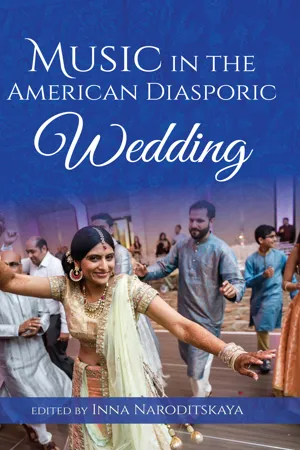
Music in the American Diasporic Wedding explores the complex cultural adaptations, preservations, and fusions that occur in weddings between couples and families of diverse origins. Discussing weddings as a site of negotiations between generations, traditions, and religions, the essays gathered here argue that music is the mediating force between the young and the old, ritual and entertainment, and immigrant lore and assimilation.
The contributors examine such colorful integrations as klezmer-tinged Mandarin tunes at a Jewish and Taiwanese American wedding, a wedding services industry in Chicago's South Asian community featuring a diversity of wedding music options, and Puerto Rican cultural activists dancing down the aisles of New York's St. Cecilia's church to the thunder of drums and maracas and rapping their marriage vows. These essays show us what wedding music and performance tell us about complex multiethnic diasporic identities, and remind us that how we listen to and celebrate otherness defines who we are.
- 296 pages
- English
- ePUB (mobile friendly)
- Available on iOS & Android
eBook - ePub
Music in the American Diasporic Wedding
About this book
Information
ONE

THEORETICAL PERSPECTIVES ON WEDDINGS, LOCALLY AND BEYOND
A. J. RACY
THE TOPIC OF WEDDINGS evokes a certain air of familiarity. Speaking about weddings usually brings to mind a variety of related experiences and memories: of the venue, the limousine, the bride’s dress, the jewelry, the food, and the music played, among others. Similarly, as a subject of research, the wedding theme may seem conceptually and methodologically discrete. As such, it may resemble a high aerial view of a city. However, the closer we descend toward the cityscape, the more expansive and intricately detailed the view appears. As we look more closely into the makeup and the significance of weddings, we may face a vast panoramic terrain of interrelated domains that are historical, social, and economic, as well as ceremonial, emotional, and aesthetic.
My interest in weddings at home and abroad reflects my own background as a Lebanese-born-and-raised performer and composer of Near Eastern music and as someone who has witnessed numerous homeland wedding events. Later on, in Southern California, I have occasionally played the role of a participant-observer while joining fellow musicians, or performing alone as guest artist, at wedding-related musical events. Meanwhile, as an ethnomusicologist, I have become increasingly cognizant of the social, conceptual, and symbolic layers that bear upon the wedding theme. In this chapter, I place the wedding within a broader theoretical and ethnographic framework that is multidisciplinary and thematically varied. In the process, I also draw on related examples from both the Arab world, especially the Levantine, or eastern Mediterranean areas, and the Arab American immigrant or diasporic experience.
SOCIAL STRUCTURE
As a starting point, I look into the wedding as a social institution. Weddings, like other comparable rituals or commemorative markers in people’s lives, have been viewed as collective manifestations that are fundamentally linked to their respective all-embracing social systems. Accordingly, in weddings, as in religious practices, the underlying ideology supposedly gains compelling presence as it becomes a social entity, as Durkheim indicates: “Of course, since categories are themselves derived from concepts, we readily understand that they are the work of the collectivity. . . . Since the world expressed by the total system of concepts is the world that society represents, society alone can provide us with the most general notions according to which it must be represented.”1 Comparably, British social theorists, notably Alfred R. Radcliffe-Brown and Bronislaw Malinowski, and others in the field of ethnomusicology have upheld the theoretical premise that the various institutions reflect the community’s shared societal values and, furthermore, perform complementary functions that together contribute to the organicity or interconnectedness within the larger social system.2 Such a perspective, which has been frequently questioned or refined, calls attention to a certain mutual relevancy between the wedding as an institution and the all-encompassing social macrocosm. Accordingly, “The rite of marriage is also an end in itself that it creates a supernaturally sanctioned bond, superadded to the primarily biological fact: the union of man and woman for lifelong partnerships in affection, economic community, the procreation and rearing of children. . . . By giving monogamous marriage an imprint of value and sanctity, religion offers another gift to human culture.”3 However, the notion of an implicit normative symbiosis between the wedding and the presumably overarching systemic social order, although in a sense quintessential, I find to be rather restrictive, or at least theoretically limiting. For one thing, such a relationship seems to underestimate or overlook the tensions or variances between the two realms. In the Arab American context, the connection between the two may become particularly complex given the heterogeneities (in terms of ethnicities, countries of origin, and social and cultural orientations) within the Arab American communities at large. Similarly to be considered are Arab American weddings’ departures from, as well as affinities with, the host country’s social mainstream, which in turn is vast and internally diversified.
RITUAL PROCESS
Meanwhile, analytical research on rituals gives us a useful model for studying weddings. In Arnold van Gennep’s classic The Rite of Passage, which addresses a variety of examples, including initiation rituals, weddings, funerals, pregnancy, and childbirth, the author examines how such events enable individuals or groups to pass from one status or social standing into another. In this case, three stages are involved: (1) “separation,” in other words, detachment from a certain status or social realm; (2) “transition,” or undergoing the transformational phase; and (3) “incorporation,” namely, the passage or merger into the newly acquired status. These stages apply to the basic contour of many traditional weddings. Of particular interest to the present study is van Gennep’s recognition of the intervening rites that permeate the broader ritual process. For example, “The passage from the transitional period, which is betrothal [that is, the mutual pledge to become married], to marriage itself, is made through a series of rites of separation from the former, followed by rites consisting of transition, and rites of incorporation into marriage.”4 Such a sequential progression reveals the numerous almost self-contained, albeit sequentially connected, episodes of liminality, temporality, and transition that usually occur within the wedding as a multiphased process. On a finer level, the wedding itself may be read or viewed in terms of separate phases, as well as linked processes.
Theoretically, the rite of passage model enables us to study the extended ritual in stages toward understanding the different weddings’ internal idiosyncrasies, or departures from certain presupposed norms, in matters of structure and signification. Providing a focused perspective on the individual ingredients, the model is particularly useful for examining Arab American weddings in the West or in other contexts where the dynamics of acculturation and diversification pervade the different facets of the ritual process.
A further perspective to be considered is Victor Turner’s work,5 which, drawing on van Gennep’s model, probes the transitory, or liminal period in the Ndembu culture of Zambia. Here, Turner speaks of an extraordinary context in which the neophytes are neither here nor there, or “betwixt and between.”6 Accordingly, they endure trying physical and mental experiences, while acquiring such “neutralizing” traits as being neither male nor female and neither living nor dead. “Their condition is one of ambiguity and paradox, a confusion of all the customary categories.”7 In the midst, allusions to particular community values are brought to the subjects’ attention in preparation for their transitioning into the desired initiated status. Turner thus envisions the overall ritual process dialectically in terms of “structure and anti-structure.”8 Furthermore, he associates the transitioning or liminal phase with what he calls “communitas,” a shared sense of collegiality among the subjects, or, as he writes, “What is interesting about liminal phenomena for our present purposes is the blend they offer of lowliness and sacredness, of homogeneity and comradeship. We are presented, in such rites, with a ‘moment in and out of time,’ and in and out of secular social structure, which reveals, however fleetingly, some recognition (in symbol if not always in language) of a generalized social bond that has ceased to be and has simultaneously yet to be fragmented into a multiplicity of structural ties.”9 The author also speaks of different types of communitas experiences as he finds them in a variety of world social and religious contexts.
Turner’s ritual design adds a certain viewpoint to the study of the wedding as a dynamic process that is capable of acting on, or challenging, the social system. As a specialized cultural mechanism, or as “anti-structure,” the wedding ritual produces new social realities through its compelling symbolic and experiential attributes. Furthermore, the state of communitas, as Turner presents it, may resemble the wedding’s collective sense of camaraderie, which is enhanced by the emotional arousal or the effervescence that prevails among the participants. However, the celebratory ethos of the wedding ritual, at least in the Arab case, stands as a clear contrast to the mood of submission and deprivation that usually underlies the communitas state as it is represented. Commenting on “rites of affliction,” Catherine Bell explains further: “Following Victor Turner, who frequently invoked this category of ritual, rites of affliction seek to mitigate the influence of spirits thought to be afflicting human beings with misfortune.”10 Arguably, the liminal ambiance of the wedding festivity grants the celebrated wedded couple extraordinary licenses and prerogatives. Similarly, I would add that the wedding-bound emotional experiences tend to be ineffably complex and varied. In Arab American, and other, weddings, I have seen deeply moved, teary-eyed individuals, as well as others who are ecstatically energized and manifestly jubilant.
SYMBOLIC SYSTEM
The profile of rituals, including weddings, as symbolically empowered expressions is linked to the interpretive or symbolic discourse.11 Here we see a departure from the functionalist supremacy of “culture” in favor of a semiotically connected network within which such expressions as wedding events can be strategically loaded and meaningfully interpreted or decoded. In his work on “The Invention of Culture,” Roy Wagner comparably speaks of dialectic processes that operate through “a critical readjustment of the tension between invention and convention.”12 Furthermore, the effect and affect of various cultural expressions have been widely noted by ethnomusicologists and others, in terms of poetry recitations challenging the male-oriented code of conduct, the momentarily achieved symbolic gender reversals through trance rituals, singing traversing physical or conceptual barriers between brothers and sisters, linking certain sounds of nature to crying, and using song to “engender” the social patterns and hierarchies at weddings.13
Along similar lines, throughout history marriage has provided means to establish new ethnic, familial, religious, and political alliances or, for that matter, to reconnect the immigrants with their homelands. Furthermore, viewed through an interpretive, or “thick descriptive,” lens, the study of wedding events may reveal several layers of meaning. At an Arab American wedding party I attended in Northern California almost thirty years ago, the event, on the surface at least, seemed typical or ordinary, except for something that caught my attention. I noticed two groups in the audience competing in requesting dance songs from the musicians on the stage, with one of the groups seeming to be more assertive in making the requests. Upon discussing this pattern with fellow musicians who knew the people at the wedding, I began to make sense of the behaviors: the bride and the groom came originally from two different villages that shared old mutual rivalries, and more requests came from the family that had covered a larger share of the wedding expenses. Interpretively speaking, the festive event seemed to provide an arena for strategized or symbolic competition, entitlement, and power play expressed through the song and dance performance.
PRACTICE
Other related theories treat the ritual...
Table of contents
- Cover
- Title Page
- Copyright
- Dedication
- Contents
- Foreword: What a Wedding Song Tells Me / Alejandro L. Madrid
- Acknowledgments
- Introduction: Say YES to US: Music in Diasporic Weddings / Inna Naroditskaya
- 1. Theoretical Perspectives on Weddings, Locally and Beyond / A. J. Racy
- 2. Negotiating Gender, Community, and Ethnicity: Balkan Romani Transnational Weddings / Carol Silverman
- 3. Dissonant Love: Music in Latina/o Diasporic Weddings / Lorena Alvarado and Frances R. Aparicio
- 4. Tambura Music, Flags, and the Deterritorialization of Ritualized Violence at Croatian American Weddings / Ian MacMillen
- 5. Like an Erhu Player on the Roof: Music and Multilayered Diasporic Negotiation at a Taiwanese and Jewish American Wedding / Meredith Schweig
- 6. Song, Sevdah, and Ceremony: An Autoethnographic Exploration of Music and Community Cohesion in Bosnian American Weddings / Tanya Merchant
- 7. Soulful Same-Sex Wedding, Aretha Franklin, Love, and the Politics of (Un)freedom / Nina C. Öhman
- 8. Trying to Get the Gig: “Ethnic” Weddings from the Musician’s Perspective / Michael Allemana
- 9. Jewish Wedding Music in the Neo-Klezmer Era / Hankus Netsky
- 10. Sound Unions: The Work of Music Specialists in Chicago’s South Asian Wedding Scene / Kaley Mason and Ameera Nimjee
- 11. Mountain Weddings in Chicago / Timothy J. Cooley
- Index
- About the Author
Trusted by 375,005 students
Access to over 1.5 million titles for a fair monthly price.
Study more efficiently using our study tools.
Frequently asked questions
Yes, you can cancel anytime from the Subscription tab in your account settings on the Perlego website. Your subscription will stay active until the end of your current billing period. Learn how to cancel your subscription
No, books cannot be downloaded as external files, such as PDFs, for use outside of Perlego. However, you can download books within the Perlego app for offline reading on mobile or tablet. Learn how to download books offline
Perlego offers two plans: Essential and Complete
- Essential is ideal for learners and professionals who enjoy exploring a wide range of subjects. Access the Essential Library with 800,000+ trusted titles and best-sellers across business, personal growth, and the humanities. Includes unlimited reading time and Standard Read Aloud voice.
- Complete: Perfect for advanced learners and researchers needing full, unrestricted access. Unlock 1.5M+ books across hundreds of subjects, including academic and specialized titles. The Complete Plan also includes advanced features like Premium Read Aloud and Research Assistant.
We are an online textbook subscription service, where you can get access to an entire online library for less than the price of a single book per month. With over 1.5 million books across 990+ topics, we’ve got you covered! Learn about our mission
Look out for the read-aloud symbol on your next book to see if you can listen to it. The read-aloud tool reads text aloud for you, highlighting the text as it is being read. You can pause it, speed it up and slow it down. Learn more about Read Aloud
Yes! You can use the Perlego app on both iOS and Android devices to read anytime, anywhere — even offline. Perfect for commutes or when you’re on the go.
Please note we cannot support devices running on iOS 13 and Android 7 or earlier. Learn more about using the app
Please note we cannot support devices running on iOS 13 and Android 7 or earlier. Learn more about using the app
Yes, you can access Music in the American Diasporic Wedding by Inna Naroditskaya in PDF and/or ePUB format, as well as other popular books in Medios de comunicación y artes escénicas & Etnomusicología. We have over 1.5 million books available in our catalogue for you to explore.