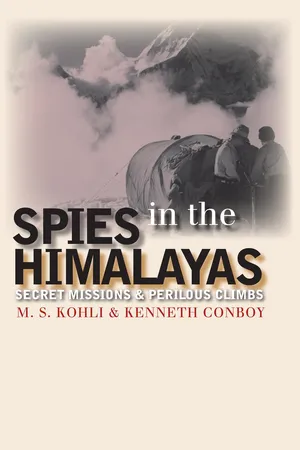
In the towering mountains of northern India, a chilling chapter was written in the history of international espionage.
After the Chinese detonated their first nuclear test in 1964, America and India, which had just fought a border war with its northern neighbor, were both justifiably concerned. The CIA knew it needed more information on China’s growing nuclear capability but had few ways of peeking behind the Bamboo Curtain. Because of the extreme remoteness of Chinese testing grounds, conventional surveillance in this pre-satellite era was next to impossible.
The solution to this intelligence dilemma was a joint American-Indian effort to plant a nuclear-powered sensing device on a high Himalayan peak in order to listen into China and monitor its missile launches. It was not a job that could be carried out by career spies, requiring instead the special skills possessed only by accomplished
mountaineers. For this mission, cloaks and daggers were to be replaced by crampons and ice axes.
Spies in the Himalayas chronicles for the first time the details of these death-defying expeditions sanctioned by U.S. and Indian intelligence, telling the story of clandestine climbs and hair-raising exploits. Led by legendary Indian mountaineer Mohan S. Kohli, conqueror of Everest, the mission was beset by hazardous climbs, weather delays, aborted attempts, and even missing radioactive materials that may or may not still pose a contamination threat to Indian rivers.
Kept under wraps for over a decade, these operations came to light in 1978 and have been long rumored among mountaineers, but here are finally given book-length treatment. Spies in the Himalayas provides an inside look at a CIA mission from participants who weren’t agency employees, drawing on diaries from several of the climbers to offer impressions not usually recorded in covert operations. A host of photos and maps puts readers on the slopes as the team attempts repeatedly to plant the sensor on a Himalayan summit.
An adventure story as well as a new chapter in the history of espionage, this book should appeal to readers who enjoyed Jon Krakauer’s Into Thin Air and to anyone who enjoys a great spy story.
Key takeaways
AI-Generated Insights
Insight 1
Analyze the geopolitical motivations and intelligence challenges that led to the joint American-Indian espionage operations in the Himalayas during the pre-satellite era.
Insight 2
Evaluate the unique operational strategies and extreme environmental obstacles faced by mountaineer-spies in attempting to deploy nuclear-powered surveillance technology on high Himalayan peaks.
Insight 3
Trace the historical trajectory of these covert missions, including their eventual public revelation and the ongoing debates surrounding their environmental impact and ethical implications.
The idea to plant a nuclear-powered sensor in the Himalayas was hatched at a Washington cocktail party, or so the story goes. National Geographic Society staff photographer Barry Bishop was a regular on the circuit, where his impressive résumé had made him a celebrity of sorts. From helping to map Mount McKinley to conducting research on the Greenland icecap to serving as scientific adviser on the staff of Rear Admiral Richard Byrd, Bishop’s experiences were as diverse as they were challenging. His defining moment had been atop Mount Everest during the first U.S. expedition to the summit in the spring of 1963. Selected as National Geographic’s official photographer for the climb, he had succeeded almost at the cost of his life. Blasted by the cold and delirious from lack of oxygen, he left its slope with his feet frozen a sickly black and eventually lost his toes.1
After that ordeal, the thirty-two-year-old Bishop was spending much of his time behind a desk in Washington when he shared a fateful cocktail with U.S. Air Force Chief of Staff Curtis LeMay in the summer of 1964. General LeMay, the first head of the Strategic Air Command (a post he held for nearly a decade) and the primary architect of America’s nuclear missile program, was the archetype of hawkish Pentagon brass. He was also a National Geographic Society trustee and had extended U.S. Air Force sponsorship, along with the magazine, for the 1963 Everest expedition.
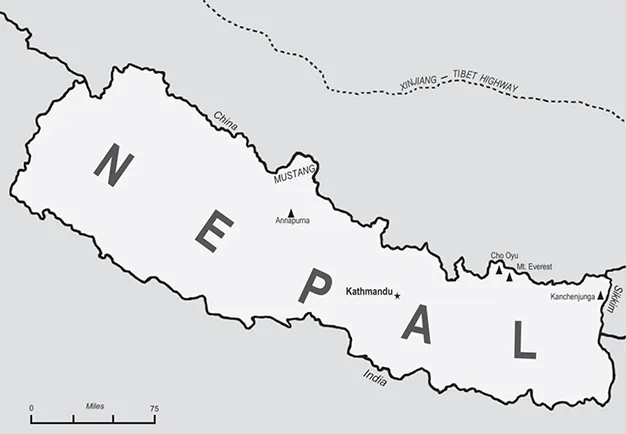
On the surface, the photographer-cum-mountaineer and crusty cold warrior seemed to have little in common. But when Bishop spoke of the unique vantage point from atop the Himalayas—with an unfettered view across Chinese-occupied Tibet—LeMay was all ears. North of the Tibetan plateau was the expansive and arid salt deserts of China’s Xinjiang province, where the Beijing government had sited testing ranges for its fledgling nuclear weapons and missile programs.
Synergy between the two men suddenly became obvious. Bishop knew the Himalayas and appreciated the scientific and photographic aspects of high-altitude climbing. LeMay, whose air force was responsible for tracking tests by nuclear states and threshold nations, felt a pressing concern about China’s nuclear program. For him, the ability to peer into Xinjiang and glean information about Beijing’s atomic tests held merit. An era of covert mountaineering was about to begin.2
Human beings and extreme altitudes are not made for each other. By the time a person reaches a height equivalent to the Mount Everest base camp—17,800 feet—there is about half the amount of oxygen found at sea level; by the time a climber reaches the Everest summit—29,028 feet—there is only a third. Atop such superpeaks, the human body starts to decay rapidly. Lethargy increases, and taking even a single step becomes a major undertaking. Appetite falls off, and the body cannot stay hydrated due to heavy breathing in the thin air; profound weight loss results. Scrapes refuse to heal, and illnesses get more serious. Blood becomes more viscous due to the lack of oxygen, making clotting a problem. Because the brain is not getting enough oxygen either, thinking is adversely affected. A person with an even temper and good sense can suddenly become argumentative or make amateurish mistakes, but he does not recognize the mistakes for what they are, and because apathy rises sharply in this hypoxic state, he is simply indifferent.
But despite facing such certain hardships, the international subculture of top mountaineers shares a willingness to perform the irrational in order to come as close as possible to touching the heavens. In the United States, Barry Bishop belonged to that club. Half a world away in India, the spotlight belonged to Manmohan “Mohan” Singh Kohli, his country’s most eminent climber. Few would have guessed that mountaineering would become his life’s passion. Kohli was born in Haripur, a small town about 60 miles northeast of Peshawar in the hilly Hazara district of the North West Frontier Province. Situated on the bank of the Indus River and centered in an area traditionally ruled by feudal chieftains, Haripur gained some sense of law and order during Sikh rule in the nineteenth century. This came at a cost: while Sikh warriors were asserting their control, one group of soldiers fought to the death on a steep precipice overlooking Haripur. This vantage point—Martyr’s Hill—became a pilgrimage site to commemorate their sacrifice.
As a child, Kohli ascended Martyr’s Hill with his family as an annual ritual. Also exposing him to the rugged outdoors were the long daily treks to school and baths in the closest river. Visits to relatives were even more arduous, almost always entailing more than a day of walking over ranges frequented by lawless tribal elements.
Such hardships aside, Kohli’s family was relatively well off. Theirs was a proud martial lineage that had been successful in business. His ancestors had been particularly prominent in the community, including one of the few Sikhs to be personally baptized by Guru Gobind Singh, the tenth and most illustrious Sikh leader who had codified the Sikh’s separate identity, including the turban, and militant image.
All this history counted for little in early 1947. With India’s freedom from colonial rule nearly a reality, sectarian violence exploded across the subcontinent. Among the first areas affected was Hazara district. With daily murders taking place in his hometown, Kohli was hard-pressed to finish his high school exams. The daily walk to school, eventful in even the best of times, took on a deadly edge when several of his friends were stabbed en route. Despite such distractions, he finished his last exam in March and got his diploma. Later that month, Kohli’s father gathered his two sons and made a fateful decision. The situation around Haripur was growing too dangerous, so they would migrate west to a more peaceful area within the subcontinent. This meant abandoning their belongings and property. Worse, finding meaningful employment promised to be almost impossible.
Kohli’s family was hardly alone. As internal migration snowballed, three top Indian leaders took to the airwaves on 2 June to give details about the country’s impending division into India and the bifurcated Muslim nation of Pakistan to the east and west. They implored their countrymen to remain in their hometowns, and those who had migrated were asked to return. Heeding that request, Kohli and his father went back to Haripur, now part of Pakistan as of 14 August. But on 15 August, when India became independent and most South Asians were celebrating their official independence from England, the mood turned ugly in Hazara district. Haripur was burned to the ground, and nearly all resident Hindus and Sikhs were butchered. Among the few to escape were Kohli and his father, who sought refuge in a nearby fort. A week later, Pakistani troops shifted the refugees to a larger military camp, and a month after that, they got word that they were being loaded on open train cars and shipped to India.
That ride was nearly Kohli’s last. Before crossing the Indian frontier, emotional Muslim militants, emerging after Friday prayers, fired on the train with rifles. With no shelter on the open cars, nearly half the refugees were killed. Kohli later found a bullet hole in his shirt-sleeve, but fortunately he ended up with only a bruise. At that point, a miracle took place. On the opposite track, a Pakistani train arrived with an infantry battalion from the Baluch Regiment. The senior officer on that train was Brigadier Ayub Khan, later field marshal and president of Pakistan. Kohli’s father, who knew the brigadier, jumped off the train and apprised him of the situation. The Baluch troops reacted quickly, forming a cordon around the open cars and escorting them to the border.
Sixty days after leaving the ruins of Haripur, Kohli arrived safely at the town of Amritsar. He later moved to Delhi, where he lived for the next seven years, and took a battery of civil service exams to try to get a job in the government. He passed them all but was drawn to a career in the navy because of its reputation for travel opportunities and good pay. Though the navy was not exactly a breeding ground for climbers, Kohli heard the mountains calling. After initial officer training in southern India, he was posted to a naval engineering base at the hill station of Lonavla, near Mumbai. By coincidence, the British naval officer who had earlier commanded Lonavla had founded a Deep Sea Scout Troop, a maritime version of the Boy Scouts. Kohli was given command of this troop, which entailed leading teens on weekend treks across the surrounding hills.
Kohli would soon see even taller terrain. In 1955, he became eligible for home leave. All officers had to declare their hometowns, but displaced persons from Pakistan were allowed to select any locale. Eager to see snow for the first time, Kohli chose Pahalgam in the mountainous Kashmir. Once there, he found snow in abundance. He also chanced upon a Hindu stranger who was planning to take a three-day pilgrimage to a holy shrine nearby. Though wearing only thin cotton clothes and casual shoes, Kohli decided to accompany him. Halfway there, the stranger—who was insulated with a woolen sweater—was turned back by deep snow. Fortified by a small bottle of brandy and a jar of honey, Kohli continued to the shrine, met with a resident hermit, and was guided back safely.
The thrill of that climb proved infectious. In 1956, the twenty-five-year-old naval officer managed to land a slot at the basic course offered by the Himalayan Mountaineering Institute (HMI), the brainchild of Indian Prime Minister Jawaharlal Nehru, who harbored a passion for mountain vistas after honeymooning in the Kashmir glaciers. HMI had opened its doors in Darjeeling only the previous year. A six-week basic course was offered by its cast of distinguished instructors, including Tenzing Norgay, who made the maiden ascent of Mount Everest. Kohli did well in the basic course and was immediately included in the advanced course, the members of which were targeted against a virgin mountain in Ladakh, situated in the Karakoram Range and buttressing a traditional Central Asian trade route to China and Russia. Though this proved to be an uncompromising baptism by fire—their expedition was plagued by avalanches and horrid weather—Kohli returned to the fleet feeling pretty good, having completed both courses in a single year.
It would be another three years before Kohli was back among the high peaks. He was posted to a frigate at Mumbai, and his captain was a climbing buff with an eye on Nanda Kot. One of the better-known mountains in the Kumoan Himalayas, it had been attempted by four previous expeditions, but only one, a 1936 Japanese team, had succeeded in reaching the top. It was the captain’s dream to scale Nanda Kot with an all-navy team. When he put out a call for volunteers, he did not have to ask Kohli twice. But as luck would have it, the captain was forced to bow out at the eleventh hour due to ill health, and suddenly, with just a single expedition under his belt, Kohli was team leader. The rest of the team consisted of two other naval officers, a pair of sailors, and some Sherpas, residents of northeastern Nepal who excel as high-altitude porters.
On 7 May, Kohli’s team managed to set up base camp on the side of Nanda Kot. A bit less than three weeks later, they had struggled up its slope and were poised within reach of the summit. The party that would make the end run consisted of Kohli, a sailor, and a single Sherpa. When they left their tents for the final leg, however, the peak still seemed a long way off. Half an hour later, they found out why. An enormous bulging dome of hard ice ran in a gentle ellipse toward the top. Using the crampons—grids of steel spikes—on their boots to grip the glassy surface, they started over the dome in a light breeze. After traversing numerous crevasses, the curved ice field was below them by 1030 hours. Another 787 feet away was the summit. In between there remained one last obstacle: a knife-edge ridge that fell away in a near-vertical drop to the Nanda Kot glacier. This meant an exhausting traverse across a harrowing path—a sight that made their Sherpa sit back in defeat, drained and unable to proceed. Roped together for safety, Kohli and the sailor carefully belayed each other upward. At 1420 hours, Kohli was touching the summit cornice. He broke a hole through it, lifted himself up on his elbows, and crawled the last few feet. When he was joined on top by the sailor, they unfurled a navy pendant before beginning the laborious descent.
By the time Kohli returned to his post at Mumbai, there was talk of an Indian expedition to Mount Everest the next summer. Coming off the Nanda Kot success, he was fortunate to land a spot on the team. After a practice run on an icefall in the princely fiefdom of Sikkim, they departed for Nepal in the spring. But the gods, it seemed, were not on their side. On the first summit attempt, the weather turned malicious, and the climbing party was forced to scurry for lower altitudes. Two more assaults were attempted—Kohli in one of them—but blizzards forced them back just 700 feet short of their goal. Though they had been proficient in overcoming physical obstacles, they had been thoroughly humbled by nature.
Exhausted by the Everest attempt, it was not until the following year, 1961, that Kohli tried his hand at another major peak. Annapurna III, a 24,858-foot mountain in Nepal’s towering Annapurna Range, was both unclimbed and unexplored. Though this should have been challenge enough, some of the greatest danger came from villagers near its base. Soon after departing up the side, Kohli received a frantic call over the walkie-talkie that locals had turned up at the base camp and were demanding an enormous ransom for the traversal of their territory. Haggling ensued, and a reduced sum of money and cigarettes was eventually agreed on.
On the slope, however, their troubles had just started. Ahead was a huge glacial trough nearly half a mile wide, and the only access was a two-mile diversion to the east. This added walk, made worse by high altitude and subzero temperatures, seemed endless. Then, when they were finally in position for a dash to the summit, the wind and snow turned up several notches. Their only option was to set up tents and wait for clear skies. Kohli woke early the next morning and found that the snow had subsided. Taking advantage of the lull, they dragged themselves toward the top, only to find a false summit. The actual peak was a small hump less than 300 feet away at the end of a mild, sloping ridge. Struggling onward, they finally got there, hoisted pendants, and snapped pictures.
As they scrambled off Annapurna III, the weather again began to conspire against them. Their earlier tracks had been obliterated by wind and snow, forcing the climbers to feel their way down as if blind. Lightning would occasionally bathe them in shades of blue, and the thunder that followed started to precipitate avalanching. All the while they were dogged by an annoying hum emanating from their goggles—apparently an effect of nearby lightning on the metal frames of the glasses.
One year after the success at Annapurna III, Kohli found himself back on Mount Everest for India’s second attempt to reach the summit. Now holding the rank of lieutenant commander, he was named deputy leader of the expedition. In many ways, this encore proved more frustrating than the initial outing. On the way up, one of the Sherpas got hit in the abdomen by a pineapple-sized rock, inflicting lethal damage. Pressing onward despite the loss, they divided into three summit parties. Kohli and his two colleagues, after spending two nights at the inhospitable South Col due to bad weather, got as far as 27,650 feet before pausing to establish the highest summit camp up to that time. This was within the so-called death zone, where the human body slowly but steadily begins to die. Waiting for good weather, they huddled in a tent with sufficient oxygen for a single night; by rationing their air, they managed to stay for two. Each time they put an oxygen bottle to their faces, they would instantly fall asleep as if mesmerized.
Finally, on the morning of the third day it dawned clear. The mountaineers started out well enough, but 330 feet short of the top the weather turned ugly. Their climb had stretched through the late afternoon, leaving them with a nightmarish choice: They could reach the summit, but because there was insufficient daylight left to return to their tent, it would be a one-way trip. If they turned around, they disappointed the nation but had a chance of surviving. Even with their senses deadened from hypoxia, the climbers showed some prudence and chose the latter option. Thunder and lightning echoed and glinted all around, and the wind churned the slopes, erasing their earlier steps and causing them to lose their way. With the sun falling below the horizon, they stumbled for an hour in darkness in a vain attempt to locate their tent. On two occasions, they paused to say last prayers.
At one point, the two climbers roped together with Kohli lost their footing and began to tumble downward. Reflexively, Kohli drove his ice ax into the snow like a bullet. He held his ground, and the other two took half an hour to move back to their earlier position. Now reduced to a crawl, all three continued on their hands and knees. Finally, at nearly 2200 hours, a black shape rose before them. It was the tent, or rather the top half of it peeking through a snowdrift. Entering with their boots on, they slid into their sleeping bags. It was their third night at that extreme height, and this time without food or bottled oxygen. Despite pain and discomfort, they drifted off...
Table of contents
Front Cover
Half Title
Series Page
Title Page
Copyright Page
Table of Contents
List of Illustrations
Prologue
1. Almost Heaven
2. Convergent Minds
3. McKinley
4. Nanda Devi
5. Members and Friends
6. Camp Four
7. Nanda Devi Redux
8. Mutiny
9. Moraine Camp
10. Nanda Kot
11. The Dome
12. Whipsawed
13. Cathedral in Ice
14. Satellite Options
15. Media Blitz
Epilogue
Appendix
Notes
Index
Back Cover
Trusted by 375,005 students
Access to over 1.5 million titles for a fair monthly price.
Study more efficiently using our study tools.
Frequently asked questions
Yes, you can cancel anytime from the Subscription tab in your account settings on the Perlego website. Your subscription will stay active until the end of your current billing period. Learn how to cancel your subscription
No, books cannot be downloaded as external files, such as PDFs, for use outside of Perlego. However, you can download books within the Perlego app for offline reading on mobile or tablet. Learn how to download books offline
Perlego offers two plans: Essential and Complete
Essential is ideal for learners and professionals who enjoy exploring a wide range of subjects. Access the Essential Library with 800,000+ trusted titles and best-sellers across business, personal growth, and the humanities. Includes unlimited reading time and Standard Read Aloud voice.
Complete: Perfect for advanced learners and researchers needing full, unrestricted access. Unlock 1.5M+ books across hundreds of subjects, including academic and specialized titles. The Complete Plan also includes advanced features like Premium Read Aloud and Research Assistant.
Both plans are available with monthly, semester, or annual billing cycles.
We are an online textbook subscription service, where you can get access to an entire online library for less than the price of a single book per month. With over 1.5 million books across 990+ topics, we’ve got you covered! Learn about our mission
Look out for the read-aloud symbol on your next book to see if you can listen to it. The read-aloud tool reads text aloud for you, highlighting the text as it is being read. You can pause it, speed it up and slow it down. Learn more about Read Aloud
Yes! You can use the Perlego app on both iOS and Android devices to read anytime, anywhere — even offline. Perfect for commutes or when you’re on the go. Please note we cannot support devices running on iOS 13 and Android 7 or earlier. Learn more about using the app
Yes, you can access Spies in the Himalayas by Mohan S. Kohli,Kenneth Conboy in PDF and/or ePUB format, as well as other popular books in History & Asian History. We have over 1.5 million books available in our catalogue for you to explore.