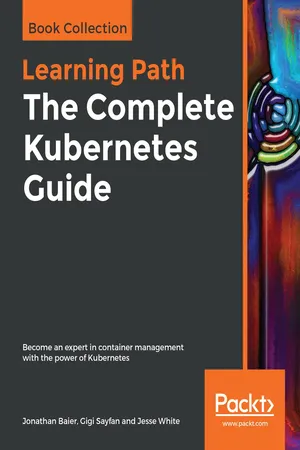
The Complete Kubernetes Guide
eBook - ePub

The Complete Kubernetes Guide

Become an expert in container management with the power of Kubernetes

  1. 628 pages
  2. English
  3. ePUB (mobile friendly)
  4. Available on iOS & Android
eBook - ePub

The Complete Kubernetes Guide

Become an expert in container management with the power of Kubernetes

About this book

Design, deploy, and manage large-scale containers using Kubernetes

Key Features

  • Gain insight into the latest features of Kubernetes, including Prometheus and API aggregation
  • Discover ways to keep your clusters always available, scalable, and up-to-date
  • Master the skills of designing and deploying large clusters on various cloud platforms

Book Description

If you are running a number of containers and want to be able to automate the way they're managed, it can be helpful to have Kubernetes at your disposal.

This Learning Path guides you through core Kubernetes constructs, such as pods, services, replica sets, replication controllers, and labels. You'll get started by learning how to integrate your build pipeline and deployments in a Kubernetes cluster. As you cover more chapters in the Learning Path, you'll get up to speed with orchestrating updates behind the scenes, avoiding downtime on your cluster, and dealing with underlying cloud provider instability in your cluster. With the help of real-world use cases, you'll also explore options for network configuration, and understand how to set up, operate, and troubleshoot various Kubernetes networking plugins. In addition to this, you'll gain insights into custom resource development and utilization in automation and maintenance workflows.

By the end of this Learning Path, you'll have the expertise you need to progress from an intermediate to an advanced level of understanding Kubernetes.

This Learning Path includes content from the following Packt products:

  • Getting Started with Kubernetes - Third Edition by Jonathan Baier and Jesse White
  • Mastering Kubernetes - Second Edition by Gigi Sayfan

What you will learn

  • Download, install, and configure the Kubernetes code base
  • Create and configure custom Kubernetes resources
  • Use third-party resources in your automation workflows
  • Deliver applications as standard packages
  • Set up and access monitoring and logging for Kubernetes clusters
  • Set up external access to applications running in the cluster
  • Manage and scale Kubernetes with hosted platforms on Amazon Web Services (AWS), Azure, and Google Cloud Platform (GCP)
  • Run multiple clusters and manage them from a single control plane

Who this book is for

If you are a developer or a system administrator with an intermediate understanding of Kubernetes and want to master its advanced features, then this book is for you. Basic knowledge of networking is required to easily understand the concepts explained.

Trusted by 375,005 students

Access to over 1.5 million titles for a fair monthly price.

Study more efficiently using our study tools.

Information

Year
2019
Print ISBN
9781838647346
eBook ISBN
9781838647704
Edition
1

Introduction to Kubernetes

In this book, we will help you build, scale, and manage production-ready Kubernetes clusters. Each section of this book will empower you with the core container concepts and the operational context of running modern web services that need to be available 24 hours of the day, 7 days a week, 365 days of the year. As we progress, you'll be given concrete, code-based examples that you can deploy into running clusters in order to get real-world feedback on Kubernetes' many abstractions. By the end of this book, you will have mastered the core conceptual building blocks of Kubernetes, and will have a firm understanding of how to handle the following paradigms:
  • Orchestration
  • Scheduling
  • Networking
  • Security
  • Storage
  • Identity and authentication
  • Infrastructure management
This chapter will set the stage for why Kubernetes? and give an overview of modern container history, diving into how containers work, as well as why it's important to schedule, orchestrate, and manage a container platform well. We'll tie this back to concrete objectives and goals for your business and product. This chapter will also give a brief overview of how Kubernetes orchestration can enhance our container management strategy and how we can get a basic Kubernetes cluster up, running, and ready for container deployments.
In this chapter, we will cover the following topics:
  • Introducing container operations and management
  • The importance of container management
  • The advantages of Kubernetes
  • Downloading the latest Kubernetes
  • Installing and starting up a new Kubernetes cluster
  • The components of a Kubernetes cluster

Technical requirements

You'll need to have the following tools installed:
  • Python
  • AWS CLI
  • Google Cloud CLI
  • Minikube
We'll go into the specifics of these tools' installation and configuration as we go through this chapter. If you already know how to do this, you can go ahead and set them up now.

A brief overview of containers

Believe it or not, containers and their precursors have been around for over 15 years in the Linux and Unix operating systems. If you look deeper into the fundamentals of how containers operate, you can see their roots in the chroot technology that was invented all the way back in 1970. Since the early 2000s, FreeBSD, Linux, Solaris, Open VZ, Warden, and finally Docker all made significant attempts at encapsulating containerization technology for the end user.
While the VServer's project and first commit (running several general purpose Linux server on a single box with a high degree of independence and security (http://ieeexplore.ieee.org/document/1430092/?reload=true)) may have been one of the most interesting historical junctures in container history, it's clear that Docker set the container ecosystem on fire back in late 2013 when they went full in on the container ecosystem and decided to rebrand from dotCloud to Docker. Their mass marketing of container appeal set the stage for the broad market adoption we see today and is a direct precursor of the massive container orchestration and scheduling platforms we're writing about here.
Over the past five years, containers have grown in popularity like wildfire. Where containers were once relegated to developer laptops, testing, or development environments, you'll now see them as the building blocks of powerful production systems. They're running highly secure banking workloads and trading systems, powering IoT, keeping our on-demand economy humming, and scaling up to millions of containers to keep the products of the 21st century running at peak efficiency in both the cloud and private data centers. Furthermore, containerization technology permeates our technological zeitgest, with every technology conference in the world devoting a significant portion of their talks and sessions devoted to building, running, or developing in containers.
At the beginning of this compelling story lies Docker and their compelling suite of developer-friendly tools. Docker for macOS and Windows, Compose, Swarm, and Registry have been incredibly powerful tools that have shaped workflows and changed how companies develop software. They've built a bridge for containers to exist at the very heart of the Software Delivery Life Cycle (SDLC), and a remarkable ecosystem has sprung up around those containers. As Malcom McLean revolutionized the physical shipping world in the 1950s by creating a standardized shipping container, which is used today for everything from ice cube trays to automobiles, Linux containers are revolutionizing the software development world by making application environments portable and consistent across the infrastructure landscape.
We'll pick this story up as containers go mainstream, go to production, and go big within organizations. We'll look at what makes a container next.

What is a container?

Containers are a type of operating system virtualization, much like the virtual machines that preceded them. There's also lesser known types of virtualization such as Application Virtualization, Network Virtualization, and Storage Virtualization. While these technologies have been around since the 1960s, Docker's encapsulation of the container paradigm represents a modern implementation of resource isolation that utilizes built-in Linux kernel features such as chroot, control groups (cgroups), UnionFS, and namespaces to fully isolated resource control at the process level.
Containers use these technologies to create lightweight images that act as a standalone, fully encapsulated piece of software that carries everything it needs inside the box. This can include application binaries, any system tools or libraries, environment-based configuration, and runtime. This special property of isolation is very important, as it allows developers and operators to leverage the all-in-one nature of a container to run without issue, regardless of the environment it's run on. This includes developer laptops and any kind of pre-production or production environment.
This decoupling of application packaging mechanism from the environment on which it runs is a powerful concept that provides a clear separation of concerns between engineering teams. This allows developers to focus on building the core business capabilities into their application code and managing their own dependencies, while operators can streamline the continuous integration, promotion, and deployment of said applications without having to worry about their configuration.
At the core of container technology are three key concepts:
  • cgroups
  • Namespaces
  • Union filesystems

cgroups

cgroups work by allowing the host to share and also limit the resources each process or container can consume. This is important for both resource utilization and security, as it prevents denial-of-service (DoS) attacks on the host's hardware resources. Several containers can share CPU and memory while staying within the predefined constraints. cgroup...

Table of contents

  1. Title Page
  2. Copyright and Credits
  3. About Packt
  4. Contributors
  5. Preface
  6. Introduction to Kubernetes
  7. Understanding Kubernetes Architecture
  8. Building a Foundation with Core Kubernetes Constructs
  9. Working with Networking, Load Balancers, and Ingress
  10. Using Critical Kubernetes Resources
  11. Exploring Kubernetes Storage Concepts
  12. Monitoring and Logging
  13. Monitoring, Logging, and Troubleshooting
  14. Operating Systems, Platforms, and Cloud and Local Providers
  15. Creating Kubernetes Clusters
  16. Cluster Federation and Multi-Tenancy
  17. Cluster Authentication, Authorization, and Container Security
  18. Running Stateful Applications with Kubernetes
  19. Rolling Updates, Scalability, and Quotas
  20. Advanced Kubernetes Networking
  21. Kubernetes Infrastructure Management
  22. Customizing Kubernetes - API and Plugins
  23. Handling the Kubernetes Package Manager
  24. The Future of Kubernetes
  25. Other Books You May Enjoy

Frequently asked questions

Yes, you can cancel anytime from the Subscription tab in your account settings on the Perlego website. Your subscription will stay active until the end of your current billing period. Learn how to cancel your subscription
No, books cannot be downloaded as external files, such as PDFs, for use outside of Perlego. However, you can download books within the Perlego app for offline reading on mobile or tablet. Learn how to download books offline
Perlego offers two plans: Essential and Complete
  • Essential is ideal for learners and professionals who enjoy exploring a wide range of subjects. Access the Essential Library with 800,000+ trusted titles and best-sellers across business, personal growth, and the humanities. Includes unlimited reading time and Standard Read Aloud voice.
  • Complete: Perfect for advanced learners and researchers needing full, unrestricted access. Unlock 1.5M+ books across hundreds of subjects, including academic and specialized titles. The Complete Plan also includes advanced features like Premium Read Aloud and Research Assistant.
Both plans are available with monthly, semester, or annual billing cycles.
We are an online textbook subscription service, where you can get access to an entire online library for less than the price of a single book per month. With over 1.5 million books across 990+ topics, we’ve got you covered! Learn about our mission
Look out for the read-aloud symbol on your next book to see if you can listen to it. The read-aloud tool reads text aloud for you, highlighting the text as it is being read. You can pause it, speed it up and slow it down. Learn more about Read Aloud
Yes! You can use the Perlego app on both iOS and Android devices to read anytime, anywhere — even offline. Perfect for commutes or when you’re on the go.
Please note we cannot support devices running on iOS 13 and Android 7 or earlier. Learn more about using the app
Yes, you can access The Complete Kubernetes Guide by Jonathan Baier, Gigi Sayfan, Jesse White in PDF and/or ePUB format, as well as other popular books in Informatica & Reti di computer. We have over 1.5 million books available in our catalogue for you to explore.