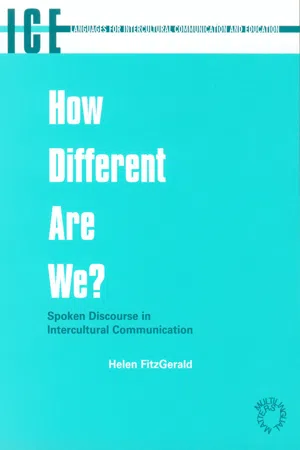
This book examines the influence of cultural values and communication styles on intercultural communication and demonstrates how training can develop intercultural communication competencies. A large number of interactions between well-educated immigrants from all continents and from more than a hundred countries, together with some including native speakers, are examined and participants’ answers to questionnaires compared with their actual communicative behaviour. The author raises questions of interest to many groups: linguists, educators, business people and sociologists. Which values are most salient and enduring, and which cause clashes between cultural groups? To what extent do people retain the communication style identified with their first language and how do these different styles impact on others?
eBook - PDF
How Different are We?
Spoken Discourse in Intercultural Communication
- 271 pages
- English
- PDF
- Available on iOS & Android
eBook - PDF
How Different are We?
Spoken Discourse in Intercultural Communication
About this book
Information
Subtopic
Éducation multiculturelleTable of contents
- Contents
- Foreword
- Acknowledgements
- Transcribing Symbols
- Chapter 1 Introduction
- Chapter 2 The Data
- Chapter 3 Cultural Value Systems: An Overview of the Literature
- Chapter 4 Data Analysis: Cultural Values Reflected in the Discourse
- Chapter 5 Communication Styles: An Overview of the Literature
- Chapter 6 Data Analysis: Discourse Organisation and Rhetorical Strategies
- Chapter 7 Data Analysis: Turn-Taking Patterns and the Distribution of Talk
- Chapter 8 Data Analysis: Assertiveness, Disagreement and Conflict
- Chapter 9 Developing Communicative Competencies: Intercultural & Linguacultural
- Chapter 10 Conclusion
- Appendix 1 The Participants
- Appendix 2 Problems
- Appendix 3 Intercultural Communication Training: Methods and Materials
- Appendix 4 Explanations for Exercise 2
- Appendix 5 Explanations of Case Studies: Exercise 5
- Appendix 6 Explanations of Non-Verbal Behaviour: Exercise 6
- References
- Index
Trusted by 375,005 students
Access to over 1.5 million titles for a fair monthly price.
Study more efficiently using our study tools.
Frequently asked questions
Yes, you can cancel anytime from the Subscription tab in your account settings on the Perlego website. Your subscription will stay active until the end of your current billing period. Learn how to cancel your subscription
No, books cannot be downloaded as external files, such as PDFs, for use outside of Perlego. However, you can download books within the Perlego app for offline reading on mobile or tablet. Learn how to download books offline
Perlego offers two plans: Essential and Complete
- Essential is ideal for learners and professionals who enjoy exploring a wide range of subjects. Access the Essential Library with 800,000+ trusted titles and best-sellers across business, personal growth, and the humanities. Includes unlimited reading time and Standard Read Aloud voice.
- Complete: Perfect for advanced learners and researchers needing full, unrestricted access. Unlock 1.5M+ books across hundreds of subjects, including academic and specialized titles. The Complete Plan also includes advanced features like Premium Read Aloud and Research Assistant.
We are an online textbook subscription service, where you can get access to an entire online library for less than the price of a single book per month. With over 1.5 million books across 990+ topics, we’ve got you covered! Learn about our mission
Look out for the read-aloud symbol on your next book to see if you can listen to it. The read-aloud tool reads text aloud for you, highlighting the text as it is being read. You can pause it, speed it up and slow it down. Learn more about Read Aloud
Yes! You can use the Perlego app on both iOS and Android devices to read anytime, anywhere — even offline. Perfect for commutes or when you’re on the go.
Please note we cannot support devices running on iOS 13 and Android 7 or earlier. Learn more about using the app
Please note we cannot support devices running on iOS 13 and Android 7 or earlier. Learn more about using the app
Yes, you can access How Different are We? by Helen FitzGerald,Dr. Helen Fitzgerald in PDF and/or ePUB format, as well as other popular books in Langues et linguistique & Éducation multiculturelle. We have over 1.5 million books available in our catalogue for you to explore.