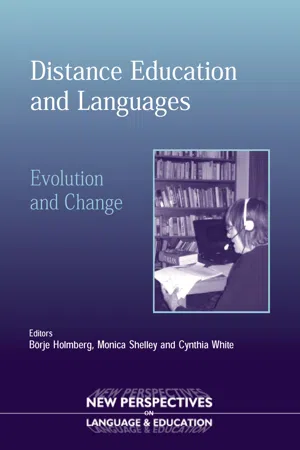
This edited book is the first collection of studies dealing specifically with the teaching of languages at a distance. It contains contributions from language teaching professionals working all over the world in different contexts and at different stages of development, and covers a variety of languages. Based on practical experience and research, it includes work on learner autonomy and support; theories of distance language learning; the development of intercultural competence; methodology and course design; different learning environments and how to make best use of them, and language teacher education. These contributions have been collected together in one volume to encourage the establishment of collaborative links between practitioners in different institutions and around the world and inspire more related research in the future to guide our understanding and reflection on evolution and change within the field.
eBook - PDF
Distance Education and Languages
Evolution and Change
- 360 pages
- English
- PDF
- Available on iOS & Android
eBook - PDF
Distance Education and Languages
Evolution and Change
About this book
Information
Table of contents
- Contents
- Preface
- Introduction
- Chapter 1 Autonomy and the Distance Language Learner
- Chapter 2 Critical Reflection and Autonomy: A Study of Distance Learners of French, German and Spanish
- Chapter 3 Theoretical and Practical Issues in the Promotion of Collaborative Learner Autonomy in a Virtual Self-access Centre
- Chapter 4 Towards a Learner-based Theory of Distance Language Learning: The Concept of the Learner–Context Interface
- Chapter 5 Feedback in Distance Language Learning: Current Practices and New Directions
- Chapter 6 A Framework for Supporting Students Studying English via a Mixed-mode Delivery System
- Chapter 7 Assessing Intercultural Competence Gain in a German Distance Learning Course for Adults
- Chapter 8 Developing Professional Intercultural Communicative Competence: Reflections on Distance Learning Programmes for Language Educators and Translators/ Interpreters in Bulgaria
- Chapter 9 Teaching Foreign Language Skills by Distance Education Methods: Some Basic Considerations
- Chapter 10 Course Design for the Distance Learner of Spanish: More Challenges than Meet the Eye
- Chapter 11 Learner Autonomy and Course Management Software
- Chapter 12 Chatlines for Beginners: Negotiating Conversation at a Distance
- Chapter 13 Making Online Students Connect: Ethnographic Strategies for Developing Online Learning Experiences
- Chapter 14 From Parrots to Puppet Masters: Fostering Creative and Authentic Language Use with Online Tools
- Chapter 15 The Challenges of Implementing Online Tuition in Distance Language Courses: Task Design and Tutor Role
- Chapter 16 Closing the Distance: Compensatory Strategies in Distance Language Education
- Chapter 17 PLEASE (Primary Language Teacher Education: Autonomy and Self-Evaluation)
- Chapter 18 Exploring Zones of Interactivity in Foreign Language and Bilingual Teacher Education
- Notes on Contributors
- Index
Trusted by 375,005 students
Access to over 1.5 million titles for a fair monthly price.
Study more efficiently using our study tools.
Frequently asked questions
Yes, you can cancel anytime from the Subscription tab in your account settings on the Perlego website. Your subscription will stay active until the end of your current billing period. Learn how to cancel your subscription
No, books cannot be downloaded as external files, such as PDFs, for use outside of Perlego. However, you can download books within the Perlego app for offline reading on mobile or tablet. Learn how to download books offline
Perlego offers two plans: Essential and Complete
- Essential is ideal for learners and professionals who enjoy exploring a wide range of subjects. Access the Essential Library with 800,000+ trusted titles and best-sellers across business, personal growth, and the humanities. Includes unlimited reading time and Standard Read Aloud voice.
- Complete: Perfect for advanced learners and researchers needing full, unrestricted access. Unlock 1.5M+ books across hundreds of subjects, including academic and specialized titles. The Complete Plan also includes advanced features like Premium Read Aloud and Research Assistant.
We are an online textbook subscription service, where you can get access to an entire online library for less than the price of a single book per month. With over 1.5 million books across 990+ topics, we’ve got you covered! Learn about our mission
Look out for the read-aloud symbol on your next book to see if you can listen to it. The read-aloud tool reads text aloud for you, highlighting the text as it is being read. You can pause it, speed it up and slow it down. Learn more about Read Aloud
Yes! You can use the Perlego app on both iOS and Android devices to read anytime, anywhere — even offline. Perfect for commutes or when you’re on the go.
Please note we cannot support devices running on iOS 13 and Android 7 or earlier. Learn more about using the app
Please note we cannot support devices running on iOS 13 and Android 7 or earlier. Learn more about using the app
Yes, you can access Distance Education and Languages by Börje Holmberg, Monica Shelley, Cynthia J. White, Börje Holmberg,Monica Shelley,Cynthia J. White in PDF and/or ePUB format, as well as other popular books in Languages & Linguistics & Inclusive Education. We have over 1.5 million books available in our catalogue for you to explore.