eBook - ePub
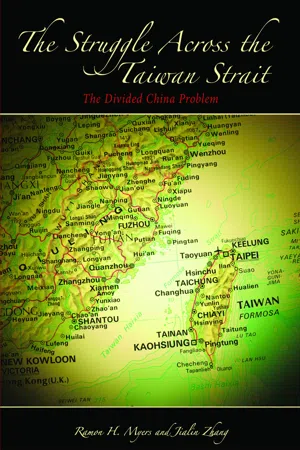
The Struggle across the Taiwan Strait
The Divided China Problem
- 168 pages
- English
- ePUB (mobile friendly)
- Available on iOS & Android
eBook - ePub
About this book
A concise and informative history of how China divided in 1949 into two regimes, why they struggled to achieve the same political goal-reunification of China—and why their struggle today continues in a more complex and dangerous way. The authors detail how the changes brought about by the 2000 election not only intensified the conflict between the regimes but locked both sides into a new contest that increased the probability of war rather than peace.
Information
1. China Divides into Two Rival Regimes
In autumn 1945, communist forces moved into Manchuria and obtained superior weapons from the Soviets, who had been there since August. The Chinese Communist Party (CCP) troops occupied vast parts of the countryside by imposing land reform and establishing their village and township governance. By using Mao’s strategy of encircling the cities and isolating them from the countryside, CCP troops, now in possession of better military equipment, soon defeated the American-trained Nationalist forces and advanced southward into North China.1 By January 31, 1949, Communist troops had occupied Beijing, and on October 1, 1949, Chairman Mao stood at Tiananmen to proclaim the founding of a new Chinese state, the People’s Republic of China.2
Despite many hundreds of millions of dollars in U.S. military and economic aid given to Nationalist China between 1945 and 1949, the Guomindang (GMD)-led Nationalist government never provided the leadership, the tactics, or the official and civil organizations necessary to win the civil war. Declining morale and mounting corruption also weakened Nationalist leadership, and within a year the CCP-led military forces were able to defeat the Nationalist government in a series of battles in North, Central, and South China.
By early 1950 the new communist government had unified the China mainland and begun military preparations for invading Taiwan, where the Nationalist leader, President Chiang Kai-shek, and his son, Chiang Ching-kuo, had taken refuge on May 25, 1949. Father and son, along with remnants of the GMD and Nationalist government, vowed to make Taiwan their last-ditch stand. On July 14, father and son flew first to Canton and then to the Southwest (where the Nationalist government had relocated in 1938 to resist Japan), hoping to build a guerrilla base to resist the CCP. But they found no popular support for their cause because the local people and elites, remembering the years of oppressive, corrupt Nationalist government rule, had decided to welcome the new communist regime. Taiwan was now Chiang Kai-shek’s last hope. But why Taiwan?
When President Chiang and his son arrived in Taiwan on May 25, 1949, Taiwan was their last hope of refuge, but a majority of the island’s people did not admire the Nationalists. President Chiang began rebuilding the island’s administration, reorganizing the GMD, preparing the island’s defenses, and hoping for a miracle. On January 5, 1950, expecting the island to fall soon into communist hands, President Harry Truman stated that “the United States will not provide military aid or advice to Chinese forces on Formosa.” His secretary of state, Dean Acheson, on that same day had this to say: “The President says, we are not going to use our forces in connection with the present situation in Formosa. We are not going to attempt to seize the island. We are not going to get involved militarily in any way on the island of Formosa.”3 All signs indicated that the United States had finally washed its hands of the Chiang regime and that civil war soon would end, leading to China’s reunification.
But some six months later, on June 25, 1950, North Korean armor and infantry slammed deep inside South Korea. President Truman and his advisers immediately reassessed the intentions of the Soviet Union and communist-ruled North Korea. They concluded that “the occupation of Formosa by Communist forces would be a direct threat to the security of the Pacific Area and to United States forces performing their lawful and necessary functions in that area.”4 Thus, on June 27, President Truman informed the United States and the world that “I have ordered the Seventh Fleet to prevent any attack on Formosa. As a corollary of this action, I am calling upon the Chinese government of Formosa to cease all air and sea operations against the mainland.”5
The United States decided to restrain both Chinese regimes from going to war. The two political parties that had contested each other in China’s long civil war governed separate territories, divided by the Taiwan Strait. These two Chinese regimes would continue their struggle but in different ways. The United States still had not been able to extricate itself from China’s civil war.
In fact, it was U.S. naval and air power intervention in the Taiwan Strait that created the divided China problem of today. A crucial legacy of U.S. intervention was that the PRC leaders believed that the United States had cheated them of a historical opportunity to unify the country. In their hearts they vowed never to allow foreign intervention to obstruct China’s reunification. For that reason, American leaders should heed Beijing’s warning that it intends to unify China, whether by peaceful means or by force.
Although China divided after 1949 to become the PRC in Beijing and ROC in Taipei, it only superficially resembles the two Germanys, the two Koreas, and the two Vietnams after World War II. Many Taiwanese politicians and scholars have used this resemblance to contend that Taiwan is an independent, sovereign state. Taiwan’s authorities asserted in February 1997, in a government report titled “The Issue of ‘one China’ in Perspective,” the following:
China has been in a divided status since the Chinese Communist regime was founded in 1949. Because neither Taipei nor Beijing has ruled the other side, neither side can represent the other. Therefore, neither side can claim that it represents the whole China, and it can represent only the part over which it exerts effective control. Thus, there is a “divided China,” not a “one China.”6
According to this interpretation, mainland and Taiwan are two sovereign states. But Beijing has a different interpretation, and claims that the divided China is not another divided Korea, or formerly divided Germany and Vietnam for the following reasons.
First, the division of Germany originated from fascism’s defeat in World War II and by international agreements between the winners. The same scenario applied to Korea and Vietnam, first occupied by the winning powers, then divided by regional wars and international agreements. China’s division arose from its long history of civil war and the U.S. involvement in that struggle. That change in political power and sovereignty was produced by a continuing civil war that has never been terminated by any formal agreement.
Second, unlike the former two Germanies and today’s two Koreas that later achieved cross-recognition and were admitted to the UN and other international organizations, the PRC ultimately inherited almost all domestic and international legal rights of the former ROC by negotiating normal relations with other countries.
Third, the former divided parts of Germany, Korea and Vietnam were roughly equal in size, population and economic potential. Not so for the divided China. In mainland China, the Communist forces seized more than 99 percent of the country, with more than 98 percent of the population. Therefore, although China was divided over the last 50 odd years, this separation can be called a partial or quasi-division.
Finally, and perhaps most important, the Chinese civil war has not legally been concluded, and both PRC and ROC Constitutions still claim the mainland and Taiwan as part of their territory. For these reasons, the divided China problem is a special case that has evolved in a complex historical context.7
The Two Regimes Continue Their Struggle
Furious that American military power had been sent to the Taiwan Strait to prevent PRC forces from occupying Taiwan, Mao Zedong and his minister of foreign affairs, Zhou Enlai, denounced such intervention in China’s civil war. The PRC also appealed to the United Nations, without success, to condemn American intervention in China’s internal affairs. Chinese resentment of American actions to protect Taiwan likely emboldened the PRC’s decision to enter the Korean War.
In response, the United States began building alliances in the Asia-Pacific region to contain the spread of communism. On April 18, 1952, the United States arranged for the ROC and Japan to sign a peace treaty; on December 21, 1954, the U.S. and ROC governments signed a mutual defense treaty.8 In a similar way the United States gradually cobbled together a series of alliances with Japan, South Korea, Taiwan, the Philippines, Australia and New Zealand, and even some Southeast Asian states, to contain Communist China.
Meanwhile, the two Chinese regimes began building the societies their respective political parties advocated as best for China and its people. The CCP, by imposing its power on urban elites and extending its control to the villages, swiftly began to replace the market economy with a socialist-type command economy, extolled the Marxist and Maoist ideologies as the doctrines of truth for the Chinese people, and organized a cooperative-type society by merging the workplace and family household.
Having imposed martial law in July 1949, in 1950 Taiwan’s GMD-led authoritarian government initiated local elections in which “limited democracy” gradually evolved under single-party rule, along with a state-guided, highly productive market economy. By limited democracy we mean elections for local government officials and members of the Taiwan Provincial Government Assembly but not the provincial governor, the central government’s president and vice-president, and National Assembly members.
Confucianism, Western liberalism, and Sun Yat-sen’s doctrine competed for popular support, and family households had a high degree of freedom of choice. By 1960, the two Chinese societies were diverging along different development paths. The mainland regime exerted almost total control over society, whereas the Taiwan regime allowed for a society having greater freedom, but crushed any criticism or activities challenging its legitimacy.
Meanwhile, the civil war continued but in a different form of struggle. The ROC government’s policy toward the mainland during Chiang Kai-shek and Chiang Ching-kuo’s early years of rule was “counterattacking the mainland, recovering the whole Chinese territory (fan gong fu guo),” and using its “Three People’s Principles of Nationalism, Democracy, and Social Welfare” (san min zhuyi) to unify China. While pushing economic and social reconstruction in Taiwan, Chiang’s government used U.S. military assistance to foment insurrection against the communist regime, in an attempt to restore the ROC’s rule in the mainland.
In 1952 and 1953, when the Korean War raged, the Nationalist government cooperated with American CIA units to launch guerrilla attacks on communist-held offshore islands across from Taiwan for the purpose of diverting Chinese troops from the Korean War to Southeast China.9 But the U.S. government soon aborted the operation and devoted its attention to preventing the ROC government from carrying out any military activities against the mainland or any covert operations in western and southwestern China.10 Meanwhile the U.S. 7th fleet patrolled the Taiwan Strait to prevent either side from attacking the other.
Both regimes also nurtured Chinese nationalism to arouse the public’s enthusiasm for reunifying China. In the summer of 1953, when the Korean War ended, the PRC leadership realized it had no national policy to mobilize popular sentiment for resolving the Taiwan problem. In June 1954 Mao Zedong informed Zhou Enlai, then in Geneva brokering a peace between the communist Viet Minh and France, that “we were wrong not to press for the liberation of Taiwan immediately after the conclusion of the Korean War. If we do not do that now, we will repeat the same political mistake.”11
On July 23, 1954, the People’s Daily announced that “we must definitely liberate Taiwan.”12 Throughout mainland China, CCP cadres began holding discussion meetings to whip up enthusiasm for the PRC to recover Taiwan while hoisting banners that proclaimed “We must definitely liberate Taiwan.”13 To ensure the public’s commitment to achieve the nation’s goal of “liberating Taiwan,” the PRC regime inserted that message into textbooks, conducted study sessions for party cadres, and made frequent public statements to that effect.
Contained and isolated by the U.S. and its allies in the 1950s, the PRC had no channel to express its attitude on the Taiwan issue to the international community. It was excluded from the UN, and had diplomatic relations with only 20 countries, among them 10 belonging to the socialist bloc. Failing to find a better option, the PRC used a strategy of focused military threat.14 In 1954, and again in 1958, the government ordered the extensive shelling of the offshore island of Jinmen (and not other ROC claimed islands) to convince the Chinese people on both sides of the Taiwan Strait and the international community of the PRC’s serious intention to recover Taiwan, but not initiate any armed conflict at that time.
The 1958 shelling influenced subsequent cross-strait as well as U.S.-China relations. On August 23, 1958, The Liberation Army launched more than 20,000 shells onto Jinmen island, and successfully blockaded it. Taiwan’s Nationalist troops incurred heavy damage. This event promptly drew the attention of the U.S. and other East Asian countries. The U.S. government, while condemning the PRC’s “armed aggression,” strengthened its naval and air force buildup in the Taiwan Strait, convoyed Taiwan’s supply fle...
Table of contents
- Cover
- Title Page
- Copyright
- Dedication
- Contents
- Introduction
- 1. China Divides into Two Rival Regimes
- 2. The Move toward Détente
- 3. Détente and Its Collapse
- 4. The Challenge of Taiwan Independence
- 5. Taiwan’s Economic Slowdown and Growing Integration with Mainland China
- 6. The Watershed Elections of 2004 and Aftermath
- 7. Conclusion: Divided China’s Continuing Struggle
- Appendix: Key Documents
- About the Authors
Trusted by 375,005 students
Access to over 1.5 million titles for a fair monthly price.
Study more efficiently using our study tools.
Frequently asked questions
Yes, you can cancel anytime from the Subscription tab in your account settings on the Perlego website. Your subscription will stay active until the end of your current billing period. Learn how to cancel your subscription
No, books cannot be downloaded as external files, such as PDFs, for use outside of Perlego. However, you can download books within the Perlego app for offline reading on mobile or tablet. Learn how to download books offline
We are an online textbook subscription service, where you can get access to an entire online library for less than the price of a single book per month. With over 1.5 million books across 990+ topics, we’ve got you covered! Learn about our mission
Look out for the read-aloud symbol on your next book to see if you can listen to it. The read-aloud tool reads text aloud for you, highlighting the text as it is being read. You can pause it, speed it up and slow it down. Learn more about Read Aloud
Yes! You can use the Perlego app on both iOS and Android devices to read anytime, anywhere — even offline. Perfect for commutes or when you’re on the go.
Please note we cannot support devices running on iOS 13 and Android 7 or earlier. Learn more about using the app
Please note we cannot support devices running on iOS 13 and Android 7 or earlier. Learn more about using the app
Yes, you can access The Struggle across the Taiwan Strait by Ramon H. Myers,Jialin Zhang in PDF and/or ePUB format, as well as other popular books in Politics & International Relations & Asian Politics. We have over 1.5 million books available in our catalogue for you to explore.