- 432 pages
- English
- ePUB (mobile friendly)
- Available on iOS & Android
eBook - ePub
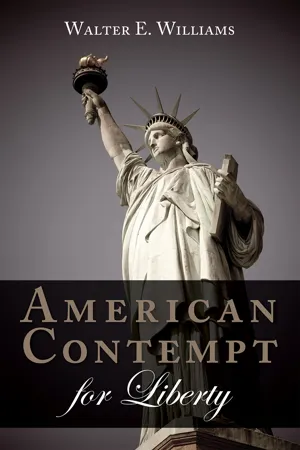
American Contempt for Liberty
About this book
Throughout history, personal liberty, free markets, and peaceable, voluntary exchanges have been roundly denounced by tyrants and often greeted with suspicion by the general public. Unfortunately, Americans have increasingly accepted the tyrannical ideas of reduced private property rights and reduced rights to profits, and have become enamored with restrictions on personal liberty and control by government. In this latest collection of essays selected from his syndicated newspaper columns, Walter E. Williams takes on a range of controversial issues surrounding race, education, the environment, the Constitution, health care, foreign policy, and more. Skewering the self-righteous and self-important forces throughout society, he makes the case for what he calls the "the moral superiority of personal liberty and its main ingredient—limited government." With his usual straightforward insights and honesty, Williams reveals the loss of liberty in nearly every important aspect of our lives, the massive decline in our values, and the moral tragedy that has befallen Americans today: our belief that it is acceptable for the government to forcibly use one American to serve the purposes of another.
Information
PART I
Constitution
My view of the US Constitution is that it represents the rules of the game—namely the relationship between the citizenry and our government. Most of what the framers of the Constitution saw as the legitimate role for the federal government is found in Article I, Section 8, of our Constitution. Briefly quoting sections thereof, it says that “The congress shall have the power to lay and collect taxes, Duties, Imposts and Excises to pay the Debts and provide for the common Defense and general Welfare of United States… to borrow money on the credit of the United States… to regulate commerce with foreign Nations, and among the several States, and with Indian tribes… to coin money… to establish Post Offices and post Roads… to raise and support Armies.” The framers granted Congress taxing and spending powers for these and a few other activities.
Nowhere in the Constitution do we find authority for Congress to tax and spend for up to three-quarters of what Congress taxes and spends for today. In other words, there is no constitutional authority for farm subsidies, bank bailouts, food stamps, Social Security, Medicare, and thousands of other federal spending programs. I think we can safely say that we have made a significant departure from the constitutional principles of individual freedom and its main ingredient limited government that made us a rich nation in the first place. These principles of freedom were embodied in our nation through the combined institutions of private ownership of property and free enterprise.
Through numerous successful attacks, private property and free enterprise, which the framers envision, are mere skeletons of their past. Thomas Jefferson anticipated this when he said, “The natural progress of things is for government to gain ground and for liberty to yield.” The best way to look at this process is to look at what has happened to government taxation and spending.
Taxes represent government claims on private property. As government taxes increase our claims to our personal property decrease. And taxes are going up. A much better measure of our loss of private property is to look at what has happened to spending. In 1902 expenditures at all levels of government totaled $1.7 billion whereas the average taxpayer paid only $60 a year in taxes. In fact, from 1787 to 1920, federal expenditures were only 3 percent of GNP, except during war times. Today federal expenditures alone are nearly $4 trillion, nearly 25 percent of the GDP. State and local governments spend close to $3.5 trillion. The average taxpayer pays more than $10,000 a year in federal, state, and local taxes.
The significance of all of this means that as time goes by we own less and less of our most valuable property—ourselves and the fruits of our labor. Another way to look at this is to recognize that the average taxpayer works from January 1st to the end of April to pay federal, state, and local taxes. That means that we work four months out of the year and we have no rights to determine how the fruits of our labor will be used. Someone else makes that decision. Keep in mind that a working definition of slavery is that you work all year and it is someone else who decides how the fruits of the slaves’ labor are used. Most federal government spending can be characterized as taking what belongs to one American and giving it to another to whom it does not belong. That is no less than the forcible use of one person to serve the purposes of another—which is also a good working definition of slavery.
My columns in this section share the radical vision of the men who founded our nation and sought to make a significant break from the most dominant characteristic of mankind’s history—the arbitrary abuse and control by others.
The Hell with Our Constitution
February 11, 2009
Dr. Robert Higgs, senior fellow at the Oakland-based Independent Institute, penned an article in The Christian Science Monitor (2/9/2009) that suggests the most intelligent recommendation that I’ve read to fix our current economic mess. The title of his article gives his recommendation away: “Instead of stimulus, do nothing—seriously.”
Stimulus package debate is over how much money should be spent, whether some should be given to the National Endowment for the Arts, research sexually transmitted diseases, or bail out Amtrak, our failing railroad system. Dr. Higgs says, “Hardly anyone, however, is asking the most important question: Should the federal government be doing any of this?” He adds, “Until the 1930s, the Constitution served as a major constraint on federal economic interventionism. The government’s powers were understood to be just as the framers intended: few and explicitly enumerated in our founding document and its amendments. Search the Constitution as long as you like, and you will find no specific authority conveyed for the government to spend money on global-warming research, urban mass transit, food stamps, unemployment insurance, Medicaid, or countless other items in the stimulus package and, even without it, in the regular federal budget.”
By bringing up the idea of constitutional restraints on Washington, I’d say Dr. Higgs is whistling Dixie. Americans have long ago abandoned respect for the constitutional limitations placed on the federal government. Our elected representatives represent that disrespect. After all I’d ask Higgs: Isn’t it unreasonable to expect a politician to do what he considers to be political suicide, namely conduct himself according to the letter and spirit of the Constitution?
While Americans, through ignorance or purpose, show contempt for our Constitution, I doubt whether they are indifferent between a growing or stagnating economy. Dr. Higgs tells us some of the economic history of the United States. In 1893, there was a depression; we got out of it without a stimulus package. There was a major recession of 1920–21; though sharp, it quickly reversed itself into what has been call the “Roaring Twenties.” In 1929, there was an economic downturn, most notably featured by the stock market collapse, after which came massive government intervention—you might call it the nation’s first stimulus package. President Hoover and Congress responded to what might have been a two- or three-year sharp downturn with many of the policies President Obama and Congress are urging today. They raised tariffs, propped up wage rates, bailed out farmers, banks, and other businesses, and financed state relief efforts. When Roosevelt came to office, he became even more interventionist than Hoover and presided over protracted depression where the economy didn’t fully recover until 1946.
Roosevelt didn’t have an easy time with his agenda; he had to first emasculate the US Supreme Court. Higgs points out that federal courts had respect for the Constitution as late as the 1930s. They issued some 1,600 injunctions to restrain officials from carrying out acts of Congress. The US Supreme Court overturned as unconstitutional the New Deal’s centerpieces such as the National Industrial Recovery Act, the Agricultural Adjustment Act, and other parts of Roosevelt’s “stimulus package.” An outraged Roosevelt threatened to pack the Court, and the Court capitulated to where it is today giving Congress virtually unlimited powers to tax, spend, and regulate. My question to my fellow Americans is: Do we want a repeat of measures that failed dismally during the 1930s?
A more fundamental question is: Should Washington be guided by the Constitution? In explaining the Constitution, James Madison, the acknowledged father of the Constitution, wrote in Federalist Paper No. 45: “The powers delegated by the proposed Constitution to the federal government are few and defined. Those which are to remain in the State governments are numerous and indefinite. The former will be exercised principally on external objects, as war, peace, negotiation, and foreign commerce.” Has the Constitution been amended to permit Congress to tax, spend, and regulate as it pleases or have Americans said, “To hell with the Constitution”?
Good Ideas
March 11, 2009
During winter months, I work out ten minutes on the treadmill and lift weights at seven stations four mornings a week. Over the years, during the spring through fall months, I racked up about two thousand miles on my road bike. This level of exercise helps account for why, at seventy-three years, I’m in such good health and physical fitness. So my question to you is whether you think regular exercise is a good idea. I think the answer is definitely yes, if nothing other than its beneficial effects on health care costs. Since exercise is a good idea, would you support a congressional mandate that all Americans engage in regular exercise?
Instead of simply saying, “Williams, you’re a lunatic!” and rejecting such a congressional mandate out of hand, let’s ask why it should be rejected. We should keep in mind that there’s precedent for congressionally mandated measures to protect our health and safety. Seatbelt and helmet laws are examples. If you’re in an accident and wind up a vegetable, you will be a burden on taxpayers; therefore, it’s argued, Congress has a right to mandate seatbelt and helmet usage. Wouldn’t the same reasoning apply to people who might burden our health care system because of obesity or sedentary lifestyles? If it is a good idea for Congress to force us to buckle up and wear a helmet on a motorcycle, isn’t it also a good idea to force us to regularly exercise?
There is only one question to ask were there to be a debate whether Congress should mandate regular exercise. Whether regular exercise is a good idea or a bad idea is entirely irrelevant. The only relevant question is: Is it permissible under the Constitution? That means we must examine the Constitution to see whether it authorizes Congress to mandate exercise. From my reading, the Constitution grants no such authority.
You say, “Aha, Williams, you’ve blown it this time. What about Article I, Section 8, of the Constitution, which says Congress shall provide for the ‘general welfare of the United States’? Surely, healthy Americans contribute to the nation’s general welfare.” That’s precisely the response I’d expect from your average law professor, congressman, or derelict US Supreme Court justice. Let’s look at what the men who wrote the Constitution had to say about its general welfare clause. In a letter to Edmund Pendleton, James Madison, the father of the Constitution, said, “If Congress can do whatever in their discretion can be done by money, and will promote the General Welfare, the Government is no longer a limited one, possessing enumerated powers, but an indefinite one.…” Madison also said, “With respect to the two words ‘general welfare,’ I have always regarded them as qualified by the detail of powers connected with them. To take them in a literal and unlimited sense would be a metamorphosis of the Constitution into a character which there is a host of proofs was not contemplated by its creators.” Thomas Jefferson said, “Congress has not unlimited powers to provide for the general welfare, but only those specifically enumerated.”
If you compare the vision of our nation’s founders to the behavior of today’s Congress, White House, and US Supreme Court, you would have to conclude that there is no longer rule of law where there is a set of general rules applicable to all persons. Today, we are commanded by legislative thugs who, with Supreme Court sanction, issue orders commanding particular people to do particular things. Most Americans neither understand nor appreciate the spirit and letter of the Constitution and accept Congress’s arbitrary orders and privileges based upon status.
What to do? Thomas Jefferson advised, “Whensoever the General [federal] Government assumes undelegated powers, its acts are unauthoritative, void, and of no force.” That bit of Jeffersonian advice is dangerous. While Congress does not have constitutional authority for most of what it does, it does have police and military power to inflict great pain and punishment for disobedience.
Why a Bill of Rights?
July 1, 2009
Why did the founders of our nation give us the Bill of Rights? The answer is easy. They knew Congress could not be trusted with our God-given rights. Think about it. Why in the world would they have written the First Amendment prohibiting Congress from enacting any law that abridges freedom of speech and the press? The answer is that in the absence of such a limitation Congress would abridge free speech and free press. That same distrust of Congress explains the other amendments found in our Bill of Rights protecting rights such as our rights to property, fair trial, and to bear arms. The Bill of Rights should serve as a constant reminder of the deep distrust that our founders had of government. They knew that some government was necessary but they rightfully saw government as the enemy of the people and they sought to limit government and provide us with protections.
After the 1787 Constitutional Convention, there were intense ratification debates about the proposed Constitution. Both James Madison and Alexander Hamilton expressed grave reservations about Thomas Jefferson’s, George Mason’s, and others’ insistence that the Constitution be amended by the Bill of Rights. Those reservations weren’t the result of a lack of concern for liberty. To the contrary, they were concerned about the loss of liberties.
Alexander Hamilton expressed his reservation in Federalist Paper No. 84, “[B]ills of rights… are not only unnecessary in the proposed Constitution, but would even be dangerous.” Hamilton asks, “For why declare that things shall not be done [by Congress] which there is no power to do? Why, for instance, should it be said that the liberty of the press shall not be restrained, when no power is given [to Congress] by which restrictions may be imposed?” Hamilton’s argument was that Congress can only do what the Constitution specifically gave it authority to do. Powers not granted belong to the people and the states. Another way of examining Hamilton’s concern: Why have an amendment prohibiting Congress from infringing on our right to picnic on our back porch when the Constitution gives Congress no authority to infringe upon that right in the first place?
Alexander Hamilton added that a Bill of Rights would “contain various exceptions to powers not granted; and, on this very account, would afford a colorable pretext to claim more [powers] than were granted.… [it] would furnish, to men disposed to usurp, a plausible pretense for claiming that power.” Going back to our picnic example, those who would usurp our God-given liberties might enact a law banning our right to have a picnic. They’d justify their actions by claiming that nowhere in the Constitution is there a guaranteed right to have a picnic.
To mollify Alexander Hamilton’s and James Madison’s fears about how a Bill of Rights might be used as a pretext to infringe on human rights, the Ninth Amendment was added that reads: “The enumeration in the Constitution of certain rights shall not be construed to deny or disparage others retained by the people.” In essence, the Ninth Amendment says it’s impossible to list all of our God-given or natural rights. Just because a right is not listed doesn’t mean it can be infringed upon or disparaged by the US Congress. The Tenth Amendment is a reinforcement of the Ninth saying, “The powers not delegated to the United States by the Constitution, nor prohibited by it to the states, are reserved to the states respectively, or to the people.” That means if a power is not delegated to Congress, it belongs to the states or the people.
The Ninth and Tenth Amendments mean absolutely nothing today as Americans have developed a level of naive trust for Congress, the White House, and the US Supreme Court that would have astonished the founders, a trust that will lead to our undoing as a great nation.
Constitutional Contempt
November 11, 2009
At Speaker Nancy Pelosi’s October 29 press conference, a CNS News reporter asked, “Madam Speaker, where specifically does the Constitution grant Congress the authority to enact an individual health insurance mandate?” Speaker Pelosi responded, “Are you serious? Are you serious?” The reporter said, “Yes, yes, I am.” Not responding further, Pelosi shook her head and took a question from another reporter. Later on, Pelosi’s press spokesman Nadeam Elshami told CNSNews.com about its question regarding constitutional authority mandating that individual Americans buy health insurance. “You can put this on the record. That is not a serious question. That is not a serious question.”
Suppose Congress was debating a mandate outlawing tea-party-type protests and other large gatherings criticizing Congress. A news reporter asks Nancy Pelosi where specifically does the Constitution grant Congress the authority to outlaw peaceable assembly. How would you feel if she answered, “Are you serious? Are you serious?” and ignored the question. And what if, later on, someone from her office sent you a press release, as was sent to CNS News, saying that Congress has “broad power to regulate activities that have an effect on interstate commerce,” pointing out that demonstrations cause traffic jams and therefore interfere with interstate commerce?
Speaker Pelosi’s constitutional contempt, perhaps ignorance, is representative of the majority of members of both the House and the Senate. Their comfort in that ignorance and constitutional contempt, and how readily they articulate it, should be worrisome for every single American. It’s not a matter of whether you are for or against Congress’s health care proposals. It’s not a matter of whether you’re liberal or conservative, black or white, male or female, Democrat or Republican, or member of any other group. It’s a matter of whether we are going to remain a relatively free people or permit the insidious encroachment on our liberties to continue.
Where in the US Constitution does it authorize Congress to force Americans to buy health insurance? If Congress gets away with forcing us to buy health insurance, down the line, what else will they force us to buy; or do you naively think they will stop with health insurance? We shouldn’t think that the cure to Congress’s unconstitutional heavy-handedness will end if we only elect Republicans. Republicans have demonstrated nearly as much constitutional contempt as have Democrats. The major difference is the significant escalation of that contempt under today’s Democrat-controlled Congress and White House with the massive increase in spending, their proposed legislation, and the appointment of tyrannical czars to control our lives. It’s a safe bet that if and when Republicans take over the Congress and White House, they will not give up the massive increase in control over our lives won by the Democrats.
In each new session of Congress since 1995, John Shadegg, R-Ariz., has introduced the Enumerated Powers Act, a measure “To require Congress to specify the source of authority under the...
Table of contents
- Cover
- Title Page
- Copyright Page
- Dedication
- Contents
- Preface
- Acknowledgments
- Part I: Constitution
- Part II: Politics
- Part III: Race
- Part IV: Education
- Part V: Environment and Health
- Part VI: International
- Part VII: Potpourri
- About the Author
- Index
Trusted by 375,005 students
Access to over 1.5 million titles for a fair monthly price.
Study more efficiently using our study tools.
Frequently asked questions
Yes, you can cancel anytime from the Subscription tab in your account settings on the Perlego website. Your subscription will stay active until the end of your current billing period. Learn how to cancel your subscription
No, books cannot be downloaded as external files, such as PDFs, for use outside of Perlego. However, you can download books within the Perlego app for offline reading on mobile or tablet. Learn how to download books offline
Perlego offers two plans: Essential and Complete
- Essential is ideal for learners and professionals who enjoy exploring a wide range of subjects. Access the Essential Library with 800,000+ trusted titles and best-sellers across business, personal growth, and the humanities. Includes unlimited reading time and Standard Read Aloud voice.
- Complete: Perfect for advanced learners and researchers needing full, unrestricted access. Unlock 1.5M+ books across hundreds of subjects, including academic and specialized titles. The Complete Plan also includes advanced features like Premium Read Aloud and Research Assistant.
We are an online textbook subscription service, where you can get access to an entire online library for less than the price of a single book per month. With over 1.5 million books across 990+ topics, we’ve got you covered! Learn about our mission
Look out for the read-aloud symbol on your next book to see if you can listen to it. The read-aloud tool reads text aloud for you, highlighting the text as it is being read. You can pause it, speed it up and slow it down. Learn more about Read Aloud
Yes! You can use the Perlego app on both iOS and Android devices to read anytime, anywhere — even offline. Perfect for commutes or when you’re on the go.
Please note we cannot support devices running on iOS 13 and Android 7 or earlier. Learn more about using the app
Please note we cannot support devices running on iOS 13 and Android 7 or earlier. Learn more about using the app
Yes, you can access American Contempt for Liberty by Walter E. Williams in PDF and/or ePUB format, as well as other popular books in Politics & International Relations & Essays in Politics & International Relations. We have over 1.5 million books available in our catalogue for you to explore.