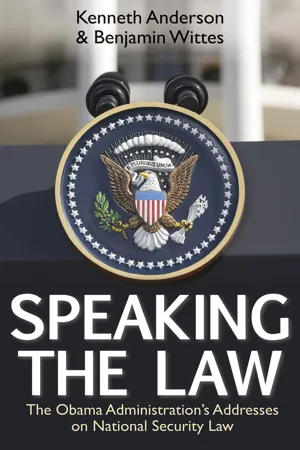
eBook - ePub
Speaking the Law
The Obama Administration's Addresses on National Security Law
- 552 pages
- English
- ePUB (mobile friendly)
- Available on iOS & Android
eBook - ePub
Speaking the Law
The Obama Administration's Addresses on National Security Law
About this book
When Barack Obama came into office, the strategic landscape facing the United States in its overseas counterterrorism operations was undergoing a shift. Even before the rise of drones necessitated the articulation of legal doctrine, the Obama administration had to explain itself. In
Speaking the Law, the authors offer a detailed examination of the speeches of the Obama administration on national security legal issues. Viewed together here for the first time, the authors lay out a broad array of legal and policy positions regarding a large number of principles currently contested at both the domestic and international levels. The book describes what the Obama administration has said about the legal framework in which it is operating with respect to such questions as the nature of the war on terrorism, the use of drones and targeted killings, detention, trial by military commission and in federal courts, and interrogation. The authors analyze this framework, examining the stresses on it and asking where the administration got matters right and where they were wrong. They conclude with suggestions for certain reforms to the framework for the administration and Congress to consider.
Information
CHAPTER 1
An Overview of the Obama Administration’s Canonical Speeches of the First Term
Let us begin with a simple effort to summarize and reconstruct what the Obama administration said in its first-term speeches on national security legal policy, ignoring for now President Obama’s pivot in his National Defense University speech in May 2013 and the resulting flux in the administration’s views of these subjects—a topic we will address in chapter 3. Here we offer, initially without much greater ambition, an overview of official statements on the wide range of issues the administration addressed during the first term. Our aim here is not to offer analysis, praise, or critique. Rather, we strive to weave the speeches together around the topics that seem most important in establishing the administration’s national security legal doctrine and to construct a synthetic policy document that brings all of the major policy threads together in one place. In doing so, we necessarily make some editorial decisions about what parts to include and exclude and how to intertwine them as a single statement and voice. We do this knowing that officials gave these speeches at different times and under different circumstances across the first four years of the Obama administration, and we specifically organize the summary thematically, not temporally. The exercise gives a sense of just how comprehensively the administration did, in fact, address a set of issues on which critics often accused it of obfuscation and silence. The goal is to establish and explain the baseline set of policies and legal views on which the administration built in its second term—and which future administrations will inherit, absent changes to the framework.We begin with those issues that frame the nature of the conflict at its deepest level.
The Fundamental Nature of the Conflict and the Law Governing It
The first-term speeches at their most fundamental were an effort to characterize legally the struggle against transnational terrorism by non-state groups and the powers the United States government has deployed to wage this fight. The speakers sought both to declare and to expound upon the US government’s exercise of national security powers in counterterrorism operations at home and abroad; at the same time, they sought to establish and maintain the legal and political legitimacy of those operations among the American people and, to the extent possible, in the wider world.
One of the striking features of the speeches is their consistent acknowledgment that international law meaningfully limits the American exercise of these powers. After the Bush administration, which very publicly—at least at first—denied legal constraints in general, and international legal constraints in particular, this was not a foregone conclusion in the construction of the US position. Yet other countries have access, or soon will have access, to the kinds of methods and means of counterterrorism that the United States deploys. And, perhaps with that fact in mind, as a matter of general principle the speeches acknowledge that the principles we apply to ourselves—principles of both permission and limitation in confronting transnational terrorist adversaries—we must grant to other sovereign states in similar situations. President Obama acknowledged this point directly in his December 10, 2009, Nobel Peace Prize Lecture in Oslo (see Appendix: Obama—B):
[A]ll nations—strong and weak alike—must adhere to standards that govern the use of force. I—like any head of state—reserve the right to act unilaterally if necessary to defend my nation. Nevertheless, I am convinced that adhering to standards, international standards, strengthens those who do and isolates and weakens those who don’t. . . . Furthermore, America [cannot insist] . . . that others follow the rules of the road if we refuse to follow them ourselves. For when we don’t, our actions appear arbitrary and undercut the legitimacy of future interventions, no matter how justified.
This high-altitude principle infuses a great deal of the rhetoric and persuasive ambition of many of the first-term speeches. And its acknowledgment represents an important starting place. It’s also a comforting one for many who ache to see the United States embrace international legal standards. But it leaves open the question of what fundamental paradigm of international law actually governs the activities that constitute the American confrontation with international terrorists. Is the fundamental legal paradigm one of the laws of war and armed conflict, on the one hand, or is it extraterritorial law enforcement as limited by international human rights law, on the other—or perhaps some mixture of these distinct legal authorities? The differences here are not academic; they can yield radically different answers to questions concerning the use of force and its conduct, starting with whether there is an obligation to seek to arrest and detain someone before striking with lethal force. They also guide questions of how one detains and tries suspects for crimes.
The Obama administration’s first-term answer to this fundamental question was far less comforting to those who seek a kinder, gentler American counterterrorism. The administration decisively rejected the widespread expectation that Obama’s election heralded a return to a purely—or more purely—law enforcement approach, at least insofar as that expectation included in the short term a law enforcement-dominated approach outside of the United States itself. From the beginning, the administration emphasized a kind of bifurcated nature of the conflict, in which law enforcement dominated domestically while war dominated beyond US shores. The first-term speeches disclaim, at least as a policy matter, any intention to use law-of-war powers here at home and fiercely defend the criminal justice apparatus as a means of dealing with both US citizens captured abroad and anyone captured state-side. On the other hand, they also emphasize that the fundamental relationship between the United States and the enemy groups it confronts is one of armed conflict, as a matter of international as well as domestic law. Let’s consider these points in turn.
As early as May 21, 2009 (see Appendix: Obama—A), President Obama himself insisted that warfare lay at the heart of the relationship in his address at the National Archives in Washington, D.C., saying, “Now let me be clear: we are indeed at war with Al Qaeda and its affiliates.” The administration throughout the first term consistently maintained both that the current conflict is authorized by domestic law—specifically by the Authorization for the Use of Military Force (AUMF)1 and by the president’s inherent constitutional power to defend the nation—and that these authorities are consistent with international law. As Attorney General Eric Holder put it on March 5, 2012 (see Appendix: Holder—A), in his address at Northwestern University School of Law:
[T]here are instances where our government has the clear authority—and, I would argue, the responsibility—to defend the United States through the appropriate and lawful use of lethal force.
This principle has long been established under both US and international law. In response to the attacks perpetrated—and the continuing threat posed—by Al Qaeda, the Taliban, and associated forces, Congress has authorized the president to use all necessary and appropriate force against those groups. Because the United States is in an armed conflict, we are authorized to take action against enemy belligerents under international law. The Constitution empowers the president to protect the nation from any imminent threat of violent attack. And international law recognizes the inherent right of national self-defense. None of this is changed by the fact that we are not in a conventional war.
The insistence that the United States is in an armed conflict with Al Qaeda and its affiliates, or associated forces, is unwavering across all the first-term speeches. The nature of this conflict, it bears emphasis, involves actual war—not war as a metaphor for policy seriousness, but armed conflict in the strict legal sense. This is the US government’s position even though the enemy is not a state. In the parlance of international law, the United States considers itself as fighting a “non-international armed conflict”—that is, an armed conflict against something other than another sovereign state.
Since many US actions using lethal force would constitute murder or other crimes during peacetime, establishing the legal propriety of a state of armed conflict is actually an important point. And the speeches offer a firm and consistent position on this basic issue. As John Brennan, Obama’s counterterrorism adviser, put it September 16, 2011 (see Appendix: Brennan—A), at Harvard Law School: “[T]he president has said many times [that] we are at war with Al Qaeda. In an indisputable act of aggression, Al Qaeda attacked our nation and killed nearly 3,000 innocent people. . . . Our ongoing armed conflict with Al Qaeda stems from our right—recognized under international law—to self-defense.”
The administration, in fact, reserved the point that America is legally at war even when defending the use—as it has done assiduously—of the domestic criminal justice system as a tool of counterterrorism. That is, the first-term speeches describe the criminal justice system as one instrument available to it in the array of national powers deployable against the enemy in this armed conflict. Speaking at the Brookings Institution in Washington on June 11, 2010 (see Appendix: Kris—A), Assistant Attorney General David Kris explicitly rejected the notion that a war paradigm disfavored the use of criminal justice tools:
The argument [of those who oppose the use of the criminal justice system], as I understand it, is basically the following:
(1) We are at war.
(2) Our enemies in this war are not common criminals.
(3) Therefore, we should fight them using military and intelligence methods, not law enforcement methods.
This is a simple and rhetorically powerful argument and, precisely for that reason, it may be attractive.
In my view, however, and with all due respect, it is not correct. And it will, if adopted, make us less safe. Of course, it’s not that law enforcement is always the right tool for combating terrorism. But it’s also not the case that it’s never the right tool. The reality, I think, is that it’s sometimes the right tool. And whether it’s the right tool in any given case depends on the specific facts of that case.
Here’s my version of the argument:
(1) We’re at war. The president has said this many times, as has the attorney general.
(2) In war you must try to win—no other goal is acceptable.
(3) To win the war, we need to use all available tools that are consistent with the law and our values, selecting in any case the tool that is best under the circumstances.
Yet at the same time as these speeches situate law enforcement as one of the available tools with which to win a war, they also consistently emphasize law enforcement as the chief—even exclusive—tool for use at home and against Americans captured anywhere in the conflict. In his Harvard speech, for example, Brennan, even while stressing that the conflict was legitimate warfare, disclaimed any interest in using war powers domestically:
[I]t is the firm position of the Obama administration that suspected terrorists arrested inside the United States will, in keeping with long-standing tradition, be processed through our Article III courts—as they should be. Our military does not patrol our streets or enforce our laws—nor should it. . . . Similarly, when it comes to US citizens involved in terrorist-related activity, whether they are captured overseas or at home, we will prosecute them in our criminal justice system.
This idea that the legal state of war involves all aspects of American national power recurs often in the first-term speeches. Speaking at the Woodrow Wilson International Center for Scholars in Washington, D.C., on April 30, 2012 (see Appendix: Brennan—B), for example, Brennan declared that in “this fight, we are harnessing every element of American power—intelligence, military, diplomatic, development, economic, financial, law enforcement, homeland security, and the power of our values, including our commitment to the rule of law.” To put the matter simply, the war to which Brennan refers is one that authorizes the use of war powers but does not in any sense preclude the use of other powers. And at home, he suggests, the chief mechanism for furthering America’s war aims lies in aggressive law enforcement.
The result for the United States of the legal state of armed conflict is that its conduct of hostilities against Al Qaeda and those affiliated or associated with it abroad is necessarily governed by the laws of war, rather than by the international law of human rights or by law enforcement legal rules. As State Department Legal Adviser Harold H. Koh said in his March 25, 2010, address to the American Society of International Law in Washington, D.C. (see Appendix: Koh—A):
[T]he Obama administration is firmly committed to complying with all applicable law, including the laws of war, in all aspects of these ongoing armed conflicts. . . . We in the Obama administration have worked hard since we entered office to ensure that we conduct all aspects of these armed conflicts—in particular, detention operations, targeting, and prosecution of terrorist suspects—in a manner consistent not just with the applicable laws of war, but also with the Constitution and laws of the United States.
These speeches leave some ambiguity at the margins concerning what the administration is promising in terms of compliance with international law. On the one hand, the speeches refer to complying with the laws of war. On the other hand, the administration sometimes emphasizes honoring “laws-of-war principles”—which arguably stops short of promising full compliance. Koh, in his ASIL speech, for example, emphasized that targeting operations complied with the “law-of-war principles” of distinction and proportionality. And Holder, in his Northwestern University School of Law speech, stated that “any such use of lethal force by the United States will comply with the four fundamental laws-of-war principles governing the use of force.”
Most notably, Stephen Preston, general counsel of the CIA, in his April 10, 2012, speech at Harvard Law School (see Appendix: Preston—A), conspicuously did not assert that the agency would comply with international law in covert uses of force, but stated instead only that it honored “international law principles.” As he put it, “The agency would implement its authorities in a manner consistent with the four basic principles in the law of armed conflict governing the use of force: necessity, distinction, proportionality, and humanity. Great care would be taken in the planning and execution of actions to satisfy these four principles and, in the process, to minimize civilian casualties.”
Was this a relaxation of an obligation to comply strictly with the “law of war”? It certainly can be read that way—as a careful hedge against a promise of strict compliance for those situations in which one might, in covert actions, have to bend the rules in the name of necessity. It might also be read, however, in the opposite direction—as a broadening of the commitment of the US government to adhere to law-of-war principles even in circumstances in which the United States uses force outside of formal armed conflicts but where it does not acknowledge the applicability of human rights law. This might include, for example, self-defense operations in belligerencies short of formal armed conflict.
Indeed, the first-term speeches carefully preserve the legal possibility of using force against non-state actors that might not be covered by the existing conflict in circumstances which, while legitimate acts of self-defense, might not be part of any armed conflict at all. Armed conflict under international law is a term of art; it does not simply refer to any situation in which forces are shooting at each other. While all hostilities between armed forces of states are governed by the laws of war, hostilities in non-international armed conflict have to rise to a certain level of sustained intensity in order to qualify. And the speeches consistently reserve the right to use force should groups arise that the president concludes he needs to attack with force but which are not part of the current conflict or, indeed, any armed conflict. Under such circumstances, the first-term speeches imply, the inherent right of self-defense of a state—and the inherent powers of the president to protect the nation under the Constitution—would permit the use of lethal force anyway. This is one of several implications found in Brennan’s claim in April 2012 that “the United States is in an armed conflict with Al Qaeda, the Taliban, and associated forces, in response to the 9/11 attacks . . .” Brennan concludes this same sentence by adding, “and we may also use force consistent with our inherent right of national self-defense” (emphasis added).
Brennan’s “also” packs a lot of content into four letters. It acknowledges uses of force against non-state actors where the level of hostilities has not necessarily risen to the level of systematic, sustained fighting required to produce an armed conflict subject to the laws of war. And it acknowledges also that the current conflict does not exhaust the lawful uses of force in counterterrorism that the United States reserves the right to undertake.
It is not an anomaly in the speeches. Koh, too, carefully preserved this self-defense category. Addressing different targeting questions in his ASIL speech, he referred at different points to “a state that is engaged in an armed conflict or in legitimate self-defense” and to a state “acting in self-defense or during an armed conflict” (emphasis added). The use of “or,” like Brennan’s use of “also,” appears intended to preserve this further category of belligerency as distinct from belligerency in armed conflict. The basic, implicit position here is that self-defense is a broader category than armed conflict but that this form of belligerency short of armed conflict is governed legally by the same fundamental principles as full-blown armed conflict.
Notably, the speeches appear to take the view that this category is—at least for now—a hypothetical one, since the speeches cast all of the uses of force actually undertaken by the United States in counterterrorism so far as part of the ongoing and preexisting armed conflict authorized by the AUMF. The self-defense theory, however, becomes critical as the administration begins imagining the end of the AUMF conflict—as the president did at the out...
Table of contents
- Cover
- Title Page
- Copyright Page
- Contents
- Introduction
- 1 An Overview of the Obama Administration’s Canonical Speeches of the First Term
- 2 The Good, the Bad, and the Underdeveloped
- 3 The President’s NDU Speech and the Pivot from the First Term to the Second
- 4 The Speeches in Interaction with Other Branches of Government
- 5 The Framework and Its Discontents
- Conclusion
- Appendixes: Addresses and Remarks by President Obama and Administration Officials on National Security Law
- About the Authors
- About the Hoover Institution’s Jean Perkins Task Force on National Security and Law
- Index
Trusted by 375,005 students
Access to over 1.5 million titles for a fair monthly price.
Study more efficiently using our study tools.
Frequently asked questions
Yes, you can cancel anytime from the Subscription tab in your account settings on the Perlego website. Your subscription will stay active until the end of your current billing period. Learn how to cancel your subscription
No, books cannot be downloaded as external files, such as PDFs, for use outside of Perlego. However, you can download books within the Perlego app for offline reading on mobile or tablet. Learn how to download books offline
We are an online textbook subscription service, where you can get access to an entire online library for less than the price of a single book per month. With over 1.5 million books across 990+ topics, we’ve got you covered! Learn about our mission
Look out for the read-aloud symbol on your next book to see if you can listen to it. The read-aloud tool reads text aloud for you, highlighting the text as it is being read. You can pause it, speed it up and slow it down. Learn more about Read Aloud
Yes! You can use the Perlego app on both iOS and Android devices to read anytime, anywhere — even offline. Perfect for commutes or when you’re on the go.
Please note we cannot support devices running on iOS 13 and Android 7 or earlier. Learn more about using the app
Please note we cannot support devices running on iOS 13 and Android 7 or earlier. Learn more about using the app
Yes, you can access Speaking the Law by Kenneth Anderson,Benjamin Wittes in PDF and/or ePUB format, as well as other popular books in Politics & International Relations & National Security. We have over 1.5 million books available in our catalogue for you to explore.