- 374 pages
- English
- ePUB (mobile friendly)
- Available on iOS & Android
eBook - ePub
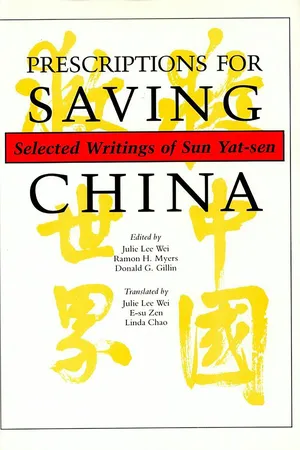
Prescriptions for Saving China
About this book
In this book, more than forty selected writings from Sun Yat-Sen, the father of modern China, have been translated into English for the first time. Ranging from early speeches to a graduation address delivered a year before his death, these translations illustrate the depth and breadth of Sun's philosophy and chronicle the development and refinement of the cornerstone of his philosophy, the Three Principles of the People—to mediate open and pluralistic marketplaces in the ideological, economic, and political spheres. Sun's vision called for the creation of a strong, modern, and democratized China to be an equal competitor with Western nations.
Information
Subtopic
Asian Literary CollectionsIndex
Literature1.1
A Plea to Li Hung-chang1
June 1894
To His Excellency the Grand Mentor to the Heir Apparent and Grand Secretary:2
I, Wen, am a native of eastern Kwangtung, where for generations my ancestors have lived in Hsiang-shan county.3 In Hong Kong, I was awarded the British medical degree after passing my examinations.4 While young, I studied abroad, where I acquainted myself with the written and spoken languages of the Western countries and with their politics, government, and customs, along with astronomy, geography, chemistry, and general science. I tried especially to learn how these countries had grown rich and strong and how they had civilized their people and formed their cultures. In addition, I was able to discern the factors at work behind political change and the proper conduct behind harmonious international relations. Today is an age of expanding awareness, when talented people are converging from every direction on the state and the court, eager to bring about good rule and to work diligently to improve the political situation. I have often wanted to submit to you, who are in authority, my humble opinions regarding the overall political situation. However, because of my humble position and the consequent insignificance of my remarks, I have not dared to do so. On the other hand, lately I have observed the state's vigorous efforts to chart a course to enrich and strengthen the nation. I have also seen the new advances that accompany each succeeding day and the concerted energies directed at achieving them, so that it has become obvious that we will soon gallop abreast of the European nations. Now, we, too, possess the swift battleships, the flying trains, the telegraphs, the ammunition, and the guns with which they once intimidated us.5 In addition, such advances will be followed swiftly by other, newer ones. I assume, therefore, that you gentlemen in authority have already pondered what we must do to maintain domestic tranquility and ward off external threats as well as enrich the nation and strengthen its military power. Furthermore, since many people have been sent abroad, nothing that happens in foreign countries is any longer unknown to us. I can only be cheered and rejoice when an ordinary citizen like myself can live in a golden age like this. What, then, could I possibly have to offer you? Nevertheless, I take this opportunity to offer my humble thoughts in the possibility that there is a one-in-ten-thousand chance that they can supplement Your Excellency's high and deep wisdom.
I am keenly aware that the wealth and power of the European nations are the result not only of their having ships and powerful guns, strong fortresses and formidable troops but also because their people can fully employ their talents, their land can be fully utilized, their natural resources can be fully tapped, and their goods can freely flow. These four elements6 are the basis of a nation's wealth and strength and the root of good government. Today, in an effort to emulate the West and strengthen itself, our country is embarking on great schemes and seeking far-reaching stratagems. However, if, instead of urgently addressing these four issues, we merely concentrate on building strong ships and powerful guns, we will be ignoring the root [pen] and seeking the flower [mo].7
The utilization of talent means that it is necessary to provide the people with proper education and nurture, correct encouragement, and appropriate appointment and employment. Now, men are not born with knowledge; it must be learned. Not everyone loves to learn; they must be taught. The people were given kings and teachers so that they could be taught and nurtured. Since ancient times, China has been peerless in the breadth and depth of its system of education. Unfortunately, that system has fallen into disrepair, and the old system of education exists only in name. Meanwhile, the modern age has witnessed the sudden emergence of the Western countries. They have inherited the legacy of the Three Dynasties.8 Their schools are everywhere in their countries, and their people, rich or poor, are diligent in the pursuit of knowledge. The sciences of heaven and earth and all creatures, the affairs of men and everyday life, are all included in the subjects taught in their schools. Everyone in the nation begins his studies in early childhood, directing and devoting his energies to whatever he has an aptitude for. Furthermore, in each of these nations there are specialized teachers who diligently instruct and inspire. Even if the subject matter is subtle and intricate, they have ways of making it clear as well as the equipment to provide the means of first-hand observation. Since the subjects studied progress from lower to ever-higher levels of complexity, the minds involved in such studies are broadened daily and their knowledge increases with each day. Men have different levels of intelligence, which only education can reveal. One may have broad or narrow talents, but only education renders them useful. Schools set up to train people will develop the intelligence of those who have it and end the stupidity of those who do not, providing a specialty to those who have narrow talent and broad knowledge to those with all-round ability. Without education for the place and the man, the rare qualities of virtue and talent may go squandered or unused, buried and unknown. The existence of such an educational system is the reason why the West has such an abundance of talented people.
Furthermore, people have differences in talent and aspiration. The superior ones are unwilling to live useless lives and, no matter how lowly their status, will make the nation their own responsibility. Such men can no doubt be ambitious and independent with no need of encouragement. "Men of outstanding ability will emerge even without the arrival of King Wen."9 As for mediocre people, they must have appropriate encouragement. Therefore, in the West a man who has even the slightest talent will be cherished by being given a specialty. Consequently, everyone strives of his own accord, and no one lives in vain. After they have graduated, established themselves, and served society, there are learned societies to further broaden their knowledge as well as scholarly journals to advance their growth. When scholars throughout a nation devote their talents to examining what the ancients already knew and what the moderns have not yet discovered, old ideas will give way to the new. When men's boundless creativity is set free and can be directed toward elucidating the endless mysteries of the universe, how can anyone be isolated or ignorant? Furthermore, if, after mastering a new subject, a scholar invents something new, he will surely receive the highest national award. Who, then, among that nation's scholars will not concentrate his efforts on doing his best? Such encouragement is the reason for the West's continual advances in various fields of learning, until accomplishments there now nearly rival those of Creation itself.
Now, if people are not employed in work for which they are trained, they will not be competent in their tasks even if they are bright, and the clever ones will easily conceal their misdeeds. Without a doubt, employing people in this way will result in many gifted people being unemployed and many people reaching high office undeservedly. Western countries, on the other hand, are guided by principles similar to those of the emperors T'ang and Yü.10 When employing people, the emphasis is on taking advantage of each person's aptitudes and providing him with long-term employment. Therefore, a civil official must attend a college of liberal arts; and a military official, a military academy. As for others, those versed in literature become teachers; those familiar with agriculture, the heads of farms; those with engineering expertise, foremen; and those familiar with commerce, business directors. In their youth all are assigned to positions appropriate to their training. In short, the state provides a post suited to whatever one has learned in school. Men in their prime practice whatever they studied while young, and those who excel in their studies enter public life. Furthermore, a person who remains in his field can be promoted without having to transfer. Lengthy service results in richer experience, and familiarity with the job leads to innovations. In addition, people do not gaze around if they are rewarded for honesty and given permanent positions; rather, they dedicate themselves to their jobs. This practice in employing people is the reason why officials in the West are both conscientious and diligent.
Thus, given the right education, there will be no waste of talent; given the right encouragement, there will be no unhappy scholar; given the right system of appointment and employment, there will be no place for people to gain undeserved promotions to high office. If these three principles are properly followed, everyone will be able to fully employ his talent, and all things will flourish. Then we need not worry about whether the nation will become strong and wealthy; it will happen as a matter of course. Why, then, do not you, the nation's leaders, give this matter your attention?
If land is to be used to best advantage, there must be officials to supervise agriculture, farming must be in the hands of those versed in agricultural affairs, and they must have machines to assist them in planting and harvesting.
Now, land is the lifeline of the common people. From the time when Hou Chi11 taught the people how to plant crops, China has had special officials in charge of agriculture. These were the "pastors" of the people of later times, for it was thought that before the Three Dynasties, the people had not developed the means of sustaining themselves, and so good government meant sustaining and feeding them. In a still later age, after agriculture had developed, good government came to mean leaving people alone to sustain and feed themselves and not disturbing them with excessive interference. For this reason, agriculture in China today has been increasingly neglected. The farmers only know how to cling to traditional ways and do not know how to adjust to change. Since clearing the wilderness has been neglected and irrigation systems have fallen into disrepair, people toil much but gain little, and feeding the people is increasingly difficult. Waterways and rivers once beneficial to cultivation have now become its scourge.12 Let us momentarily set aside the subject of the Yellow River in the north. In Kwangtung, even the East, West, and North rivers, which never flooded in ancient times, have been bringing ever-worse floods each year. Similar situations exist all over other provinces. This is the result of not having officials charged with overseeing agriculture. The farmers, though victimized, are helpless; they wish to repair the waterways but have no power, so they can only leave it to a vague Destiny. Across the nation, the amount of crops lost each year because of lack of timely cultivation has reached astronomical proportions. Such is the magnitude of losses caused by neglected waterworks. Then too, substantial losses have resulted from wilderness land being left unreclaimed and from the neglect of forests and water resources.
When one says, "The land has unused benefits, and the people have excess strength," it means that the soil for growing crops is not fully cultivated and that the forests and waters are not fully tapped. How can we achieve wealth in this fashion? The countries of the great West are keenly aware that the great source of wealth lies in not wasting the land and in making certain that it is planted and harvested in a timely manner. For this reason they have set up special offices to manage such matters. In those countries, everything that is good for agriculture is promoted and everything harmful to it is removed. Take, for example, the Ganges in India and the Mississippi in the United States. These rivers once caused disastrous floods as often as the Yellow River; the fact that they were eventually controlled proves that human effort can compensate for acts of nature. How can a nation's rulers not take urgent action to help its people by setting up government departments in charge of agriculture?13 However, even after floods have been controlled, hydraulic works have been promoted, and wilderness has been cultivated, it does not necessarily follow that the problem of utilizing the land and feeding the population will have been solved, for, while the population increases every day, the amount of land cannot daily increase. Unless new advances take place each day, will not overpopulation subsequent to cultivation of the wilderness result in more famines? In order to prevent such recurrences, therefore, it is urgent that the agricultural sciences be promoted and that planting and husbandry be constantly improved so as to speed up growth and multiply production. In making man the intelligent being among the myriad things, heaven has provided the myriad things for his use. And even though these things are inexhaustible, it is up to man's intelligence to put them to good use. Man cannot eat soil, but soil can produce the five grains and the hundred fruits to feed man. Man cannot eat grass, but grass can nurture the six animals, which provide meat for his table. Now, to be sure, earth and grass are inexhaustible, but only if man can study what is suitable for the soil and can understand the nature of the soil. If we understand the laws involved, we can convert rocky and barren soil into fertile land. This is the soil science and chemistry of agriculture. By differentiating the biological laws of species and by distinguishing the differences in their productivity, by investigating the nature of plants, and understanding the physiology of animals, man can hold sway over them. These are the botany and zoology of agriculture. Sunlight can enhance growth, electricity can accelerate the process of maturation; this is the physics of agriculture. Pests can be prevented, and epidemics avoided; this is the medicine of agriculture. Once agriculture is enlightened, the productivity of the same patch of land will multiply several times, which amounts to transforming one acre of land into several acres and enlarging one country into the size of several countries. Consequently, although the size o...
Table of contents
- Front Cover
- Preface
- Acknowledgments
- Introduction
- Principal Events in the Life of Sun Yat-sen: A Chronology
- SECTION ONE: To Overthrow the Manchu Regime
- 1.1: A Plea to Li Hung-chang: June 1894
- 1.2: An Autobiography: Written in October 1896 at the request of Professor Herbert Giles of Cambridge University, England
- 1.3: A Joint Discussion of the Question of China's Preservation or Its Partition: Tokyo, August 1, 1903
- 1.4: A Refutation of an Article in the Pao-huang Pao [Protect the Emperor Newspaper]: Honolulu, December 1903
- 1.5: Discussion with Wang Ching-wei: Autumn 1905
- 1.6: Editorial Introducing the First Issue of Min Pao [People's Journal]: Tokyo, November 26, 1905
- 1.7: A Talk with Hu Han-min: Before 1911
- 1.8: The Three People's Principles and the Future of the Chinese People: A speech given at a Tokyo gathering to celebrate the first anniversary of Min Pao [People's Journal], Decemeber 2, 1906
- 1.9: Those Who Fear a Revolution Will Cause Partition Are Ignorant of Current Affairs: Singapore, August 6, 1908
- 1.10: Statement of Proposals by the T'ung-meng-hui [United League]: December 30, 1911
- SECTION TWO: Establishing and Consolidating the First Chinese Republic
- 2.1: The Principle of the People's Livelihood and Social Revolution: Speech to members of the T'ung-meng-hui [United League] at a farewell party in Nanking after Sun Yat-sen's resignation as provisional president of the Republic of China, April 1, 1912
- 2.2: The Popular Mind Depends on the Power of the Press: A speech made on a visit to Min-li Pao [Popular Stance Tribune] in Shanghai, April 16, 1912
- 2.3: The Intrinsic Duty of Military Men: A speech made at a welcome given by military men in Canton, April 26, 1912
- 2.4: The Press Should Be United: A speech given on April 27, 1912, to reporters of Canton newpapers
- 2.5: Kwangtung Province Should Quickly Elect a Governor: A speech made before the Kwangtung Provincial Assembly, April 27, 1912
- 2.6: Everyone Should Strive to Be a Patriotic Citizen: A speech made at a reception hosted by Chinese members of the Rotary Club of Kwangtung, May 6, 1912
- 2.7: Reconstruction Is Impossible without Learning: A speech made on May 7, 1912, at the Ling-nan School, Canton
- 2.8: Christians Should Give Full Play to Their Faith and Help Shoulder National Responsibilities: Extract of a May 9, 1912, lecture to the Christian Alliance of Canton
- 2.9: Students Should Champion Social Virtue: The gist of a speech to a reception hosted by academic circles in Peking in August 1912
- 2.10: In Order to Unify the Republic of China, Members of the Revolutionary Brotherhood Should Befriend Nonmembers: Extract of an August 25, 1912, lecture delivered at a reception in Peking given by the Revolutionary Brotherhood
- 2.11: In Seeking the Means to Reconstruction, Be Responsive to the People of the Entire Nation: A lecture delivered to educational circles at a reception at the Hu-kuang Clubhouse on the afternoon of August 30, 1912
- 2.12: The Duty of the Army and the Police: A speech at a September 1, 1912, reception given by army circles in Peking
- 2.13: Using Religious Virtues to Remedy Political Inadequacies: The substance of a speech made at 2:00 p.m. on September 5, 1912, in responsse to a welcome by the churches of Peking
- 2.14: An Open-Door Policy Is the Only Way to Resolve the Diplomatic Question: A speech made on September 5, 1912, at 4:00 p.m. during a thank-you reception at the Guest House in Peking
- 2.15: Building Railroads across the Nation Is a Matter of Life and Death for the Republic of China: A lecture delivered at a Peking Guest House press conference at 2:00 p.m. on September 14, 1912
- 2.16: Speech to a Kuomintang Electoral Meeting: A speech made in Shanghai on October 6, 1919, to an electoral meeting of the Kuomintang
- 2.17: Always Adhere to the Right, and There Will Be No Need to Fear: A speech given on October 10, 1912, at a meeting of the Chinese World Student Association, in Shanghai, to commemorate Double-Ten Day
- 2.18: An Expression of Political Views: A speech given on October 12, 1912, at a reception hosted by the Shanghai Newspaper Guild
- 2.19: The Monetary Revolution: Shanghai, December 6, 1912
- 2.20: Our Political Party Should Stress Party Principles and Party Ethics: A speech at a tea discussion party of the Kuomintang, Shanghai, January 19, 1913
- SECTION THREE: Launching a New Revolution
- 3.1: The Meaning of the Republic of China: A speech delivered at a welcome party given by Cantonese Parliament members stationed in Shanghai, July 15, 1916
- 3.2: Our Nation's Strength Depends on Our United Efforts: A speech to the Shao-hsing Business Association, August 23, 1916
- 3.3: The Question of China's Survival: 1917
- 3.4: The Doctrine of Sun Yat-sen: To Act Is Easy, to Know Is Difficult: December 3, 1918
- 3.5: The Three Principles of the People [San-min chu-i]: 1919
- 3.6: How China's Industry Should Be Developed: 1919
- 3.7: The Means of Introducing Local Self-Government: March 1, 1920
- 3.8: The Foundation for Building the Republic of China: Written for the thirtieth anniversary of the Shanghai hsin-wen jih-pao [Shanghai Daily News], 1922
- 3.9: A History of the Chinese Revolution: January 29, 1923
- 3.10: A Speech to the First Graduating Class of the Institute for the Study of the Farmers' Movement: Canton, August 12, 1924
- 3.11: Farewell Speech to the Whampoa Military Academy: November 3, 1924
- Notes
- Bibliographic Note
- Contributors
- Index
Trusted by 375,005 students
Access to over 1.5 million titles for a fair monthly price.
Study more efficiently using our study tools.
Frequently asked questions
Yes, you can cancel anytime from the Subscription tab in your account settings on the Perlego website. Your subscription will stay active until the end of your current billing period. Learn how to cancel your subscription
No, books cannot be downloaded as external files, such as PDFs, for use outside of Perlego. However, you can download books within the Perlego app for offline reading on mobile or tablet. Learn how to download books offline
Perlego offers two plans: Essential and Complete
- Essential is ideal for learners and professionals who enjoy exploring a wide range of subjects. Access the Essential Library with 800,000+ trusted titles and best-sellers across business, personal growth, and the humanities. Includes unlimited reading time and Standard Read Aloud voice.
- Complete: Perfect for advanced learners and researchers needing full, unrestricted access. Unlock 1.5M+ books across hundreds of subjects, including academic and specialized titles. The Complete Plan also includes advanced features like Premium Read Aloud and Research Assistant.
We are an online textbook subscription service, where you can get access to an entire online library for less than the price of a single book per month. With over 1.5 million books across 990+ topics, we’ve got you covered! Learn about our mission
Look out for the read-aloud symbol on your next book to see if you can listen to it. The read-aloud tool reads text aloud for you, highlighting the text as it is being read. You can pause it, speed it up and slow it down. Learn more about Read Aloud
Yes! You can use the Perlego app on both iOS and Android devices to read anytime, anywhere — even offline. Perfect for commutes or when you’re on the go.
Please note we cannot support devices running on iOS 13 and Android 7 or earlier. Learn more about using the app
Please note we cannot support devices running on iOS 13 and Android 7 or earlier. Learn more about using the app
Yes, you can access Prescriptions for Saving China by Julie Wei in PDF and/or ePUB format, as well as other popular books in Literature & Asian Literary Collections. We have over 1.5 million books available in our catalogue for you to explore.