eBook - ePub
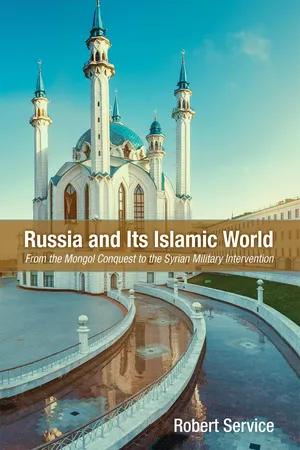
Russia and Its Islamic World
From the Mongol Conquest to The Syrian Military Intervention
- 128 pages
- English
- ePUB (mobile friendly)
- Available on iOS & Android
eBook - ePub
Russia and Its Islamic World
From the Mongol Conquest to The Syrian Military Intervention
About this book
Russia has long played an influential part in its world of Islam, and not all the dimensions are as widely understood as they ought to be. In
Russia and Its Islamic World, Robert Service examines Russia's interactions with Islam at home and around the globe and pinpoints the tsarist and Soviet legacy, current complications, and future possibilities. The author details how the Russian encounter with Islam was close and problematic long before the twenty-first century and how Russia has recently chosen to interfere in Muslim states of the Middle East, building alliances and making enemies. Service reveals how some features of the present-day relationship continue past policies; others are starkly and perilously different, making the current moment in global affairs dangerous for both Russians and the rest of us. He describes how the Kremlin dominates Muslims in the Russian Federation, exerts a deep influence on the Muslim-inhabited states on Russia's southern frontiers, and has lunged militarily and politically into the Middle East. Foreign Muslims, he shows, do not value the leadership in Moscow except as a means to an end; Putin's pose as a friend of the Islamic world is no more than a pose—and a hypocritical one at that.
Information
1
Russia’s Long Interaction with Islam
THE RUSSIAN ENCOUNTER WITH ISLAM WAS CLOSE and problematic long before the twenty-first century. Eight hundred years earlier, Russians as a people fell under the dominion of foreign Muslim rulers. Nowadays the Kremlin dominates Muslims in the Russian Federation, exerts a deep influence upon the Muslim-inhabited states on its southern frontiers, and has lunged militarily and politically into the Middle East.
The current moment in global affairs is dangerous for Russians and the rest of us. Since the turn of our millennium, Moscow has pursued a militant agenda in its internal and external policies. Foreigners have been taken aback by the transformation, having become accustomed to a Russia that came to the West as a needy supplicant. Russia has confirmed itself as a great power even if it is no longer the superpower of yesteryear. The pacification of Chechnya and the Syrian military intervention are the troubling examples of recent Russian assertiveness. But Russia is also entangled with its Islamic world in ways that have nothing to do with war. Muslims have for several centuries lived alongside Russians as objects of wonder and fear, and large Muslim communities continue to exist across the Russian Federation. Since the collapse of the USSR in late 1991, Russia has had to deal with the newly independent, Muslim-inhabited states on its southern frontiers. Moreover, it has chosen to interfere in Muslim states of the Middle East, building alliances and making enemies. Some features of the present-day scene display continuities with the past while others are starkly different—starkly and hazardously different.
The first impact of Muslim states on the Russian people was registered in the thirteenth century when the Golden Horde, one of the powers that emerged from the struggles inside the Mongol elite upon the death of Genghis Khan, converted to Islam. The Golden Horde for a brief while controlled all the lands from Siberia across to the Danube. The experience for Russians was lengthy and extremely brutal. The Mongols were warrior horsemen who had swept across Asia without facing effective resistance. In the course of their campaigns they adopted the Islamic faith. Islam had already spread much earlier to some of the territories of what later came to constitute Russia, including well-established communities of believers along the river Volga as well as in Siberia, the Caucasus, and the oases of Central Asia. Strapped pitilessly to the “Mongol yoke,” Muscovy’s Christians had to render an annual tribute to their masters from the east. The Mongol khanate all too often fixed the burden without regard for its devastating economic consequences. The Mongols executed Russian rulers and sacked their cities whenever they fell short in meeting Mongol demands.
Nevertheless, the Mongols and their allies were pragmatic enough to practice religious tolerance despite the general lacerations of their rule. As a result, the Orthodox Church survived intact two centuries of Mongol domination. Christianity provided Russians with spiritual solace and dignity and became an integral feature of their national identity. It was only a matter of time before they mounted an effective challenge to the Mongols. When in the fifteenth century the Grand Duke of Moscow, Ivan III, declared a war of liberation, he sallied forth as a Christian warrior. This time the Muscovite armies dislodged the military balance and shattered the yoke that had lain on their people’s shoulders. The war had a religious dimension, since Russians were fighting as Christians against infidels. No quarter was given to the enemy by either side. Mosques were burned to the ground in celebration of the Christian triumph. The Volga region was annexed to Muscovy, and Kazan’s Muslim leaders were compelled to swear fealty, just as Muscovite grand dukes had prostrated themselves in the presence of the Mongol khan. Muscovy steadily expanded its sovereignty over other areas where the Russian tongue—or something like it—was spoken. Russia was on the way to becoming one of Europe’s great powers.
The fighting near the Volga was by no means over. In 1552, Ivan IV—known to history as Ivan the Terrible—laid siege to Kazan to suppress a Muslim rebellion. When Russian forces broke into the fortress, they razed the great mosque to the ground. Sultan Suleiman the Magnificent sent a message of protest from the Sublime Porte. This was an early example of the intersection of internal and external factors in Russia’s Islamic world. As it happened, the Russian authorities recognized that a forcible attempt to convert Muslim communities to Christianity would be counterproductive. Muscovite interests therefore lay in granting legal status to Islam, and the Russians treated Muslims as unfortunates who persisted in the worship of a false god. (This was the mirror image of the attitude that Muslim rulers had shown to their Russian subjects.) Russians permitted the Muslim elites to stay in charge of their localities, albeit under ultimate Russian supervision and on condition that they guaranteed order and fulfilled their tax obligations. Muslim communities had no choice but to adapt themselves to Russia’s legislation. But they strove to preserve what they could of sharia (Islamic law), and the Russian rulers accepted a degree of compromise as a practical necessity: Russia was vast and growing vaster, and imperial control was impossible without a degree of local acquiescence.
Russian territorial expansion continued northward toward the Baltic coast, westward across Ukraine, and eastward into the Si-berian taiga and tundra. But there was no further conquest of Muslim-held territory until Russia defeated the Ottomans in the war of 1768−74 and forced them to disclaim sovereignty over the Black Sea’s northern coastline. Rivalry with the Ottoman Empire had been intense ever since the Ottoman seizure of Constantinople in 1453 and the definitive destruction of the Byzantine Empire. Russia’s rulers championed the peoples of Orthodox Christianity when military conditions were propitious. Ambitions of conquest, trade, and faith were intertwined. Catherine the Great’s lover and general, Grigori Potëmkin, swept down into the Tatar principality of Crimea. The Tatars, or Tartars as they were usually called in Europe, had until then frustrated Russia’s ambitions in regard to the Black Sea. Their involvement in the slave trade served to perpetuate the image of Islam as an alien, barbarous, and threatening phenomenon, and the jubilant Russians celebrated their Crimean success as proof of European, Orthodox Christian Russia’s superiority over the rival powers of the East.
Wealthy Tatars were expelled from Crimea, provoking a growing emigration to Turkey. The tsars in subsequent decades were to contrast Crimea’s Muslims with the less fiery Islamic communities of the Volga towns and villages, where Russian administrators had built up a relationship of mutual understanding in the course of two centuries of rule.
Even so, there was always a danger of Muslim revolts elsewhere in the Russian domains, which was why Catherine the Great introduced the institution that came to be known as the Orenburg Mohammedan Spiritual Assembly, where Muslim notables gathered for discussions under official Russian supervision. The notables addressed matters pertaining to their religious and social traditions on condition that they steered clear of infringing Russia’s state interests. For Russia’s rulers in their capital of St. Petersburg, the Orenburg Assembly provided a means of controlling the growing number of Muslim communities. Imams could preach without interference so long as they avoided criticism of imperial authority. The central government assumed that religious devotion, education, and worship were conducive to social stability. The objective was obedience rather than conversion (although some pressure was put on Volga Tatars to declare formally in favor of Christianity). Of all the great powers apart from the Ottoman Empire, the Russians were sensitive to the possibility that disgruntled Islamic believers might rise in rebellion against their rulers and that an extreme variant of the faith might supply the motivation.
The Russian Empire raced to accumulate additional territories in the nineteenth century when yet more Muslims were brought under Russian rule. Muslim peoples in the south Caucasus—most notably the Azeris living on the eastern side of the Caspian Sea who belonged to the Shia branch of Islam—were subjugated after a long war with Persia in 1804−13. The expansionary process was resumed in later decades when vast tracts of central Asia with mainly Sunni inhabitants were subjugated. Russian power was restlessly on the march.
All this was watched with concern by Western politicians, who knew that the Russians felt frustrated by the Ottomans’ continued control over the western exit of the Black Sea. Limitations remained upon Russian commercial and military access to Mediterranean waters. To many foreigners it appeared that the Russians were eyeing the Turkish-occupied parts of Europe for eventual conquest; it was assumed that the tsar’s armies might also pounce on Turkey itself and subjugate the entire Middle East. Although a few Russian statesmen indeed had ambitions in this direction, they had their own worries about Ottoman pretensions. Russia found itself competing with the Ottomans for the loyalty of its Muslim subjects. The Ottoman Empire, despite weakening as an international power, retained the confidence to urge Russia’s Muslims to shake off the tsarist yoke. The sultan not only wielded temporal authority but also, as caliph, was the spiritual leader of the entire Islamic world and could foment rebellion on religious principles. The tsars and their ministers had to handle their Muslim subjects with additional caution if they wanted to avoid provoking a jihad in the southernmost swaths of their empire.
Meanwhile, the tsars began to present themselves as the protectors of Christian shrines in the Holy Land regardless of the Ottoman imperial prerogatives. The Ottomans had for centuries caused trouble for the governance of the Russian Empire. Now the boot was on the other foot after the Russians became the stronger power. St. Petersburg’s growing diplomatic pressure on the sultan caused agitation in London and Paris, leading in 1853 to a punitive military expedition to Crimea. Britain and France resolved to prevent the Middle East from falling into Russia’s hands. The Russian armed forces, poorly organized and equipped, performed so inadequately against the Anglo-French landings that Tsar Alexander II was compelled to recognize the sovereignty of the Ottomans over their lands as the price of peace.
Russia’s armies had unfinished business in the north Caucasus where Imam Shamil led an uprising in the 1830s, proclaiming a jihad against foreign military occupation. Not until 1859, after years of conflict in the mountains in and around Dagestan, was Shamil defeated and taken captive. Shamil was given dignified treatment as a way of assuring his followers that the Russians aimed to bring stability and prosperity to the region. This objective was thwarted by a revolt of the Circassians, which was finally suppressed only in 1862. The imperial authorities deported hundreds of thousands across the Black Sea to Turkey; a large number of them perished in the harsh conditions of transit. A lesson was given that if a Muslim group gave trouble, the Russian authorities would have no scruples about “cleansing” it from their territories. Expansion continued on the eastern side of the Caspian Sea, where the Turkmen people put up a bitter resistance until their defeat at the siege of Geok Tepe in 1881 and Transcaspia’s annexation by the empire. For the rest of the century, the tsar’s viceroy, commanders, and administrators worked to cast a net of irresistible authority over the entire Caucasus, north and south. In St. Petersburg, the desire burned as strongly as ever to wrest control of the Black Sea from the Ottomans.
Russian power penetrated deep into central Asia in the same decades. The lands of the Kazakhs, Kyrgyz, and Uzbeks were gathered into a single vast territorial unit that the Russians called Turkestan. Thus were yet more Muslims subdued. Significantly, this process brought the Russian and British colonial territories close to each other for the first time. Only Afghanistan separated the Russian Empire from British India. The Anglo-Russian rivalry became known as the Great Game, with the two sides using spies and army agents to undermine each other. The British perceived a threat to their hold on the Indian subcontinent. In Turkestan, meanwhile, Russia set about filling the sparsely inhabited steppes with Russian farmers and taming a Kazakh rebellion that lasted until 1846. A Russian governor-generalship was formally established in Tashkent in 1867 and the imperial administration was consolidated. As usual, local governance was devolved to traditional elites on condition of their political obedience. Russian culture was propagated as superior and beneficial. Alexander II’s foreign affairs minister, Alexander Gorchakov, sharing the conventional European attitude of the day, referred to the process as Russia’s mission civilisatrice.
In 1876, as the Ottomans faced growing resistance in their Balkan territories, Alexander II started a military campaign to take Istanbul (or Constantinople, as the Russians still called it) with the aim of controlling the marine exit from the Black Sea. Sultan Abdul Hamid took the banner of the Prophet Muhammad, which was in Ottoman safekeeping, and declared a jihad against the invaders. But Russian imperial forces reached the outskirts of Istanbul by the start of 1878, forcing Abdul Hamid to accept an armistice. At the Congress of Berlin later that year, the Ottomans lost two-fifths of their empire, including three provinces in eastern Anatolia which were given to the Russians—and yet more Muslims thereby became subjects of the tsar.
According to the 1897 Russian census, nearly fourteen million people professed the Islamic faith, which was 11 percent of the empire’s population. Most of the Muslim subjects of the tsars gave them little cause for concern. But the Caucasus and central Asia remained pinch points of governance in a period when Russia wanted to assert itself against the rival powers on its borders. The Caucasian territories provided Russia with its second biggest Muslim area and population after the Volga region. The Kabardinians and Ossetians were swiftly pacified, and their leaders were granted titles of Russian nobility. Christian Georgia, too, had its aristocracy incorporated in the Russian social ranking. But the tsars declined to accord aristocratic status to the Muslim elites in Azerbaijan. The Azeris, as it happened, were obedient to Russian rule. But Chechen Muslims on the northern slopes of the Caucasus proved more resistant, and the Chechen territory seethed with discontent. Conquest, difficult though it had been, was easier than administrative control. The maintenance of power in the north Caucasus alone devoured a quarter of the annual state budget. Ministers could never afford to overlook the mood of its millions of Islamic believers. Empire was a costly asset.
Discontent with the political and social system was reaching the boil by the turn of the century, and in 1905−06 a revolutionary emergency enveloped Nicholas II and his government. While workers, peasants, and sections of the middle class in Russia jointly challenged the authoritarian order in society, disturbances broke out in the north Caucasus. Dagestan and neighboring Chechnya were hot spots of rebellion. Muslims elsewhere, too, demanded fundamental reforms or joined in outright rebellion. Nicholas agreed to hold elections to a parliamentary assembly known as the State Duma; at the same time he ordered a severe repression of revolutionary organizations. He survived in power, but the assertive spirit persisted throughout society. The Tatars of the Volga region, for instance, petitioned to be recognized as Muslims rather than as the Christian converts that had previously been the status of many of them; they wanted to free themselves from sin by obtaining an end to the restrictions on sharia law. With the monarchy and the Orthodox Church on the defensive, the habits of compromise suddenly seemed unnecessary and even indecent. But Nicholas II succeeded in facing down such challenges. Although his administration incurred endless criticism in the new parliament, he restored most aspects of his authority over policy.
When the Great War broke out in 1914, Tsar Nicholas obtained the agreement of his French and British allies to Russia’s old objective of annexing Istanbul and monopolizing control of the Black Sea. The tsar’s conservative and liberal critics shared this goal but objected to his refusal to allow the formation of a government accountable to the State Duma. The ensuing wartime travails disrupted the civilian economy and undermined social amenities as priority was given to the armed forces, and blame was increasingly heaped upon Nicholas. Strikes broke out in Russian industrial cities in 1915−16.
The Ottomans entered the war on the side of Germany and Austria-Hungary. Among Sultan Mehmed V’s first steps was his declaration of a jihad against Britain, France, and Russia, whose empires ruled well over half of the world’s Muslims. The Germans hoped that Mehmed’s words would persuade Muslim communities to rise in revolt and cause a serious disruption of the Allied war effort. In fact, the Russian Empire experienced little disturbance in its Muslim-inhabited territories until 1916, when ministers responded to the growing labor shortage by conscripting half a million young Muslim men to serve in work units behind the front lines. Immediately mullahs told everyone that the recruits would be sent against fellow Muslims: the Ottoman armies. This restoked the fires of revolt in central Asia as Muslim militants attacked Russian settlers, garrison soldiers, and even Islamic dignitaries. Ninety thousand or more rebels were killed in the operation to pacify the region. It was a bloody example of the intersection of internal and external factors in Russia’s treatment of its Muslim subjects.
It was also the most serious uprising in the empire at war until March 1917, when political demonstrations of workers and garrison troops overwhelmed the authorities in the Russian capital, now renamed Petrograd. After learning that the general staff shared the judgment of conservative and liberal political leaders that there was no prospect of restoring order while he stayed on the throne, Nicholas II felt compelled to abdicate. The liberal-led Provisional Government took office, but it proved unable to prevent the collapse of the economy and administrative order; workers’ and soldiers’ councils (or soviets) came under the sway of Vladimir Lenin and his communist party. In October, the communists seized power and established a Soviet dictatorship, proclaiming the goal of spreading communism around the world. Muslims, like every other social and religious group, had already taken the opportunity of revolutionary times to demand better treatment from the government regardless of who headed it. The outlying regions seceded from Russia either because of chronic hostility to Russian control or in rejection of the communism that Lenin was striving to impose. Scores of regional wars broke out. The peoples of central Asia and the north Caucasus were prominent in declaring their independence, and jihadists were among the militant forces.
But the Red Army had superior weaponry and organization. Once it had achieved mastery in Russia, the borderlands were easy prey for it. The communist administration was two-faced in the way that it handled national and religious organizations. Its armed forces frequently acted as if they were traditional imperialists in Red disguise, and military atrocities were widely attested. What is more, the Reds were militant atheists who were just as likely to burn down mosques and execute mullahs as they did churches and priests in Russia. In the peace that followed, however, Lenin insisted on allowing Muslims to practice their faith as they liked in those parts of the country where they were in the majority. Communists were confident that they could win the struggle for Muslim sympathy and appealed to young Muslim men and women to rally to the Soviet cause. Trainee mullahs were welcomed into the communist party so long as they opposed the conservative features of contemporary Islamic society. The aim was to foster an acceptance of Marxism by persuasion and education and then to use the Tatar, Azeri, Uzbek, and Dagestani youngsters to propagate...
Table of contents
- Cover
- Title Page
- Copyright
- Contents
- Acknowledgments
- 1 Russia’s Long Interaction with Islam
- 2 Muslims in the Russian Cultural Imagination
- 3 The Communist Offensive against Islam
- 4 The Soviet Quest Abroad for Muslim Allies
- 5 Perestroika and Its Complications
- 6 The Islamic Question in the Russian Federation
- 7 Dealing with the “Near Abroad”
- 8 The Recovery of Russian External Confidence
- 9 Russia’s Internal Politics under Putin
- 10 The Assertion of Russian Power and Status
- 11 The Fateful Years: 2015 to the Present
- 12 Possible Futures
- Further Reading
- About the Author
- Index
Trusted by 375,005 students
Access to over 1.5 million titles for a fair monthly price.
Study more efficiently using our study tools.
Frequently asked questions
Yes, you can cancel anytime from the Subscription tab in your account settings on the Perlego website. Your subscription will stay active until the end of your current billing period. Learn how to cancel your subscription
No, books cannot be downloaded as external files, such as PDFs, for use outside of Perlego. However, you can download books within the Perlego app for offline reading on mobile or tablet. Learn how to download books offline
Perlego offers two plans: Essential and Complete
- Essential is ideal for learners and professionals who enjoy exploring a wide range of subjects. Access the Essential Library with 800,000+ trusted titles and best-sellers across business, personal growth, and the humanities. Includes unlimited reading time and Standard Read Aloud voice.
- Complete: Perfect for advanced learners and researchers needing full, unrestricted access. Unlock 1.5M+ books across hundreds of subjects, including academic and specialized titles. The Complete Plan also includes advanced features like Premium Read Aloud and Research Assistant.
We are an online textbook subscription service, where you can get access to an entire online library for less than the price of a single book per month. With over 1.5 million books across 990+ topics, we’ve got you covered! Learn about our mission
Look out for the read-aloud symbol on your next book to see if you can listen to it. The read-aloud tool reads text aloud for you, highlighting the text as it is being read. You can pause it, speed it up and slow it down. Learn more about Read Aloud
Yes! You can use the Perlego app on both iOS and Android devices to read anytime, anywhere — even offline. Perfect for commutes or when you’re on the go.
Please note we cannot support devices running on iOS 13 and Android 7 or earlier. Learn more about using the app
Please note we cannot support devices running on iOS 13 and Android 7 or earlier. Learn more about using the app
Yes, you can access Russia and Its Islamic World by Robert Service in PDF and/or ePUB format, as well as other popular books in History & Russian History. We have over 1.5 million books available in our catalogue for you to explore.