eBook - ePub
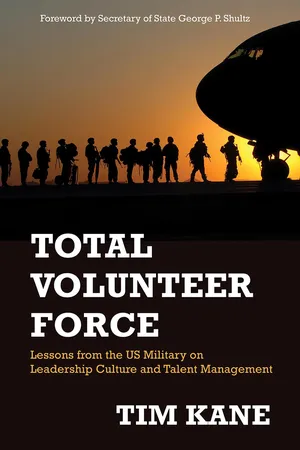
Total Volunteer Force
Lessons from the US Military on Leadership Culture and Talent Management
- 240 pages
- English
- ePUB (mobile friendly)
- Available on iOS & Android
eBook - ePub
Total Volunteer Force
Lessons from the US Military on Leadership Culture and Talent Management
About this book
Tim Kane analyzes the strengths and weaknesses of the US armed forces leadership culture and personnel management. He proposes a blueprint for reform that empowers troops as well as local commanders. Kane's proposals extend the All-Volunteer Force reforms of 1973 further along the spectrum of volunteerism, emphasize greater individual agency during all stages of a US military career, and restore diversity among the services. The Leader/Talent Matrix–an analytic framework Kane develops in the book–offers a multidimensional view of an organization's personnel practices. A survey of hundreds of veterans and active-duty troops reveals world-class strengths in the US armed forces leadership culture but a wide array of weaknesses in talent management. The Total Volunteer Force returns autonomy to the army, navy, air force, and Marine Corps. Kane offers an array of reforms to improve performance evaluations, create a talent market for job-matching, and revolutionize compensation to better reward merit and skill.
Information
CHAPTER ONE
Analyzing the Problem
How can the Army break up the institutional concrete, its bureaucratic rigidity in its assignments and promotion processes, in order to retain, challenge, and inspire its best, brightest, and most battle-tested young officers to lead the service in the future?
—SECRETARY OF DEFENSE ROBERT M. GATES’S SPEECH AT THE UNITED STATES MILITARY ACADEMY, WEST POINT, NEW YORK, FEBRUARY 25, 2011
What is wrong with the Pentagon’s personnel system? Perverse incentives in compensation and retirement have distorted the shape of the force—matching highly talented people with the wrong jobs, incessantly rotating employees up and sideways, and fostering a culture where employees feel obligated to express insincere preferences to stay on the career track to “get to twenty.” Neutered command authority over personnel decisions makes it difficult to match the right people with the right jobs, hurts readiness, and prevents toxic and predatory individuals from being weeded out of the ranks. Inflated performance evaluations are corrosive to fairness and integrity in the Army, Navy, and, especially, the Air Force.
During his farewell address to the cadets at West Point, Secretary of Defense Robert M. Gates identified the personnel system as his main worry for the future of the Army. Likewise, Secretary of Defense Ash Carter emphasized fixing personnel policies as vital to building “the force of the future” in his first speech in March 2015. Carter said, “We also have to look at ways to promote people, but not on just when they joined, but even more based on their performance and their talent. And we need to be on the cutting edge of evaluating performance.… We also need to use twenty-first-century technologies—like LinkedIn kinds of thing—to help develop twenty-first-century leaders and give our people even more flexibility and choice in deciding their next job—in the military.”6
Red Alert
One statistic above all else serves as a red alert that the military personnel system is dysfunctional: the unemployment rate of young veterans. It averaged nearly a third higher than nonveterans (10.7 percent compared to 8.0 percent) before the 2009 recession. After 2009, more than one in five veterans age eighteen to twenty-four could not find a job between 2009 and 2012, twice the jobless rate of nonveterans. The persistence of this employment gap has reinforced some misperceptions about the quality of troops, even among top policymakers.
The unemployment rate of veterans may seem irrelevant to the readiness of the active-duty force, but it is a profoundly relevant symptom of the real problem: the institutional inefficiency of central planning. In blunt terms, some of the nation’s most talented young men and women are on active duty but never empowered to take—and in fact are discouraged from taking—an active role in applying their unique skills to the military’s needs. Job-matching is centrally planned in all of the armed forces. Young veterans enter the private sector almost totally unprepared to search for a job because that activity—the engine that drives America’s free market economy—is anathema to the modern Pentagon bureaucracy. It wasn’t always this way.
Ben Bernanke, the former chairman of the Federal Reserve, remarked at a public event in August 2015, “If you go into the military at age eighteen—versus an identical person who stays in the private sector and takes a private sector job—ten years later, if you leave the military, your skills and wages are probably not going to be quite as high on average as the private sector person.” Bernanke chided the Pentagon for advertising that service in uniform adds beneficial skills: “The evidence appears to be that there really is not an advantage,” and further that the military “is really not adding much to the private sector through training or experience.” He mentioned academic research by MIT economists Joshua Angrist and Stacey Chen, but unfortunately, Bernanke misinterpreted their work. Angrist and Chen compare veterans to nonveterans from the late 1960s when soldiers were drafted. In fact, the authors conclude that “lifetime earnings consequences of conscription … have almost surely been negative.” The authors were expressly not analyzing the impact of military service, let alone service in the modern era, but focused exclusively on the negative impact of conscription nearly six decades ago.
So, Bernanke was wrong, but his belief was rooted in the “civ-mil” employment gap that still persists today.
In August 2015, the US Bureau of Labor Statistics (BLS) issued a major report titled Employment Situation of Veterans.7 That month, the national civilian unemployment rate was 5.1 percent. For all 21.2 million veterans, the average rate of unemployment was lower, but for the 3.2 million recent veterans who served during the post-9/11 era, unemployment was higher than the civilian norm. Individuals in this cohort are described as “Gulf War II era” veterans (including all who served after 9/11 as their most recent period of service).
Those who served in Iraq or Afghanistan had lower unemployment rates than other veteran peers, 4.1 and 4.0 percent, respectively. Surprisingly, veterans who had served tours of duty in both Iraq and Afghanistan had the lowest unemployment rate of all, 2.9 percent.8 This suggests that combat experience involves skills that do transition well to civilian jobs. It seems that discipline, courage, teamwork, and other soft skills are highly valued and valuable in civilian occupations.
Another sign of the positive impact of military service comes from a recent study by the Department of Veterans Affairs, which found that “post-9/11 veterans attain 11 percent higher median earnings than non-veterans with similar demographic characteristics,” an advantage that was even higher for female veterans.9
| TABLE 1.1. | ||||||
| Unemployment Rates of Male US Citizens, by Age and Service (2015 annual averages) | ||||||
| | | Nonveterans | All Veterans | Gulf War II–Era Veterans | ||
| Total, 18 years and over | 5.3 | 4.5 | 5.7 | |||
| 18 to 24 years | 12.0 | 13.6 | 13.6 | |||
| 25 to 34 years | 5.4 | 6.9 | 6.8 | |||
| 35 to 44 years | 4.0 | 3.8 | 3.8 | |||
| 45 to 54 years | 3.7 | 3.4 | 2.6 | |||
| 55 to 64 years | 3.8 | 4.7 | 4.3 | |||
| 65 years and over | 3.6 | 4.0 | - | |||
| Source: US Bureau of Labor Statistics | ||||||
General comparisons of veterans to civilians can easily be skewed by the heavy gender and age differences among those two populations. A closer look at demographically similar cohorts offers an insight into where the problem lies. Note in table 1.1 that younger male veterans have unemployment rates one and a half points higher than male nonveterans...
Table of contents
- Contents
- Foreword
- Acknowledgments
- Introduction
- Chapter One. Analyzing the Problem
- Chapter Two. Background
- Chapter Three. Total Volunteer Force Reforms
- Chapter Four. Reforming Evaluations
- Chapter Five. Reforming Promotions and Assignments
- Chapter Six. Reforming Compensation
- Appendix. Leader/Talent Categories and Elements
- Bibliography
- Endnotes
- Index
- About the Author
Trusted by 375,005 students
Access to over 1.5 million titles for a fair monthly price.
Study more efficiently using our study tools.
Frequently asked questions
Yes, you can cancel anytime from the Subscription tab in your account settings on the Perlego website. Your subscription will stay active until the end of your current billing period. Learn how to cancel your subscription
No, books cannot be downloaded as external files, such as PDFs, for use outside of Perlego. However, you can download books within the Perlego app for offline reading on mobile or tablet. Learn how to download books offline
Perlego offers two plans: Essential and Complete
- Essential is ideal for learners and professionals who enjoy exploring a wide range of subjects. Access the Essential Library with 800,000+ trusted titles and best-sellers across business, personal growth, and the humanities. Includes unlimited reading time and Standard Read Aloud voice.
- Complete: Perfect for advanced learners and researchers needing full, unrestricted access. Unlock 1.5M+ books across hundreds of subjects, including academic and specialized titles. The Complete Plan also includes advanced features like Premium Read Aloud and Research Assistant.
We are an online textbook subscription service, where you can get access to an entire online library for less than the price of a single book per month. With over 1.5 million books across 990+ topics, we’ve got you covered! Learn about our mission
Look out for the read-aloud symbol on your next book to see if you can listen to it. The read-aloud tool reads text aloud for you, highlighting the text as it is being read. You can pause it, speed it up and slow it down. Learn more about Read Aloud
Yes! You can use the Perlego app on both iOS and Android devices to read anytime, anywhere — even offline. Perfect for commutes or when you’re on the go.
Please note we cannot support devices running on iOS 13 and Android 7 or earlier. Learn more about using the app
Please note we cannot support devices running on iOS 13 and Android 7 or earlier. Learn more about using the app
Yes, you can access Total Volunteer Force by Tim Kane in PDF and/or ePUB format, as well as other popular books in Politics & International Relations & Human Resource Management. We have over 1.5 million books available in our catalogue for you to explore.