J. T. Headley was born at the very end of the convulsive period of the French revolution and Napoleonic Wars that followed, and wrote a number of volumes on the French army and its leadership of the period. An admirer of the equality and liberty that Napoleon and the Napoleonic Myth expounded, Headley takes an interesting and entertaining view of Napoleon and his Marshals. The glittering array of military talent available to Napoleon, was formed by the upsurge in manpower revolutionary levée en masse and the egalitarian principals. Whilst not an absolute meritocracy, a great number of Generals and indeed Marshals came from humble backgrounds.
In this volume, the author charts the careers of
Napoleon, Marshals Murat, Lefebvre, Massena, Marmont, Victor, Brune, Oudinot, Bessières, Jourdan, Bernadotte, Suchet, Poniatowski, Grouchy and Ney
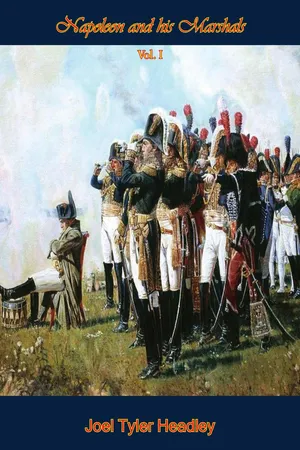
- 223 pages
- English
- ePUB (mobile friendly)
- Available on iOS & Android
eBook - ePub
Napoleon and his Marshals - Vol I
About this book
Information
Subtopic
British HistoryIndex
HistoryChapter I—NAPOLEON BONAPARTE
A Defence of Him against English Historians—Analysis of his Character—Causes of his Success—His Death.
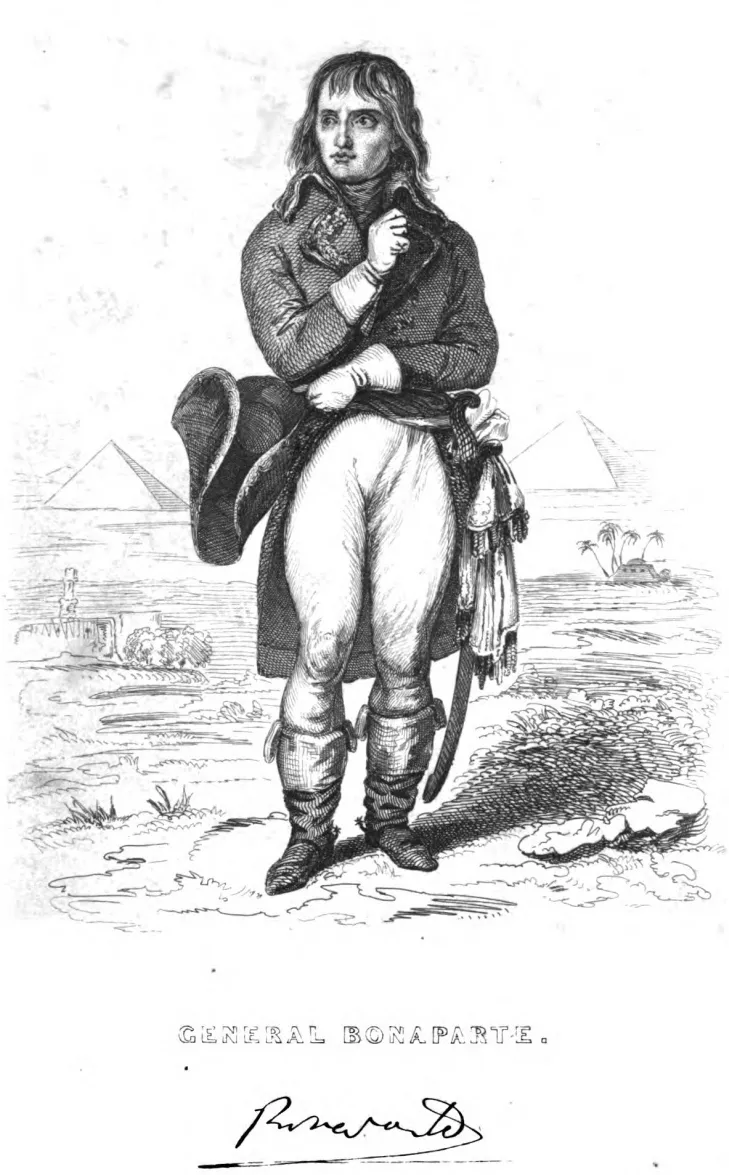
PERHAPS there is no greater example of the control English literature and English criticism exert over public opinion in this country, than the views they have impressed upon it respecting Bonaparte. With Wordsworth, Southey and Byron in poetry, and Scott, and Alison, and the English Reviews, in prose, all making him a monster in cruelty and selfishness even though he might be an angel in genius; we have, without scruple, adopted the same sentiments, and get him down as a scourge of his race.
The few American writers that have ever attempted to give an analysis of his character, and a fair criticism on his actions, have failed, by judging him as if he had grown up on the Puritan soil of New England, instead of amid the chaos and anarchy of France, and the exciting sounds of war as Europe moved to battle. Their criticisms have in reality usually been mere essays on the horrors of war, in which Bonaparte figures as the chief illustration. There is no recognition of the peculiar trials that surrounded him, of the genius that mastered them, of the temptations to which he was exposed, and the necessity that frequently compelled him to courses that warred with his wishes.
English historians make no scruple of belying him; and while some of our American writers, by placing on him the guilt of those desolating wars that loaded Europe with the dead, have done him gross injustice;—they have also committed an unpardonable error in history. That English historians should attempt to cover their most successful enemy with unmerited guilt, especially when it is necessary to do so, in order to screen their own nation against the accusations which France lays at her door, is to be expected. Still Scott has done himself more injury in his Life of Napoleon than he has the great man he slandered; and Mr. Mitchell, who has lately written three volumes to convince men that Napoleon was a fool, has succeeded only in proving himself one. Mr. Alison is almost the only one who has at all comprehended his true character; but, while he is forced to bear noble testimony to his genius, he is afraid of offending the prejudices and vanity of his countrymen, and so attempts, as an offset to his praise, to prove him destitute of conscience, and capable of great meannesses. To do this he not only falsifies history, but drags forth, with the most ludicrous gravity, all the petulant speeches he ever made in sudden ebullitions of passion, or in the first chagrin of disappointment. The unjust and passionate remarks a man of Napoleon’s temperament, however noble his character, will always make in moments of irritation, are arrayed against his greatest acts with studied exaggeration, and declared sufficient to neutralize them all. This is like going into a man’s bed-chamber to report his unguarded speeches, or make a peevish remark to a servant in a moment of irritability offset the noblest acts of his life.
Napoleon Bonaparte, whether we think of his amazing genius—his unparalleled power of embracing vast combinations, while he lost sight of none of the details necessary to insure success—his rapidity of thought, and equally sudden execution—his tireless energy—his ceaseless activity—his ability to direct the movements of half a million of soldiers in different parts of the world, and at the same time reform the laws—restore the finances—and administer the government of his country;—or whether we trace his dazzling career from the time he was a poor proud charity boy at the Military School of Brienne, to the hour when he sat down on the most brilliant throne of Europe, he is the same wonderful man—the same grand theme for human contemplation.
But before entering on his character, it is necessary that whatever unjust prejudices we entertain should be removed, and our errors in history corrected. The first great barrier in the way of rendering him justice is the conviction everywhere entertained, that he alone, or chiefly, is chargeable with those desolating wars that covered the Continent with slain armies. His mounting ambition is placed at the foundation of them all, and no greatness of mind can of course compensate for the guilt of such wholesale murder.
It is impossible for one who has not traveled amid the monarchies of Europe, and witnessed their nervous fear of republican principles, and their fixed determination at whatever sacrifice of justice, human rights, and human life, to maintain their oppressive forms of government, to appreciate at all the position of France at the time of the revolution. The balance of political power had been the great object of anxiety, and all the watchfulness directed against the encroachment of one state on another; and no one can imagine the utter consternation with which Europe saw a mighty republic rise in her midst. The balance of power was forgotten in the anxiety for self-preservation. The sound of the falling throne of the Bourbons rolled like a sudden earthquake under the iron and century-bound framework of despotism, till everything heaved and rocked on its ancient foundations. Our Declaration of Independence, the everlasting and immutable principles of human rights, were uttered in the ears of the astonished world, and unless that voice could be hushed, that alarming movement checked, every monarchy of Europe would soon have a revolution of its own to struggle with. That the Revolution of France is justifiable, if a revolution is ever so, no one acquainted with the history of that time can for a moment doubt. The violence that marked its progress shows only, as Macaulay says, the greater need of it. At all events, France confused, chaotic, bleeding, and affrighted, stood up and declared herself, in the face of the world, a republic. She made no encroachments on other states, sought no war, for she needed all her strength and energy to save herself from internal foes. But the power of Europe determined to crush her at once before she had acquired strength and consistency. First, Austria and Prussia took up arms, with the avowed purpose of aiding Louis. After his death, Holland, Spain, and England came into the alliance, and moved down on that bewildered republic. Here was the commencement and origin of all the after-wars that devastated Europe. Not on France, but on the allied powers, rests the guilt of setting in motion that terrible train of evils which they would fain transfer to other shoulders. It was a war of principle and a war of aggression. It was despotism invading liberty—oppression summoning human rights to lay down its arms, and because it would not, banding the world together to crush the republic that nourished them. Bonaparte was yet a boy when this infamous war was strewing the banks of the Rhine with slain armies.
After struggling bravely for years for self-defence France at length found her saviour in the young Corsican. Quelling the revolt of the sections in Paris, he was appointed to the command of the Army of Italy. He found it badly provisioned, worse paid, ragged and murmuring, yet, by his energy, skill, and, more than all, by his example, restored order and confidence; and, though numbering less than forty thousand men, replenished, as it wasted away, by slender reinforcements, he with it attached and cut to pieces several armies, the most magnificent Austria could furnish, finishing one of the most brilliant campaigns the world has ever witnessed, amid the tumultuous joy of the French. The next year he subjugated Lombardy, and forced the Austrian plenipotentiary, by his daring threats, to sign the treaty of Campo Formio, which was most favorable to the French Republic. In the bloody battles of Millesimo, Montenotte, Lodi, Arcola, and Castiglione, and Rivoli, he certainly acted as became a general fighting under the orders of his government, carrying on a defensive war with a boldness, skill, and success, considering the superiority of the force opposed to him, deserving of the highest praise. Returning to Paris in triumph, hailed everywhere as the saviour of France, he notwithstanding became tired of his inactive life, and still more weary of the miserable Directory to whose folly he was compelled to submit, and proposed the expedition to Egypt. This furnishes another charge against Bonaparte, and this war is denounced as aggressive and cruel, growing out of a mad ambition. That it was unjust, no one can deny; but instead of being a thing worthy of censure by the cabinets of Europe, it was simply carrying out their own systems of policy. His designs on the East were just such as England had for years been prosecuting. The East was always to Bonaparte the scene of great enterprises, and Egypt furnished a basis to his operations, and at the same time would serve as a check to English encroachment in the Indies.
While Russia, Austria, and Prussia were stripping Poland, and England was extending her conquests in the Indies—cumbering its burning plains with tens of thousands of its own children, and carrying out the most iniquitous system of oppression toward Ireland ever tolerated by a civilized people—it does seem ludicrous to hear her historians complimenting the Deity on his even-handed justice, in finally arresting the cruel ambition of Bonaparte and of France.
While the expedition to Egypt was experiencing the vicissitudes that characterized it, Austria, seeing that France had got the lion’s share in Italy, joined with Naples, and again commenced hostilities. The French were driven back across the Apennines, and all the advantages gained there over Austria were being lost, when Bonaparte returned in haste from Egypt—overthrew the imbecile Directory—was proclaimed First Consul—and immediately set about the restoration of France. The consolidation of the government—the restoration of the disordered finances—the pacification of La Vendée—the formation and adoption of a constitution, engrossed his mind, and he most ardently desired peace. He, therefore, the moment he was elected First Consul, wrote with his own hands two letters, one to the King of England, and the other to the Emperor of Germany; hoping by this frank and friendly course to appease the two governments, and bring about a general peace. He had acquired sufficient glory as a military leader, and he now wished to resuscitate France, and become great as a civil ruler. In his letter to England, he uses the following language: “Must the war, Sire, which for the last eight years has devastated the four quarters of the world, be eternal? Are there no means of coming to an understanding? How can two of the most enlightened nations of Europe, stronger already and more powerful than their safety or their independence requires, sacrifice to ideas of vain-glory the well-being of commerce, internal prosperity, and the peace of families? How is it they do not feel peace to be the first of necessities as the first of glories?” Similar noble, frank, and manly sentiments, he addressed to the Emperor of Germany. There were no accusations in these letters, no recriminations, and no demands. They asked simply for negotiations to commence, for the spirit of peace to be exhibited, leaving it to after-efforts to settle the terms. Austria was inclined to listen to this appeal from the First Consul, and replied courteously to his letter. But she was trammeled by her alliance with England, and refused to enter into negotiations in which the British Empire was not represented. Pitt, on the contrary, returned an insulting letter to the French Minister—heaped every accusation on Bonaparte—recapitulated individual acts of violence, and laid them at the door of the French Republic and charged it with designing to overthrow both religion and monarchy throughout the Continent. He declared that the English government must see some fruits of repentance and amendment, before it could trust the proffers of peace; and that the restoration of the Bourbon throne was the only guarantee she should deem sufficient of the good behavior of the French government. Bonaparte, in reply, fixed the first aggressive acts clearly on the enemies of France, and then asked what was the use of these irritating reminiscences—if the war was to be eternal, because one or the other party had been the aggressor; and then adverting to the proposal that the Bourbons should be restored, asked, “What would be thought of France, if in her propositions she insisted on the restoration of the dethroned Stuarts, before she would make peace?” This home-thrust disconcerted the English Minister; and in reply he frankly acknowledged that his government did not wage war for the re-establishment of the Bourbon throne, but for the security of all governments, and that she would listen to no terms of peace until this security was obtained. This settled the question. England would have no peace while France continued to be a republic. Bonaparte had foreseen all this, and finding he could not separate Austria from her English alliance, immediately set on foot immense preparations for war. Moreau was sent with a magnificent army into Swabia, to drive back the Austrians toward their capital; Masséna was appointed over the miserably provided Army of Italy, while he himself fell from the heights of San Bernard, on the plains of Lombardy.
At the fierce-fought battle of Marengo, he reconquered Italy, while Moreau chased the vanquished Austrians over the Danube. Victory everywhere perched on the French standards, and Austria was ready to agree to an armistice, in order to recover from the disasters she had suffered. The slain at Montebello, around Genoa, on the plains of Marengo, in the Black Forest, and along the Danube, are to be charged over to the British government, which refused peace in order to fight for the philanthropic purpose of giving security to governments.
Austria, though crippled, lets the armistice wear away, refusing to make a treaty because she is bound for seven months longer to England. Bonaparte, in the meantime, is preparing to recommence hostilities. Finding himself unable to conclude a peace, he opened the campaign of Hohenlinden, and sent Macdonald across the Splugen. Moreau’s victorious march through Austria, and the success of the operations in Italy, soon brings Austria to terms, and the celebrated peace of Lunéville, of 1801, is signed.
The energy and ability, and above all the success, of the First Consul, had now forced the continental powers to regard him with respect, and in some cases with sympathy; while England, by her imperious demands, had embroiled herself with all the northern powers of Europe.
But this universal and wasting war began at length to be tiresome to all parties, and, after much negotiation and delay, a general peace was concluded at Amiens, and the world was at rest. Universal joy was spread through France and England, and the transports of the people knew no bounds.
Peace, which Bonaparte needed and wished for, being restored, he applied his vast energies to the development of the resources of France, and to the building of stupendous public works. Commerce was revived—the laws administered with energy—order restored, and the blessings of peace were fast healing up the wounds of war. Men were amazed at the untiring energy and the amazing plans of Bonaparte. His genius gave a new birth to the nation—developed new elements of strength, and imparted all impulse to her growth that threatened to outstrip the greatness of England. His ambition was to obtain colonial possessions, like those of England; and if allowed to direct his vast energies in that direction, there was no doubt France would soon rival the British Empire in its provinces. England was at first fearful of the influence of the French Republic, but now a new cause of alarm seized her. It was evident that France was fast tending toward a monarchy. Bonaparte had been made First Consul for life, with the power to appoint his successor; and it required no seer to predict that his gigantic mind and dictatorial spirit would not long brook any check from inferior authority. From the very superiority of his intellect, he must merge everything into his majestic plans, and gradually acquire more and more control, till the placing of a crown on his head would be only the symbol of that supreme power which had long before passed into his hands. England, therefore, had no longer to fear the influence of a Republic, and hence fight for the security of government in general. She had, however, another cause of anxiety—the too rapid growth of her ancient rival. She became alarmed at the strides with which France advanced under the guiding genius of Napoleon, and refused to carry out the terms of the solemn treaty she had herself signed. In that treaty it was expressly stipulated that England should evacuate Egypt and Malta; while France, on her part, was to evacuate Naples, Tarento, and the Roman States. His part of the treaty, Napoleon had fulfilled within two months after its completion; but ten months had now elapsed, and the English were still in Alexandria and Malta. But Napoleon, anxious to preserve peace, did not see fit to urge matters, and made no complaint till it was suddenly announced that the English government had proclaimed her determination not to fulfill the stipulations she had herself made. The only pretext offered for this violation of a solemn contract was her suspicions that France had designs on these places. The truth was, England—with her accustomed jealousy of other nations acquiring colonial possessions, and remembering what a struggle it had just cost her to wrest Egypt and Malta from France—resolved, though in violation of her own treaty, not to give them up. Talleyrand was perfectly amazed at this decision of the British ministry, while Napoleon was thrown into a transport of rage. His keen penetration discerned at a glance the policy of England, and the dreadful conflict that must ensue. He saw that she was resolved to resist the advancement of France, and to band, while she could, the powers of Europe against her. He knew that if she would remain at peace, he could by force of arms, and diplomatic skill, compel Russia, Austria, Prussia, and Spain to let him alone to carry out his plans for the aggrandizement of France. But with England constantly counteracting him, and throwing firebrands in the cabinets of the continent, he would be engaged in perpetual conflicts and wranglings. It had, therefore, come to this: England must be chastised into quietness and respect for treaties, or there was to be continual war till France should yield to the strength of superior numbers. England knew that in a protracted war France must fall: for her very victories would in the end melt away her armies, before the endless thousands all Europe could pour upon her; and this she determined to accomplish. But war at this time was the last thing Napoleon wished—it interfered with his plans, and cut short his vast projects. Besides, he had won all the military renown he wished in fighting with the rotten monarchies that surrounded him, and his genius sought a wider field in which to display itself. It was, therefore, with the greatest reluctance he would entertain the idea of a rupture. He sent for Lord Whitworth, the English minister at Paris, and had a long personal conversation with him. He recapitulated the constant and unprovoked aggressions of his government on France, ever since the Revolution—spoke of his ardent wish to live on terms of amity—“But,” said he, “Malta must be evacuated: for although it is of no great value in a maritime point of view, it is of immense importance as connected with a sacred treaty and with the honour of France.” “For,” he continued, “what would the world say, if we should allow a solemn treaty to be violated?” He asked the nation to act frankly and honestly toward him, and he would act equally so toward it. “If you doubt my sincerity,” said he, “look at the power and renown to which I have attained. Do you suppose I wish to hazard it all in a desperate conflict?” The English government then endeavored to negotiate with him to let it retain Malta. “The treaty of Amiens,” he replied, “and nothing but the treaty!” Placed in this dilemma, England was compelled to do two things at once: first, violate a treaty of her own making; and second, to take upon herself, in doing it, the responsibility of convulsing Europe, and bringing back all the horrors of the war that had just closed. Napoleon was right, and England was wrong, totally wrong; and if the violation of a solemn treaty is a just cause for war, then is he justifiable. From the objects of peace which had filled his mind, Bonaparte immediately strung his vast energies for the fearful encounter that was approaching. Hostilities commenced, and Napoleon resolved at once to invade England, and strike a deadly blow at the head of his perfidious enemy, or perish in the attempt. He collected an enormous flotilla at Boulogne; and the French coast, that looks toward the English isle, was alive with armies and boats, and rang with the artisan’s hammer and the roar of cannon. Nothing but unforeseen circumstances prevented his carrying out this project, which would have shaken the British throne to its foundations.
England drew Russia first into this new alliance, the basis of which was, first, to reduce France to her limits before the Revolution; and second, to secure the peace and stability of the European states. Look for a moment at this perfidious policy—this mockery of virtue—this philanthropic villainy. Russia, sundered so far from France, was in peaceable possession of all her territory—bad not a right to maintain, nor a wrong to redress. England, on the other hand, had no province to wrest back from the enemy—no violated treaty to defend—no encroachment to resist. Their removal from the theater of war rendered them secure; and whose peace and stability were they to maintain? They anticipated no danger to themselves. Italy preferred the French domination to the Austrian, for it gave greater liberty and prosperity. Austria did not ask to be propped up, for she had had enough of those alliances which made her own plains the field of combat; and it was with the greatest difficulty she could be brought into the confederacy, and not till her possessions in Italy, which she had ceded to France, were offered as a bribe for her co-operation. Prussia resolutely refused to enter the alliance, and at length sided with France. Russia, Austria, England, and Sweden finally coalesced, and convulsed Europ...
Table of contents
- Title page
- TABLE OF CONTENTS
- Preface
- Chapter I-NAPOLEON BONAPARTE
- Chapter II-MARSHAL BERTHIER
- Chapter III-MARSHAL AUGEREAU
- Chapter IV-MARSHAL DAVOUT
- Chapter V-MARSHAL ST. CYR
- Chapter VI-MARSHAL LANNES
- Chapter VII-MARSHAL MONCEY
- Chapter VIII-MARSHAL MACDONALD
- Chapter IX-MARSHAL MORTIER
- Chapter X -MARSHAL SOULT
Trusted by 375,005 students
Access to over 1.5 million titles for a fair monthly price.
Study more efficiently using our study tools.
Frequently asked questions
Yes, you can cancel anytime from the Subscription tab in your account settings on the Perlego website. Your subscription will stay active until the end of your current billing period. Learn how to cancel your subscription
No, books cannot be downloaded as external files, such as PDFs, for use outside of Perlego. However, you can download books within the Perlego app for offline reading on mobile or tablet. Learn how to download books offline
We are an online textbook subscription service, where you can get access to an entire online library for less than the price of a single book per month. With over 1.5 million books across 990+ topics, we’ve got you covered! Learn about our mission
Look out for the read-aloud symbol on your next book to see if you can listen to it. The read-aloud tool reads text aloud for you, highlighting the text as it is being read. You can pause it, speed it up and slow it down. Learn more about Read Aloud
Yes! You can use the Perlego app on both iOS and Android devices to read anytime, anywhere — even offline. Perfect for commutes or when you’re on the go.
Please note we cannot support devices running on iOS 13 and Android 7 or earlier. Learn more about using the app
Please note we cannot support devices running on iOS 13 and Android 7 or earlier. Learn more about using the app
Yes, you can access Napoleon and his Marshals - Vol I by Joel Tyler Headley in PDF and/or ePUB format, as well as other popular books in History & British History. We have over 1.5 million books available in our catalogue for you to explore.