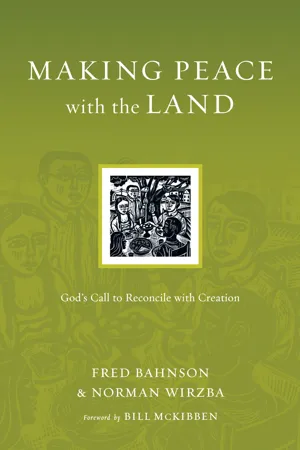
God is reconciling all things in heaven and on earth.We are alienated not only from one another, but also from the land that sustains us. Our ecosystems are increasingly damaged, and human bodies are likewise degraded. Most of us have little understanding of how our energy is derived or our food is produced, and many of our current industrialized practices are both unhealthy for our bodies and unsustainable for the planet.Agriculturalist Fred Bahnson and theologian Norman Wirzba declare thatin Christ, God reconciles all bodies into a peaceful, life-promoting relationship with one another. Because human beings are incarnated in material, bodily existence, we are necessarily interdependent with plants and animals, land and sea, heaven andearth. The good news is that redemption is cosmic, with implications for agriculture and ecology, from farm to dinner table.Bahnson and Wirzba describe communities that model cooperative practices of relational life, with local food production, eucharistic eating and delight in God's provision.Reconciling with the land is a rich framework for a new way of life. Read this book to start down the path to restoring shalom and experiencing Jesus' kingdom of shared abundance, where neighbors are fedand all receive enough.
In the fall of 1986, I left the foothills and plains of southern Alberta to begin a master’s degree at Yale Divinity School. On my way, I traveled through Gary, Indiana. Nothing prepared me for what I experienced there: thick gray air, an unbelievably foul smell, a greenish-orange cloud in place of the horizon and smokestacks belching putrid poison into the sky.
I couldn’t believe people lived there. I saw a few men fishing in lagoons of brackish, foamy water. What sort of fish could possibly be living in this sludge? I wondered if they ate what they caught. What kind of health issues did these men and their families face, surrounded as they were by toxic water, land and air? Knowing it was a futile gesture, I opened my window and yelled to the world outside.
It took me a long time to absorb what I saw. I’m still absorbing it. The air that I knew as a farm boy in southern Alberta was crisp and clear and even fragrant, often carrying the scent of sweet grass. The Rocky Mountain snowpacks an hour to my west provided clean, fresh water. And the deep brown soil smelled of fertility. The contrast with Gary was jarring.
I know it is dangerous to put too much stock in childhood memories. Was I being naive in remembering only the good and pleasant parts? As children, we don’t have the complicated understanding we gradually acquire as adults, and I now recognize that plenty of problems were associated with the industrial agriculture and resource development taking hold in Alberta. Still, as I drove through Gary, I knew with the certainty of my nose and eyes that something was deeply wrong with the way this section of the Great Lakes region, with its plant and animal and human inhabitants, was being treated.
When I arrived at Yale, I discovered that almost no one was talking in theological terms about our capacity to destroy the land. The stench and death that Gary exhibited hardly appeared as a theological concern or problem. Although almost everyone I met professed belief in God as the Creator—indeed, this may be one teaching that most people professing belief in God can agree on!—it seemed that creation itself was of little concern. Surely it is a contradiction to profess belief in the Creator while showing disregard or disdain for the works of the Creator’s hands.
The Wide Scope of God’s Reconciling Concerns
Today’s church suffers from a reconciliation deficit disorder. The cause of this disorder is an impoverished imagination. As Christians, we have a hard time imagining that God desires all creatures—human and nonhuman, living and nonliving—to be reconciled with each other and with God. For a variety of reasons, we have come to think that God cares primarily, perhaps only, about us.
The history of the church shows that Christians have frequently curtailed the scope of what and whom God cares about. Are we to include everyone—all men and women and children, all races and ethnic groups, all social and economic classes—within the group that God chooses to love and save? Should we think of God’s salvific purposes as including bodies, communities and the land? Maybe God cares only about individual souls (white, male, American, heterosexual, economically successful) making their way to heaven.
Clarence Jordan, founder of Koinonia Farm in Americus, Georgia, said that as a child of the Jim Crow South he sang, “Jesus loves the little children, all the children of the world. Red and yellow, black and white, they are precious in his sight. Jesus loves the little children of the world.” He sang this, Jordan recalled as an adult, while watching the poor, hungry black children of his town be mistreated by the members of his congregation. Could it be that God had favorite children, or was it that we were picking favorites? Jordan was seeing the propensity of humans to limit the scope of God’s love. Depending on your class, race and even gender, you were either in the group God really cared about or out of it. As Jordan later turned the wasted and abused red clay of southwest Georgia into a productive farm and forest, he must have wondered if we as a species had also come to limit God’s love only to humanity, thus forgetting God’s love for the whole creation.
As members of the early church thought about the significance of Christ’s life and ministry, they came to an astounding affirmation of the cosmic, all-inclusive scope of God’s love. The long arc of God’s redemptive purposes is not confined to individual, disembodied souls, let alone souls of a particular gender or race or ethnicity or class. Referring to Jesus, they sang in one of their earliest hymns that “all things in heaven and on earth,” “things visible and invisible,” were created in him, through him and for him (Col 1:16). Jesus is the one in whom “all things hold together” (Col 1:17). And it is through this particular man that “God was pleased to reconcile to himself all things, whether on earth or in heaven, by making peace through the blood of his cross” (Col 1:20). Clearly, this hymn declares that “all things” have a place in God’s reconciling and redeeming life. All places—from the foothills of southern Alberta to industrial centers like Gary, Indiana—are destined to know the health and salvation of God.
This way of thinking should startle us. Here we are presented with a vision in which nothing escapes God’s love and attention. Why? Because God created everything. As created by God, the creation is all good and beautiful and of the highest value. But what could it possibly mean to say that a person who lived within the created order—Jesus—is also the one through whom and for whom all creatures came to be? Why should we think that the great diversity of creation holds together in him? And what are the implications of believing that Christ’s cross makes possible the peace and reconciliation of all creatures?
Clearly, Jesus is no ordinary person. What Christ accomplishes exceeds the expectations and imaginations of most people. Indeed, part of the good news of the gospel is the fact that we cannot limit God’s love. Good news has been proclaimed “to every creature under heaven,” which means that the gospel is also intended for every creature and will have its appropriate, divinely desired effect (Col 1:23). What would it look like, practically speaking, to proclaim the gospel to rivers, redwoods, raccoons and roaches? Is our presence on earth good news for all the creatures with which we live?
One of the more striking aspects of this early Christian hymn is its affirmation of material, fleshly life. Here Christ is not reduced to a moral or spiritual teacher who comes down to earth to deliver a few special teachings that will get some of us to heaven. God’s life with us, his dwelling with us, does not happen as an immaterial soul-to-soul or mind-to-mind connection. It is body to body, flesh to flesh. What God accomplishes in Christ he accomplishes through blood, the medium of bodily life. God reconciles all the bodies of this world in and by Jesus’ “fleshly body through death” (Col 1:22).
What these passages mean, and what practical transformations they entail, we have yet to see. For now, we can determine that this way of speaking sets a baseline for our thinking about the nature of God’s reconciliation through Christ: Christian reconciliation is about bringing all bodies into a peaceful, life-promoting and convivial relationship with each other. It makes no sense to limit reconciliation to people, let alone individual souls, since we thrive only insofar as we are nurtured, warmed, inspired and protected by the countless bodies of creation that daily touch or circulate through us. The reconciliation of only human souls with each other, however commendable and beautiful, would be an impoverished reconciliation if such souls were consigned to bodies that must eat, drink and breathe their way through a poisoned and degraded creation. Such an incomplete reconciliation would amount to a repudiation of the created earth God loves and daily sustains. It would be a denial of the resurrection power that will bring our bodies into the new heaven and new earth to live with God forever (see Rev 21).
We can spend a lot of time debating whether or not Paul and the early Christians really believed worms, plants and bees to be included in God’s salvation of the world. In certain respects, the debate is beside the point. Unless we believe that God cares only about disembodied souls—a position consistently condemned by the church as heretical—then it is all of creation or none of it that God will save. Human life simply makes no sense apart from the life of all creation. We live only because the worms, plants and bees do too. And they live because God loves them.
Resisting the Socratic Urge
The allure of Socrates is responsible for the difficulty that many Christians have with the idea that God is reconciling all things in heaven and on earth. Although they may have never read a Socratic dialogue, many people are tempted to follow his teaching about the fate of bodies, which suggests that bodies have no eternal value because they are subject to disease, decay and death, and the source of so much rivalry, disappointment and pain. Think about all the violence the world has known because of envy and lust. The best thing about bodies, in this perspective, is that we can leave them behind when we die. Bodies, in other words, have no place in our future, eternal life.
For Socrates, the main problem with bodies is their materiality. All things material are temporal, changeable and corruptible. Put simply, they are imperfect. That means we cannot count on them to endure or even behave as we want. We have to deal with the fact that the beauty and fitness and health of our bodies, though perhaps enabling a few temporary pleasures, are fleeting phenomena. Though we may be physically attractive to somebody for a time, the time will also come when our bodies will be ravaged by disease and age, thus likely becoming unattractive to others and to us. We will perhaps even come to hate our bodies, seeing in them little but frustration and limit and misery. Having been with medical staff who work with sick and aging patients and who see the disintegration of bodies and minds, I understand why they might say, “It will be a blessed day when this poor soul is freed from her wasting body and confused mind.”
This dualistic way of thinking, however, all but inevitably leads to placing our hope in the immortality of the soul. This teaching says that when we die, our souls separate from our bodies. If our souls have been properly prepared—for Socrates, this preparation entailed extensive philosophical training, but for Christians it might take the form of believing the right doctrines or doing the right things—they will then make their flight to a spiritual heaven where they will enjoy the bliss of a life no longer constrained or damaged by imperfect, unruly, disease-ridden and death-bound bodies.
Socratic thinking about bodies has been attractive to Christians for a long time. It is, however, a profoundly anti-Christian way of understanding the world. Why? Because it denies the goodness and beauty of the material world that God so deeply and forever loves. It denies the incarnation of God in the body of Jesus Christ. Thus it falls prey to one of the many gnostic heresies that have either disdained or denied or simply been suspicious of Christ’s fleshly life. It denies the Christian hope in the resurrection of the body. It denies John’s vision of the new heaven and the new earth in which God’s holy city descends to earth because “the home of God is among mortals” (Rev 21:3).
From the beginning, God’s nurture, love and joy have been revealed and made real in our bodies and in the material bodies of the world. Jesus’ body is of supreme, unalterable significance because its materiality—the fact that it could physically touch us and dwell with us—makes possible the healing and the liveliness of every body on earth. Jesus’ miracles are not, as modern deists suppose, an “interruption” of the laws governing a body’s life; rather, they are the body’s liberation into wholeness. From a Christian point of view, there can be no Socratic-like hatred of bodies. Rather than seeking an escape from our bodies, we must hope and invest in their healing, reconciliation and redemption.
Notice that a Christian view of the body does not take delight in bodies that are hungry, ill or wasting away. Much of Jesus’ ministry was devoted to the feeding, healing and touching of bodies. The Christian Scriptures show us that God’s created order is now in a state of pain and suffering. The effects of sin are everywhere visible to us. What the resurrection of Jesus teaches is that this state will not endure, because Christ has overcome sin and death. Christ calls his followers to take up his ministries of nurturing, feeding and healing. In so doing, we bear witness to the God who has never stopped loving the world.
The resurrection of reconciled bodies: this is the gospel’s good news. Without it, we and the whole world are lost. Without it, we may grow to despise the creation. The apostle Paul put the matter bluntly: “If there is no resurrection of the dead, then Christ has not been raised; and if Christ has not been raised, then our proclamation has been in vain and your faith has been in vain. We are even found to be misrepresenting God, because we testified of God that he raised Christ” (1 Cor 15:13-15). If Christians believed in the immortality of the soul and the wretchedness of human bodies, the tomb on Easter morning would not have been empty—because Jesus’ body would have remained and only his soul ascended.
Paul knew what was at stake in teaching the resurrection of the body. From his experience at the Athenian Areopagus, he knew that such a radical affirmation of embodiment would provoke the doubt and ridicule of many (see Acts 17:32). To affirm it requires an entirely new way of thinking about God, the inestimable value of the material world and the meaning of life.
Forsaking the Bodies of the World
The Socratic urge to despise bodies is not the only impediment to understanding God’s reconciliation with the whole material world. Another source of our difficulty is that we suffer from ecological amnesia. This condition is a fairly recent development in the history of humanity. It is a form of amnesia that, while having a philosophical expression, takes root because of the ways we live in the world. Its most basic cause is the practical separation of people from the land. This separation takes two forms: physical (a matter of location) and existential (a matter of how we relate to others).
First, many of us are physically separated from the land. More people now live in cities than live on farms. This has never before been the case. Just two generations ago, most people worked on the land, drew their livelihood from it and understood with the certainty of their stomachs that human life is inextricably intertwined with the health of fields, plants, forests and animals. If people were not themselves farmers, they most likely knew or were related to many people who were.
Cities have existed for a very long time, of course, but today’s cities are historically unique because of their large size, which tends to insulate inhabitants from agricultural and ecological realities. This means that the people living in them may have no understanding or appreciation for the ecological contexts and responsibilities that make their living possible. Today’s forms of urban and suburban life make it likely that people will not appreciate where their food and energy come from and what processes have been used to make them available. They may not understand how easily ecological systems can come to ruin. This is problematic because what people do not see and understand they will less likely value and protect.
Ecologists now tell us that all the world’s ecosystems are in varying states of crisis. We are eroding our soils and then pounding them with herbicides and fertilizers. We are depleting and poisoning our groundwater. We are felling our forests and contributing to the growth of deserts. Meanwhile, the oceans are warming and becoming more acidic, coral reefs are bleaching and dying, plant and animal species are becoming extinct at a vastly accelerated rate, glaciers and permafrost are melting, and arctic and Antarctic ice sheets are simply disappearing. We did not come to this unprecedented state of affairs by people waking up each morning and plotting to destroy the earth. Instead, we have committed many small acts that we think will improve our standing in this world without realizing their disastrous ecological effects. We have bought into an economic system that depends on and becomes more successful by the destruction of the earth. All around the world there is an alarming inability to see—let alone correct—the effects of our consumer decisions.
For instance, nearly half of the electricity produced in America depends on the burning of coal. The cheapest and most efficient method for getting this coal is called mountaintop removal. Rather than sending miners down deep shafts so they can mine coal and send it to the surface, coal companies use explosives to remove layers of a mountain, thus exposing the coal seams to big equipment.
Think of these mountains as if they were very large, irregularly shaped pieces of lasagna. The coal resides in several layers, some in the middle and others near the bottom. You might attempt to drill holes from the top and then siphon the desired layers through these holes. This would take a long time, require considerable expense and is not without many dangers. Rather, why not remove the undesirable levels altogether so as to have more efficient access to the layers you want?
But the mountains are large. You can’t neatly remove one layer with the hope of putting it back. To remove each layer requires explosive force—force that forever destroys the vegetation and water tables and the animal and human lives that depend on a healthy ecological system. Although we might have a cheap source of coal as a result of this practice, and thus a cheaper source of electricity—this is usually the consumer’s overriding concern—we have forever destroyed an ecosystem to get it. Streams that once provided drinking water and fish are now destroyed and polluted with toxic metals. The forests, the birds and the wildlife are simply gone. Communities are ravaged by unemployment, poisoned water and respiratory illnesses. Heavy trucks hauling the coal degrade the roads. Explosions crack the foundations of homes, and everywhere is the depressing vision of mountain rubble. Promises made on behalf of the land’s “reclamation” rarely materialize or are successful.
Destruction of ecosystems did not start with mountaintop removal. What is important to understand, however, is that massive ecological destruction becomes more likely when people are not in a position to see the effects of their decisions. When the location of our increasingly insular and urban living shields us from the harmful effects of our consumer preferences, we are more likely to destroy what we clearly depend on: clean ...
Table of contents
Cover
Copyright
Contents
Series Preface
Foreword
Prologue
1 Reconciliation with the Land
2 Learning to See
3 Reconciliation Through Christ
4 Field, Table, Communion
5 Reconciliation Through Eating
6 Bread for the Whole Body of Christ
Epilogue
Acknowledgments
Recommendations for Further Reading
Study Guide
Notes
About the Duke Divinity School Center for Reconciliation
Other Books in This Series
About Resources for Reconciliation
About the Author
Endorsements
Trusted by 375,005 students
Access to over 1.5 million titles for a fair monthly price.
Study more efficiently using our study tools.
Frequently asked questions
Yes, you can cancel anytime from the Subscription tab in your account settings on the Perlego website. Your subscription will stay active until the end of your current billing period. Learn how to cancel your subscription
No, books cannot be downloaded as external files, such as PDFs, for use outside of Perlego. However, you can download books within the Perlego app for offline reading on mobile or tablet. Learn how to download books offline
Perlego offers two plans: Essential and Complete
Essential is ideal for learners and professionals who enjoy exploring a wide range of subjects. Access the Essential Library with 800,000+ trusted titles and best-sellers across business, personal growth, and the humanities. Includes unlimited reading time and Standard Read Aloud voice.
Complete: Perfect for advanced learners and researchers needing full, unrestricted access. Unlock 1.5M+ books across hundreds of subjects, including academic and specialized titles. The Complete Plan also includes advanced features like Premium Read Aloud and Research Assistant.
Both plans are available with monthly, semester, or annual billing cycles.
We are an online textbook subscription service, where you can get access to an entire online library for less than the price of a single book per month. With over 1.5 million books across 990+ topics, we’ve got you covered! Learn about our mission
Look out for the read-aloud symbol on your next book to see if you can listen to it. The read-aloud tool reads text aloud for you, highlighting the text as it is being read. You can pause it, speed it up and slow it down. Learn more about Read Aloud
Yes! You can use the Perlego app on both iOS and Android devices to read anytime, anywhere — even offline. Perfect for commutes or when you’re on the go. Please note we cannot support devices running on iOS 13 and Android 7 or earlier. Learn more about using the app
Yes, you can access Making Peace with the Land by Fred Bahnson,Norman Wirzba in PDF and/or ePUB format, as well as other popular books in Theology & Religion & Religion. We have over 1.5 million books available in our catalogue for you to explore.