Francisco Franco: The Times and the Man, is the English translation of Dr. Joaquin Arrara´s' biography of Francisco Franco Bahamonde, the Spanish general and politician who ruled over Spain as a military dictator from 1939, after the nationalist victory in the Spanish Civil War, until his death in 1975—a period commonly known as Francoist Spain in Spanish history.
Born in 1892 in El Ferrol, Spain, Franco was a career soldier who rose through the ranks until the mid-1930s. When the social and economic structure of Spain began to crumble, he joined the growing right-leaning rebel movement. He soon led an uprising against the leftist Republican government and took control of Spain following the bloody Spanish Civil War (1936-39) when, with the help of Nazi Germany and Fascist Italy, his Nationalist forces overthrew the democratically elected Second Republic. Franco then presided over a brutal military dictatorship, persecuting political opponents, repressing the culture and language of Spain's Basque and Catalan regions, and censuring the media. He died in Madrid in 1975, as Spain transitioned to a democracy.
"It is with Franco, then, that [Arrarás] is concerned, with his character, his early upbringing, his entrance into the army, his thrilling adventures, his dramatic military career that made him through merit alone a captain at the age of twenty and Europe's youngest general at thirty-two. We next find him, on his return home, commissioned to establish the Spanish West Point, immediately destroyed by the new government. Quickly after this there follow the world-stirring events that now are history.[…]
"Fortunately the author's work, in its transformation from Spanish into English, has lost none of its freshness and flavor. The velvet is still on the fruit. We have apparent here the same journalistic verve, the same vividness of narration, the same colorful descriptions and sharp-edged statement of facts…"
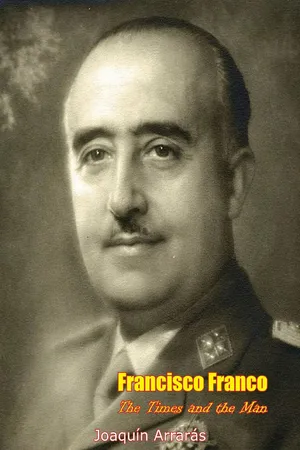
- 190 pages
- English
- ePUB (mobile friendly)
- Available on iOS & Android
eBook - ePub
About this book
Information
Subtopic
British HistoryIndex
HistoryCHAPTER I—El Ferrol: Franco’s Early Years
“THE port of El Ferrol has been known since ancient times as one of the best in the world, being made famous with the name ‘Port of the Sun.’” William Pitt, Prime Minister of England, summed up his impression of a visit to El Ferrol with the words, “If England had a port like this, she would plate it with an armor of silver.”
There is room in it for all the fleets of the world. A range of towering mountains guards it preciously, as an oyster its pearl. Its lake-smooth, placid waters extend inland for eleven miles, and from its shores are mirrored innumerable naval works and villages and summer homes, whitening the lovely and perennial verdure of its shores. They are tense, placid, and silken waters, like those of all Galician streams; waters that descended from the frozen Baltic, or that uprose, turbulent and boiling, from the Equator, and which come to rest among these towering peaks and isles to convalesce and dream of distant stars.
The Spanish government did not become aware of the real importance of El Ferrol until the eighteenth century, when the little fishing village was advanced to the rank of a Naval Base. This was in 1726. Its shores soon rang to the awakening of an industrial springtime. Docks, drydocks, shipyards, and fortresses appeared, and one after the other, in endless succession, warships, frigates, brigantines, careenage boats, and packet boats departing for the paths of war and adventure cleaved the crystal of its waters. In 1752, El Ferrol possessed the finest shipyards in the world, and provided employment for fifteen thousand workers. At one time twelve ships were built at the same time. They were dubbed by the populace with the name “The Twelve Apostles.” English technicians were hired by Jorge Juan, the famous navigator, for pay which at the time seemed fabulous: a guinea a day. Of seventy-nine warships that Spain possessed in 1793, thirty-seven were anchored at El Ferrol.
The city grew up around its bay, at once its life and its glory. The memory of that fishing village was a thing of the past. The fishermen were now sailors that fought on the seven seas, holding together the remnants of the Spanish Empire that now cracked and crumbled. More and more ships sallied forth, many never to return. Spain was fighting against the fleets of half the world. Pirate ships which coveted their cargoes of American gold, hunted them; tempests lashed them cruelly. El Ferrol continued to send forth her ships. The typhoons of the Far East and the seas of the Antilles, pirate frigates, Nelson’s cannon—these beckoned to them relentlessly. Rare was the day when El Ferrol was free of sorrow. For every disaster on the sea there was mourning in El Ferrol. But tradition reasserted itself with the strength of law. In the place of mariners who never came back there went forth sons or brothers.
Ill-treated by the rigors of the sea and war, El Ferrol stands out as an example of perseverance toward destiny. The sea brought it gifts and glory, just as from the sea came tragedy and ruin. For its exceptional location El Ferrol was coveted with that eagerness that draws men on to treasure. For centuries it was the greatest temptation for the ambitions of Great Britain. Once Essex and Admiral Howard sailed forth with the aim of seizing this rich Spanish port, but they were obliged to abandon their plans at the very entrance, for El Ferrol was impregnable. But England did not abandon her determination. She blockaded it, watched over it, stalked it; and in 1800 Putney sailed with fifteen thousand troops to the conquest of El Ferrol. The landing ended in tragedy. The people of El Ferrol, and perhaps Divine Providence, which keeps watch over them, decreed that the attempt should end in disaster.
The first half of the nineteenth century witnessed the decline of the power of El Ferrol. Even its promise seemed to have vanished. The poor boats of Spain were but phantoms fleeing over the seas, leaving a wake behind that seemed more like streamers of a shroud. A succession of wars, insurrections, and conspiracies had so impoverished the National Treasury that the state found it impossible to pay its employees their wages. And without wages, El Ferrol was a city condemned to starvation.
About 1847, when the Marquis of Molíns assumed charge of the Ministry of the Navy, El Ferrol came to life again from its ashes, and the cycle of its misfortunes was ended. Its drydocks were repaired. New shipyards, lighthouses, and moles were constructed, and the structures of the Navy Yard were rebuilt. The first steam-engine factory in the history of the Spanish Navy was built; and its complement, new shipyards. Once again El Ferrol was the scene of launching celebrations, events that had persisted only in the memory of its oldest inhabitants. In 1853 the Rey Francisco de Asís (King Francis of Assisi) had been launched into the water. For fifty years there had been no such occurrence. The city felt the beneficent influence of its straining shipyards, and was happy. It kept on giving its sons to the navy, and in its homes there was always the assurance that no vocation inspired by the sea should come to naught.
At this time there was living in El Ferrol a certain Francisco Franco Vietti, a son of mariners, a grandson and great-grandson of mariners, and the father of sons in whom was to be seen that same inclination to follow the career that opened from their very doorsteps. A sailor, too, was his father-in-law, Ladislao Baamonde{1} y Ortega, superintendent-general of the navy, as were his ancestors.
Franco Vietti was a man of medium stature, of vivacious intellect, and possessed of a frown that lent an air of severity and energy to his glance. His thick gray beard and bushy mustache emphasized his martial mien, very much in the fashion of the epoch. Methodical, austere, and pious, at fifty he was superintendent-general of the navy and the author of several textbooks. His schedule of living was changeless. Early on Saturday afternoon he went to the church of San Julian, where he prepared himself for his Sunday communion, which he would not dispense with for anything. At nightfall he retired to his home, where he gathered about him the members of his family and any guests who might be present to say the Rosary.
Franco Vietti was one of the children of Nicolas Franco y Sanchez, reviewing officer of the Administrative Body of the Navy, who married thrice and was the father of fifteen children. Shortly after reaching his twentieth year Franco Vietti married Hermenegilda Salgado Araujo y Pérez, of a family of El Ferrol, who was ten years older than her husband. She was small, home-loving, and possessed of a plenitude of spirit so needed then, when one realizes the vicissitudes of the era.
Seven sons were born of this marriage. The oldest, Nicolas, followed in the footsteps of his forebears. He entered the navy, and as paymaster on a warship he made two voyages to the Philippines. In 1890 he married the daughter of a landed family of El Ferrol named Pilar Baamonde y Pardo, daughter of Ladislao Baamonde, a commandant of the navy.
Pilar Baamonde had that delicate, transparent beauty that is the pride, almost the inheritance, of Galician women. An oval, symmetrical face, and pensive, melancholy eyes. When she reached maturity, Pilar was still very conservative in dress, in all that this connotes of nobility and respect, for this concept of dignity and modesty in dress did not in the least subtract from the admirable elegance of her bearing. A mistress always of herself, her moral courage strengthened by the intensive life of her spirit, she faced life’s problems with a serenity and a fortitude that might be called stoical were they not more aptly described as Christian.
Five children were born of this marriage: Nicolás, the oldest, and Paquito (Francisco), Pilar, Ramón, and Pazita. The youths, heeding the call of the army, left their home at a very early age to enroll in military academies. All except Pazita who died at the age of five.
Far away though they were from El Ferrol, the glory of her sons did not fail to reach that white-walled cottage with its green blinds; Francisco, the youngest general in the army, commander-in-chief of the Legion, a general at thirty-two; Ramón, the hero of the ship Plus Ultra, who traced in his flight triumphal arches over the sea and Spanish America.
Their mother smiled, happy, and hid herself from the eyes of the curious. In vain the people sought her to give her the congratulations they wished to tender to her absent sons. She was to be seen neither in the streets nor at receptions. But she did not fail to attend for a single night the classes which she taught in the Workers’ Night School, and there was nothing that could make her break this apostolate of duty she had chosen for herself.
When Ramón, flying out into the darkness of the Atlantic, stirred the world, the mother of the flyer was calm. And when on another flight Ramón was lost in the sea, and the days passed, without a sign, the lady showed herself unruffled and resigned, and those who went to console her left rebuffed, for the mother of the heroes had that same sublime courage which she had passed on to her sons.
She was neither dismayed in days of trial and tribulation nor vain in hours of triumph. The arrival of Ramón at Pernambuco was celebrated in El Ferrol with a Te Deum, from which Pilar Baamonde was not missing. The public was waiting afterwards at the door to applaud her, but she did not appear. Upon inquiry, the curious discovered that she had left through another entrance.
All this did not indicate an utter scorn of human glory, but rather a singular tendency of the spirit to flee from all that might seem vain and frivolous. “The laurels,” she used to say, “are for my sons, who deserve them.” She was satisfied to give thanks to heaven during long hours of prayer which she spent in the solitude of the churches of El Ferrol.
On February 28, 1934, while traveling through Madrid, Pilar Baamonde Pardo passed away. She was sixty-eight years of age. Death took her when she was preparing to make a pilgrimage to Rome.
The register of the military parish of San Francisco, El Ferrol, records the note that on the 17th of December, 1892, was celebrated the baptism of Francisco Franco Baamonde, “who was born one half hour after midnight on the 4th day of that month, and who was baptized with the names of Francisco, Paulino, Hermenegildo, and Teódulo; the son of the naval paymaster Nicolás Franco and Pilar Baamonde.”
There was a school in El Ferrol named The School of the Sacred Heart. It was founded by Marcos Vázquez, a priest of exemplary habits, and following his death the good work was carried on by Manuel Comellas, an upright man, jealously and paternally solicitous of the welfare of the children entrusted to his care. Francisco Franco received his early education in this school, and, following a course then traditional in El Ferrol, he entered the Naval School, which was directed by the war-sloop captain, Saturnino Suances, where he pursued the studies leading to the bachelor’s degree and other subjects required for entrance to the Naval Academy.
It happened, however, that at that time the Spanish Treasury was laboring under difficult circumstances, and extensive economies had to be resorted to in order to balance accounts. One of the economies consisted in the reduction of the personnel of the army and navy, and a suspension until further notice of the entrance examinations of the Naval Academy. Francisco Franco was one of those affected by this measure. He adjusted his situation, however, by taking the entrance examinations of the Toledo Military Academy, which he entered on August 29, 1907, and from which he was graduated on the 13th of July, 1910, with the rank of second lieutenant.
Franco was a slender youth, of delicate features and large, shining, curious eyes. He was very devoted and always ready to discharge the duties, no matter how rigorous, which the discipline of the Academy imposed. At the same time he was restless, and of a merry, lively disposition that led him to take part in all of the pranks and adventures that were a part of those colorful years as a cadet.
As a second lieutenant he served the first period of his military career in the Zamora Regiment No. 8, stationed at El Ferrol. But Franco’s youth rebelled against the immobility of life in the garrison at El Ferrol. It seems that in the innermost recesses of his soul there struggled that verse of Shelley, that Lyautey accepted as his slogan: “The soul’s joy lies in doing.”
And up from Morocco there grumbled a warlike roar that shattered like thunder over Spain. Franco listened attentively. For an officer of his age, such a curiosity for Africa in those times was strange and unusual.{2}
In the partitioning of Africa prior to the World War Spain kept close watch. A treaty was signed with France in 1904 whereby Spain was given control over a zone in northern Morocco, and the international Algeciras Conference in 1906, following the brusque intervention of Germany in Moroccan affairs, entrusted to Spain and France the policing of the region. Shortly after this there began a series of native uprisings in both the French and Spanish zones which were very costly to Spain. A new treaty with France in 1912 established a Spanish “zone of influence” in northern Morocco. But Spanish control there was destined to be a tragic story of continuous war waged against native tribes which refused to be incorporated into the patterns of Spanish society. Morocco became Spain’s burden. (Note by Translator.)
CHAPTER II—Franco in Melilla
THE year 1911 was begun under the sign of Morocco. The echoes of the recent parliamentary debates over the campaign of 1909—the battle of Sidi Musa, the Ravine of the Lobo—still resounded, and as a result of this debating the people of Spain had aligned themselves into two opposing camps. While one group demanded that Spain withdraw from Morocco, the other asked for a complete conquest of the Riffs.
But suddenly an event of transcendental importance was announced: the voyage of the King to Melilla to visit the conquered territory. On the 5th of January, Alfonso XIII left Spain accompanied by the Prime Minister, Canalejas, and a magnificent retinue. A great reception was tendered him in Melilla. The King inspected the positions, and the trip inspired an outburst of writing, ardent with praise and embellished with the highest hopes. There were some who exhumed the last will of Queen Isabella the Catholic. The statement that Spain’s future (ay in Africa was repeated, and some newspapers even demanded that the King be given the title “Africanus.” Canalejas himself, reflecting on his impressions of the trip, said, “Today is opened a new era for our aggrandizement, and a new chapter in the history of Spain.”
With that versatility that characterizes the Spanish people, forgetful and optimistic by nature, they began to count their chickens before they were hatched. They promised for the recently conquered lands, dry and barren though they were, things that they denied to the fertile fields of the Peninsula. There was talk of building bridges on the African coast, of exploiting mines, of opening up natural resources, which existed in most cases only in the imaginations of the dreamers. One needs only to remember what Spain controlled, and the precarious conditions under which she exercised that control. Finally, the dark background of the year 1909 faded into the distant horizon.
Toward the middle of the same year, 1911, some ships of the Spanish squadron stationed off the coast of Larache landed several companies of soldiers, who occupied this city and Alcázarquivir with the purpose of protecting the nationals residing there. The enemies of what was called “the Moroccan adventure” were angered and excited, especially the liberal ex-Minister Miguel Villanueva, who distinguished himself for his tenacious opposition. Not only in Spain did these disembarkments provoke polem...
Table of contents
- Title page
- PREFACE BY THE GENERAL EDITOR
- CHAPTER I-El Ferrol: Franco’s Early Years
- CHAPTER II-Franco in Melilla
- CHAPTER III-The Call to Arms
- CHAPTER IV-Franco in the Foreign Legion
- CHAPTER V-Melilla, 1921
- CHAPTER VI-Blockhouse and Convoys
- CHAPTER VII-The Reconquest of Melilla
- CHAPTER VIII-The Road to Annual
- CHAPTER IX-Franco, Commander-in-Chief of the Legion
- CHAPTER X-Primo De Rivera and Morocco
- CHAPTER XI-The Retreat from Xauen
- CHAPTER XII-The Landing at Alhucemas
- CHAPTER XIII-Unscathed and Unbowed
- CHAPTER XIV-The General Military Academy
- CHAPTER XV-The Republic
- CHAPTER XVI-The October Revolution
- CHAPTER XVII-Franco, Chief of Staff
- CHAPTER XVIII-1936: The Reign of Terror
- CHAPTER XIX-Franco Faces the Revolution
- CHAPTER XX-The Explosion
- CHAPTER XXI-From Tenerife to Tetuán
- CHAPTER XXII-The Battle of the Straits
- CHAPTER XXIII-Franco in Cáceres
- CHAPTER XXIV-Generalissimo Francisco Franco
- BIBLIOGRAPHICAL NOTES
- REQUEST FROM THE PUBLISHER
Trusted by 375,005 students
Access to over 1.5 million titles for a fair monthly price.
Study more efficiently using our study tools.
Frequently asked questions
Yes, you can cancel anytime from the Subscription tab in your account settings on the Perlego website. Your subscription will stay active until the end of your current billing period. Learn how to cancel your subscription
No, books cannot be downloaded as external files, such as PDFs, for use outside of Perlego. However, you can download books within the Perlego app for offline reading on mobile or tablet. Learn how to download books offline
Perlego offers two plans: Essential and Complete
- Essential is ideal for learners and professionals who enjoy exploring a wide range of subjects. Access the Essential Library with 800,000+ trusted titles and best-sellers across business, personal growth, and the humanities. Includes unlimited reading time and Standard Read Aloud voice.
- Complete: Perfect for advanced learners and researchers needing full, unrestricted access. Unlock 1.5M+ books across hundreds of subjects, including academic and specialized titles. The Complete Plan also includes advanced features like Premium Read Aloud and Research Assistant.
We are an online textbook subscription service, where you can get access to an entire online library for less than the price of a single book per month. With over 1.5 million books across 990+ topics, we’ve got you covered! Learn about our mission
Look out for the read-aloud symbol on your next book to see if you can listen to it. The read-aloud tool reads text aloud for you, highlighting the text as it is being read. You can pause it, speed it up and slow it down. Learn more about Read Aloud
Yes! You can use the Perlego app on both iOS and Android devices to read anytime, anywhere — even offline. Perfect for commutes or when you’re on the go.
Please note we cannot support devices running on iOS 13 and Android 7 or earlier. Learn more about using the app
Please note we cannot support devices running on iOS 13 and Android 7 or earlier. Learn more about using the app
Yes, you can access Francisco Franco by Joaquín Arrarás, J. Manuel Espinosa in PDF and/or ePUB format, as well as other popular books in History & British History. We have over 1.5 million books available in our catalogue for you to explore.