It is this study of the techniques of Communism on any large scale which has been lacking, although there is no subject more important for the United States. An increasing number of community leaders have become aware of this defect and have sought to remedy it through courses on the techniques of Communism. Certain colleges and universities have introduced such courses into the curriculum. The National Education Association, at its 1952 convention, recommended moves in the same direction by suggesting the study of Communism in the schools. The Senate Sub-Committee on Internal Security, in its July 1953 report on education, strongly recommends the necessity of classes for teachers and students in high schools and colleges, conducted by those effective in combating Communism.
An adequate textbook will make possible a dynamic study of Communism in our schools and in community groups. It will give an impetus to the wider introduction of this subject into colleges and civic organizations which have lacked the material for organizing such courses. The fact that a handbook or textbook of this character was not prepared in the past is one of the chief explanations for the slow progress so far.
The present book, designed to answer this need, is an analytical and critical study of Communism. It deals with Communist ideology, strategy, and 'movement' as presented by the Marxist-Leninist classics themselves and by current Communist documents and directives. It examines the relationship of the directives given by the Kremlin to the basic works of Marx, Engels, Lenin, and Stalin. It considers these books and documents as the Communist himself studies and uses them. It analyzes Communist activities as the Communist is instructed to carry them out.
This is the competent manner in which the techniques of Communism can be mastered in order to defeat them.
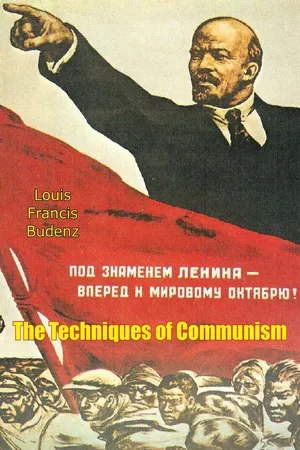
- 251 pages
- English
- ePUB (mobile friendly)
- Available on iOS & Android
eBook - ePub
The Techniques of Communism
About this book
Information
Subtopic
Russian HistoryPART ONE—The Nature and Organization of the “Communist Movement”
CHAPTER I—THE COMMUNIST PHILOSOPHY
SOVIET COMMUNISM of its very nature is intent on world conquest. The establishment of the world Soviet dictatorship is bound up inevitably with the Communist world outlook. The very laws which irrevocably govern the course of nature and society, as the Communist understands them, make this goal a necessity. It may be glossed over for tactical reasons from time to time, as it was in World War II in order to deceive the Western world, but it can never be abandoned. It is the guide and measuring rod of all Communist activities. If these activities further that goal, they are desirable; if they retard it, they are “reformist” or “revisionist” and are to be rejected.
It was to keep alive this concept of the world Soviet dictatorship that the representatives of sixty-five Communist Parties, assembled at the Seventh World Congress of the Communist International in 1935, pledged their loyalty to Stalin as “leader, teacher, and friend of the proletariat and the oppressed of the whole world.” In like vein, they pledged to him “that the Communists will always and everywhere be faithful to the end to the great and invincible banner of Marx, Engels, Lenin, and Stalin. Under this banner, Communism will triumph throughout the world.” (Proceedings of the Seventh World Congress, Communist International, International Press Correspondence, Aug. 8, 1935, p. 861.)
It was in the same spirit that the Chinese Communist Party, in its official greetings to this Seventh World Congress, closed with the announcement of its purpose to “facilitate the preparation for the decisive barricade fights for the Soviet power throughout the world.” Their greetings concluded: “Long live the world proletarian revolution! Long live our leader and teacher, Comrade Stalin!” (Ibid., p. 857.)
This objective, too, moved D. Z. Manuilsky, then General Secretary of the Communist International, to explain: “That is why, comrades, the exploited and oppressed in all parts of the world regard our land of victorious Socialism as their fatherland; that is why they regard our Party and our working class as the shock brigade of the world proletariat; that is why they regard our Stalin as the great, wise, and beloved leader of the whole of toiling humanity.” (Ibid., Sept. 17, 1935, p. 1173.)
The same theme runs through the Cominform organ, For a Lasting Peace, for a People’s Democracy, in its special issue celebrating Stalin’s seventieth birthday. Its banner headline on the first page reads: “Long Live the Leader of the Working People of the World, Joseph Visarionovich Stalin!” Leaders of the Communist Parties from all countries hailed him as “the light and hope of peoples,” “the man who has regenerated the world,” “our teacher and father,” all expressed in terms of world ambitions. Palmiro Togliatti, General Secretary of the Communist Party of Italy, taking the same global view, declared that “Stalin is in front of us. Our cause is Stalin’s cause. The cause of Stalin has never known defeat. It is invincible.” He added: “With Stalin’s name on our lips, we have always been victorious. With Stalin’s name, all victories will be ours.”
This interconnection between Stalin and world conquest is explained by D. Zaslavsky, one of the chief theoretical writers of Soviet Russia, who declares that Stalin is “the great innovator of the new epoch, the architect of the new society and the new man.” Therefore, “his celebration is a triumph of Communism, because when they say ‘Stalin’ they mean ‘Communism.’” Zaslavsky adds that when people exclaimed with boundless devotion, “Long life to Stalin!” they also meant, “Long live Socialism throughout the world and may it be victorious.” (For a Lasting Peace, for a People’s Democracy, Dec. 21, 1949.)
With the installation of G. M. Malenkov as Stalin’s successor in the Soviet Union and in world Red leadership, the Communist purpose continues. Malenkov is gradually fitting himself into Stalin’s place as Stalin did into Lenin’s from 1925 to 1928. Just as Stalin was acclaimed as “the best disciple of Lenin,” so Malenkov is hailed by William Z. Foster, leader of the American Communists, in the following terms: “Malenkov has been trained in the very best Marxist-Leninist tradition. He long had the tutorship of the greatest teacher of them all—Stalin—and he got his experience in the heart of the world Socialist movement, the Soviet Union.” These qualifications and experiences, according to Foster, make Malenkov “a giant compared to the petty politicians currently heading the capitalist states of the world.” (William Z. Foster, “Malenkov at the Helm,” Political Affairs, April 1953, pp. 20, 21.)
Speaking for himself, Malenkov declared to the Supreme Soviet of the USSR on August 8, 1953, that “our cause is invincible.” He gave the following as the heart of this “invincibility”: “The Communist Party and the Soviet government know whither and how to lead the people, because they are guided by Marxism-Leninism—the scientific theory of social development—the banner of which was raised aloft by Lenin, the genius, our father and teacher, and by the continuer of his cause, the great Stalin.” The basis of all Communist views and action is again proclaimed by Malenkov to be “the teaching of Marx-Engels-Lenin-Stalin,” and the very core of this teaching is the attainment of the world Soviet dictatorship. This objective was codified in detail in 1928, when Stalin came into full power, in the Resolutions and Theses of the Sixth World Congress of the Communist International, appearing in International Press Correspondence for that year. (“Speech by Comrade G. M. Malenkov,” at Session of Supreme Soviet of USSR, For a Lasting Peace, for a People’s Democracy, August 14, 1953, p. 4.)
The world conquest ambitions of Communism were expressed precisely by Malenkov in his Report to the Nineteenth Congress of the Communist Party of the Soviet Union, October, 1952, when he said: “The teachings of Marx, Engels, Lenin, and Stalin impart to our Party invincible force...the Lenin-Stalin ideas shed the bright light of revolutionary theory on the tasks and perspectives of the struggle of the masses in all lands against imperialism, for peace, democracy, and Socialism.” (Italics mine.) The Socialism which exists in Soviet Russia, “the land of Socialism,” is to be extended, by Malenkov’s promise, into all lands. (On the Threshold of Communism, G. M. Malenkov, New Century Publishers, N.Y., p. 93.)
Thousands of similar declarations with like intent and purpose dot Communist literature and directives. They are to be found as a chief theme of the most fundamental Communist documents, such as the Program of the Communist International, which declares its aim to be the setting up of a world system of Communism, with the world dictatorship of the proletariat as the instrument toward that end. (Published in Blueprint for World Conquest, Henry Regnery Co.)
We begin, then, with the recognition that in studying Communism we are analyzing a force which seeks world domination, considers world Soviet dictatorship inevitable, and believes that the progress of mankind depends upon its attainment. The embodiment of this necessity for global conquest is Stalin, the continuer of Lenin, hailed as the greatest scientist of our time.
Soviet Objective Arises from Philosophy
When we inquire why Soviet Communism must have this objective, we find that it lies in its philosophy. It is not within the scope of this book to treat exhaustively the philosophy of Communism, but only to examine the essentials necessary to deal with Communist techniques. It is impossible to analyze intelligently the methods and operations of the Communists unless these essentials at least have been grasped. For it is Communist philosophy which gives to “the movement” its dynamic, fires the fanaticism of Stalin’s followers everywhere, and brings about logically those peculiar modes of operation which are met with in every American community.
What, after all, is Soviet Communism? It is the triumph or climax of the philosophy of materialism, the denial of the existence of God or the world of the spirit. Man is considered exclusively as an animal. In the mass of matter in which the animal man functions, there is at work a dialectical motion, a motion of debate or conflict. Whence this motion comes the Communists cannot say, but they assert that it exists in nature and in society.
Stalin writes in his History of the Communist Party of the Soviet Union, (Bolsheviks), which is the fundamental work for the Communists today:
“Dialectical and historical materialism constitute the theoretical basis of Communism, the theoretical foundation of the Marxist Party, and it is the duty of every active member of our Party to know these principles and hence to study them.” (History of the Communist Party of the Soviet Union, [Bolsheviks], Foreign Languages Publishing House, Moscow, 1939, p. 105.)
Dialectical materialism, which operates in nature and is nature’s inevitable law, “is the world outlook of the Marxist-Leninist Party.” Historical materialism is “the extension of the principles of dialectical materialism to the study of social life,” to the development and history of human society.
The motion of debate or conflict at work in nature and society is brought about by the attraction and opposition of opposites. In every natural phenomenon, and in each stage of society, a contradiction exists which brings about a force opposite to that which is dominant. Out of the reaction of these forces upon each other, there arises a new stage of nature and society.
This is the famous thesis, antithesis, and synthesis, which forms the trinity of Communist thought and action. The thing that exists, the opposite that grows out of it, and the higher stage that develops from their interaction or conflict, govern all correct thinking and the proper interpretation of life and society.
In our present historical period, the conflict exists between the bourgeoisie and the proletariat, and will inevitably resolve itself after a violent contest in the victory of the proletariat and the inevitable introduction of Socialism.
That which retards Socialism is “reactionary” and is to be destroyed. That which advances Socialism is “progressive” and “liberating” and is to be encouraged and forwarded.
Violence is Agency of Progress
This transition to Socialism can be successfully attained only through violence, in the suppression by force of the bourgeoisie. For the state, from the Communist viewpoint, always represents the interests of the ruling class and is the dictatorship of the ruling class, no matter how “democratic” it may seem to be. But the dictatorship of the proletariat, shattering the existing state machine of all countries by force, will usher in the Socialist era. (Joseph Stalin, Foundations of Leninism, International Publishers, N.Y., 1932, pp. 44-57.)
This enunciation by Stalin of dialectical materialism and his stress on force as the agency of progress is a reiteration of what his predecessor “scientists,” Karl Marx and Frederick Engels, had declared. More than one hundred years ago, in the Communist Manifesto of 1848, Marx had stated that the proletariat “by means of a revolution” will make itself the ruling class, “and as such sweeps away by force the old conditions of production.” In Capital he had stressed again: “Force is the midwife of every old society pregnant with the new one.” It is force, therefore, that always brings the new society into life. (Capital, I, 776, International Publishers Co.)
On the foundation of this necessity of force and violence as a means to progress and the attainment of Socialism, Lenin developed the new dictatorship of the proletariat, particularly as expressed in Soviet power. This has made Marxism-Leninism the fundamental Communist viewpoint, with the theory and tactics of the dictatorship of the proletariat as the center, the guiding principle, and the goal of all Communist thought and action.
Without the establishment of this dictatorship of the proletariat, this organized violence or compulsion, it is impossible to win the Socialist goal which will bring “progress” to mankind. Thus for the Communist, as stressed so clearly by Stalin in his Foundations of Leninism, the basic objective of bringing about the proletarian dictatorship must condition and color every tactic adopted and every step taken.
We need consider but for a moment this philosophy or world outlook—with its statement that man is exclusively an animal and that for the animal man the sole agency of progress is violence—to appreciate that it logically brings about the ruthlessness represented by the Soviet dictatorship.
It may be stated at once that both the “proletariat” of Marx and the “proletariat” of Stalin are largely fictitious. According to Marx, this class of factory workers without the ownership of its own tools was to be subjected to progressive disintegration in living standards and income. This has not occurred, specifically not in the United States. With Stalin, the “dictatorship of the proletariat” has become a dictatorship over the proletariat and the masses. It is a dictatorship of the Communist Party, “the vanguard of the masses,” which in reality is the dictatorship of the oligarchy in the Kremlin headed now by Stalin’s successor Malenkov. A privileged bureaucracy has been created, living on the backs of the people, under the Soviet regime, a bureaucracy which owes its being to the dictatorship and upon which the dictatorship rests. (David Dallin, The Real Soviet Russia, Yale University Press, 1947, chaps, vii, viii.)
Both Lenin and Stalin have foretold that this would occur, that the dictatorship of the proletariat is actually the dictatorship of the chosen few over the proletariat. In Foundations of Leninism, Stalin cites with approval Lenin’s statement in “Left” Communism that “the dictatorship of the proletariat is the fiercest, sharpest, and most merciless war” against the bourgeoisie. But he adds, citing Lenin again, that it is just as necessary “to re-educate in a protracted struggle, under the controlling auspices of the dictatorship of the proletariat, the proletarians themselves,” who must be rid of their bourgeois habits of thinking. Thus, the proletarians are to be compelled by the forceful compulsion of “their own”...
Table of contents
- Title page
- TABLE OF CONTENTS
- INTRODUCTION
- PART ONE-The Nature and Organization of the “Communist Movement”
- PART TWO-Communist Methods
- PART THREE-Communism, in Action
- PART FOUR-How to Fight Communism
- REQUEST FROM THE PUBLISHER
Trusted by 375,005 students
Access to over 1.5 million titles for a fair monthly price.
Study more efficiently using our study tools.
Frequently asked questions
Yes, you can cancel anytime from the Subscription tab in your account settings on the Perlego website. Your subscription will stay active until the end of your current billing period. Learn how to cancel your subscription
No, books cannot be downloaded as external files, such as PDFs, for use outside of Perlego. However, you can download books within the Perlego app for offline reading on mobile or tablet. Learn how to download books offline
Perlego offers two plans: Essential and Complete
- Essential is ideal for learners and professionals who enjoy exploring a wide range of subjects. Access the Essential Library with 800,000+ trusted titles and best-sellers across business, personal growth, and the humanities. Includes unlimited reading time and Standard Read Aloud voice.
- Complete: Perfect for advanced learners and researchers needing full, unrestricted access. Unlock 1.5M+ books across hundreds of subjects, including academic and specialized titles. The Complete Plan also includes advanced features like Premium Read Aloud and Research Assistant.
We are an online textbook subscription service, where you can get access to an entire online library for less than the price of a single book per month. With over 1.5 million books across 990+ topics, we’ve got you covered! Learn about our mission
Look out for the read-aloud symbol on your next book to see if you can listen to it. The read-aloud tool reads text aloud for you, highlighting the text as it is being read. You can pause it, speed it up and slow it down. Learn more about Read Aloud
Yes! You can use the Perlego app on both iOS and Android devices to read anytime, anywhere — even offline. Perfect for commutes or when you’re on the go.
Please note we cannot support devices running on iOS 13 and Android 7 or earlier. Learn more about using the app
Please note we cannot support devices running on iOS 13 and Android 7 or earlier. Learn more about using the app
Yes, you can access The Techniques of Communism by Louis Francis Budenz in PDF and/or ePUB format, as well as other popular books in Politics & International Relations & Russian History. We have over 1.5 million books available in our catalogue for you to explore.