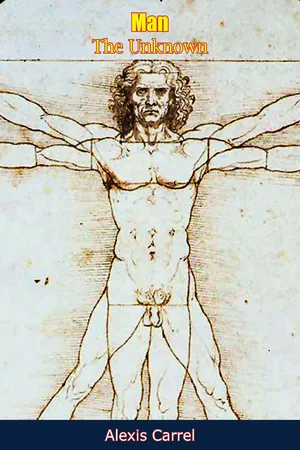
Winner of the Nobel Prize for physiology and medicine, Dr. Alexis Carrel, one of the truly great scientists who ever lived, tells us what man is in terms of his mental and physical make-up—and how he can become the actual rule of his universe if he learns to use wisely his amazing, God-given powers.
"The wisest, profoundest, most valuable book that I have come upon in the American literature of our century"—Will Durant, Author of Story of Philosophy
"Significant, candid, courageous and genuinely sincere"—New York Times
"Provocative and stimulating"—Saturday Review
"A work of genius…the spaciousness, the variety of outlook, the brave disregard for currently accepted beliefs that characterize great books"—New York Herald Tribune
- 315 pages
- English
- ePUB (mobile friendly)
- Available on iOS & Android
eBook - ePub
Man, The Unknown
About this book
Information
Topic
Theology & ReligionSubtopic
BuddhismChapter I—THE NEED OF A BETTER KNOWLEDGE OF MAN
1
THERE is a strange disparity between the sciences of inert matter and those of life. Astronomy, mechanics, and physics are based on concepts which can be expressed, tersely and elegantly, in mathematical language. They have built up a universe as harmonious as the monuments of ancient Greece. They weave about it a magnificent texture of calculations and hypotheses. They search for reality beyond the realm of common thought up to unutterable abstractions consisting only of equations of symbols. Such is not the position of biological sciences. Those who investigate the phenomena of life are as if lost in an inextricable jungle, in the midst of a magic forest, whose countless trees unceasingly change their place and their shape. They are crushed under a mass of facts, which they can describe but are incapable of defining in algebraic equations. From the things encountered in the material world, whether atoms or stars, rocks or clouds, steel or water, certain qualities, such as weight and spatial dimensions, have been abstracted. These abstractions, and not the concrete facts, are the matter of scientific reasoning. The observation of objects constitutes only a lower form of science, the descriptive form. Descriptive science classifies phenomena. But the unchanging relations between variable quantities—that is, the natural laws, only appear when science becomes more abstract. It is because physics and chemistry are abstract and quantitative that they had such great and rapid success. Although they do not pretend to unveil the ultimate nature of things, they give us the power to predict future events, and often to determine at will their occurrence. In learning the secret of the constitution and of the properties of matter, we have gained the mastery of almost everything which exists on the surface of the earth, excepting ourselves.
The science of the living beings in general, and especially of the human individual, has not made such great progress. It still remains in the descriptive state. Man is an indivisible whole of extreme complexity. No simple representation of him can be obtained. There is no method capable of apprehending him simultaneously in his entirety, his parts, and his relations with the outer world. In order to analyze ourselves, we are obliged to seek the help of various techniques and, therefore, to utilize several sciences. Naturally, all these sciences arrive at a different conception of their common object. They abstract only from man what is attainable by their special methods. And those abstractions, after they have been added together, are still less rich than the concrete fact. They leave behind them a residue, too important to be neglected. Anatomy, chemistry, physiology, psychology, pedagogy, history, sociology, political economy do not exhaust their subject. Man, as known to the specialists, is far from being the concrete man, the real man. He is nothing but a schema, consisting of other schemata built up by the techniques of each science. He is, at the same time, the corpse dissected by the anatomists, the consciousness observed by the psychologists and the great teachers of the spiritual life, and the personality which introspection shows to everyone as lying in the depth of himself. He is the chemical substances constituting the tissues and humors of the body. He is the amazing community of cells and nutrient fluids whose organic laws are studied by the physiologists. He is the compound of tissues and consciousness that hygienists and educators endeavor to lead to its optimum development while it extends into time. He is the homo oeconomicus who must ceaselessly consume manufactured products in order that the machines, of which he is made a slave, may be kept at work. But he is also the poet, the hero, and the saint. He is not only the prodigiously complex being analyzed by our scientific techniques, but also the tendencies, the conjectures, the aspirations of humanity. Our conceptions of him are imbued with metaphysics. They are founded on so many and such imprecise data that the temptation is great to choose among them those which please us. Therefore, our idea of man varies according to our feelings and our beliefs. A materialist and a spiritualist accept the same definition of a crystal of sodium chloride. But they do not agree with one another upon that of the human being. A mechanistic physiologist and a vitalistic physiologist do not consider the organism in the same light. The living being of Jacques Loeb differs profoundly from that of Hans Driesch. Indeed, mankind has made a gigantic effort to know itself. Although we possess the treasure of the observations accumulated by the scientists, the philosophers, the poets, and the great mystics of all times, we have grasped only certain aspects of ourselves. We do not apprehend man as a whole. We know him as composed of distinct parts. And even these parts are created by our methods. Each one of us is made up of a procession of phantoms, in the midst of which strides an unknowable reality.
In fact, our ignorance is profound. Most of the questions put to themselves by those who study human beings remain without answer. Immense regions of our inner world are still unknown. How do the molecules of chemical substances associate in order to form the complex and temporary organs of the cell? How do the genes contained in the nucleus of a fertilized ovum determine the characteristics of the individual deriving from that ovum? How do cells organize themselves by their own efforts into societies, such as the tissues and the organs? Like the ants and the bees, they have advance knowledge of the part they are destined to play in the life of the community. And hidden mechanisms enable them to build up an organism both complex and simple. What is the nature of our duration of psychological time, and of physiological time? We know that we are a compound of tissues, organs, fluids, and consciousness. But the relations between consciousness and cerebrum are still a mystery. We lack almost entirely a knowledge of the physiology of nervous cells. To what extent does will power modify the organism? How is the mind influenced by the state of the organs? In what manner can the organic and mental characteristics, which each individual inherits, be changed by the mode of life, the chemical substances contained in food, the climate, and the physiological and moral disciplines?
We are very far from knowing what relations exist between skeleton, muscles, and organs, and mental and spiritual activities. We are ignorant of the factors that bring about nervous equilibrium and resistance to fatigue and to diseases. We do not know how moral sense, judgment, and audacity could be augmented. What is the relative importance of intellectual, moral, and mystical activities? What is the significance of esthetic and religious sense? What form of energy is responsible for telepathic communications? Without any doubt, certain physiological and mental factors determine happiness or misery, success or failure. But we do not know what they are. We cannot artificially give to any individual the aptitude for happiness. As yet, we do not know what environment is the most favorable for the optimum development of civilized man. Is it possible to suppress struggle, effort, and suffering from our physiological and spiritual formation? How can we prevent the degeneracy of man in modern civilization? Many other questions could be asked on subjects which are to us of the utmost interest. They would also remain unanswered. It is quite evident that the accomplishments of all the sciences having man as an object remain insufficient, and that our knowledge of ourselves is still most rudimentary.
2
Our ignorance may be attributed, at the same time, to the mode of existence of our ancestors, to the complexity of our nature, and to the structure of our mind. Before all, man had to live. And that need demanded the conquest of the outer world. It was imperative to secure food and shelter, to fight wild animals and other men. For immense periods, our forefathers had neither the leisure nor the inclination to study themselves. They employed their intelligence in other ways, such as manufacturing weapons and tools, discovering fire, training cattle and horses, inventing the wheel, the culture of cereals, etc., etc. Long before becoming interested in the constitution of their body and their mind, they meditated on the sun, the moon, the stars, the tides, and the passing of the seasons. Astronomy was already far advanced at an epoch when physiology was totally unknown. Galileo reduced the earth, center of the world, to the rank of a humble satellite of the sun, while his contemporaries had not even the most elementary notion of the structure and the functions of brain, liver, or thyroid gland. As, under the natural conditions of life, the human organism works satisfactorily and needs no attention, science progressed in the direction in which it was led by human curiosity—that is, toward the outer world.
From time to time, among the billions of human beings who have successively inhabited the earth, a few were bora endowed with rare and marvelous powers, the intuition of unknown things, the imagination that creates new worlds, and the faculty of discovering the hidden relations existing between certain phenomena. These men explored the physical universe. This universe is of a simple constitution. Therefore, it rapidly gave in to the attack of the scientists and yielded the secret of certain of its laws. And the knowledge of these laws enabled us to utilize the world of matter for our own profit. The practical applications of scientific discoveries are lucrative for those who promote them. They facilitate the existence of all. They please the public, whose comfort they augment. Everyone became, of course, much more interested in the inventions that lessen human effort, lighten the burden of the toiler, accelerate the rapidity of communications, and soften the harshness of life, than in the discoveries that throw some light on the intricate problems relating to the constitution of our body and of our consciousness. The conquest of the material world, which has ceaselessly absorbed the attention and the will of men, caused the organic and the spiritual world to fall into almost complete oblivion. In fact, the knowledge of our surroundings was indispensable, but that of our own nature appeared to be much less immediately useful. However, disease, pain, death, and more or less obscure aspirations toward a hidden power transcending the visible universe, drew the attention of men, in some measure, to the inner world of their body and their mind. At first, medicine contented itself with the practical problem of relieving the sick by empiric recipes. It realized only in recent times that the most effective method of preventing or curing illness is to acquire a complete understanding of the normal and diseased body—that is, to construct the sciences that are called anatomy, biological chemistry, physiology, and pathology. However, the mystery of our existence, the moral sufferings, the craving for the unknown, and the metaphysical phenomena appeared to our ancestors as more important then bodily pain and diseases. The study of spiritual life and of philosophy attracted greater men than the study of medicine. The laws of mysticity became known before those of physiology. But such laws were brought to light only when mankind had acquired sufficient leisure to turn a little of his attention to other things than the conquest of the outer world.
There is another reason for the slow progress of the knowledge of ourselves. Our mind is so constructed as to delight in contemplating simple facts. We feel a kind of repugnance in attacking such a complex problem as that of the constitution of living beings and of man. The intellect, as Bergson wrote, is characterized by a natural inability to comprehend life. On the contrary, we love to discover in the cosmos the geometrical forms that exist in the depths of our consciousness. The exactitude of the proportions of our monuments and the precision of our machines express a fundamental character of our mind. Geometry does not exist in the earthly world. It has originated in ourselves. The methods of nature are never so precise as those of man. We do not find in the universe the clearness and accuracy of our thought. We attempt, therefore, to abstract from the complexity of phenomena some simple systems whose components bear to one another certain relations susceptible of being described mathematically. This power of abstraction of the human intellect is responsible for the amazing progress of physics and chemistry. A similar success has rewarded the physicochemical study of living beings. The laws of chemistry and of physics are identical in the world of living things and in that of inanimate matter, as Claude Bernard thought long ago. This fact explains why modern physiology has discovered, for example, that the constancy of the alkalinity of the blood and of the water of the ocean is expressed by identical laws, that the energy spent by the contracting muscle is supplied by the fermentation of sugar, etc. The physicochemical aspects of human beings are almost as easy to investigate as those of the other objects of the terrestrial world. Such is the task which general physiology succeeds in accomplishing.
The study of the truly physiological phenomena—that is, of those resulting from the organization of living matter—meets with more important obstacles. On account of the extreme smallness of the things to be analyzed, it is impossible to use the ordinary techniques of physics and of chemistry. What method could bring to light the chemical constitution of the nucleus of the sexual cells, of its chromosomes, and of the genes that compose these chromosomes? Nevertheless, those very minute aggregates of chemicals are of capital importance, because they contain the future of the individual and of the race. The fragility of certain tissues, such as the nervous substance, is so great that to study them in the living state is almost impossible. We do not possess any technique capable of penetrating the mysteries of the brain, and of the harmonious association of its cells. Our mind, which loves the simple beauty of mathematical formulas, is bewildered when it contemplates the stupendous mass of cells, humors, and consciousness which make up the individual. We try, therefore, to apply to this compound the concepts that have proved useful in the realm of physics, chemistry, and mechanics, and in the philosophical and religious disciplines. Such an attempt does not meet with much success, because we can be reduced neither to a physicochemical system nor to a spiritual entity. Of course, the science of man has to use the concepts of all the other sciences. But it must also develop its own. For it is as fundamental as the sciences of the molecules, the atoms, and the electrons.
In short, the slow progress of the knowledge of the human being, as compared with the splendid ascension of physics, astronomy, chemistry, and mechanics, is due to our ancestors’ lack of leisure, to the complexity of the subject, and to the structure of our mind. Those obstacles are fundamental. There is no hope of eliminating them. They will always have to be overcome at the cost of strenuous effort. The knowledge of ourselves will never attain the elegant simplicity, the abstractness, and the beauty of physics. The factors that have retarded its development are not likely to vanish. We must realize clearly that the science of man is the most difficult of all sciences.
3
The environment which has molded the body and the soul of our ancestors during many millenniums has now been replaced by another. This silent revolution has taken place almost without our noticing it. We have not realized its importance. Nevertheless, it is one of the most dramatic events in the history of humanity. For any modification in their surroundings inevitably and profoundly disturbs all living beings. We must, therefore, ascertain the extent of the transformations imposed by science upon the ancestral mode of life, and consequently upon ourselves.
Since the advent of industry, a large part of the population has been compelled to live in restricted areas. The workmen are herded together, either in the suburbs of the large cities or in villages built for them. They are occupied in the factories during fixed hours, doing easy, monotonous, and well-paid work, The cities are also inhabited by office workers, employees of stores, banks, and public administrations, physicians, lawyers, schoolteachers, and the multitude of those who, directly or indirectly, draw their livelihood from commerce and industry. Factories and offices are large, well lighted, clean. Their temperature is uniform. Modern heating and refrigerating apparatuses raise the temperature during the winter and lower it during the summer. The skyscrapers of the great cities have transformed the streets into gloomy canyons. But inside of the buildings, the light of the sun is replaced by electric bulbs rich in ultra-violet rays. Instead of the air of the street, polluted by gasoline fumes, the offices and workshops receive pure air drawn in from the upper atmosphere by ventilators on the roof. The dwellers of the modern city are protected against all inclemencies of the weather. But they are no longer able to live as did our ancestors, near their workshops, their stores, or their offices. The wealthier inhabit the gigantic buildings of the main avenues. At the top of dizzy towers, the kings of the business world possess delightful homes, surrounded by trees, grass, and flowers. They live there, as sheltered from noise, dust, and all disturbances, as if they dwelt on the summit of a mountain. They are more completely isolated from the common herd than were the feudal lords behind the walls and the moats of their fortified castles. The less wealthy, even those with quite modest means, lodge in apartments whose comfort surpasses that which surrounded Louis XIV or Frederick the Great. Many have their residence far from the city. Each evening, express trains transport innumerable crowds to suburbs, where broad roads running between green strips of grass and rows of trees are bordered with pretty and comfortable houses. The workmen and the humblest employees live in dwellings better appointed than those of the rich of former times. The heating apparatuses that automatically regulate the temperature of the houses, the bathrooms, the refrigerators, the electric stoves, the domestic machinery for preparing food and cleaning rooms, and the garages for the automobiles, give to the abode of everybody, not only in the city and the suburbs, but also in the country, a degree of comfort which previously was found only in that of very few privileged individuals.
Simultaneously with the habitat, the mode of life has been transformed. This transformation is due chiefly to the increase in the rapidity of communications. Indeed, it is evident that modern trains and steamers, airplanes, automobiles, telegraph, telephone, and wireless have modified the relations of men and of nations all over the world. Each individual does a great many more things than formerly. He takes part in a much larger number of events. Every day he comes into contact with more people. Quiet and unemployed moments are exceptional in his existence. The narrow groups of the family and of the parish have been dissolved. Intimacy no longer exists. For the life of the small group has been substituted that of the herd. Solitude is looked upon as a punishment or as a rare luxury. The frequent attendance at cinema, theatrical, or athletic performances, the clubs, the meetings of all sorts, the gigantic universities, factories, department stores, and hotels have engendered in all the habit of living in common. The telephone, the radio, and the gramophone records carry unceasingly the vulgarity of the crowd, as well as its pleasures and its psychology, into everyone’s house, even in the most isolated and remote villages. Each individual is always in direct or indirect communication with other human beings, and keeps himself constantly informed about the small or important events taking place in his town, or his city, or at the other end of the world. One hears the chimes of Westminster in the most retired houses of the French countryside. Any farmer in Vermont, if it pleases him to do so, may listen to orators speaking in Berlin, London, or Paris.
Everywhere, in the cities, as well as in the country, in private houses as in factories, in the workshop, on the roads, in the fields, and on the farms, machines have decreased the intensity of human effort. Today, it is not necessary to walk. Elevators have replaced stairs. Everybody rides in buses, motors, or street cars, even when the distance to be covered is very short. Natural bodily exercises, such as walking and running over rough ground, mountain-climbing, tilling the land by hand, clearing forests with the ax, working while exposed to rain, sun, wind, cold, or heat, have given place to well-regulated sports that involve almost no risk, and to machines that abolish muscular effort. Everywhere there are tennis-courts, golf-links, artificial skating-rinks, heated swimming-pools, and sheltered arenas where athletes train and fight while protected against the inclemencies of the wea...
Table of contents
- Title page
- TABLE OF CONTENTS
- DEDICATION
- INTRODUCTION
- Chapter I-THE NEED OF A BETTER KNOWLEDGE OF MAN
- Chapter II-THE SCIENCE OF MAN
- Chapter III-BODY AND PHYSIOLOGICAL ACTIVITIES
- Chapter IV-MENTAL ACTIVITIES
- Chapter V-INWARD TIME
- Chapter VI-ADAPTIVE FUNCTIONS
- Chapter VII-THE INDIVIDUAL
- Chapter VIII-THE REMAKING OF MAN
- REQUEST FROM THE PUBLISHER
Trusted by 375,005 students
Access to over 1.5 million titles for a fair monthly price.
Study more efficiently using our study tools.
Frequently asked questions
Yes, you can cancel anytime from the Subscription tab in your account settings on the Perlego website. Your subscription will stay active until the end of your current billing period. Learn how to cancel your subscription
No, books cannot be downloaded as external files, such as PDFs, for use outside of Perlego. However, you can download books within the Perlego app for offline reading on mobile or tablet. Learn how to download books offline
Perlego offers two plans: Essential and Complete
- Essential is ideal for learners and professionals who enjoy exploring a wide range of subjects. Access the Essential Library with 800,000+ trusted titles and best-sellers across business, personal growth, and the humanities. Includes unlimited reading time and Standard Read Aloud voice.
- Complete: Perfect for advanced learners and researchers needing full, unrestricted access. Unlock 1.5M+ books across hundreds of subjects, including academic and specialized titles. The Complete Plan also includes advanced features like Premium Read Aloud and Research Assistant.
We are an online textbook subscription service, where you can get access to an entire online library for less than the price of a single book per month. With over 1.5 million books across 990+ topics, we’ve got you covered! Learn about our mission
Look out for the read-aloud symbol on your next book to see if you can listen to it. The read-aloud tool reads text aloud for you, highlighting the text as it is being read. You can pause it, speed it up and slow it down. Learn more about Read Aloud
Yes! You can use the Perlego app on both iOS and Android devices to read anytime, anywhere — even offline. Perfect for commutes or when you’re on the go.
Please note we cannot support devices running on iOS 13 and Android 7 or earlier. Learn more about using the app
Please note we cannot support devices running on iOS 13 and Android 7 or earlier. Learn more about using the app
Yes, you can access Man, The Unknown by Alexis Carrel in PDF and/or ePUB format, as well as other popular books in Theology & Religion & Buddhism. We have over 1.5 million books available in our catalogue for you to explore.