During 1789-90, Nicholai Mikhailovich Karamzin, a young poet and short-story writer, toured Western Europe. On his return, he distilled his impressions in the form of travel letters. Letters of a Russian Traveler, 1791-1801, in which Karamzin's impressions are woven into a wealth of information about Western European society and culture that he derived from wide reading, became a favorite of readers and was widely imitated.
The most influential prose stylist of the eighteenth century, Karamzin shaped the development of the Russian literary language, introducing many Gallicisms to supplant Slavonic-derived words and idioms and breaking down the classicist canons of isolated language styles.
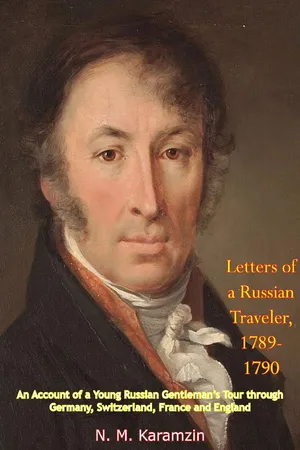
eBook - ePub
Letters of a Russian Traveler, 1789-1790
An Account of a Young Russian Gentleman's Tour through Germany, Switzerland, France and England
- 275 pages
- English
- ePUB (mobile friendly)
- Available on iOS & Android
eBook - ePub
Letters of a Russian Traveler, 1789-1790
An Account of a Young Russian Gentleman's Tour through Germany, Switzerland, France and England
About this book
Information
Subtopic
Historical BiographiesIndex
HistoryPART ONE—MOSCOW THROUGH GERMANY
Tver, May 18, 1789
I have left you, my dears, I have left you! My heart is yours in all its tenderest feelings, but now with each moment I move farther and farther away from you.
Oh, my heart, my heart! Who knows your wishes? For how many long years has this journey been my fancy’s most pleasing dream? Have I not told myself with delight: At last you are going! Have I not awakened each morning with joy? Have I not felt a surge of pleasure at the thought: You are actually going! For how long have I been unable to think of anything, to be interested in anything save this journey? Have I not counted the days, the hours? But—when the longed-for day arrived, how sad I grew, realizing for the first time that I must part from my beloved friends and from everything that has become a piece, as it were, of my moral being. Wherever I glanced; at the table where, for years, I had poured out my youthful thoughts and sentiments; at the window beneath which I sat scorched by fits of melancholy and where the rising sun so often found me; at the Gothic mansion, favorite object of my eyes during my nightly vigils—in a word, everything that met my gaze became a precious monument of my past years, years rich not in deeds but rich, rather, in thoughts and feelings. To inanimate objects I bade farewell as to friends; and at that very moment of tenderness, of distress, my servants came in, began to weep and to implore me not to forget them and to take them back again when I returned. Tears are contagious, my dears, especially at such a time.
Though you are dearer to me than all else, yet I had to leave you. My heart was so full that I could not speak. But what was there to say? The moment of our parting was such that thousands of pleasant moments to come will scarce repay me for it.
Dear Petrov{1} saw me to the gate. There we embraced, and for the first time I noticed his tears. There I took my place in the kibitka{2} and turned toward Moscow, where there remained so much that is dear to me, and said, “Farewell!” The bells rang, the horses galloped off...and your friend became an orphan in the world, an orphan in his soul.
All that has passed is a dream and a shadow. Oh, where, where are the hours when my heart rejoiced amongst you, my dear friends? If the future were suddenly revealed to even the most fortunate of men, his heart would stand still with fright and his tongue would grow dumb at that very second when he deemed himself the happiest of mortals!
Not a single happy thought entered my mind on the entire journey. At the last station before Tver my melancholy had become so great that, while standing in a country tavern in front of caricatures of the Queen of France and the Roman Emperor, I should have liked “to have wept my heart out,” as Shakespeare says. At that moment everything that I had left appeared in such a touching aspect. But enough, enough! Again I am growing exceedingly sad. Farewell! May God comfort you! Think of your friend, but without any sorrow.
St. Petersburg, May 26, 1789
Having spent five days here, my friends, I shall leave within an hour for Riga.
I have not enjoyed myself in Petersburg. Arriving at our friend D—’s,{3} I found him in extreme despair. This kind and worthy man opened his heart to me. It is pathetic—he is unhappy.
“My situation is quite the opposite of yours,” he said with a sigh. “Your deepest desire is being fulfilled. You go to find pleasure, to enjoy yourself, but I shall go in search of death, which alone can end my suffering.”
I did not venture to comfort him, but was content only to share his sorrow.
“But do not think, my friend,” I said to him, “that you see before you a man contented with his lot. In gaining one thing, I lose another and I regret this.”
With all our hearts both of us lamented mankind’s sad fate or remained silent. In the evenings we strolled in the summer garden, each deep in his own thoughts, always thinking more than we said.
Before dinner I had gone to the exchange to see an English acquaintance through whom I was to secure some bills of exchange. Looking at the ships there, I took it into my head to go by water to Danzig, Stettin, or Lübeck in order to reach Germany more quickly. The Englishman was of the same opinion and found a captain who planned to sail for Stettin in a few days. The matter seemed at an end, but it did not turn out this way I had to present my passport at the Admiralty. They did not want to sign it because it had been issued by the Moscow and not by the Petersburg administration and it did not indicate how I should travel, that is, it did not state that I would go by sea. My remonstrances were unsuccessful. I did not know the procedure, and it remained for me to go by land or to obtain another passport in Petersburg. I decided upon the former. I ordered post horses, and now the horses are prepared. And so farewell, my dear friends! Sometime I shall be more cheerful! But till this moment it has all been quite sad. Farewell!
Riga, May 31, 1789
Yesterday, my dearest friends, I arrived at Riga and put up at the Hôtel de Petersbourg. The road exhausted me. My dejection, whose cause you well know, was not enough. In addition I had to travel in a driving rain, and to take it into my head, unfortunately, to go from Petersburg by post-chaise. There were no good kibitkas anywhere. Everything irritated me. Everywhere, it seemed, they overcharged me. At each change we were detained too long. But nowhere was I so miserable as at Narva, where I arrived completely soaked and completely filthy. Only with difficulty was I able to find two bast mattings, so that I might protect myself a little from the rain, and I paid at least as much for them as for two skins. The kibitka they gave me was worthless, the horses vile. We had gone scarcely half a verst when the axle broke, the kibitka fell into the mud and I with it. My Ilya and the coachman set off for another axle, and your poor friend was left in the pouring rain. This, however, was not enough. Some kind of policeman came and began to shout because my kibitka was lying in the center of the road.
“Put it in your pocket!” I said, feigning indifference and drawing my cloak about me.
God knows what I felt at that moment! All pleasant thoughts of travel grew clouded in my soul. Oh, if I could then have been transported to you, my friends! Inwardly I cursed that restlessness of the human heart which draws us from object to object, from true pleasures to false, the moment the first have lost their novelty; that restlessness which attunes our fancy to dreams and drives us to search for happiness in the uncertain future!
There is a limit to everything. The wave, having struck the shore, recedes again or, having surged, ebbs.
At that very instant when my heart was filled to overflowing, there appeared a well-dressed lad of thirteen, who, with a sweet, sincere smile, said to me in German, “Has your kibitka broken down? I’m sorry, very sorry! Please come to our house. There it is. My father and mother bade me invite you to us.”
“Thank you, sir! But I cannot leave my kibitka. In addition, I am dressed for travel and completely drenched.”
“We will send a man to look after the kibitka. And who takes any notice of a traveler’s clothes? Please, sir, please!”
With this he smiled so persuasively that I had to shake the water from my hat, so that I might go with him. We joined hands and ran quickly into a large stone house where I found, in a hall on the ground floor, a large family seated about a table. The mistress was pouring tea and coffee. They received me so cordially and welcomed me so warmly that I forgot all my misfortune. The master, an elderly man whose good nature was written on his face, asked me about my journey with interest and sincerity. His nephew, a young man recently returned from Germany, told me how to go from Riga to Königsberg more easily. I stayed with them about an hour. Meanwhile an axle had been brought and all was now in readiness.
“No, wait a bit!” they said. And the mistress brought three loaves of bread on a plate.
“Our bread, they say, is good. Take it.”
“God be with you! God be with you!” said the master, pressing my hand.
I thanked him through my tears, and expressed the hope that with his hospitality he would continue to cheer sad wayfarers parted from their dear friends.
Hospitality, blessed virtue, so common in the youthful days of the human race and so uncommon in ours! If ever I forget thee, may my friends forget me! Let me forever be a wanderer on earth and nowhere find a second Kramer!{4}
I bade farewell to this kind family, took my place in the kibitka, and set off, gladdened by the discovery of good people!
The post from Narva to Riga is called the German post, because all the postmasters are Germans. The post-houses are everywhere the same—low, wooden buildings divided into two parts, one for the travelers, the other for the postmaster, from whom you can obtain everything needed to satisfy hunger and thirst.
The distances between the stations are short, only ten to twelve versts. Instead of postillions they use soldiers. Some of them still remember Münnich.{5} Spinning their yarns, they forget to press the horses, and because of this it took me five days to come here from Petersburg.
Save for language and caftans, I have observed little difference between the Estonians and Livonians. The former wear black, the latter gray. Their languages are similar. They have little of their own and many German and even some Slavic words. I have noticed that they soften all German words, from which one might conclude that they have a sensitive ear. But noting their awkwardness, clumsiness, and slow-wittedness, one cannot but think that they are, to put it simply, dullards. The noblemen with whom I managed to speak complained of their indolence, and called them a lethargic people who will do nothing of their own volition. Thus a great deal of coercion must be applied, for the people work very hard, and a Livonian or Estonian peasant produces for his master four times as much as one of our Kazan or Simbirsk peasants.
Because these poor people toil for their masters in fear and trembling on all the workdays, they indulge in riotous merrymaking on holidays. There are very few of these on their calendar, however. The road is dotted with inns, and all those we passed were crowded with merrymakers, celebrating Whitsuntide.
Both peasants and noblemen are of the Lutheran faith. Their churches resemble ours, except that on the spire, in place of a cross, stands a cock, as a reminder of the fall of the Apostle Peter. Even though all the pastors know German, they conduct the services in their own language.
As for scenery, there is nothing to look at but forests, sand, and swampland. There are neither lofty mountains nor broad valleys. You will look in ...
Table of contents
- Title page
- TABLE OF CONTENTS
- DEDICATION
- PREFACE
- INTRODUCTION BY LEON STILMAN
- PART ONE-MOSCOW THROUGH GERMANY
- PART TWO-SWITZERLAND
- PART THREE-FRANCE
- PART FOUR-ENGLAND...AND HOME
- REQUEST FROM THE PUBLISHER
Trusted by 375,005 students
Access to over 1.5 million titles for a fair monthly price.
Study more efficiently using our study tools.
Frequently asked questions
Yes, you can cancel anytime from the Subscription tab in your account settings on the Perlego website. Your subscription will stay active until the end of your current billing period. Learn how to cancel your subscription
No, books cannot be downloaded as external files, such as PDFs, for use outside of Perlego. However, you can download books within the Perlego app for offline reading on mobile or tablet. Learn how to download books offline
Perlego offers two plans: Essential and Complete
- Essential is ideal for learners and professionals who enjoy exploring a wide range of subjects. Access the Essential Library with 800,000+ trusted titles and best-sellers across business, personal growth, and the humanities. Includes unlimited reading time and Standard Read Aloud voice.
- Complete: Perfect for advanced learners and researchers needing full, unrestricted access. Unlock 1.5M+ books across hundreds of subjects, including academic and specialized titles. The Complete Plan also includes advanced features like Premium Read Aloud and Research Assistant.
We are an online textbook subscription service, where you can get access to an entire online library for less than the price of a single book per month. With over 1.5 million books across 990+ topics, we’ve got you covered! Learn about our mission
Look out for the read-aloud symbol on your next book to see if you can listen to it. The read-aloud tool reads text aloud for you, highlighting the text as it is being read. You can pause it, speed it up and slow it down. Learn more about Read Aloud
Yes! You can use the Perlego app on both iOS and Android devices to read anytime, anywhere — even offline. Perfect for commutes or when you’re on the go.
Please note we cannot support devices running on iOS 13 and Android 7 or earlier. Learn more about using the app
Please note we cannot support devices running on iOS 13 and Android 7 or earlier. Learn more about using the app
Yes, you can access Letters of a Russian Traveler, 1789-1790 by N. M. Karamzin, Florence Jonas in PDF and/or ePUB format, as well as other popular books in History & Historical Biographies. We have over 1.5 million books available in our catalogue for you to explore.