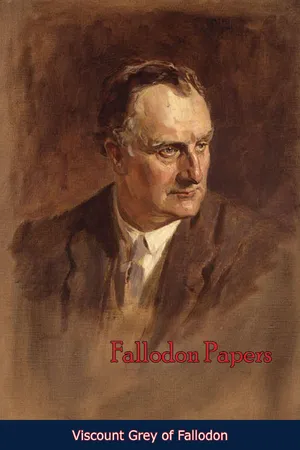
- 97 pages
- English
- ePUB (mobile friendly)
- Available on iOS & Android
eBook - ePub
Fallodon Papers
About this book
A slim volume of essays by Viscount Grey of Fallodon, first published in 1926, this book is a collection of seven addresses he gave on subjects such as reading, nature, and public life. The essays range from 1919-1924.
In these stimulating and delightful papers, written at his ancestral home at Fallodon in Northumberland, England's foreign minister tells of those aspects of life from which he drew refreshment and lasting pleasure. Included is his famous essay on "The Fly-Fisherman," which appeared in this book for the first time in 1926.
The Viscount's essays were presented as lectures and as he was unable to read from a manuscript, owing to poor eyesight, he delivered his thoughts with no notes at all, relying on a shorthand writer to record the words for print.
Full essay list: "The Pleasure of Reading;" "Pleasure in Outdoor Nature;" "Recreation;" "Some Thoughts on Public Life;" "Waterfowl at Fallodon;" "The Fly-Fisherman;" "Wordsworth's 'Prelude'."
Beautifully illustrated throughout with art deco woodcuts.
An unmissable addition to any World War I library.
In these stimulating and delightful papers, written at his ancestral home at Fallodon in Northumberland, England's foreign minister tells of those aspects of life from which he drew refreshment and lasting pleasure. Included is his famous essay on "The Fly-Fisherman," which appeared in this book for the first time in 1926.
The Viscount's essays were presented as lectures and as he was unable to read from a manuscript, owing to poor eyesight, he delivered his thoughts with no notes at all, relying on a shorthand writer to record the words for print.
Full essay list: "The Pleasure of Reading;" "Pleasure in Outdoor Nature;" "Recreation;" "Some Thoughts on Public Life;" "Waterfowl at Fallodon;" "The Fly-Fisherman;" "Wordsworth's 'Prelude'."
Beautifully illustrated throughout with art deco woodcuts.
An unmissable addition to any World War I library.
Trusted by 375,005 students
Access to over 1 million titles for a fair monthly price.
Study more efficiently using our study tools.
Information
VII—WORDSWORTH’S ‘PRELUDE’
FIRST of all, let me say, that like many lovers of Wordsworth, I not only find ‘The Prelude’ very interesting, but every time I read it the interest to be found in it grows wider and deeper and more intense, so that it ranks very high indeed in Wordsworth’s work. This estimate of ‘The Prelude’ is by no means universal. I once possessed—I am glad to say that I possess it no longer—a copy of an edition of Wordsworth in one volume, in which I was disappointed not to find ‘The Prelude.’ On turning to the Preface I found it stated that the volume contained all the poems of Wordsworth which were of real value, and that the only omissions were of poems such as ‘The Prelude,’ which were by general consent not up to the mark; I have even found myself an object of pity to at least one literary friend for reading ‘The Excursion’ or ‘The Prelude’ at all. I once heard a distinguished man describe the speeches of another man also distinguished, whose speeches were full of learning, but more copious than inspiring, as being like a magnum of soda-water that had stood uncorked for a week. To some people, I fear, ‘The Prelude’ and ‘Excursion’ appear dreary and flat. As against their depreciation, I will read you an appreciation of ‘The Prelude’ from a very unexpected quarter—the words are these: ‘When I came in after years to read “The Prelude,” I recognized, as if it were my own history which was being told, the steps by which the love of the country boy for his hills and moors grew into poetical susceptibility for all imaginative presentations of beauty in every direction.’ I think I might safely say that no man or woman in this room, however great his literary knowledge, unless he already knows from whom that quotation comes, would guess the author of it. It comes from one who was apt to depreciate rather than appreciate many things about which others were enthusiastic. The words are those of Mark Pattison. You may set that unexpected appreciation of ‘The Prelude’ against much depreciation of it; Mark Pattison says here just what makes many of us feel Wordsworth a special poet, the sense that in him we find our own experiences reproduced. As we read him, we constantly find ourselves saying, ‘I know that I have felt that.’ And sometimes he reveals to us what we have not been previously conscious of, so that we say, ‘I have felt that without knowing it.’ Thus, to those of us who have the same sort of susceptibility that Wordsworth had to all the aspects of natural beauty, his poetry becomes something not to be measured merely by poetic merit, but something which reproduces, interprets, and reveals to us our own experiences, and is therefore not like something outside appealing to our admiration, but like something which is akin to us, part of ourselves, part of our lives. Therefore, in speaking especially of ‘The Prelude,’ I am not going to talk of its poetic merit or speak of it as a poem, though it has passages which seem to me of the highest poetical beauty. I want to speak of it as what it really is, an autobiography, a document of real authentic human interest. It begins with a description of Wordsworth’s childhood and schooltimes, and as you read on in ‘The Prelude.’ you realize, or at least I realize, especially four things about Wordsworth: his extraordinary independence of spirit; his resentment at any restraint; his deep and unflinching love of liberty for himself and for the world; and finally, his firm conviction that it is not through knowledge that we grow—unless that knowledge be accompanied by feeling—that great, pure, exalted thoughts are due not to knowledge, but to right and elevated feeling. Those four things I find coming out again and again in ‘The Prelude.’ First take his childhood. His childhood really was incredibly free. At five years old, he was making ‘one long bathing of a summer’s day’ in a small millrace separated from the main stream. At ten years old he was out half the night in the late autumn or the early winter, alone on the hills, scudding from snare to snare, which he had set for woodcocks, taking the woodcocks from his own snares and sometimes taking those that were not in his snares, but were caught in the snares set by another boy. That act he knew was wrong; he tells us how the consciousness of wrongdoing wrought on him; he says:
...and when the deed was done
I heard among the solitary hills
Low breathings coming after me, and sounds
Of undistinguishable motion, steps
Almost as silent as the turf they trod.
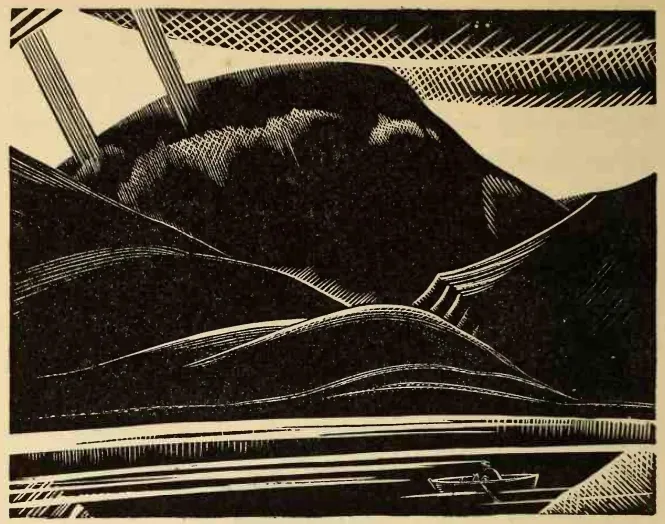
I will take one more passage parallel to this. Again he does something that he feels to be wrong. He finds a boat tied to a willow-tree on a moonlit night. He looses the boat and rows himself out onto the lake in it. It was, he says, an act of stealth. As he rowed, taking pride in his rowing, rising on his oars, he fixed his eyes on a bare ridge above which was nothing visible but the sky; as he rowed farther, gradually there opened up the view of a high, dark peak behind the ridge, and as he rowed on, the peak grew in height until it seemed to be something great and immense that was stalking after him. His conscience smote him; he took the boat back to the willow-tree and he went home, but after that, his conscience working in him, he was haunted by the vision he had seen of the peak. In a passage, too long to quote in full, he tells what he felt, and he ends with these words:
...for many days my brain
Worked with a dim and undetermined sense
Of unknown modes of being; o’er my thoughts
There hung a darkness, call it solitude
Or blank desertion. No familiar shapes
Remained, no pleasant images of trees,
Of sea or sky, no colours of green fields;
But huge and mighty forms, that do not live
Like living men, moved slowly through the mind
By day, and were a trouble to my dreams.
I quote these passages to make this observation. You observe that on both occasions he thought in himself that the acts he had done were wrong. There is no trace that he felt any fear of being found out, no trace that he dreaded human censure or punishment by his guardians or those who looked after him, or by any human agency; no trace of his caring for what others might think of his conduct. His own conscience finds the reproof in what he thinks he sees in the aspects of Nature; and so you will find throughout ‘The Prelude’ an almost abnormal indifference to human censure; he is never depressed by blame nor elated by praise, but constantly worked upon by his susceptibility to the outward aspects of Nature. In that alone he found his education and discipline. He goes on to describe various things in childhood—all examples of a wonderfully free life—in words that bring home to us the experience of our own boyhoods; things like his climbing cliffs for the raven’s nest on a precipice so steep that he seemed hardly to be supported by foothold or handhold, but almost to be suspended in air; and then he says:
With what strange utterance did the loud dry wind
Blow through my ear! the sky seemed not a sky
Of earth—and with what motion moved the clouds!
Passages like this abound, and as you read on and turn the pages you see ‘Schooltime,’ ‘Schooltime,’ ‘Schooltime,’ all through two books at the top of every page; and in the text not a single mention of his once entering a school, having any lessons or teaching or discipline, any rewards or any punishment, and he sums up at last by a passage—again too long to quote—in which he says that he and his companions loved sitting up late at night till all other lights were out, scampering over the country in the daytime, leading a life of sheer pleasure so far as we can judge from ‘The Prelude,’ innocent but u...
Table of contents
- Title page
- TABLE OF CONTENTS
- PREFACE
- I-THE PLEASURE OF READING
- II-PLEASURE IN OUTDOOR NATURE
- III-RECREATION
- IV-SOME THOUGHTS ON PUBLIC LIFE
- V-WATERFOWL AT FALLODON
- VI-THE FLY-FISHERMAN
- VII-WORDSWORTH’S ‘PRELUDE’
- REQUEST FROM THE PUBLISHER
Frequently asked questions
Yes, you can cancel anytime from the Subscription tab in your account settings on the Perlego website. Your subscription will stay active until the end of your current billing period. Learn how to cancel your subscription
No, books cannot be downloaded as external files, such as PDFs, for use outside of Perlego. However, you can download books within the Perlego app for offline reading on mobile or tablet. Learn how to download books offline
Perlego offers two plans: Essential and Complete
- Essential is ideal for learners and professionals who enjoy exploring a wide range of subjects. Access the Essential Library with 800,000+ trusted titles and best-sellers across business, personal growth, and the humanities. Includes unlimited reading time and Standard Read Aloud voice.
- Complete: Perfect for advanced learners and researchers needing full, unrestricted access. Unlock 1.4M+ books across hundreds of subjects, including academic and specialized titles. The Complete Plan also includes advanced features like Premium Read Aloud and Research Assistant.
We are an online textbook subscription service, where you can get access to an entire online library for less than the price of a single book per month. With over 1 million books across 990+ topics, we’ve got you covered! Learn about our mission
Look out for the read-aloud symbol on your next book to see if you can listen to it. The read-aloud tool reads text aloud for you, highlighting the text as it is being read. You can pause it, speed it up and slow it down. Learn more about Read Aloud
Yes! You can use the Perlego app on both iOS and Android devices to read anytime, anywhere — even offline. Perfect for commutes or when you’re on the go.
Please note we cannot support devices running on iOS 13 and Android 7 or earlier. Learn more about using the app
Please note we cannot support devices running on iOS 13 and Android 7 or earlier. Learn more about using the app
Yes, you can access Fallodon Papers by Viscount Grey of Fallodon in PDF and/or ePUB format, as well as other popular books in History & Military Biographies. We have over one million books available in our catalogue for you to explore.