In Fighting Handguns, author Jeff Cooper not only takes the reader through the development of this weapon from its beginnings in mid-16th-century Europe through the various iterations of single- and double-action revolvers and semiautomatic pistols, he also discusses some important aspects of carrying and shooting a fighting handgun under combat conditions.
"For good or ill, man is a fighting animal. While most feel that this is an unmitigated evil, it may, like most aspects of nature, have its positive side. Certainly man's combative nature is responsible for most of the massive tragedy of history, but it's possible that history of any sort just wouldn't have happened had it not been characteristic of the race to struggle against its environment. And man's environment, of course, includes man. A placid, gentle, contented creature—a koala, for instance—is nice to contemplate but does not progress, and if it encounters a challenge it simply dies. Whether progress, at the price of a fighting disposition, is worth it is a question, but it's a bit on the academic side. Man is the way he is, and gets along as he must. Being human, we are involved in strife. Much as we may deplore this, we must master the techniques of strife or perish.
"This book is devoted to one of these techniques—the one-hand firearm as used by man against man."—Jeff Cooper
- 200 pages
- English
- ePUB (mobile friendly)
- Available on iOS & Android
eBook - ePub
Fighting Handguns
About this book
Information
Subtopic
Military & Maritime HistoryIndex
HistoryCombat Pistol Techniques
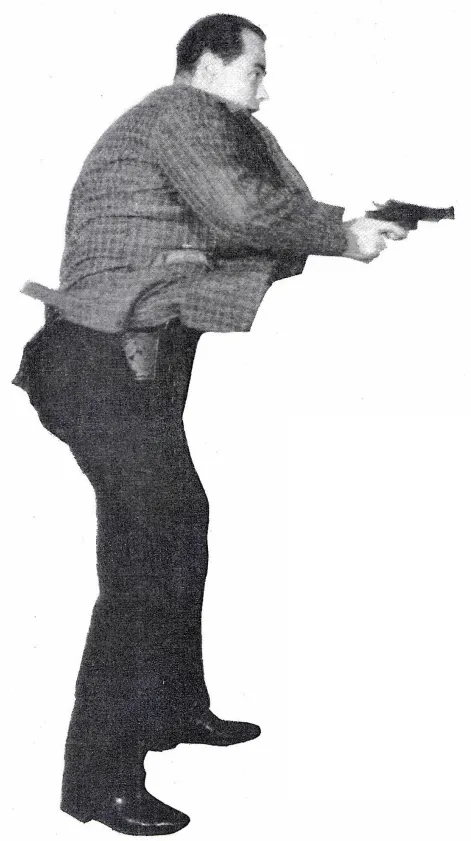
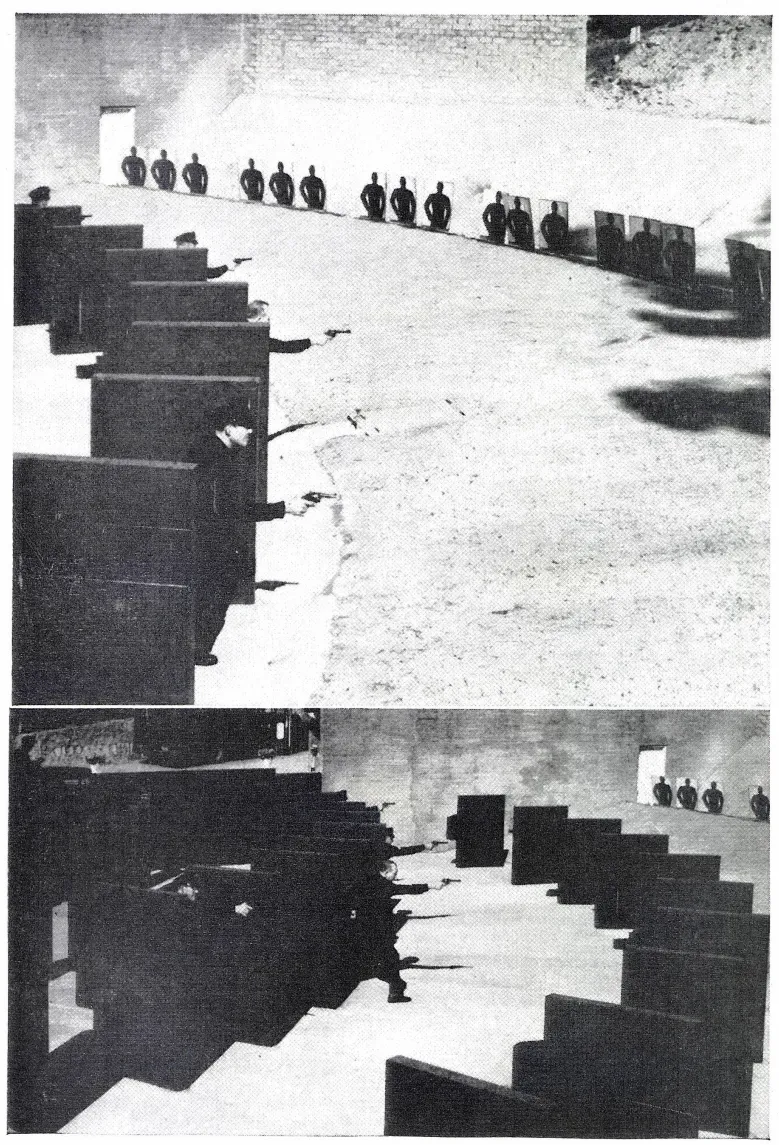
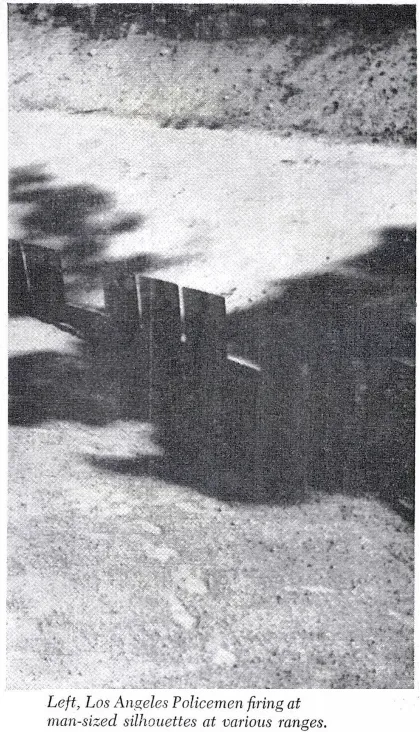
Primarily, the pistol is a fighting tool, and one’s ability to use a pistol is a fighting technique. Marksmanship is a large part of this, but by no means all. It’s quite possible for a man to be an excellent pistol shot and a very poor gunfighter, but it’s nearly impossible for a man to be a good gunfighter without being at least an acceptable marksman. Therefore, the first step in mastering the handgun is to become proficient in conventional pistol marksmanship. The degree of proficiency is debatable, but if pressed I would say that until a man can put nine out of ten shots into a six-inch ring at 25 yards, using a major caliber weapon—slow fire—offhand, he is not ready to take up combat technique. Some training systems avoid bullseyes entirely in order to maintain confidence, using silhouettes only and gradually increasing the range. If this is done I would say that all shots must be kept in the silhouette at 50 yards, under the same conditions. Target pros will sneer at these standards as far too easy, but quick-draw cowboys may think they’re too tough. They’ll do as a compromise.
GUN SELECTION
You should learn your fighting technique with one gun, as it will be hard enough to acquire without confusing your reflexes with a variety of tools. If you have read the rest of the book it will be clear that I believe the available choice of effective combat pistols to be somewhat limited. This is rather a good thing, since you don’t have to wade through a confusingly long list.
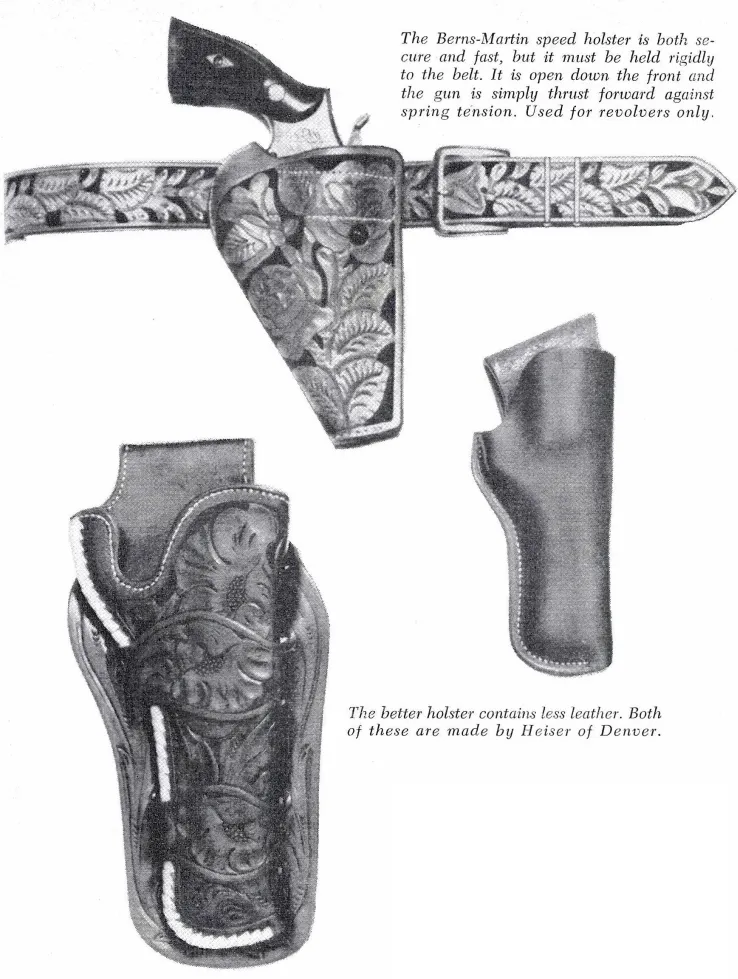
First, if your need for a handgun is such that minimum size and weight are overriding considerations and actual combat efficiency is secondary, you should select one of the aluminum .38 Specials. Full particulars are given in the chapter on pocket pistols, but my choice (by a slender margin) would be the Smith & Wesson “Bodyguard.” Immediately upon purchase I would fit it with a set of handfull grips and have its action worked over to provide a smooth, light, double-action pull. I’d do this before I even fired it, so as not to be demoralized on my first session at the range.
Second, if you are sold on a sixgun (or are required to use one by your organization, or have access to a lot of cheap .38 Special ammunition) and want to use the lightest revolver you can get which will still give you adequate stopping power, pick either the S & W Combat Magnum or the Colt “Three-Fifty-Seven.” With four-inch barrels and current factory loadings these guns are a little on the feeble side, but they weigh only 35-36 ounces, and they’ll take the .38 Special round for practice. The Smith comes with a good grip and the Colt may be had with one for $10 extra, but it will probably be necessary to have either of them tuned for good double-action behavior.
Third, if you feel that great power is your prime need, and that you don’t mind the weight and bulk it entails, there is only one gun for you—the Smith & Wesson .44 Magnum. It needs no modification, unless you might wish to lighten its double-action a bit by means of its adjusting screw.
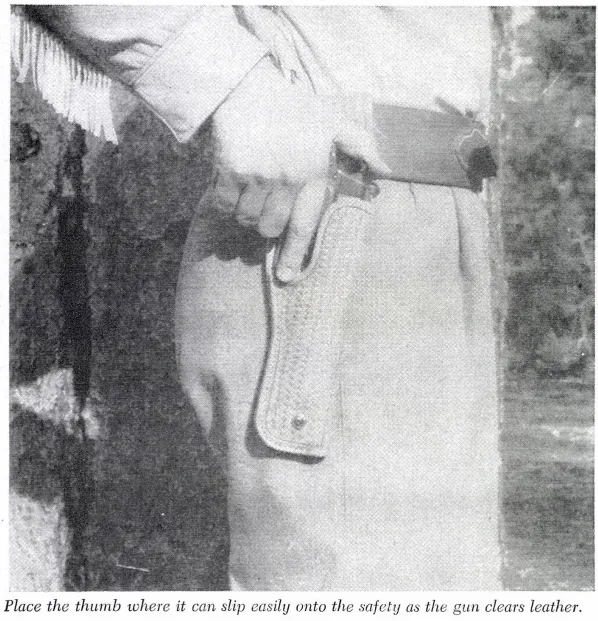
Lastly, if you favor light-weight compactness and speed, together with full adequate stopping power and penetration, plus the ability to stay in the fight for more than a few shots, you want a Colt Commander .45. This gun needs modification of the grip, and a trigger job. In addition you must pin the grip safety shut and weld an extension on the thumb safety for quick, certain operation. But these changes are not too difficult or expensive, and there is the advantage of being able to use G.I. ammunition, which is sometimes available to civilians at reduced rates, for practice. Only the Super-X factory load, or handloads, should be used for business.
So much for picking your gun. There are a couple of dozen others which will do, if you already own one of them, but anyone buying a new gun, for combat purposes, should stick to one of these four choices. Target shooting, plinking, trail work, and small game hunting are something else again.
BIG BORE PRACTICE
Having bought your business gun and prepared it, the next step is to repeat the work you did with the .22, using the big gun with light loads. Use target wadcutters in the hideout gun, and either these or G.I. .38 Specials in the .357. Use .44 Special factory loads, or similar light handloads, in the .44 Magnum, and target wadcutters or G.I. fodder in the Commander.
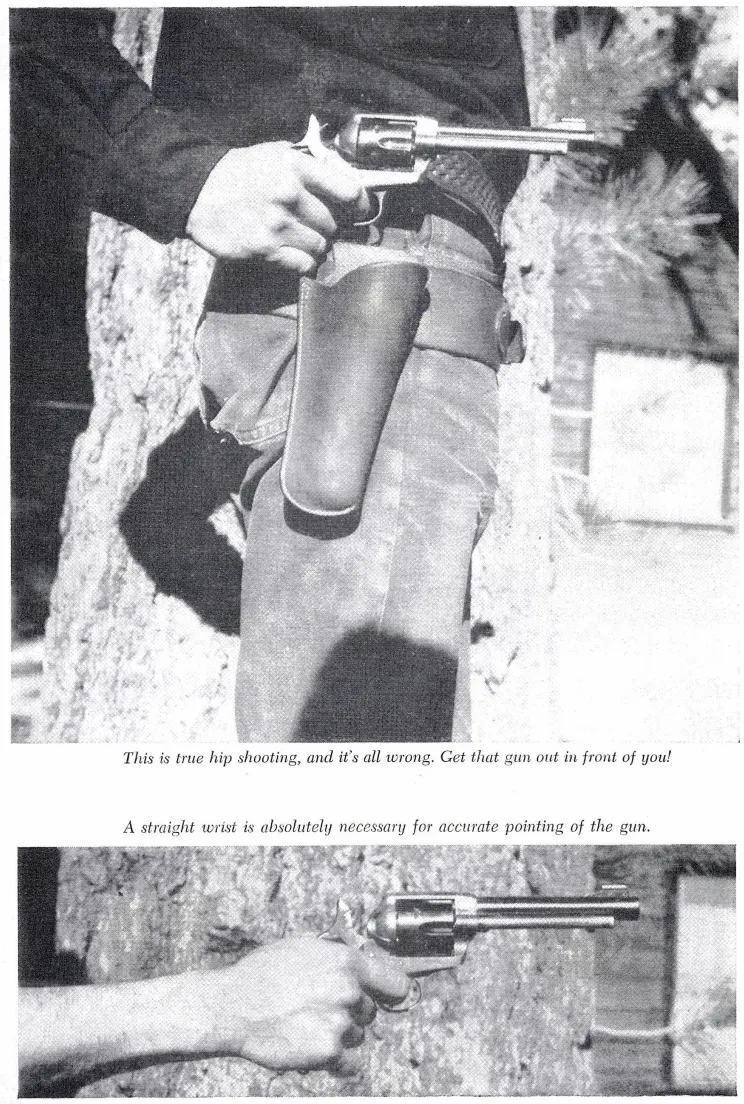
When you can deliver adequate rapid fire groups with this combination, the road forks. Here the revolver man must take up double-action work, while the auto-pistol user need not. If the sixgunner wants to cover the whole field, he must work with offhand, sighted, double-action, as well as with pointed double-action from waist level. The chance to skip this phase of training is one reason why I favor the auto-pistol.
Our budding gunfighter is now a pretty fair hand with a pistol—he’s about as good as old-fashioned official training programs can make him. If he can keep all his shots in that six-inch bull at 25 yards, and do it quickly, he’ll make “expert” on the military course.
POSITION SHOOTING
At this point I favor a short course in what might be called “field shooting,” for lack of a conventional term. This involves the study of the various positions which a handgunner can assume to increase his accuracy, and in some cases to provide cover from return fire. These positions are illustrated, and should be practiced until they feel natural. Most circumstances offer the shooter a rest of some kind, and he should certainly know how to take advantage of it. Even if caught completely in the open, and prevented by grass or brush from using prone, the experienced gunfighter can assume the standing-rest position just as quickly as offhand and probably double his effective range.
I’ll admit that the two sitting positions are of more use on the trail than in a fight, but the prone and wall-rest positions are both excellent ways to shoot straighter and reduce your enemy’s target at the same time. The wall-rest, both right-and left-hand, is a favorite of the F.B.I., who expect a lot of business in city streets. It takes up half of the Bureau’s “Practical Pistol Course.”
POINTER FIRE
It’s an axiom that hitting your target is your main concern, and the best way to hit is to use your sights, but circumstances do arise in which the need...
Table of contents
- Title page
- TABLE OF CONTENTS
- The Beginning
- Before the Revolver
- Sam Colt and the first Revolvers
- Metallic Cartridges and the Peacemaker
- The Western Tradition
- Double Action
- The Autoloading Pistol
- Pocket Pistols
- Combat Pistol Techniques
- The Power of Pistols
- Odds and Ends
- REQUEST FROM THE PUBLISHER
Trusted by 375,005 students
Access to over 1.5 million titles for a fair monthly price.
Study more efficiently using our study tools.
Frequently asked questions
Yes, you can cancel anytime from the Subscription tab in your account settings on the Perlego website. Your subscription will stay active until the end of your current billing period. Learn how to cancel your subscription
No, books cannot be downloaded as external files, such as PDFs, for use outside of Perlego. However, you can download books within the Perlego app for offline reading on mobile or tablet. Learn how to download books offline
Perlego offers two plans: Essential and Complete
- Essential is ideal for learners and professionals who enjoy exploring a wide range of subjects. Access the Essential Library with 800,000+ trusted titles and best-sellers across business, personal growth, and the humanities. Includes unlimited reading time and Standard Read Aloud voice.
- Complete: Perfect for advanced learners and researchers needing full, unrestricted access. Unlock 1.5M+ books across hundreds of subjects, including academic and specialized titles. The Complete Plan also includes advanced features like Premium Read Aloud and Research Assistant.
We are an online textbook subscription service, where you can get access to an entire online library for less than the price of a single book per month. With over 1.5 million books across 990+ topics, we’ve got you covered! Learn about our mission
Look out for the read-aloud symbol on your next book to see if you can listen to it. The read-aloud tool reads text aloud for you, highlighting the text as it is being read. You can pause it, speed it up and slow it down. Learn more about Read Aloud
Yes! You can use the Perlego app on both iOS and Android devices to read anytime, anywhere — even offline. Perfect for commutes or when you’re on the go.
Please note we cannot support devices running on iOS 13 and Android 7 or earlier. Learn more about using the app
Please note we cannot support devices running on iOS 13 and Android 7 or earlier. Learn more about using the app
Yes, you can access Fighting Handguns by Jeff Cooper in PDF and/or ePUB format, as well as other popular books in History & Military & Maritime History. We have over 1.5 million books available in our catalogue for you to explore.