When Handguns Afield was first published in 1961, hunting with a handgun was in its infancy. Surely settlers and cowboys of the 19th century would have used a handgun on wild game from time to time to fill the campfire stewpot, but as far as using a handgun for hunting as a pastime, this sport was not yet widely recognized.
Author Jeff Cooper expertly summarizes the various aspects of hunting with handguns in the few dozen pages of this volume. Handguns, cartridges, holsters, and shooting small and large game are all thoroughly described and explained here. If the average handgun shooter follows the advice of this book—most of which is still relevant today—he will be prepared to hunt game with a pistol.
"THE MAN who wants to take game with a pistol must realize that if he is to be successful he must be good. He must be a good woodsman, a good hunter, a good sportsman, and an extremely good shot. Because he cannot reach out as with a rifle, he must be able to get right up on his target, and this takes both knowledge of game and much stalking skill. The more open the country, the more skill is required. In thick brush the pistol is handier than the rifle, and the problem becomes one of moving-target marksmanship.
"The pistol hunter is more agile than the rifleman, since he has both hands free to use in climbing or parting brush. For the same reason he may be quieter. These things help him in very rough, heavily wooded terrain. In fact, every aspect of hunting is easier for the handgunner than for the rifleman—except hitting. Therefore marksmanship is the big problem."—Jeff Cooper

- 80 pages
- English
- ePUB (mobile friendly)
- Available on iOS & Android
eBook - ePub
Handguns Afield
About this book
Information
Subtopic
Military & Maritime HistoryIndex
HistoryCatalog of Cartridges
IN THIS CHAPTER I will list and describe those pistol cartridges which I believe to be suitable for game shooting. I make no attempt to include every cartridge which might conceivably be used for this purpose, as this would be confusing. Two excellent small game rounds—the .32-20 and the .30 Mauser—are not covered because handguns are no longer made for them. While only high velocity cartridges (in pistols this implies 1300 f/s or over) are really serviceable for all around use in the field, certain standard velocity calibers are mentioned because they can be most useful in particular circumstances. Velocities given are naturally related to pistol-length barrels.
.22 RIM-FIRE LONG RIFLE
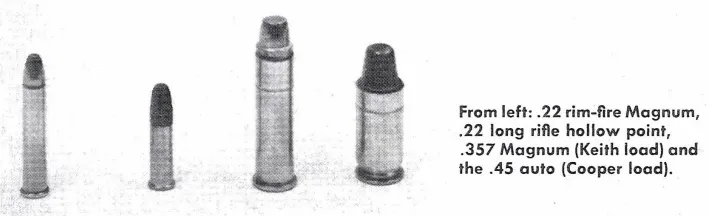
This cartridge is almost too well known to mention. It is nearly the oldest and by a huge margin the most popular round in existence. It is the ideal training and practice load, and it is also quite suitable for the smallest game. It is fantastically accurate, very flat shooting with the high-velocity loading, and has so little recoil and noise that the novice readily masters it. Retail it cost about 1½ȼ per round, so that much shooting may be had for a very reasonable cost. The empties may not be practically reloaded.
One of the attractive things about the .22 is that modern powders, primers, and bullet coatings make it unnecessary to clean the bore after firing. Tests have shown that under most conditions the bore is actually better protected against corrosion if it is not cleaned. Of course if the weapon is to be placed in storage in a damp climate it should be greased, but ordinarily a .22 needs no internal care.
The basic .22 rim-fire cartridge is manufactured in three lengths—“short,” “long,” and “long-rifle.” Revolvers will usually take all three sizes, while auto pistols must be chambered either for the long-rifle or the short. The long never had any purpose that I can discover, and today only three of the nine available combinations need be considered. The standard-velocity, solid, short is useful for indoor practice. The standard-velocity, solid, long-rifle is best for target shooting as it is very slightly more accurate and a bit cheaper than the hunting round. The high-velocity, hollow-point, long-rifle is the cartridge for the field, and your pistol should be zeroed for this round if you intend to hunt with it.
The standard .22 is good for squirrels, iguanas, snakes, and small to medium birds. In spite of what has been done with it, it is not a satisfactory round for jackrabbits, cottontails, turkeys, or marmots. Because pistols may be had for it which weigh only a pound or so, it is a wonderful source of groceries for the backpacker, as long as he confines himself to targets within its reach.
The high-velocity hollow-point bullet weighs 36 grains and leaves a pistol at about 1200 f/s. Its energy is some 120 ft/lbs.
.22 RIM-FIRE MAGNUM
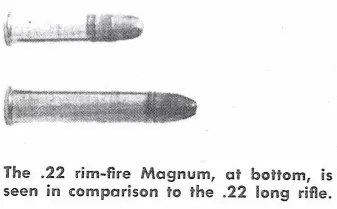
This is an attempt to jazz-up the .22 rim-fire so that it will be a satisfactory killer on all small game. It throws four more grains of lead at 350 more f/s than the long-rifle high-speed hollow-point. To get this you pay 5½ȼ per round instead of 1½ȼ, and you cannot reload the empties.
The .22 Magnum unquestionably does kill better than the long-rifle, and is apparently a practical round for jackrabbits. However it is not as good a killer as any of the good center-fire rounds, most of which may be custom-loaded for about the price of the factory rim-fire Magnum.
.22 CENTER-FIRE
These are “wildcats.” They must be made to order by custom gunsmiths and are thus necessarily expensive. The .22 K-Chuck is a Smith & Wesson K-22 modified to take a shortened version of the .22 Hornet cartridge, while the .22 Stabnau is a Great Western single-action .22 modified to take the .218 Bee.
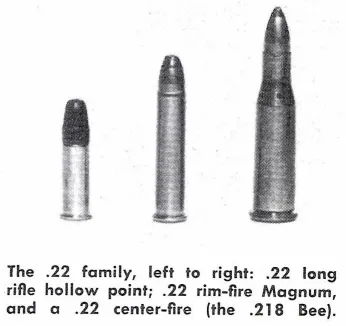
Throwing 46-and 48-grain bullets at around 2000 f/s, these guns are great fun to shoot. The recoil is negligible and yet the bullet seems to be right on the line of sight right out to the shooter’s holding limit. With glass sights these pistols perform literally “like a rifle.”
While the great majority of pistol shooters cannot shoot well enough to take advantage of them, the .22 center-fires can provide the master shot with a belt gun suitable for all small game to 150 yards. These cartridges can be reloaded at a figure lower than that of the over-the-counter .22 Magnum.
.38 SPECIAL
This cartridge, standard with most of police forces, is a very poor combat round but comes into its own on the target range. It is magnificently accurate, and while its velocity is too low for use at long range it is fine for small game at short distances. Very accurate pistols are made for it, enabling a good marksman to take head shots on squirrels, rabbits and grouse with confidence.
It is loaded in all sorts of ways, both commercially and privately, but only full wad-cutter or Keith-type bullets should be used on live targets. I have had excellent luck with the squib-loaded target wadcutter on such things as crows and owls—the chopping action of the slow-moving, soft-lead cylinder putting them down and out humanely without mutilation. Of course you have to get up close with this load, for its rainbow trajectory prevents any fancy work.
There is a hot load for the .38 Special intended for use in heavy-frame revolvers and generally known as the .38-44. Its 158-grain Keith bullet at nearly 1200 f/s encroaches upon the lower limits of the .357. Its 100-yard trajectory ordinate of 4.2″ makes it a fair hunting arm for medium game, but since the .357 will do everything the .38-44 will, and do it better, the latter must be regarded essentially as a substitute.
.38 Special ammunition retails for a little less than 10ȼ a round, while good reloads may be had for 3ȼ.
SUPER .38
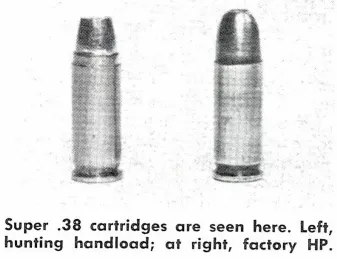
This is an auto pistol cartridge, and auto pistols are not usually thought of as hunting weapons. However, in a carefully accurized gun, fitted with accurately adjustable sights, the cartridge will perform well on medium game if proper bullets are used. I have taken bobcats and coyotes with the 130-grain factory hollow-point at 1300 f/s and have had no reason to complain, but I cannot recommend the full-jacket round-nosed bullet currently loaded. The latter seems to slip through tissue like a knitting needle, causing death by loss of blood but too late to matter much to the hunter. In an animal so heavy that the solid bullet would remain in the body, the Super .38 might make better use of its energy, but certainly no one with good sense would try to take a heavy animal with a weapon of this power.
Ammunition (full-jacket solid only) retails at about the same figure as the .38 Special. Reloading is a little more of a problem with the auto than with a revolver, but it can be done.
(The 9mm Parabellum cartridge of the Luger, P-35, P-38, S.I.G., etc. is similar to the Super .38 though slightly less powerful. Using proper bullets in very accurate pistols, it is satisfactory for small game.)
Factory ammunition for the Super costs 10½ȼ.
.357 MAGNUM
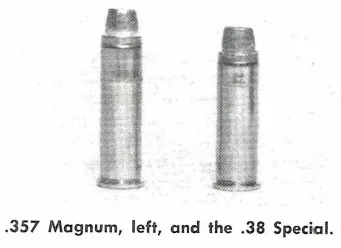
This is the hot version of the .38 Special, with a case lengthened ⅛″ so you can’t accidentally drop a Magnum cartridge into a gun not designed to take its pressure. You can, on the other hand, shoot .38 Specials in a Magnum. In Mexico today this cartridge is called simply the “.38 Magnum.”
When originally introduced in 1935 this round fired a 158-grain Keith bullet at 1510 f/s from an 8⅜″ barrel, which up till then had only been surpassed by the Gabbett-Fairfax “Mars” pistol (9mm, 156 grains, 1750 f/s, 1040 f/lbs. ). Since these ballistics produced a 100-yard trajectory ordinate of under 2½”, it was for the first time possible to sight a big-caliber pistol for six o’clock at 50 yards and achieve a point-of-aim group at 100. This opened vistas, for the medium-weight bullet, with its excellent game-killing design, was still moving fast enough out at 150 yards to hit pretty hard. This was the first of the “big-game” pistols.
Unfortunately, it has been foolishly overrated. There is no magic in ballistics, and when it is seen that a .30-30 rifle bullet of almost identical weight is moving as fast at 300 yards as a .357 bullet is at the muzzle, a lot of the extravagance of the pistol’...
Table of contents
- Title page
- TABLE OF CONTENTS
- The Sidearm as a Sporting Weapon
- Handgun Hunting
- Small Game
- Large Game
- The Auxiliary Pistol
- Field Marksmanship
- Sights and Sighting
- Hunting Ammunition
- Catalog of Cartridges
- Double Single Action?
- Field Holsters
- REQUEST FROM THE PUBLISHER
Trusted by 375,005 students
Access to over 1.5 million titles for a fair monthly price.
Study more efficiently using our study tools.
Frequently asked questions
Yes, you can cancel anytime from the Subscription tab in your account settings on the Perlego website. Your subscription will stay active until the end of your current billing period. Learn how to cancel your subscription
No, books cannot be downloaded as external files, such as PDFs, for use outside of Perlego. However, you can download books within the Perlego app for offline reading on mobile or tablet. Learn how to download books offline
Perlego offers two plans: Essential and Complete
- Essential is ideal for learners and professionals who enjoy exploring a wide range of subjects. Access the Essential Library with 800,000+ trusted titles and best-sellers across business, personal growth, and the humanities. Includes unlimited reading time and Standard Read Aloud voice.
- Complete: Perfect for advanced learners and researchers needing full, unrestricted access. Unlock 1.5M+ books across hundreds of subjects, including academic and specialized titles. The Complete Plan also includes advanced features like Premium Read Aloud and Research Assistant.
We are an online textbook subscription service, where you can get access to an entire online library for less than the price of a single book per month. With over 1.5 million books across 990+ topics, we’ve got you covered! Learn about our mission
Look out for the read-aloud symbol on your next book to see if you can listen to it. The read-aloud tool reads text aloud for you, highlighting the text as it is being read. You can pause it, speed it up and slow it down. Learn more about Read Aloud
Yes! You can use the Perlego app on both iOS and Android devices to read anytime, anywhere — even offline. Perfect for commutes or when you’re on the go.
Please note we cannot support devices running on iOS 13 and Android 7 or earlier. Learn more about using the app
Please note we cannot support devices running on iOS 13 and Android 7 or earlier. Learn more about using the app
Yes, you can access Handguns Afield by Jeff Cooper in PDF and/or ePUB format, as well as other popular books in History & Military & Maritime History. We have over 1.5 million books available in our catalogue for you to explore.