Here is all the magnificent color, the sweep, the rich romance of a brilliant era. Here are the three unforgettable men who dominated it—and the strong-willed women who destroyed one of them and sought to enslave another.
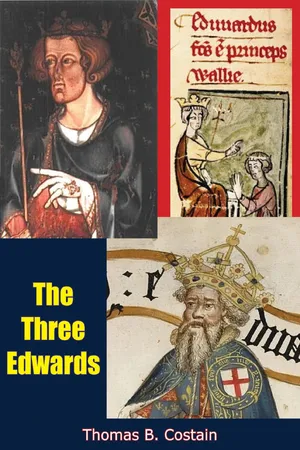
THE THREE EDWARDS, third in Thomas B. Costain's survey of Britain under the Plantagenets, covers the years between 1272 and 1377 when three Edwards ruled England. Edward I brought England out of the Middle Ages. Edward II had a tragic reign but gave his country Edward III, who ruled gloriously, if violently.
First published in 1958, The Three Edwards, written by "one of the great storytellers of our time," Thomas B. Costain, is the third volume in the brilliant series, including The Conquering Family, The Magnificent Century and The Last Plantagenets.
"Deals with turbulent human experience...a wonderful story."—New York Herald Tribune
"So colorful and gusty is his style, so filled with phrases that grip and hold, no fiction he ever wrote holds the breathless interest of the reader more tightly...Here is an historical tapestry, filled with Color and movement...with kings and nobles, their wives and their doxies...with sound and fury unknown in our age of science without chivalry"—Miami Herald
"DRAMATIC...THE FIGURES OF HISTORY COME MAGICALLY TO LIFE"—Ladies Home Journal
"Under the touch of Mr. Costain's brilliant pen, the era comes alive...fills his pages with a lively combination of biography, history, anecdote—yet seldom does he miss the mark of historical accuracy...not only exciting reading, but also stimulating and rewarding."—Christian Science Monitor
"Fascinating...Costain writes history with the pen of a novelist...This century yields inspiration in its richly narrative patterns."—Virginia Kirkus
"No events that Mr. Costain enlivens with his magic pen can fail to gain some luster from the contact."—Saturday Review
- 459 pages
- English
- ePUB (mobile friendly)
- Available on iOS & Android
eBook - ePub
The Three Edwards
About this book
Information
Subtopic
British HistoryIndex
HistoryBook Three—EDWARD THE THIRD
CHAPTER ONE—Hamlet on the Steps of the Throne
1
The foul deed which brought to a close the days of that poor shadow of a king, Edward II, inaugurated a reign which would touch the peaks. Edward III was the most spectacular of the Plantagenets; fair, of goodly proportions, with a face, so it was said, of a demi-god; a conqueror, brave, vainglorious, extravagant, ostentatious; somewhat shallow of character, lacking, at any rate, the deep sense of kingly responsibility which has kept the memory of his grandfather so green. It must have been a great sight to watch the third Edward riding in a tournament, his lance expert and deadly, his delight in the sport so keen. Or to observe him in his brilliant and gay court, strutting like a peacock in the velvets he loved, the doublepiled new varieties from Lucca and Genoa; his voice richly modulated, his laughter spontaneous, an intimate look in his eye for every pretty lady.
These were the days when chivalry reached its greatest height in England. The armies with which Edward defeated the French and came so close to establishing his claim to the French throne were filled with knights of spirit and repute, knights-errant in the fullest sense of the word, about whom much will be told later. One of the stories of the period which is repeated with the most gusto concerns a beautiful lady of the court who had dressed herself for a ball with such splendor that a line from Piers Plowman seems to fit her: “Her array ravished me, such richness saw I never.” But the lady’s dress had beauties which did not show on the surface, and when she lost a most necessary part of her attire, a delicate thing of rich silk with jewels nestling in its rosebuds, and the king found it, he was inspired (or so runs the story) to form the Order of the Garter, which has been the only rival for the legendary Round Table of Arthurian days. It may be recorded also that only the most perfunctory efforts were made to capture a Frenchwoman of high rank who set herself up as a pirate in and around the Channel. Was she not a lady and beautiful, forsooth?
But the rise of chivalry was no more than the flare-up before its final extinction. The brave knights were certain, no doubt, that they had won Crécy and Poictiers, but a realistic vision would have taught them a different story. Those great battles were won by stout-limbed, brawny-backed, sun-bronzed fellows of low degree who wore lincoln-green jerkins and had a deadly skill with a new weapon called the longbow. The chivalry of France died under the lethal hail of English arrows, without realizing that the fine bloom of chivalry withered with their passing. An insignificant item is found (without foundation) in Froissart. The English, he reports, had something very strange called cannon; long-snouted barrels of bronze which spewed forth shells under the compulsive force of a substance that a very great Englishman named Roger Bacon had discovered a century before, gunpowder. But the longbow and the death-dealing powder would soon revolutionize warfare and change it from the sport of knights to a much deadlier business: the clash of great armies and the use of artillery which would cover battlefields with smoke and cut wide swaths of death in the serried ranks. A form of conflict in which the exquisite rules of chivalry would have no part at all.
The fifty long years of Edward’s reign make robust telling after the shambles of his father’s rule, although the third Edward took no interest in constitutional matters, granting rights to his subjects with a careless flourish of his pen and then trampling on them with equally careless steel-shod feet. But progress was made under these conditions toward democratic understandings. It was a period also of commercial expansion, a prosaic phase of life in which the king, strangely enough, seemed to take a great deal of interest. Perhaps his consort, Philippa, who came from the Low Countries, where business had become the most important part of life, had influenced him in that direction. His chief interests remained, however, diplomacy and war; and because he was skilful in the one and bold and lucky in the other, he scaled the heights.
Alexandre Dumas, the elder, has asserted that a man reaches the full prime of life between his forty-sixth and forty-eighth years. When Edward III was forty-six he held on St. George’s Day at Windsor the most magnificent tournament of the age and competed mightily himself. That Christmas he had among his guests the kings of France and Scotland, both of whom had been taken prisoners in their wars with England and were being held in captivity; and he was entertaining at the moment proposals of peace by which he would have been awarded all of the southeast of France in full sovereignty. This would have restored to him the Angevin empire which had been lost by John and Henry III. The novelist seems to have been right as far as Edward was concerned. When the yule log was dragged into the hall and the three monarchs watched the merrymaking over their goblets of hippocras (a cordial highly spiced and strained through a hippocratian bag of cloth or linen), the English king was at his zenith.
2
For four years the young king was supposed to be under the guidance of the council which had been set up by Parliament, but in reality there was a regency in operation. Queen Isabella had expected to be made regent, and when that honor was denied her she had proceeded coolly to assume all the powers and responsibilities of the post, with Mortimer always at her right hand. The boy seems to have acquiesced. In any event, he did nothing immediately to express disapproval or to interfere with his mother’s highhandedness. He even allowed her to appropriate for herself nearly all of the royal funds, two thirds of everything, in fact.
What was the young king thinking as he watched his still beautiful and still popular mother (although the first rumblings of discontent were being heard in the land) assume all the powers of the throne? What were his feelings toward the strutting, arrogant Mortimer, who was proving himself more dangerous and grasping than Gaveston or the Despensers had ever been? Above all else, what did he think of the relationship between them? If he did not know they were living in almost open sin, his were the only eyes in the kingdom which had failed to detect the truth.
Edward, it may be taken for granted, was watching everything and biding his time. A Hamlet in his early teens, he was not in a position to act at once. He knew the fierce temper and the savage methods of Mortimer and he had seen how dilatory and feeble were the men who made up the council. He might be as roughly thrust aside as his father had been. Did he want to share the fate of Arthur of Brittany, who had stood in the way of John of infamous memory? All the qualities he would later display were developing in the young king and would manifest themselves when he felt it safe to make his move. In the meantime he did not mope as Hamlet had done. There was no mooning about the battlements of the White Tower, no soliloquizing at midnight in the ghostly lunar light through the arches of the great hall at Westminster. He was bestirring himself in many ways. And he was watching the men about him, weighing their merits and the courage they had in them, considering, discarding, and finally selecting the few he could take into his confidence.
There were two things he could do while he waited. He could lead an army against the Scots, who had come down in full force and with fire and sword into the northern counties. And he could take the necessary steps to marry his Philippa.
Queen Isabella, who had reason to know the Plantagenet ways, was apprehensive of her son. She wanted to keep him in the background as long as possible, but she saw the need to have him occupied. Accordingly she took his proposed marriage in hand and persuaded the members of the council that a daughter of the house of Hainaut would be the most suitable wife for him. Care was taken not to let the members know that the young king’s mind was already made up. It was their business, not his, to find him a wife. The document finally drawn up gave their consent to a match with “a daughter of that nobleman, William, Count of Hainaut, Holland and Zealand and Lord of Friesland.” No mention was made of Philippa. Any one of the four daughters apparently would suit the council. The next step was to send a deputation to Count William to lay the proposal before him, and Adam of Orleton was selected to head it.
It will be remembered that when King John sent a deputation to Rome to aid in selecting an Archbishop of Canterbury he told them they could vote for anyone they desired, provided it was the king’s candidate. Adam of Orleton was given secret instructions of a similar nature. Use your own judgment, Sir Bishop, in selecting one of the four, provided it is Philippa.
The deputation traveled to Valenciennes, where Count William resided with his bevy of pretty daughters, and there was much solemn discussion as to which one was to be selected. It is likely that Philippa did not worry, remembering the long talks she had had with the handsome young prince, their rambles together in the gardens, the vows of fidelity he had sworn. Adam of Orleton finally gave his head an owl-like shake and announced the selection of the fairest, the most apple-cheeked, the somewhat plumper one of the four.
Then the matter of the Pope’s sanction came up, for the two mothers were cousins-german and so within the bounds of consanguinity. It was decided to send messengers at once to Avignon to win the papal nod, for an urgency was recognized in getting the matter settled without delay. Edward, after all, was a boy in years and not allowed to make his own decisions. His mother was no longer a suppliant for military aid and she might change her mind in favor of a more important match. And finally there was Mortimer, with daughters of his own and a willingness, possibly, to solidify his position by marrying the prince to one of them. Two Flemish knights and a parcel of clerks were sent off on horseback with instructions to ride fast and long and get the papal consent before London could change its mind.
British poets have been partial to recording the stories of urgent rides. There is the midnight race from Ghent to Aix, the horseback perambulations of John Gilpin, and the mad ride of Tam o’ Shanter. Some bard should have selected the journey of the two knights of Hainaut. They had to cover the whole face of France, starting at Valenciennes, traversing the full depth of Burgundy, then through Auvergne, striking sparks from the rocky roads and pausing only long enough to bawl for relays, passing Rheims, Troyes, Dijon, and Lyons, and coming finally to the city of Avignon perched high on the banks of the mighty Rhône; Avignon, once called the windy city because it lay directly in the path of the hot mistral which blew across the Mediterranean, but was now the new home of the popes.
Rome had become almost a ghost city. Her great palaces and cathedrals were empty and silent, for the personnel and machinery of the papacy had been moved to Avignon. Lacking all facilities for accommodating the thousands of priests and clerks and functionaries of all classes, not to mention the acolytes and guards and servants who had come pouring out of Italy at the beck of lordly France, Avignon had become a place of chaos. Pope John XXII was madly busy raising the buildings which would become known as the Palace of the Popes on the rocky Rocher des Doms. He had two thoughts only in mind—speed and solidity—and was not attempting to match the grandeur and solemnity of Rome. The result would be a depressing cluster of gray stone structures where the affairs of the papacy would be conducted for seventy long years. About them miles of square stone ramparts were rising, and in course of time no fewer than thirty-nine massive towers would be added.
When the weary knights from Hainaut came galloping into Avignon, the streets were crowded with priests afoot and on muleback, there were three albs in every attic, and the church bells were competing with the whine of saws and the screech of winches. Architects and master masons and carpenters were trailing dust through the anterooms of the Pope while clerical deputations sat unnoticed and bit their fingernails in impatience.
Pope John was a tiny man, with hunched shoulders which made him look deformed. He had been born in Cahors, the son of a poor cobbler, and he was still so partial to his old home that seven out of the fifteen cardinals he appointed came from that somewhat insignificant city; an extraordinary thing, surely, for a pope to do. He proceeded now to do something which also seems extraordinary. Instead of letting the Flemish knights wait their turn outside, a matter perhaps of months, he had them in at once. He listened to what they had to tell him, nodded his head, and said “Yes.”
3
The Scots had been feeling their oats since Bannockburn. Rome had at last recognized Robert the Bruce as king of the country and there was peace with England, a nominal kind of peace, since the people on both sides of the border paid little attention to it. The succession to the throne had been well established by the arrival of a son who was given the name of David. This Scottish prince was a fine, handsome lad with strong limbs and a will and a fierce temper of his own; all the qualities, in fact, which are looked for in candidates for thrones.
Immediately after the deposition of Edward II, old Robert the Bruce decided it would be a good thing to teach the new king a lesson. He sent his two eager warriors, the Black Douglas and Randolph, Earl of Moray, down into Northumberland to stir up the Sassenach. Things had indeed changed for the Scots. The whole troop was mounted, even the poorest clansman having some sorry sort of Galloway nag of his own. This was the kind of warfare in which they excelled. They had no kitchens, no food supplies, no lumbering wagons to hamper their movements. Each horseman had his bag of oatmeal and, at the worst, he could sustain himself for a long time on that, cooking it on a metal plate. When luck favored them and they picked up English cattle, they would roast or boil the animals in their skins and each man would then carry a haunch over his shoulder. They came and went like the wind and they left behind them the scent of burning homesteads and the wailing of new-made widows and the weeping of children.
The English decided to put a stop to this kind of raiding. A large army was raised, nearly sixty thousand men, and Sir John of Hainaut was brought back with a body of trained Flemish cavalry to help. The young king, eager to win his spurs, rode to Durham and assumed command; a nominal command, since Sir John was there to advise him and all the best English generals, none of whom was very good. It might have seemed to a shrewd observer that the powers behind the throne, the ambitious queen and her constant attendant Mortimer, were content to keep the prince busy at something, even to place him at a disadvantage. They did not want him to emerge victorious from the war like his grandfather and that prince of glowing memory, Richard Cœur-de-Lion. It was farthest from their thoughts to supply the people with a young hero, to the end that they, Isabella and her gentle Mortimer, would be shoved into the background.
He had no chance to win against the Scots. Twenty thousand strong, the horsemen of Douglas and Randolph were never where the English expected to find them. Finally the prince got sound information and caught up with them. He located them in such a strong position back of the Wear River that he dared not attempt a crossing in front of them. After a long wait, hoping the Scots would draw back like chivalrous knights and invite them to come over and fight, the English army waded off through the peat bogs and the marshes to cross at a ford higher up the river. The Scots sidestepped nimbly and were found in a still stronger position at Stanhope Park. By this time the English troops were in a bad way. They had no food and there was no decent forage for their mounts. The great Flanders horses became hopelessly mired whenever they attempted to move. Through it all a persistent and dismal rain continued to fall.
To cap the English misfortunes, the Black Douglas played one of his most daring...
Table of contents
- Title page
- TABLE OF CONTENTS
- Book One-EDWARD THE FIRST
- Book Two-EDWARD THE SECOND
- Book Three-EDWARD THE THIRD
- REQUEST FROM THE PUBLISHER
- REQUEST FROM THE PUBLISHER
Trusted by 375,005 students
Access to over 1.5 million titles for a fair monthly price.
Study more efficiently using our study tools.
Frequently asked questions
Yes, you can cancel anytime from the Subscription tab in your account settings on the Perlego website. Your subscription will stay active until the end of your current billing period. Learn how to cancel your subscription
No, books cannot be downloaded as external files, such as PDFs, for use outside of Perlego. However, you can download books within the Perlego app for offline reading on mobile or tablet. Learn how to download books offline
We are an online textbook subscription service, where you can get access to an entire online library for less than the price of a single book per month. With over 1.5 million books across 990+ topics, we’ve got you covered! Learn about our mission
Look out for the read-aloud symbol on your next book to see if you can listen to it. The read-aloud tool reads text aloud for you, highlighting the text as it is being read. You can pause it, speed it up and slow it down. Learn more about Read Aloud
Yes! You can use the Perlego app on both iOS and Android devices to read anytime, anywhere — even offline. Perfect for commutes or when you’re on the go.
Please note we cannot support devices running on iOS 13 and Android 7 or earlier. Learn more about using the app
Please note we cannot support devices running on iOS 13 and Android 7 or earlier. Learn more about using the app
Yes, you can access The Three Edwards by Thomas B. Costain in PDF and/or ePUB format, as well as other popular books in History & British History. We have over 1.5 million books available in our catalogue for you to explore.