AT 9:47 on the morning of February 20, 1962, American life came to a breathless halt as millions paused to listen and watch while a mighty rocket hurled a man-carrying capsule into orbit around the earth.
The successful flight and safe return of Marine Astronaut Lt.-Col. John Herschel Glenn, Jr., have given his name a luster that few other American names have ever achieved.
But John Glenn is more than a name. He is a dedicated maker of history who modestly believes that his God-given talents, and his ability and opportunity to use them, are his destiny—indeed his duty to his country and the world.
Here, written by men who know him, is the biography of that remarkable man and his historic flight.
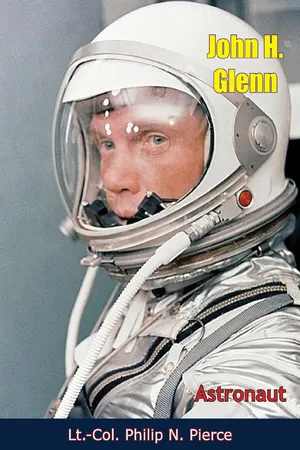
- 149 pages
- English
- ePUB (mobile friendly)
- Available on iOS & Android
eBook - ePub
John H. Glenn, Astronaut
About this book
Information
Subtopic
American Civil War HistoryIndex
HistoryELEVEN—The Big Day
TUESDAY, THE twentieth of February, began early for John Glenn. It was 2:20 A.M. when Lt.-Col. Bill Douglas, the astronauts’ physician, stepped into the bedroom of the quarters in Hangar S and snapped on the lights. “OK, Marine, rise and shine!” he called. “Today’s the day.”
John came awake, and stretched. “Good morning, Bill. How’s the weather look?”
“Socked in right now, John. But aerology says there’s a good chance it’ll clear up before launch time.”
John grinned, heading for the shower. “Better keep your fingers crossed, Bill.”
After a shower and a shave, Glenn joined the doctor and Astronaut Deke Slayton for breakfast. If everything went according to plan, it was going to be a long time between breakfast and lunch. Accordingly, John took on a pretty good load of personal fuel: a big glass of orange juice; two scrambled eggs; a small steak; several slices of toast and jelly; and a cup of Postum. The inner man taken care of, he declared that he was ready to go to work.
Bill Douglas went to work first, however, giving Glenn a complete physical check, then attaching the bio-sensors to his body which during the flight would record his physical reactions for radio transmission back to earth.
Joking with Deke Slayton, John donned his long underwear and, with the help of technician Joe Schmidtt, climbed into his 20-pound silver space suit. After a pressure check to be sure there were no leaks in the suit, the astronaut was ready for the ride in the special van out to Launching Pad 14.
Emerging from the big door of Hangar S, he flashed a big grin at the small crowd of workers and newsmen gathered around the entrance. One meticulous reporter carefully recorded that John gave three quick waves of his right hand to the crowd, and took exactly 14 steps between the hangar door and the van. In his left hand he carried a portable air conditioner to keep his close-fitting space suit cool.
The four-mile trip to the launching pad took 17 minutes—a slow journey indeed for a man who in a few hours would be covering almost 5,000 miles in the same amount of time.
The weather still hadn’t cleared by 5:59. But Glenn had already left the van and entered the gantry elevator which carried him his first 120 feet into space—up to the eleventh deck “white room” surrounding the space capsule atop the great Atlas missile. Stepping off the elevator, he exchanged pleasantries with the technicians and shook hands with Guenther Wendt, boss of the “white room.” Like the astronaut, Wendt had flown his share of World War II missions. But he had logged his combat time a long way from the Pacific, and in a different uniform. During the war he had been a German Luftwaffe pilot.
Kicking off the outer boots which protected his space shoes from dirt and grime, Glenn eased himself into the capsule with the help of a couple of technicians. He was very careful not to snag his silver suit. It took considerable squirming to get himself onto the contoured couch of the 6-foot, 10-inch spacecraft. “You don’t just get into one of these things,” he once explained. “You put it on!”
The word was passed down to Mercury Control that John had entered the capsule. The official time clock showed 6:03 A.M., seven minutes after sunrise. The hands on the counting clocks had been motionless since 5:30—stopped at T minus 120 minutes and holding. One of the thousands of checks made during the countdown had turned up a faulty transponder, a small part in the Atlas’ radar tracking equipment. The new transponder was no sooner installed than it was discovered that the respiration measuring device in John’s helmet wasn’t working properly. There was another ten minutes’ delay while that was replaced.
The countdown resumed at 6:25. By now many anxious eyes were watching the clock. John’s take-off was scheduled for 7:30. In order to make the planned three orbits, he had to launch by 9:30, at the very latest. This would allow three hours of daylight for the sea recovery forces in the impact area to make their search for the capsule after Glenn had landed. A later launch would mean that the flight would have to be limited to two, or even a single orbit.
In the east the sky began to lighten, showing a faint promise of clearing. Overhead the clouds still hung dark and heavy. From the north a cool breeze began to stir across the launching site. In the “white room” the technicians carefully fitted the side hatch onto the Friendship 7. It was 6:59. Astronaut Glenn was alone in his space capsule.
Swept by a brisk wind, now blowing from the west, the clouds began to break away. A few minutes after 7:00 the sun broke through, and conditions began to look more promising. Twenty minutes went by. Another “hold.” One of the hatch-cover bolts was broken. It would have to be replaced.
Remove the hatch cover....
Replace the broken bolt....
Reinstall the hatch....
It was 8:05 by the time the countdown was resumed—T minus 60 minutes and counting.
At 8:30, there was another “hold” in order to add ten gallons of Rp-1 kerosene fuel to the rocket. The operation required fifteen minutes of precious time. While they were adding the fuel, the great orange gantry rolled back. Now the shining, silver missile towered alone above the launching pad, its slim nose reaching toward a bright, clear sky.
The critical task of pumping the liquid oxygen into the Atlas began at 8:44—T minus 35 minutes. As the “lox” flowed into the tanks at 200 degrees below zero, sparkling crystals of frost began to form on the rocket’s outer skin. From a vent, high on the side, near the base of the capsule, a feathery plume of white vapor curled upward. The missile was primed. All systems reported “go,” Weather in the launch area and downrange favorable. T minus 22....
“Hold!”
Trouble with a valve in the liquid oxygen equipment. Ten to fifteen minutes to fix the valve. Resume the countdown.
9:35—T minus 10 minutes and counting.
All systems “Go.”
“Hold!”
Trouble at the Bermuda tracking station....
“Hello, Cape, this is Bermuda.”
“Go ahead.”
“We just lost power on our computer. Stand by for an estimate.”
“Roger...standing by, Bermuda.”
“Estimate five minutes, Cape...five minutes.”
“Do you want us to continue to count?”
“Take it down to T minus seven. We may have it by then.”
“Roger.”
The speeding hands of the counting clock erased the seconds, the minutes...
“Do you want us to hold, Bermuda?”
“Uh...yes, we would like to hold at seven. We lost the main power on the computer and we just want to check that nothing else has gone wrong.”
“What do you estimate?”
“Somewhere between five and ten minutes.”
“Can’t you expedite?”
“Make it five.”
“All stations are holding at six minutes and thirty seconds. Estimate five minutes.”
At 9:42 Bermuda came back on the air.
“Hello, Cape. We just got a ‘Go.’”
“Are you ready?...Are you ready to continue?”
“OK, go ahead, Cape...”
“All stations, your attention, please. On my mark we will pick up the count at T minus six minutes and thirty seconds....Mark!”
Alone in his tiny, cramped world above the sands at Cape Canaveral, John Glenn waited.
“Four minutes....”
In the eighteen tracking stations around the world, tensio...
Table of contents
- Title page
- TABLE OF CONTENTS
- DEDICATION
- ONE-Lift-Off!
- TWO-The Boy Called Bud
- THREE-The Islands, Hell Jelly; and the Yalu
- FOUR-Test Pilot
- FIVE-“Bullet”
- SIX-Only Seven Would Serve
- SEVEN-Colonel Pierce Recalls...
- EIGHT-Training for Space
- NINE-The Atlas and Friendship 7
- TEN-The Long Wait
- ELEVEN-The Big Day
- TWELVE-Hero’s Return
- APPENDIX A-Transcript of Lt. Col. John H. Glenn’s Message to the Joint Meeting of Congress, February 26, 1962
- APPENDIX B-Chronology of Mercury Test Launchings
- APPENDIX C-Glossary of Space Terms
- REQUEST FROM THE PUBLISHER
Trusted by 375,005 students
Access to over 1.5 million titles for a fair monthly price.
Study more efficiently using our study tools.
Frequently asked questions
Yes, you can cancel anytime from the Subscription tab in your account settings on the Perlego website. Your subscription will stay active until the end of your current billing period. Learn how to cancel your subscription
No, books cannot be downloaded as external files, such as PDFs, for use outside of Perlego. However, you can download books within the Perlego app for offline reading on mobile or tablet. Learn how to download books offline
Perlego offers two plans: Essential and Complete
- Essential is ideal for learners and professionals who enjoy exploring a wide range of subjects. Access the Essential Library with 800,000+ trusted titles and best-sellers across business, personal growth, and the humanities. Includes unlimited reading time and Standard Read Aloud voice.
- Complete: Perfect for advanced learners and researchers needing full, unrestricted access. Unlock 1.5M+ books across hundreds of subjects, including academic and specialized titles. The Complete Plan also includes advanced features like Premium Read Aloud and Research Assistant.
We are an online textbook subscription service, where you can get access to an entire online library for less than the price of a single book per month. With over 1.5 million books across 990+ topics, we’ve got you covered! Learn about our mission
Look out for the read-aloud symbol on your next book to see if you can listen to it. The read-aloud tool reads text aloud for you, highlighting the text as it is being read. You can pause it, speed it up and slow it down. Learn more about Read Aloud
Yes! You can use the Perlego app on both iOS and Android devices to read anytime, anywhere — even offline. Perfect for commutes or when you’re on the go.
Please note we cannot support devices running on iOS 13 and Android 7 or earlier. Learn more about using the app
Please note we cannot support devices running on iOS 13 and Android 7 or earlier. Learn more about using the app
Yes, you can access John H. Glenn, Astronaut by Lt.-Col. Philip N. Pierce in PDF and/or ePUB format, as well as other popular books in History & American Civil War History. We have over 1.5 million books available in our catalogue for you to explore.