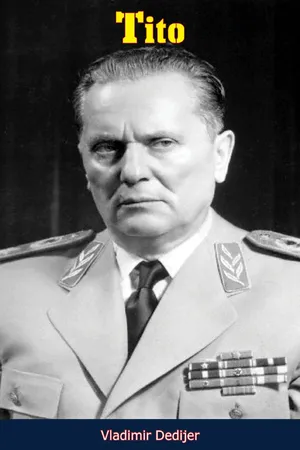
THE STORY, TOLD LARGELY BY HIMSELF, OF MARSHAL TITO OF YUGOSLAVIA—THE MAN WHOM STALIN MOST HATES AND FEARS
THE FIRST BIG HOLE in the iron curtain was cut in 1948 by Marshal Tito and the Yugoslavian people when they walked out of the Cominform, defying Stalin, the Red Army, and Moscow's secret police. This was the first rebellion of a Soviet satellite state. It is not likely to be the last.
Here is the only authentic inside story of this decisive moment in modern history, told in the context of Tito's life, with about forty per cent of the text in Tito's own words, recorded by one of his closest friends. Here is the story of Tito's personal relations with Stalin, how the leaders of the Communist world would drink and talk and joke with each other, how Stalin felt about the Communists in Greece and China, the true stories of Dimitrov, Gomulka, Anna Pauker and the fierce struggle for power which goes on among the rulers of the Communist world. No other man has seen this world on the top level and survived to tell it.
It is told here in the exciting story of the life of an itinerant machinist who wandered around Europe, Russia and the revolutionary movement until Hitler's attack on his country in 1941 threw him into leadership of the Yugoslav Partisan Army.
eBook - ePub
Tito
About this book
Information
Subtopic
European HistoryIndex
HistoryCHAPTER I—1900: “My childhood was difficult...”
IN THE summer of 1942, after two months of hard fighting in the rocky mountains of Montenegro, the Partisans set out on their 185-mile march through territory held by the Italians and Germans, toward western Bosnia.
Dusk was descending when we reached the foothills of Zelengora. Nature’s apparel had suddenly changed. Instead of bare rock, we were now passing through meadows of narcissus and forests of beech. A Partisan rarely has time to heed the countryside through which he passes, but now the change was so abrupt and the picture so impressive that we began to chatter about our new surroundings. As his horse stepped wearily along, Tito said:
“This vegetation means life. The stony region behind us gives the impression of death. This country reminds me of Zagorje, my native land.”
We halted at a clearing, where we erected our tents and made fires of beech, the fuel most precious to Partisans because it gives the hottest embers. For supper we each had a pound of meat. We cut it into small pieces, added salt and flavored it with the garlic that grew abundantly nearby, skewered the meat and held it over the hot embers. Then there was singing.
We heard machine-gun fire, so distant it sounded like the whispering of the breeze through the branches. Our shackled horses were grazing not far from the fire, neighing nervously, pricking up their ears as if fearing wolves. Someone threw a thick branch on the fire, and the flame lit Tito’s face. His are regular features; his forehead is high, his jaw rather protruding, his cheeks strong, giving his whole countenance a certain sharpness and determination. But his eyes and smile add a tone of tenderness. These two elements, constantly alternating, make it difficult to describe him whenever friends of mine ask me what Tito looks like.
The fire began to die down and so did the singing. Then Tito began to tell us about his Zagorje, which so greatly resembles the regions we were passing through:
I was born Josip Broz in May, 1892, in the Croatian village of Kumrovec, which lies in a district called Zagorje (“the country behind the mountain”). This is in the northwestern part of Croatia, one of the six Yugoslav republics. My village rests in a pretty valley bordered by wooded hills, where the little green Sutla River meanders through woods, past pastel-blue cottages roofed with homemade tiles or shingles green with moss.
Wherever you look in Zagorje you see on the hilltops the walls of some ancient fortress, castle or church, the relics of a history that goes back to Roman times, a history full of war and oppression. On one of the hills above Kumrovec, towering like a giant, is Cesargrad, the jagged ruins of the medieval castle of the Counts Erdödy. They were the masters of my village and the surrounding countryside until the middle of the last century, when feudalism was officially abolished in Croatia. They were cruel, and their serfs were often in revolt.
One winter morning in 1573 the serfs of Cesargrad, wearing the cock’s feather as a symbol of revolt, stormed into the castle, beheaded the bailiff, burned one part of the castle, and seized several cannon and some muskets. The leader of the rebels was Matija Gubec but the main body was led by Ilija Gregorić, who crossed the Sutla from Cesargrad to rouse the Slovenian serfs to arms. The rebellion spread through the whole of Zagorje and parts of Slovenia; there were tens of thousands of rebels. But the army of the nobility, under the command of Juraj Drašković, Governor of Croatia and Bishop of Zagreb, was mounted and stronger. The poorly clad serfs suffered from the harsh winter weather. Near my home, Gregorić retreated to Zagorje, and at the crossing of the Sutla between St. Peter and Kumrovec, beneath Cesargrad, he was defeated. The following day saw the decisive battle with the main body of the rebel serfs near Donja Stubica,{1} where the serfs were led by Matija Gubec. He was captured. The Bishop-Governor Drašković informed the Austrian Emperor Maximilian:
“As an example to others, with Your Holy Majesty’s permission, I shall crown Gubec with an iron crown, and a red-hot one at that.”
And he did. Ilija Gregorić was captured and taken to Vienna, where he was interrogated and after a year returned to the Erdödys in Zagorje, who beheaded him.
The Zagorje serfs were severely punished. Historians say that the bodies of hundreds of peasants hung from the trees in the villages. It is estimated that during this rebellion between four thousand and six thousand serfs were killed in Zagorje. Baroness Barbara Erdödy, who had escaped the sack of her castle, was particularly cruel to the Cesargrad serfs. Three centuries later, whenever as children we awoke at night our mother threatened that the Black Queen of Cesargrad would take us away if we did not go back to sleep at once.
My forefathers probably were in this famous rebellion, for they had come to Kumrovec from Dalmatia in the middle of the sixteenth century, retreating before the onslaught of the Turkish invaders, and were serfs of the Erdödy family. In later generations there was always at least one of them who became a blacksmith, so that the family came to bear the nickname of Kovači, or Blacksmith. The tradition may later have influenced my own choice of a trade.
My ancestors lived in a patriarchal collective called the “zadruga.” The land was tilled in common, and the whole zadruga was under the rule of the “Gospodar” (head man), who was elected. He lived in the biggest house, in which everybody ate together. When a member of the zadruga married, the zadruga would build him a special little room attached to the big house, so that the whole zadruga looked like a beehive. Twice a year the Gospodar paid the dues to the Count of Erdödy and to the Church.
Count Erdödy was required to maintain fifty horsemen and two hundred footmen for the army of the Hapsburg Emperor. Usually these soldiers were recruited from among the village idlers, for the Count wanted to keep the good workers. As far as I have heard tell there were no soldiers from the Broz family except one, and he was a sentinel on the Drava Bridge during the Hungarian rebellion of 1848.
This same year saw the end of the rule of the Erdödys over our village and the beginning of the decay of the zadruga. The serfs of Kumrovec received the land, but they had to pay for it, and taxes were increased, especially after the wars of 1859 and 1866 which ended to the disadvantage of Austria-Hungary, which ruled Croatia. As the number of members and the cost of maintenance increased, the zadruga began to decline.
Abruptly, the bankers of Budapest and Vienna replaced the Erdödys. The peasants needed land; the firm of Deutsch and Gruenwald bought the entire Erdödy estate, and offered it for sale to the peasants. But the peasants had no money. In a nearby town, Deutsch and Gruenwald established a bank to lend it to them. The rate of interest was nominally 8 per cent, but commissions and extras raised it to 24 per cent.
My grandfather Martin was the last Broz to live in the zadruga. In the sixties he left and began to earn his living carting merchandise from Zagreb to nearby towns. He married Ana Blažičko, a tall strong woman who was extremely proud of coming from a peasant family who had been freemen for more than two centuries. One winter, while Grandfather Martin was driving a cart of salt, a wheel broke and the load crushed the old man. He left a son and six daughters; the son, Franjo, was my father.
At that time an Austrian law was in force in Croatia, according to which the eldest son could no longer be sole heir, but had to share the inheritance equally among all members of the family. This measure was intended to accelerate the disintegration of the peasant holdings. Thus Franjo Broz, reluctant to sell his father’s land, was forced into debt so that he might buy off his sisters. Soon the debt was too much for him, and he began to sell one acre after another.
My father was a wiry man with black curly hair and an aquiline nose. The peasants of Kumrovec and the whole of that part of Zagorje used to cross the River Sutla to the wooded Slovene hills where they secretly cut fuel, which they otherwise lacked. Going to the villages across the Sutla, Franjo became acquainted with a sixteen-year-old Slovene girl called Marija, the oldest of fourteen children of Martin Javeršek, who owned sixty-five acres of farm and woodland.
She was a tall, blonde woman, with an attractive face. The wedding took place in January, 1881, when my father was twenty-four. It was a very big wedding and my aunt Ana told me the guests came from Kumrovec on five sleighs.
A hard life awaited my parents. Fifteen acres of land, which dwindled as my father’s debts came due, were insufficient to feed the family. When the debts became intolerable, the soft and good-natured Franjo gave it up and took to drinking, and the whole family burden fell upon my mother, an energetic woman, proud and religious.
My father and mother had fifteen children, of whom I was the seventh. In those days, about 80 per cent of the children of Zagorje died before the age of fifteen, most of them in infancy. My parents were only a little more fortunate than most. Of their fifteen children, seven survived.{2} When I was ten I fell ill with diphtheria, one of the commonest scourges of our countryside, which had already killed one of my sisters, but I recovered with no bad effects.
Our family lived in house No. 8 at Kumrovec, built almost a century ago, solid, with big windows. We shared the house with a cousin. The hall was used by both families; on either side of the hall were two rooms. An open-hearth kitchen, where there was always a stock of firewood, was also shared.
My childhood was difficult. There were many children in the family and it was no easy matter to look after them. Often there was not enough bread, and my mother was driven to lock the larder while we children received what she considered she could give us, and not what we could eat. In January my father had to buy cornmeal bread because we could not afford wheat. We children often took advantage of the visit of relatives to beg a slice of bread more than the ration we had eaten. My mother, a proud woman, would not refuse us before relatives. But after they went there was scolding and even an occasional whipping.
One feast-day our parents went somewhere for a visit. We were hungry. Up in the garret hung a smoked pig’s head which we were keeping for the New Year. My brothers and sisters were crying, so I brought the head down and dropped it into a pan of boiling water. I added a bit of flour and let it cook for an hour or two. What a feast we had! But the meal was so greasy that we all became sick. When my mother returned we were silent except for an occasional groan. She took pity on us, and that time we got off without a hiding.
Then came the “lukno,” a feudal custom that still survived at Kumrovec in my childhood. After Christmas, for the New Year, friars from Klanjec would appear in every village carrying a cross and followed by a sexton with a sack. A friar would chalk the words “Anno Domini...” on the door, thus wishing us a happy New Year, and the host would have to give him a few pounds of corn, a bunch of golden flax or two forinths, which in those days meant two days’ wages. You can imagine how we children felt as we stood by, hungry as usual, and watched the sexton pour our corn into his sack.
I remember very well how in my childhood the Hungarian soldiers once entered our village. In 1903 the people in Croatia revolted against the fiscal system which helped Hungary plunder Croatia, and against Hungarian control over Croatian railways. In our country there were thirty-six thousand railwaymen, all Hungarians, and if a Croat went to a station to buy a ticket, he was compelled to ask for it in Hungarian, or be refused. At a nearby village in Zagorje, peasants removed the Hungarian flag from the station. The police opened fire, killing one and wounding some ten others. Incidents followed throughout Croatia, in which three thousand people were arrested and twenty-six killed. As punishment, the people had to maintain the Hungarian troops. Four Hungarian soldiers were billeted in our house, and we had to feed them a whole month, out of supplies that were not enough for our own meager needs.
The happiest days of my childhood were spent at the house of my maternal grandfather in Slovenia. He was a small stocky man, who called me Jožek (Joey). I looked after the livestock and carried water for the household. His village was in a wood on the steep slopes above the river, and I played in the wood and carved whistles and made whips for the horses I tended.
This was the job I liked best, for as early as I can remember, one of my greatest pleasures was to be with horses. I was already riding bareback when my head barely reached the horse’s belly; my father had a horse called “Putko” that I alone could bridle. I learned in those days that the better you tend a horse, the better he will serve you. During the war I made a point of dismounting from my horse, Lasta (Swallow), when climbing a hill, and I urged my men to save their horses for the plain.
My grandfather Martin was a very witty man and liked practical jokes. From him I inherited the habit which still persists. When my sister was to be married, I, unnoticed by anyone, took her wreath and put it on the chicken-coop. They looked for it all over the house and at last they found it. I no longer remember whether I laughed or not. Let me tell you how the joke was once on me, when I was six. I was on a visit to my grandfather Martin and often went to a spot where some neighbors were burning lime. One day one of them asked me: “Josip, would you like to get married?” I said I would, and he promised to find me a bride. He sent me into the hills where my uncle lived and taught me what to say. “When you get there,” he told me, “you first say ‘good evening—good appetite!’ They will reply, ‘Thank you very much, and draw up a chair with us!’ Then you say ‘Thanks, but I’ve already...’ Then they’ll ask you why you came. Tell them you’ve heard there is a girl in the house and that you would like to get married.” Now that girl was my cousin. I did as I was told. I went, and declared in all earnestness why I had come. They all burst out laughing. I felt ashamed because, being so little, I had not the faintest idea what it all meant. My uncle put me on his knees, showed me the girl, and said: “There is your bride!” Finally I had to tell who had played the joke on me.
But once I caused my grandfather great pain. He always liked to keep the tip of a head of sugar for himself because it was the sweetest. (Sugar was sold in big chunks, the size of a large grenade.) For the same reason I liked the tip too. One day I took the whole head, small as I was, and carried it off toward a copse to hide it. Unfortunately, as I was crossing a brook the sugar slipped from my arms and fell into the water. It was not fated that I should satisfy my sweet tooth, and Grandfather was equally distressed.
My happy days with him soon came to an end and I returned home.
It was taken for granted in my village that by the time a child was seven, he was already a productive worker. I drove the cattle and helped hoe the corn and weed the garden and, I remember so well, turned the heavy grindstone that made our grain into flour. Hundreds of times I finished, soaked with sweat, and the porridge was the sweeter for that. But the hardest task of all was not physical. It was when my father would send me round the village with his I.O.U. to ask someone to endorse it for him. The other peasants were, like my father, deep in debt, hungry, with many children. I had to listen to curses and complaints and then, at last, almost always they would endorse the I.O.U.
One terrible winter when there was no food in the house and no wood for the fire, my father decided to sell our sheepdog, Polak. He traded him with an estate keeper for two cords of wood. Welcome as the fire was, we children were inconsolable. Polak was our faithful friend who had helped us with our first steps, for when we could only crawl we would reach up to him, hold on to his thick fur and draw ourselves to our feet, and Polak would then walk slowly round the room. We cried bitterly when we watched our father take him away. Imagine how glad we were when he reappeared even before Father got home. Father took him back to the estate keeper, and again he returned. This time we hid him in a cave in the woods and fed him secretly for two weeks. By then the estate keeper had given up hope of finding him, so we brought him out of the woods and Father relented and let us keep him. He stayed with us for many years and lived to be sixteen. Polak gave me a lasting love for dogs. I had one with me whenever I could and later, during the war, a dog called Lux saved my life.
In Croatia in those years 60 per cent of the population was illiterate. There were few schools, and many peasants resented schooling, for it took their children away from the fields and cost them their labor. But in that respect I was lucky. An elementary school was opened in Kumrovec when I was seven years old and my parents, despite their poverty, agreed that ...
Table of contents
- Title page
- TABLE OF CONTENTS
- PROLOGUE-“Serious things are involved...”
- CHAPTER I-1900: “My childhood was difficult...”
- CHAPTER II-1912: “I learned many complex jobs...and spoke against the war.”
- CHAPTER III-1923: “I was elected a member of the District Party Committee...”
- CHAPTER IV-1925: “I decided to begin a hunger strike...”
- CHAPTER V-1928: “I consider myself responsible only to my Communist Party...”
- CHAPTER VI-1934: “I could no longer go under my own name...”
- CHAPTER VII-1936: “My whole being rebelled against what I saw in Moscow...I thought this was a temporary internal matter.”
- CHAPTER VIII-1939: “As our political influence increased, our underground work grew easier...”
- CHAPTER IX-1941: “Do not lose heart, close your ranks...”
- CHAPTER X-1941: “The attack against the USSR only hastened the beginning of our struggle...”
- CHAPTER XI-1941: “If you cannot help us do not hinder us...”
- CHAPTER XII-1941: “We have been fighting for twenty months without the least material assistance from any quarter...”
- CHAPTER XIII-1943: “Recognition by the Soviet people and their army of our struggle-that was our dearest recognition...”
- CHAPTER XIV-1944: “It was then for the first time in my life that I met Stalin...”
- CHAPTER XV-1945: “The most dangerous thing for us now is to stop midway...”
- CHAPTER XVI-1946: “The cause of the conflict...is the aggressive tendencies of the Soviet Union toward Yugoslavia...”
- CHAPTER XVII-1946 “They sought to exploit us economically...”
- CHAPTER XVIII-1947: “We extended the hand of friendship...”
- CHAPTER XIX-1948: “But now...the Russians are hindering us...”
- CHAPTER XX-1948: “I felt as if a thunderbolt had struck me...”
- CHAPTER XXI-1948: “If only we do not lose our nerve, our victory will be certain...”
- CHAPTER XXII-1948: “We began to lose faith in Stalin, but not in socialism...”
- CHAPTER XXIII-1949: “Our revolution does not devour its children...”
- CHAPTER XXIV-1952: “I was an ignorant young man and the Party took me, educated me, made me a man...”
- CHAPTER XXV-1952: “Plenty of work is ahead of us still...”
- A NOTE ABOUT THE AUTHOR
Trusted by 375,005 students
Access to over 1.5 million titles for a fair monthly price.
Study more efficiently using our study tools.
Frequently asked questions
Yes, you can cancel anytime from the Subscription tab in your account settings on the Perlego website. Your subscription will stay active until the end of your current billing period. Learn how to cancel your subscription
No, books cannot be downloaded as external files, such as PDFs, for use outside of Perlego. However, you can download books within the Perlego app for offline reading on mobile or tablet. Learn how to download books offline
Perlego offers two plans: Essential and Complete
- Essential is ideal for learners and professionals who enjoy exploring a wide range of subjects. Access the Essential Library with 800,000+ trusted titles and best-sellers across business, personal growth, and the humanities. Includes unlimited reading time and Standard Read Aloud voice.
- Complete: Perfect for advanced learners and researchers needing full, unrestricted access. Unlock 1.5M+ books across hundreds of subjects, including academic and specialized titles. The Complete Plan also includes advanced features like Premium Read Aloud and Research Assistant.
We are an online textbook subscription service, where you can get access to an entire online library for less than the price of a single book per month. With over 1.5 million books across 990+ topics, we’ve got you covered! Learn about our mission
Look out for the read-aloud symbol on your next book to see if you can listen to it. The read-aloud tool reads text aloud for you, highlighting the text as it is being read. You can pause it, speed it up and slow it down. Learn more about Read Aloud
Yes! You can use the Perlego app on both iOS and Android devices to read anytime, anywhere — even offline. Perfect for commutes or when you’re on the go.
Please note we cannot support devices running on iOS 13 and Android 7 or earlier. Learn more about using the app
Please note we cannot support devices running on iOS 13 and Android 7 or earlier. Learn more about using the app
Yes, you can access Tito by Vladimir Dedijer in PDF and/or ePUB format, as well as other popular books in History & European History. We have over 1.5 million books available in our catalogue for you to explore.