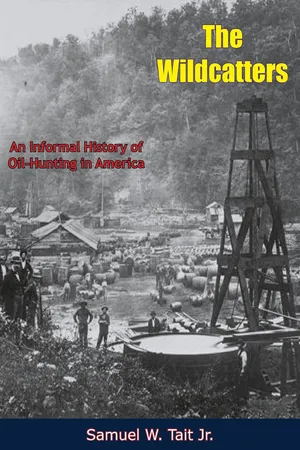
The Wildcatters: An Informal History of Oil-Hunting in America takes a close look at the early histories of the chief oil fields of the United States, with special emphasis on the fields of Pennsylvania, West Virginia and Ohio. The author, himself the son of a successful oilman from Blackford County, Indiana, describes how oilmen without much (if any) knowledge of geology migrated westward from Pennsylvania and West Virginia into Ohio, Kansas, Oklahoma, Texas, and even into California, and how these "wildcatters"—a term for an individual who drills wildcat wells, which are exploration oil wells drilled in areas not known to be oil fields—would often drill holes that would prove to be successful and bring in new fields. Tait explores the very first serious attempt in the United States to develop and oil industry, which was in 1859 in Titusville, Pennsylvania, and how the great Appalachian oil field was developed, with exploration rapidly carried into West Virginia, and continued into Ohio and Indiana. A well-drilling in Findlay, Ohio in 1884 discovered gas, resulting in the opening of the great Lima-Indiana oil field, and the great interior basin fields in Illinois were developed around 1937, largely through the use of geophysics.
Samuel W. Tait's book provides an impressive historical contribution to the history to oil discovery east of the Mississippi River.
- 215 pages
- English
- ePUB (mobile friendly)
- Available on iOS & Android
eBook - ePub
About this book
Trusted by 375,005 students
Access to over 1.5 million titles for a fair monthly price.
Study more efficiently using our study tools.
Information
Subtopic
American Civil War HistoryIndex
HistoryVII. DOODLEBUGS & ROCKHOUNDS
JONATHAN WATSON, of the lumber firm of Brewer, Watson and Company, which helped promote Drake’s well, was without doubt America’s first large-scale wildcatter. On the Monday morning news was circulating down valley and over hills that there was oil in the hole near Titusville, Watson was at the door of a farmer far down the creek making offers for a lease on three hundred acres.
From then on for some years he kept increasing his operations, with success almost equal to their daring. He went so far afield from proved producing areas in his early wildcatting as almost to open the Bradford field. When he was not in his residence at Titusville, which is said to have been the finest there and to have had a conservatory which cost $50,000, he was usually on one of his saddle horses, making the rounds of his drilling wells or leasing additional lands. In 1871 an oil country journal called him the “champion oil operator,” and added that he had either drilled personally or been interested in no fewer than 2,000 wells. Either large-handed generosity or unwillingness to waste effort on small producing territory—both characteristic of the wildcatter everywhere—caused him to give to a workman an eleven-barrel well he drilled on Oil Creek that same year. Eventually, of course, he went the way of many in his spectacular line. A long succession of dry holes and the dollar oil which came with the Bradford boom cost him a million dollar reserve fund and his home, and made him a minor figure in the game. The picture of his operations, gigantic for that era, is already dim and hard to recover, perhaps because he did not live long enough to be included in the volumes of flattering biographical sketches of oil men which were peddled to the industry in the final years of the century.
But at least one feature of his career should not be allowed to pass out of memory: he was the first oil man to put reliance in “spirits” for the discovery of pools. This probably arose from family predilection rather than personal faith. His wife was a medium and he humored her by occasionally letting her place one of his prospecting holes. Finally he must have come to believe in the voices of the unseen, for he began using other mediums as well.
While we have no record of the procedure by which Watson’s spiritualists made their decisions, we have an account of the selection of the site of the Harmonical well at Pleasantville which is no doubt typical of all similar incidents. A spiritualist named James was calmly riding along a country road in a buggy, when suddenly he became agitated by his spirit-guide. As he related the incident afterwards, he soon could not tell whether he was “in the body or out.” He seemed to be forced out of the buggy, over a fence, toward the south and then the north end of a field. Next, he said, he was thrown to the ground, where he made a mark with his finger and forced a penny some inches into the earth. Finally, he lay upon his bosom, still and apparently lifeless, eyes closed, face pale, pulse feeble. All this, he understood, was to show him that oil existed in great quantities at the spot.
The well there did over one hundred barrels a day for a while, and James did a big business as what was vulgarly called the “boss locator.” Apparently he promised too much and went too far from well-defined oil fields, for he is said eventually to have left a trail of dry holes through the counties of Elk, Warren and Forest.
Doodlebugs—a term used colloquially in oil regions to mean not only pseudoscientific mechanisms used to find petroleum but also operators of these devices—began to show up along the creek almost as soon as the spiritualists. The first and most common device of this kind was one which John Fiske traced to the lightning myth of the dim periods before primitive man understood the true explanation of natural phenomena. Fiske tells of his own experience with it:
“In the course of my last summer’s vacation, which was spent at a small inland village, I came upon an unexpected illustration of the tenacity with which conceptions descended from prehistoric antiquity have now and then kept their hold upon life. While sitting one evening under the trees by the roadside, my attention was called to the unusual conduct of half a dozen men and boys who were standing opposite. An elderly man was moving slowly up and down the road, holding with both hands a forked twig of hazel, shaped like the letter Y inverted. With his palms turned upward, he held in each hand a branch of the twig in such a way that the shank pointed upward; but every few moments, as he halted over a certain spot, the twig would gradually bend downwards until it had assumed the likeness of a Y in its natural position, where it would remain pointing to something in the ground beneath. One by one the bystanders proceeded to try the experiment, but with no variation in the result. Something in the ground seemed to fascinate the bit of hazel, for it could not pass over that spot without bending down and pointing to it.
“My thoughts reverted at once to Jacques Aymar and Dousterswivel, as I perceived that these men were engaged in sorcery. During the long drought more than half the wells in the village had become dry, and here was an attempt to make good the loss by the aid of the god Thor. These men were seeking water with a divining-rod. Here, alive before my eyes, was a superstitious observance, which I had supposed long since dead and forgotten by all men except students interested in mythology.”
Though Fiske says the forked stick did not work in his hands, he should not have been surprised upon hearing of its use to find oil, for it had long been employed to find coal, iron, gold, buried treasure, even criminals in hiding. The oil men had the opinion of Professor Silliman that “the pretensions of diviners are worthless. The art of finding fountains of minerals by a peculiar twig is a cheat upon those who practice it, an offense to reason and common sense, an art abhorrent to the laws of nature, and deserves universal reprobation.”
Still the oil men, even the sceptical ones, flocked to take leases near locations made with forked sticks as avidly as they had near those made by spiritualists after the completion of the Harmonical well. The reason may have been that the doings of the spiritualists and doodlebugs were no more mysterious than those of the earth with which prospectors daily came in contact. The early oil man was kept in a constant state of bewilderment by the seemingly conflicting results of his search, and in such a condition he was an excellent subject upon which to try the exploded superstitions of earlier and less enlightened eras.
One of the first prospectors to use the divining rod was Jonathan Watson, for whom the unseen guides had begun to give such fallible advice that he was ready to try anything. The doodlebugs made an inauspicious start by locating two dry holes for him. They tried to extricate themselves from their embarrassment by saying that the field was right in the middle of a river, supposing that would be the end of the matter. They didn’t know Watson. He ordered that the stream be diverted. After working for months, workmen got the river dammed for a distance long enough to permit the locating of several rigs. The result nearly cured even Watson of his faith in oil smelling, for every well came in dry!
There are still doodlebugs, and while no recent case of hunting oil with spiritualist guidance has been publicized, the procedure is no doubt being tried at this moment somewhere. In 1927 and 1928 southwestern Ontario saw in operation an elaborate form of the divining rod which consisted of two electrodes connected by a brass rod, one end of which was supposed to swing up and down when over an oil pool. In the Middle West some time ago a device connected to a car radio was being demonstrated. Doodlebugs claim credit for predicting the success of one of the few wells which opened pools during 1943 in Oklahoma.
An occasional phenomenon in oil-finding eludes scientific explanation, as, for example, the coincidences where productive wells have been located according to directions received in dreams. I remember when we in northeastern Indiana laughed at a traveling salesman who asserted he dreamed a good well could be found between two dry holes drilled many years previously in territory generally held to be tested and condemned. He formed a common venture with several other amateurs and opened a pool which was remunerative over two decades.
Across Oil Creek from Petroleum Centre in Pennsylvania was the Hyde and Egbert farm, of which one Kepler was superintendent. This Kepler’s brother one night dreamed he was shot at by an Indian with a bow and arrow. A coquettish woman handed him a gun to frighten away the redskin. Thereupon oil gushed from the ground at the spot. He visited his brother later at the Hyde and Egbert farm and recognized the place he had seen in the dream. After securing three partners, he leased one acre at three-quarters royalty and drilled a well which was appropriately called the Coquette. It came in at 1,200 barrels a day, and produced 800 daily for a year!
Even when men began to find scientific reasons for the presence of petroleum, many were not satisfied with Professor Silliman’s theory that petroleum was a product of vegetable decomposition, or with Professor D...
Table of contents
- Title page
- TABLE OF CONTENTS
- DEDICATION
- ACKNOWLEDGMENTS
- MAPS AND DRAWINGS
- QUOTATION FROM WALLACE E. PRATT
- PROLOGUE
- I. A STAGE IS SET
- II. THE CONNECTICUT COLONEL
- III. ALONG CREEK AND RIVER
- IV. NATIONAL PANORAMA
- V. FROM SALT TO OIL
- VI. THE FIELD THAT LIVED AGAIN
- VII. DOODLEBUGS & ROCKHOUNDS
- VIII. THAT WORTHLESS LIME ROCK
- IX. CYCLORAMA
- X. SHAPE OF THINGS TO COME
- XI. POOR MAN’S PARADISE
- XII. FIELDS THAT COULDN’T BE THERE
- XIII. OIL TOWNS: STYLES NEW AND OLD
- XIV. COWPUNCHERS AND CLAIM JUMPERS
- XV. END OF THE TRAIL
- XVI. BACKTRACKING
- EPILOGUE
- NOTE ON SOURCES
- REQUEST FROM THE PUBLISHER
Frequently asked questions
Yes, you can cancel anytime from the Subscription tab in your account settings on the Perlego website. Your subscription will stay active until the end of your current billing period. Learn how to cancel your subscription
No, books cannot be downloaded as external files, such as PDFs, for use outside of Perlego. However, you can download books within the Perlego app for offline reading on mobile or tablet. Learn how to download books offline
Perlego offers two plans: Essential and Complete
- Essential is ideal for learners and professionals who enjoy exploring a wide range of subjects. Access the Essential Library with 800,000+ trusted titles and best-sellers across business, personal growth, and the humanities. Includes unlimited reading time and Standard Read Aloud voice.
- Complete: Perfect for advanced learners and researchers needing full, unrestricted access. Unlock 1.5M+ books across hundreds of subjects, including academic and specialized titles. The Complete Plan also includes advanced features like Premium Read Aloud and Research Assistant.
We are an online textbook subscription service, where you can get access to an entire online library for less than the price of a single book per month. With over 1.5 million books across 990+ topics, we’ve got you covered! Learn about our mission
Look out for the read-aloud symbol on your next book to see if you can listen to it. The read-aloud tool reads text aloud for you, highlighting the text as it is being read. You can pause it, speed it up and slow it down. Learn more about Read Aloud
Yes! You can use the Perlego app on both iOS and Android devices to read anytime, anywhere — even offline. Perfect for commutes or when you’re on the go.
Please note we cannot support devices running on iOS 13 and Android 7 or earlier. Learn more about using the app
Please note we cannot support devices running on iOS 13 and Android 7 or earlier. Learn more about using the app
Yes, you can access The Wildcatters by Samuel W. Tait Jr. in PDF and/or ePUB format, as well as other popular books in History & American Civil War History. We have over 1.5 million books available in our catalogue for you to explore.