From the patristic period until today, John's Gospel has served as a major source for the church's knowledge, doctrine and worship of the triune God. Among all New Testament documents the Fourth Gospel provides not only the most raw material for the doctrine of the Trinity, but also the most highly developed patterns of reflection on this material—particularly patterns that seek to account in some way for the distinct personhood and divinity of Father, Son and Spirit without compromising theunity of God. While there have been recent, fine studies on aspects of John's doctrine of God, it is surprising that none summarizes and synthasizes what John has to say about God as Father, Son, and Holy Spirit. In order to fill this gap, Köstenberger and Swain offer a fresh examination of John's trinitarian vision in this New Studies in Biblical Theology volume.Part One situates John's trinitarian teaching within the context of Second Temple Jewish monotheism. Part Two examines the Gospel narrative in order to trace the characterization of God as Father, Son and Spirit, followed by a brief synthesis. Part Three deals more fully with major trinitarian themes in the Fourth Gospel, including its account of Jesus Christ, the Holy Spirit, andmission. A final chapter discusses the significance of John's Gospel for the church's doctrine of the Trinity, and a brief conclusion summarizes some practical implications.Addressing key issues in biblical theology, the works comprising New Studiesin Biblical Theology are creative attempts to help Christians better understand their Bibles. The NSBT series is edited by D. A. Carson, aiming to simultaneously instruct and to edify, to interact with current scholarship and to point the way ahead.
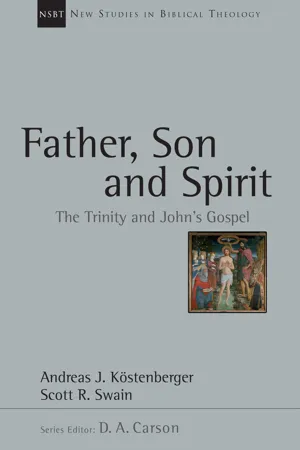
eBook - ePub
Father, Son and Spirit
The Trinity and John's Gospel
- 224 pages
- English
- ePUB (mobile friendly)
- Available on iOS & Android
eBook - ePub
Father, Son and Spirit
The Trinity and John's Gospel
About this book
Information
Topic
Theology & ReligionSubtopic
Biblical StudiesPart 1: Historical Context
Chapter One
John’s Gospel and Jewish monotheism
John’s Gospel was not written in a vacuum. One’s construal of the most likely context in which the Gospel was written will significantly affect the way in which one understands the Gospel’s teaching on God, Jesus and the Spirit. In this chapter, the ensuing study of John’s presentation of God, the Father, the Son and the Spirit, will be set within the larger framework of the notion of monotheism in the OT and Second Temple literature. In this context, it will also be helpful to consider the most likely background for John’s portrayal of Jesus’ pre-existence. This will enable a more accurate assessment of John’s teaching on this subject in relation to notions of God in the larger Jewish and Greco-Roman world in which he lived.
John’s context
The traditional view holds that the apostle John, at the urging of some of his disciples, wrote the Gospel toward the end of the first century AD in Ephesus in Asia Minor.1 On this view, John’s Gospel, alongside the Synoptics, occupies a place well within the mainstream of first-century Christianity. The sources underlying the Gospel not merely comprise what may be called ‘Johannine tradition’ (i.e. material independent of the so-called ‘Synoptic tradition’) but the Gospel is ultimately grounded in eyewitness testimony on the part of one of the key participants in the actual story and history leading to Jesus’ crucifixion (cf. e.g. 19:35; 21:24).2
In the wake of the Enlightenment, scholars began to question the traditional attribution of apostolic authorship to the Gospel of John. Edward Evanson believed the author was familiar with Platonic philosophy.3 Karl Gottlieb Bretschneider construed the background as Philonic Alexandrian philosophy.4 David Friedrich Strauss viewed the Gospel as mythological, an understanding refined and further developed by Rudolf Bultmann, a proponent of the history-of-religions school. Bultmann, for his part, believed John was aligned with Mandaean Gnosticism and saw numerous parallels in Hellenistic mystery religions.5 Similarly, C. H. Dodd detected parallels in the Hermetic literature.6
Others, however, such as Adolf Schlatter and B. F. Westcott, maintained that John’s Jewish background predominates.7 Schlatter adduced detailed rabbinic parallels, while Westcott located the context of John’s Gospel in the matrix of three major events: (1) the Pauline Gentile mission; (2) the destruction of the Jerusalem temple; and (3) the emergence of Gnosticism.8 In the second half of the twentieth century, a rather novel construal of the setting of John’s Gospel emerged, the ‘Johannine community hypothesis’ in its various permutations. J. L. Martyn proposed that the reference to synagogue expulsion in John 9:22 actually refers to a then-recent event in the life of the Johannine sect: its expulsion from its parent synagogue.9
According to Martyn, the primary setting of John’s Gospel is not its overt location in Jesus’ earthly ministry (c. AD 30), but rather the life of the ‘Johannine community’ (c. AD 90). In order to unearth this latter history, Martyn devised a ‘two-level hermeneutic’ that substitutes symbolic or allegorical references to the ‘Johannine community’ for language overtly pertaining to the historical Jesus. An important historical datum for Martyn’s fully fledged version of the ‘Johannine community hypothesis’ was the ‘curse of the Christians’ (birkat-hamînîm) that was allegedly added to Jewish synagogue liturgy around AD 90 and applied to messianic, Christian Jews.10
Others, such as Raymond Brown, held to a form of ‘Johannine community hypothesis’ without mentioning the birkat-ha-mînîm. Brown, for his part, postulated a five-stage trajectory of development of the ‘Johannine community’ inferred from the Gospel’s and the epistles’ internal evidence.11 However, many forms of the ‘Johannine community hypothesis’ are essentially sectarian,12 which was recognized by some to be rendered unlikely by the manifest mission thrust of the Gospel.13 For this reason, efforts were made to refine the hypothesis to accommodate the mission emphasis.14 The alleged role of the birkat-ha-mînîm, as well as the ‘Johannine community hypothesis’ in its various forms, has undergone extensive critique in recent years.15
The demise of the ‘Johannine community hypothesis’, especially in its sectarian form, is apparent in that a substantial recent volume on the contexts of John’s Gospel does not even mention this hypothesis.16 Instead, a plurality of studies is presented on a variety of Johannine topics, and an integrative approach is urged that combines smaller detailed investigations into a coherent whole. Tellingly, however, the work itself does not actually attempt such a larger synthesis. In another important development, the recent substantive rehabilitation of the historical reliability of John’s Gospel has rendered the essence of the traditional view more plausible once again (or at least the view that John contains eyewitness testimony), and studies of the OT background of John’s Gospel underscored the predominance of its Jewish background.17
In this context, Richard Bauckham’s work Jesus and the Eyewitnesses (2006) has broken new ground by showing that the Gospels constitute eyewitness testimony. According to Bauckham, the ideal source in ancient Greco-Roman literature is not the dispassionate observer, but the eyewitness.18 The written Gospels, Bauckham contends, contain oral history related to the personal transmission of eyewitness testimony, not merely oral tradition that is the result of the collective and anonymous transmission of material.19 Bauckham (2006: 93) states his own thesis as follows:
It is the contention of this book that, in the period up to the writing of the Gospels, gospel traditions were connected with named and known eyewitnesses, people who had heard the teaching of Jesus from his lips and committed it to memory, people who had witnessed the events of his ministry, death, and resurrection and had formulated the stories about these events that they told. These eyewitnesses did not merely set going a process of oral transmission that soon went its own way without reference to them. They remained throughout their lifetimes the sources…
In this context, the Twelve served as ‘an authoritative collegium’.20 Especially important in this regard is the phrase ‘from the beginning’, which is found at several strategic points in the Gospels and the NT record (e.g. Luke 1:2; 1 John 1:1; cf. John 1:1). Several other literary devices are used to stress the Gospels’ character as eyewitness testimony, such as ‘the inclusio of eyewitness testimony’ (see esp. Mark 1:16–18 and 16:7 for Peter; John 1:40 and 21:24 for the Beloved Disciple). According to Bauckham, the transmission process of the Jesus tradition resulting in our written canonical Gospels is best understood as a formal controlled tradition in which the eyewitnesses played an important, and continuing, part.21
What is more, the Gospel material was transmitted not merely in a given community’s quest for self-identity but for profoundly theological reasons, in the conviction that the events of Jesus’ history were of epochal historical significance when understood in the larger framework of the (salvific) activity of Israel’s God. Jesus was viewed not merely as the founder of a movement, but as the source of salvation, and Christianity was not just a new movement: it celebrated the fulfilment of God’s promises in Jesus the Messiah who had now come, died and risen.
With regard to John’s Gospel, Bauckham contends that the Beloved Disciple should be regarded as the author, but he identifies John the Elder (not John the apostle, the son of Zebedee) as the author, primarily, it appears, because of his reading of the patristic evidence (Papias, Polycrates and Irenaeus) and because of his understanding of the reference to the ‘sons of Zebedee’ in John 21:2. Regarding the latter point, Bauckham finds the Beloved Disciple’s anonymity throughout the Gospel an insurmountable obstacle to the apostolic authorship of John’s Gospel, since the ‘sons of Zebedee’ are named (though not by first name); he believes the Beloved Disciple is one of the two unnamed disciples in that list.
This may be so, but there seems to be no good reason why John the apostle (if he was the author) could not have put himself inconspicuously at the scene without lifting his anonymity as the author. Put a different way, since the Beloved Disciple must be one of the seven disciples mentioned in 21:2, but since he cannot be Peter, Thomas or Nathanael, there is at least a one in four possibility that he is John the son of Zebedee, and if his brother James is ruled out (as he should be), the probability rises to one in three. The argument for John the apostle as the author becomes all the more compelling when one considers the following list of concerns with Bauckham’s argument:
- 1. Mark 14:17–18 clearly places the Twelve in the upper room with Jesus at the Last Supper (cf. Luke 22:14: the ‘apostles’); this militates against Bauckham’s thesis that the author was not one of the Twelve and seems to pit one apostolic eyewitness (Peter as the source for Mark) against another eyewitness (that of the Beloved Disciple).
- 2. What is the historical plausibility of someone other than one of the Twelve being at Jesus’ side at the Last Supper, even more so as we know that Judas (one of the Twelve) was on the other side?
- 3. Bauckham makes nothing of the strong historical link between Peter and John the apostle in all of the available NT evidence (all four Gospels, Acts and Galatians); this is especially significant in the light of the fact that Peter and the Beloved Disciple are indisputably and consistently linked in John’s Gospel.22
- 4. The presence of the phrase ‘I suppose’ (oimai) in John 21:25 as a device of authorial modesty (in keeping with the label ‘Beloved Disciple’) supports the integrity of the entire Gospel as from the same author, who is identified as an eyewitness at strategic points in the Gospel (e.g. 13:23; 19:35; cf. 21:20).23
- 5. Methodologically, the question arises as to how legitimate it is to put a large amount of weight on one’s reading of the patristic evidence over against the internal evidence of the Gospels themselves.
- 6. How likely is it, in the light of Bauckham’s own theory, that the primary eyewitness behind John’s Gospel is a non-apostle, yet one whose testimony is superior even to that of Peter? In this regard, the question arises whether the early church would ever have received such a gospel, especially if written a generation after the Synoptic Gospels and in the light of the crucial importance placed on apostolicity in the canonization process.
- 7. Why did the author leave out the name John, other than for the Baptist? Surely, it is surprising that someone as important as John the apostle would not be mentioned in the Gospel at all (apart from 21:2). Would ...
Table of contents
- Cover
- Titles in this series
- Title Page
- Contents
- Series preface
- Authors' preface
- Abbreviations
- Introduction: John's Gospel and the church's doctrine of the Trinity
- PART 1: HISTORICAL CONTEXT
- PART 2: BIBLICAL FOUNDATIONS
- PART 3: THEOLOGICAL REFLECTIONS
- Conclusion: The gift of life: Knowing the triune God
- Bibliography
- Index of authors
- Index of Scripture references
- Index of ancient sources
- Notes
- Praise for Father, Son and Spirit
- About the Authors
- More Titles from InterVarsity Press
- Copyright
Trusted by 375,005 students
Access to over 1.5 million titles for a fair monthly price.
Study more efficiently using our study tools.
Frequently asked questions
Yes, you can cancel anytime from the Subscription tab in your account settings on the Perlego website. Your subscription will stay active until the end of your current billing period. Learn how to cancel your subscription
No, books cannot be downloaded as external files, such as PDFs, for use outside of Perlego. However, you can download books within the Perlego app for offline reading on mobile or tablet. Learn how to download books offline
Perlego offers two plans: Essential and Complete
- Essential is ideal for learners and professionals who enjoy exploring a wide range of subjects. Access the Essential Library with 800,000+ trusted titles and best-sellers across business, personal growth, and the humanities. Includes unlimited reading time and Standard Read Aloud voice.
- Complete: Perfect for advanced learners and researchers needing full, unrestricted access. Unlock 1.5M+ books across hundreds of subjects, including academic and specialized titles. The Complete Plan also includes advanced features like Premium Read Aloud and Research Assistant.
We are an online textbook subscription service, where you can get access to an entire online library for less than the price of a single book per month. With over 1.5 million books across 990+ topics, we’ve got you covered! Learn about our mission
Look out for the read-aloud symbol on your next book to see if you can listen to it. The read-aloud tool reads text aloud for you, highlighting the text as it is being read. You can pause it, speed it up and slow it down. Learn more about Read Aloud
Yes! You can use the Perlego app on both iOS and Android devices to read anytime, anywhere — even offline. Perfect for commutes or when you’re on the go.
Please note we cannot support devices running on iOS 13 and Android 7 or earlier. Learn more about using the app
Please note we cannot support devices running on iOS 13 and Android 7 or earlier. Learn more about using the app
Yes, you can access Father, Son and Spirit by Andreas J. Köstenberger,Scott R. Swain, D. A. Carson in PDF and/or ePUB format, as well as other popular books in Theology & Religion & Biblical Studies. We have over 1.5 million books available in our catalogue for you to explore.