"It is my earnest hope that pondering upon the past may give guidance in days to come, enable a new generation to repair some of the errors of former years and thus govern, in accordance with the needs and glory of man, the awful unfolding scene of the future."—Winston Spencer Churchill
From the miracle of Dunkirk to the rape of Warsaw, from the dark corridors of the Kremlin to the embattled heroes of Corregidor, here is the whole panorama of The Second World War. And here is the story of the man upon whose shoulders fell the deadly weight of leadership in the darkest days of the conflict. This is the narrative of Winston Churchill's—and the Allies'—most valiant years.
Captured between these covers are all the exciting action and profound drama of mankind's most awesome struggle. This concise yet comprehensive narrative encompasses the most vivid events of the War, as seen through the eyes of its greatest leader—and through the eyes of those who were led.
We listen to the secret conferences between Roosevelt, Stalin and Churchill, peer through the rifle sight of an American infantryman, hear the skirl of the pipes at Alamein, learn how the great decisions were made, measure their cost in blood and courage.
Here are the tears and the laughter, the heroism, the glory and the senselessness of war, the pageantry, the black ruin, the excitement, the despair. Here is the palpable taste of war. Here, in dramatic, readable form, is the story of how Sir Winston Churchill achieved immortality in his own lifetime.
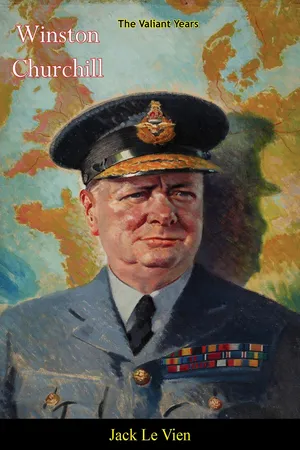
- 331 pages
- English
- ePUB (mobile friendly)
- Available on iOS & Android
eBook - ePub
About this book
Information
Subtopic
European HistoryIndex
HistoryEPISODE 1—A PRETEXT FOR WAR
I canna see the target
I canna see the target
I canna see the target,
It’s o’er far away.—SONG OF THE HIGHLAND DIVISION
AS THE cool luminous dawn of autumn rises over the eastern frontier of Germany it picks out the stark steel sinews of a radio mast, barely inside the German boundary. A few cows ramble heavily about the pastures, their breath steaming as they bend to crop the dewy grass. A faint mist outlines the shape of hedgerows and trees. Over all there is a pastoral stillness, but a stillness that carries a sinister air.
At the foot of the mast, grouped haphazardly and sprawling awkwardly as if caught up and scattered by some sudden appalling gale, lie twelve bodies. Their uniforms are cold with morning damp, their limbs stiffened. Each has died of multiple wounds. Each is dressed like a Polish infantryman. They provide a pretext for war.
Soon the exultant Gestapo will shepherd a party of foreign newspapermen to the site, allow them to gaze, offer them facilities for sending off cables, return them to Berlin. If the newspapermen were given time they would quickly see that things are not as they appear. None of the weapons beside the bodies is loaded. Each man has been shot in the back. The whole thing is an inhuman fraud.
The previous afternoon twelve criminals have been taken in closed vans from a concentration camp, dressed in captured uniforms and driven to this quiet field near Gleiwitz. Blinking at the light as they tumble out they are surprised to see the lane blocked at both ends by SS troops squatting behind medium machine guns. Weapons are thrust into their hands and they are told to line up facing the steel mast. It is all a propaganda matter, the smiling Gestapo explain. They are to pretend to attack the radio station while a film is made. See—there are the cameras! Puzzled, docile, they lumber across the grass. A sudden clamor scythes them down. They are known, with a perverted appropriateness, by the code name CANNED GOODS.
Beyond them to the east, four German armies are systematically annihilating everything in their path. In the ears of every soldier ring the parting words of the Führer: “I expect every soldier to be conscious of the high tradition of the eternal German soldierly qualities and to do his duty to the last. Remember always and in any circumstances that you are the representatives of National Socialist Greater Germany. It is 1 September 1939 and Fall Weiss is going according to plan, as Hitler felt confident it would when with a fat red pencil he added to his Directive Number 1 for the Conduct of the War “Time of attack—0445 hours.” The glorious representatives of National Socialist Greater Germany storm eastward, conscious of their high calling. In their wake, villages smolder, Polish children scream beside the blackened bodies of their mothers. Theirs is a bitter and a brutal ambassadorship.

Striking for the heart, the Luftwaffe’s heavy bombers swarm over Warsaw. Without fighters, without artillery, the city is spread-eagled like a sacrificial victim. Her destruction is a mere academic exercise, a mathematical question only of how quickly the requisite number of bombs can be carried from airfield to target and unloaded. For Warsaw, where the gentle heart of Chopin lies enshrined, there is only the appalling music of death.
Easily, efficiently, the Germans harrow Poland with fire and steel. Not yet fully mobilized, their armies caught off balance, their obsolete planes smashed on their airfields, the Poles fight with suicidal gallantry. Their cavalrymen charge with lance and saber against the tempered steel of panzers: the chivalry of the Middle Ages meets the mechanization of the twentieth century and gallantry alone proves futile.
Oblivious of the carnage, the English are enjoying an English weekend. The most famous fortune-teller in the land has read the stars and their welcome message is “No War This Year.” Across England on this sparkling morning comfortable families digest their fat Sunday newspapers and their toast and marmalade and hope for the best. It is such a beautiful day for the time of year.
They are enjoying the last few moments of a world they will never see again. At ten o’clock the wireless says, “Stand by for an announcement of national importance.” Every fifteen minutes people are warned that the Prime Minister will speak to the nation at eleven-fifteen. In the meantime there is light but decorous music. At eleven-fourteen a lady with a highly educated voice is giving a talk on “How to Make the Most of Tinned Foods: Some Useful Recipes” when the air goes dead.
She is replaced by a thin, pedantic voice that sounds unutterably sad, mortally tired. It is Neville Chamberlain. Patiently he explains that his diplomacy has failed, that the country is already at war. “The situation in which no word given by Germany’s ruler could be trusted, and no people or country could feel themselves safe, has become intolerable. And now that we have resolved to finish it, I know that you will all play your part with calmness and courage. At such a moment as this the assurances of support that we have received from the Empire are a source of profound encouragement to us. Now may God bless you all. May He defend the right. It is the evil things that we shall be fighting against—brute force, bad faith, injustice, oppression, and persecution—and against them I am certain that the right will prevail.”
One man among his audience is not a bit surprised. For years Winston Spencer Churchill has been a prophet without honor in his own country, and now he has been proved right. He switches off the radio, and at that moment is dramatically vindicated. Wailing with a hideous urgency the air-raid sirens start up all over London. With all the panache of a seasoned warrior Churchill ushers his wife up to the flat roof of their town house. Fat silver barrage balloons are rising like ghostly whales all around them. They survey the miles of rooftops, the bustling target of a vast metropolis.
After a while, heeding their duty, they make their way down to a shelter, “armed with a bottle of brandy and other appropriate medical comforts.” Below there broods a frightened stillness. As I gazed from the doorway along the empty street, Churchill remembers, my imagination drew pictures of ruin and carnage and vast explosions shaking the ground, of buildings clattering down in dust and rubble, of fire brigades and ambulances scurrying through the smoke, beneath the drone of hostile airplanes. Despite his premonition, however, no hostile airplanes appear and Churchill goes over to the House of Commons and sits quietly in his place, filled with a strange exhilaration. The benches about him have for years been deaf to his voice; now, at last, they will hear him. Now they will acknowledge that he was right all the time.
For Churchill the middle decade of his life has been the years that the locusts have eaten. A firebrand, unorthodox, unpopular for his favorite themes of India and Germany, he is spurned by his Party and feared by the people. He exists in a political wilderness; I earned my livelihood by dictating articles which hid a wide circulation, not only in Great Britain and the United States, but also, before Hitler’s shadow fell upon them, in the most famous newspapers of sixteen European countries. I lived in fact from mouth to hand...I meditated constantly upon the European situation and the rearming of Germany. I lived mainly at Chartwell, where I had much to amuse me. I built with my own hands a large part of two cottages and extensive kitchen-garden walls, and made all kinds of rockeries and waterworks and a large swimming-pool which was filtered to limpidity and could be heated to supplement our fickle sunshine. Thus I never had a dull or idle moment from morning till midnight, and with my happy family around me dwelt at peace within my habitation.
But as he writes in his neat, small hand, standing at his desk in the mullioned study of Chartwell, or as he relaxes in the comfortable sun of a Kentish spring, when the blossoms cream and froth in every orchard, Churchill stays constantly on guard, with his eyes on Europe. He has been one of the first to read the Nazi gospel, penned in Landsberg jail, the odious Mein Kampf. Its aggressive, unbalanced philosophy spells only one thing. When Hitler, triumphant after his years of struggle, speaks to the first meeting of the Reichstag of the Third Reich on 21 March 1933 Churchill can predict the outcome: Adolf Hitler had at last arrived; but he was not alone. He had called from the depths of defeat the dark and savage furies latent in the most numerous, most serviceable, ruthless, contradictory, and ill-starred race in Europe. He had conjured up the fearful idol of an all-devouring Moloch, of which he was the priest and incarnation.
No one will listen. The people of Britain have graver problems than a German fanatic, and those problems are closer to home. Like the rest of the world she is suffering a depression that is sending her unemployed by the hundreds of thousands to the pitiful lines that wait for charity outside drab offices in every town in the land. Poverty and want lay waste men’s souls.
Some have been out of work for months, idling their empty days away standing on street corners. They do not talk, for there is nothing to discuss but unemployment. A few have not worked for years, and these men are as good as dead. Even those who still have worked stand at their lathes and presses with aching hearts, for who knows when the factory will close and throw them, too, on the rubbish heap?
Thus directed inwardly, the vision of the British does not distinguish the ominous movements in Europe. Hitler’s National Socialist Party has been raised to power by funds from German industrialists, but it has won its security with its own strong right arm. By the spring of 1934 this force—the brown-shirted Sturmabteilung, the SA—has reached a total of almost three million men. Hitler has now gained the confidence of the Army, and with Himmler has built up an even deadlier security force, the black SS. He no longer needs the SA, and is growing apprehensive of its strength. On the night of 30 June 1934 he strikes. All that “Night of the Long Knives” his SS execution squads kill and torture until every possible threat to the Führer has been extinguished in a welter of blood.
This massacre, Churchill observes, however explicable by the hideous forces at work, showed that the new Master of Germany would stop at nothing, and that conditions in Germany bore no resemblance to those of a civilized state.
Sadly Churchill stands on the sidelines of history while his country is betrayed, waiting for the next maneuver from the Führer. By now Hitler has broken the power of that military caste whom once he wooed. He uses a personal scandal to dispose of the clique of generals ruling the Reichswehr and himself assumes supreme command and sets up the Oberkommando der Wehrmacht, the OKW, an instrument with which he will later control the armed forces of Germany in war. Every member of those forces must swear an oath of loyalty not to Germany, but to Adolf Hitler. He must solemnly declare, “I swear before God to give my unconditional obedience to Adolf Hitler, Führer of the Reich of the German People, Supreme Commander of the Wehrmacht, and I pledge my word as a brave soldier to observe this oath always, even at peril of my life.”
The gray troops of a resurgent Germany crumble frontier after frontier, without let or hindrance. In the fall of 1938 the pathetic history of appeasement reaches its tawdry climax at Munich, where Hitler gives shameful audience to Prime Minister Neville Chamberlain.
On his return to Horton aerodrome, Chamberlain waves a joint declaration he and Hitler have signed that expresses their common desire never to go to war. He waves it again from the windows of 10 Downing Street as crowds below him weep with relief. In his precise way he assures them, “This is the second time there has come back from Germany to Downing Street peace with honor. I believe it is peace in our time.” Next day Czechoslovakia disappears into the German maw.
In the House of Commons Churchill speaks her epitaph. All is over. Silent, mournful, abandoned, broken, Czechoslovakia recedes into the darkness. He goes on with yet another warning. And do not suppose that this is the end. This is only the beginning of the reckoning. This is only the first sip, the first foretaste of a bitter cup which will be proffered to us year by year unless, by a supreme recovery of moral health and martial vigour, we arise again and take our stand for freedom as in the olden time.
When Hitler turns to the East, concludes a cynical pact with Russia, and picks a quarrel over the free port of Danzig with the Poles, Churchill knows that the crisis is almost at hand. If you will not fight for the right when you can easily win without bloodshed; if you will not fight when your victory will be sure and not too costly, you may come to the moment when you will have to fight with all the odds against you and only a precarious chance of survival. There may even be a worse case. You may have to fight when there is no hope of victory, because it is better to perish than to live as slaves.
Now that time has come, ironically enough in a season of warmth and gentle weather. For on this first day of War London is flooded with the softness of an Indian Summer. In the decent gloom of the debating chamber Churchill savors the echoes of his many warnings that now—perhaps too late—may be recognized as truth. Now Chance is king and all rests upon the hazard. Now the testing time is come. Of all men present in that ancient hall Churchill knows himself the one most fitted to endure the fire. That night he is made First Lord of the Admiralty.
He goes to work at once. Captain Pim, an officer of the Naval Reserve, is one of the first to meet him: “I was ordered to report to the First Sea Lord, Admiral Sir Dudley Pound. Sir Dudley told me three things. ‘First,’ he said, ‘Mr. Churchill is back with us. Secondly, he wants the War Room as he had it in the First World War established in Admiralty House. Thirdly’ he said, ‘you’ve been selected to run this War Room. Better go along and look at Admiralty House!’ So I went along to Admiral...
Table of contents
- Title page
- TABLE OF CONTENTS
- ACKNOWLEDGMENTS
- DEDICATION
- LIST OF MAPS
- EPISODE 1-A PRETEXT FOR WAR
- EPISODE 2-REAP THE WHIRLWIND
- EPISODE 3-THE FALL OF FRANCE
- EPISODE 4-BRITAIN MANS THE RAMPARTS
- EPISODE 5-DAYS OF GLORY
- EPISODE 6-SINK HER BY GUNFIRE
- EPISODE 7-THE INLAND SEA
- EPISODE 8-TAKE UP THE SWORD
- EPISODE 9-DEADLY SUNRISE
- EPISODE 10-A TIME OF HOPE
- EPISODE 11-CITY OF STEEL
- EPISODE 12-THE ROAD TO ROME
- EPISODE 13-THE TRIUMVIRS
- EPISODE 14-THE FORGOTTEN ARMY
- EPISODE 15-THE COUNTER ATTACK
- EPISODE 16-THE SWORD IS FORGED
- EPISODE 17-D-DAY: THE GREAT ASSAULT
- EPISODE 18-LIBERATION
- EPISODE 19-CLANDESTINE COMBAT
- EPISODE 20-AIRBORNE ARMY
- EPISODE 21-THE LAST CHRISTMAS
- EPISODE 22-YALTA: FATEFUL RENDEZVOUS
- EPISODE 23-THE ULTIMATE BARRIER
- EPISODE 24-THE LAST JUDGMENT
- EPISODE 25-FAREWELL, MR. CHURCHILL
- REQUEST FROM THE PUBLISHER
Trusted by 375,005 students
Access to over 1.5 million titles for a fair monthly price.
Study more efficiently using our study tools.
Frequently asked questions
Yes, you can cancel anytime from the Subscription tab in your account settings on the Perlego website. Your subscription will stay active until the end of your current billing period. Learn how to cancel your subscription
No, books cannot be downloaded as external files, such as PDFs, for use outside of Perlego. However, you can download books within the Perlego app for offline reading on mobile or tablet. Learn how to download books offline
Perlego offers two plans: Essential and Complete
- Essential is ideal for learners and professionals who enjoy exploring a wide range of subjects. Access the Essential Library with 800,000+ trusted titles and best-sellers across business, personal growth, and the humanities. Includes unlimited reading time and Standard Read Aloud voice.
- Complete: Perfect for advanced learners and researchers needing full, unrestricted access. Unlock 1.5M+ books across hundreds of subjects, including academic and specialized titles. The Complete Plan also includes advanced features like Premium Read Aloud and Research Assistant.
We are an online textbook subscription service, where you can get access to an entire online library for less than the price of a single book per month. With over 1.5 million books across 990+ topics, we’ve got you covered! Learn about our mission
Look out for the read-aloud symbol on your next book to see if you can listen to it. The read-aloud tool reads text aloud for you, highlighting the text as it is being read. You can pause it, speed it up and slow it down. Learn more about Read Aloud
Yes! You can use the Perlego app on both iOS and Android devices to read anytime, anywhere — even offline. Perfect for commutes or when you’re on the go.
Please note we cannot support devices running on iOS 13 and Android 7 or earlier. Learn more about using the app
Please note we cannot support devices running on iOS 13 and Android 7 or earlier. Learn more about using the app
Yes, you can access Winston Churchill by Jack Le Vien,John Lord in PDF and/or ePUB format, as well as other popular books in History & European History. We have over 1.5 million books available in our catalogue for you to explore.