"The challenges of identity, assimilation, achievement, and politics that were faced by Lahoma and Cindy are the same challenges our youth are facing today." –Jaki Shelton Green, poet and NC Literary Hall of Fame inductee
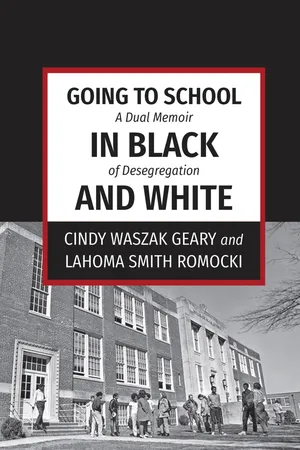
The school careers of two teenage girls who lived across town from each other—one black, one white—were altered by a court-ordered desegregation plan for Durham, NC in 1970.
LaHoma and Cindy both found themselves at the same high school from different sides of a court-ordered racial "balancing act." This plan thrust each of them involuntarily out of their comfort zones and into new racial landscapes. Their experiences, recounted in alternating first person narratives, are the embodiment of desegregation policies, situated in a particular time and place.
Cindy and LaHoma's intertwining coming of age stories are part of a bigger story about America, education and race—and about how the personal relates to the political.
This dual memoir covers the two women's life trajectories from early school days to future careers working in global public health, challenging gender biases, racial inequities, and health disparities. LaHoma and Cindy tell their stories aware of the country's return to de facto school segregation, achieved through the long-term dismantling of policies that initially informed their school assignments.
As adults, they consider the influence of school desegregation on their current lives and the value of bringing all of us into conversation about
what is lost or gained when children go to school in black and white.
- 228 pages
- English
- ePUB (mobile friendly)
- Available on iOS & Android
eBook - ePub
About this book
Information
1—Setting the Stage
One
Setting the Stage
LaHoma
I grew up during a time when the integration of the Durham public schools was thought to be the single most important factor in improving the lives of the city’s black residents. The idea was simple—if they went to schools with whites, black children would benefit by attending better-resourced schools, and that would lead to more academic opportunities and social mobility as a way to ensure social and economic success. This was the rationale for the struggle in which my parents and most of the adults I knew were engaged.
I moved overseas after college in the late 1970s and lost touch with the day-to-day skirmishes on the front lines of school integration in my hometown. Judging from my experiences and evidence from the people with whom I kept in touch, the integration experiment had been mostly successful. All my friends had graduated from two- or four-year colleges, attended graduate schools, law schools, and medical schools, and had secured jobs or started their own businesses. I had long convinced myself that integration had benefited all of us, despite my youthful objections. The naysayers had been wrong. Those who dared to believe otherwise appeared to be a dwindling minority.
As newlyweds, my husband and I moved back to the U.S. in 1989 and searched for a place to call home. We looked in the greater Durham area and eventually settled on a small, rural community about 12 miles north of Durham. The reason for not moving back to Durham was largely a financial one: We could afford to buy more house and property in the country. My Yankee-born husband, Tim, was a newcomer to North Carolina, and I thought that it would be fair if we lived in a relatively new community for both of us. Besides that, Tim loves the outdoors, and our new home suited both of us. He had a place to fish and garden, and I relished the large backyard for family cookouts. I reconnected with Durham friends from my youth. Many of them already had children in grade school, but none in high school, and although we talked about a lot of things, I never thought to ask about the school system. In hindsight, I realize we might even have discussed schools, but the subject didn’t register in my pre-kids brain. Our conversations were nostalgic reflections of Hillside “back in the day,” but they never led me to ask about the Hillside “of today.”
So I was speechless when I read an op-ed piece in the News & Observer of Raleigh, the nearby state capital, about the state of public schools in Durham. I brought the article to share with Cindy and our former doctoral advisor, Jane, with whom we had formed a small writing group. I read aloud to them: “Durham schools’ student population is now 17 percent white, 25 percent Hispanic, and the rest mostly African American. Seventy-seven percent of the 33,900 students who attend Durham’s district schools qualify for a free or reduced price lunch. In some schools, the percentage is more than 80.”
The 2015 op-ed described the dismal end-of-year letter grades awarded to the Durham school system. Out of 53 district schools graded, 29 received either a D or F. The article stated that as Durham’s district schools’ grades had begun a downward slide, “there has been a corresponding increase in the number of high poverty schools and more segregation by race and class.” The writer continued: “It’s frustrating that the schools are growing poorer even as the city enjoys a boom in restaurants, the arts and downtown real estate. In that paradox, the responsibility can’t be put on conservative lawmakers. It reflects the decision of middleclass (white) residents to send their children to charter or private schools….” (1)
“What happened to the grand experiment?” I mumbled to myself and then turned to Jane and Cindy. Everything had worked out OK for me and my friends; had it not worked out well for everyone? What was wrong, and why were white parents moving their children out of the Durham public school system?
I looked over at Cindy, who was shaking her head slowly as she considered my question. Several minutes later, we realized that we had been at the same school, at the same time—during the integration of the Durham public school system. As we peeled back layers of memories and feelings about this pivotal period in our lives, we realized that we were reliving events through different racial filters.
Our reactions brought more questions to the fore as we considered this newly found connection from long ago. Was there something unique about our individual perspectives that was worth exploring? Would we gain greater insight through reliving a shared journey of our experiences? Had my assumptions about the merits of integration been so wrong? We also wanted to make sense of the troubling narrative unfolding about race, class and education in Durham, a narrative that seemed at odds with our own experiences.
Over the past couple of years, Cindy and I have grown closer as we nurtured our budding book project. We learned that we have a great deal in common. We also realized that we were embarking on an ambitious project with immeasurable pitfalls. What if our memories were distorted with the passage of time? We promised each other to stay true to our authentic voices even if they did not always portray events or ourselves in the most flattering light. As we worked through the transitions of inquiry and research, meditation and reflection, awe and abandon to our writing, we revealed stories and shared memories that we thought had long ago faded away.
In the middle of our discussions about if and how we wanted to share our stories, I attended my 40th high school reunion, talked to old classmates and teachers, and even got a hug from Dr. Lucas, the high school principal at Hillside when both Cindy and I were students. I told a few of them about the book project and received overwhelming interest and promises to purchase a copy once it was published. But more important, their opinions validated my own, regardless of whether they were black or white. We all seemed to believe that the experiment had worked and that we had indeed been its greatest beneficiaries. Former classmates fondly remembered our time together, with many having made tremendous sacrifices to come to the weekend event. Others had used the occasion to visit elderly parents or siblings and other family members still living in the area. Many, like me, lived in Durham or nearby. The reunion of more than 120 alumni and their families, both black and white, reinforced my resolve to finish the project.
Together, Cindy and I tell our stories of integration in the context of our lives in our different communities. What appears here is the result of reaching far back into our memories to put to paper the feelings that these experiences elicited. This book, I hope, will contribute to the local, state and national discourse on whether there is inherent value in requiring children from different racial and ethnic backgrounds to attend integrated schools together.
Cindy
The civil rights movement of the 20th century took place on many stages, but arguably one of the most important was public education. The intention of the Brown v. Board of Education decision of 1954 was to bring equality to the education of black children whose segregation from white students was recognized as counterproductive to that goal. Sending black and white children to the same schools was part of a socialization process as well, with the expectation that children of different races would learn to get along with each other, even if their parents had not. Enforcement of Brown came at a slower pace than “with all deliberate speed” might suggest, but it did eventually come in the late 1960s and early 1970s, after much resistance from white school boards and parents. Racial equality required court-ordered school redistricting and buses, and it required black parents and white parents who were willing to support their children as they ventured into new geographic and social territory. Equality also required children who trusted adults to protect them.
My schooling was part of this social-change experiment as it played out in Durham, North Carolina, in the 1970s. What difference did it make? I imagine there are as many answers to this question as there were children in school. In this book, LaHoma and I tell our stories of integration that converge with and diverge from each other in telling ways. LaHoma and I did not know each other while we attended the same school. We were two years apart in age and had gone to different junior high schools, having lived in separate parts of a racially segregated city. We did meet each other some 15 years later when we worked for the same organization in Durham doing global public health work. We still did not know each other well because we worked in different departments, and LaHoma eventually left to return to school for a Ph.D.
LaHoma and I remained in overlapping networks of friends and colleagues; in 2014 we found ourselves part of the writing group she described above with our mutual friend and mentor. During a meeting of this group, over a mushroom and artichoke frittata at a local bakery, LaHoma and I discovered that we both were students at Hillside High School the year she was a sophomore and I was a senior. A torrent of memories took over our discussion that day, and we realized we had a story to tell, made richer by our individual perspectives. In our conversation about the op-ed piece she brought in, we realized we also were similarly concerned about the way Durham schools (and schools everywhere) have reverted to racial segregation because of a combination of white flight and the loss of a court mandate to maintain racial integration.
The resegregation of schools in Durham that LaHoma writes about reflects a reality across the country. The percentages of black students enrolled in schools in which the student population is 91-100 percent minority (often referred to as ‘hypersegregation’) ranged in 2011 from 34 percent in the South and West to 51 percent in the Northeast, reflecting substantial increases since 1991(2). Learning about this turn of events woke us up to the startling realization that though we had been among the students whose school lives were altered by court decisions to promote racial equality, we had not actually given much further thought to what this meant to us. Nor had we paid close attention to what had happened in the schools since we left high school.
Our immediate reaction was that this reversal in policy and its effects felt wrong to us. We wrote this book to explore our own experiences and find out what was good and helpful to us from them—as people who believe in racial equality and as citizens who believe that our government has a role in ensuring equal access to education for everyone. We wanted to find out if we had idealized the value of our experiences and/or if they had made some difference in our lives. It was important for us to do this together, to bring stories from our separate racial identities. We wrote separately but read each other’s work frequently and then talked to each other about what we learned from each other.
Our motivation for writing this book evolved as we wrote and shared. At first, we wanted to tell stories that we thought reflected a particular place and time, stories about our coming of age that might resonate with others. Later, we began to see the value for each of us in the conversations we were having as these memories surfaced. Some of what we were telling each other was surprising, and some of it was confirming. A lot of it was just fun—reliving high school memories several decades removed. It was our common history and our willingness to listen to each other’s stories with our hearts that created our true friendship with each other. Examining our past has been revelatory; this examination has kicked up a lot of questions for us, too. We have done much soul-searching for answers, and we are still not sure about some of them. But we are committed to the continuing conversation.
Writing this book has been a gift to me, a time to remember what we had not thought about for so long—what my poet friend Jaki Shelton Green calls “remembering what you remember”—and to understand it in the context of what we know now and what we are still learning. Writing together has doubled the gift for me, not only transforming an acquaintanceship into a strong friendship but also giving us a chance to understand this time in our lives from another’s perspective in a safe and trusting collaboration.
2— In the Beginning Was “The Letter”
Two
In the Beginning Was “The Letter”
LaHoma
The summer of 1970 was a long and agonizing one for me. There had been talk—rumors—that the Durham City School System was going to make changes and that some students were going to be reassigned to go to schools with “the Whites.” The grownups in my life didn’t talk about it with me much, but I could hear them talking about “it” to each other and how “it” was going to change everything. I didn’t like the uncertainty I heard in their voices, but I tried not to dwell on it too much. I was secretly hoping that the changes they were talking about were not really going to affect me, that I would just be able to continue to go to the best school in Durham with...
Table of contents
- Title Page
- Copyright
- Contents
- Quotations
- Dedications
- Foreword
- Prologue— Why We Wrote This Book
- 1—Setting the Stage
- 2— In the Beginning Was “The Letter”
- 3—Growing Up Black in Durham Before Desegregation
- 4— My White World Before Hillside
- 5— Going to Whitted With the White Kids
- 6— Being White at Hillside High: A Different World
- 7— Finally at Hillside: It’s All About the Band
- 8— The Junior Miss Pageants
- 9— From Black and White to White and Black
- 10— Discovering I Was Black
- 11— Taking It With Us
- 12— Sending Our Kids to School
- Epilogue—What now
- Notes
- Acknowledgments
- The Authors
- If you liked Going to School in Black and White
Trusted by 375,005 students
Access to over 1.5 million titles for a fair monthly price.
Study more efficiently using our study tools.
Frequently asked questions
Yes, you can cancel anytime from the Subscription tab in your account settings on the Perlego website. Your subscription will stay active until the end of your current billing period. Learn how to cancel your subscription
No, books cannot be downloaded as external files, such as PDFs, for use outside of Perlego. However, you can download books within the Perlego app for offline reading on mobile or tablet. Learn how to download books offline
Perlego offers two plans: Essential and Complete
- Essential is ideal for learners and professionals who enjoy exploring a wide range of subjects. Access the Essential Library with 800,000+ trusted titles and best-sellers across business, personal growth, and the humanities. Includes unlimited reading time and Standard Read Aloud voice.
- Complete: Perfect for advanced learners and researchers needing full, unrestricted access. Unlock 1.5M+ books across hundreds of subjects, including academic and specialized titles. The Complete Plan also includes advanced features like Premium Read Aloud and Research Assistant.
We are an online textbook subscription service, where you can get access to an entire online library for less than the price of a single book per month. With over 1.5 million books across 990+ topics, we’ve got you covered! Learn about our mission
Look out for the read-aloud symbol on your next book to see if you can listen to it. The read-aloud tool reads text aloud for you, highlighting the text as it is being read. You can pause it, speed it up and slow it down. Learn more about Read Aloud
Yes! You can use the Perlego app on both iOS and Android devices to read anytime, anywhere — even offline. Perfect for commutes or when you’re on the go.
Please note we cannot support devices running on iOS 13 and Android 7 or earlier. Learn more about using the app
Please note we cannot support devices running on iOS 13 and Android 7 or earlier. Learn more about using the app
Yes, you can access Going to School in Black and White by Cindy Waszak Geary in PDF and/or ePUB format, as well as other popular books in Social Sciences & Social History. We have over 1.5 million books available in our catalogue for you to explore.