- 369 pages
- English
- ePUB (mobile friendly)
- Available on iOS & Android
eBook - ePub
About this book
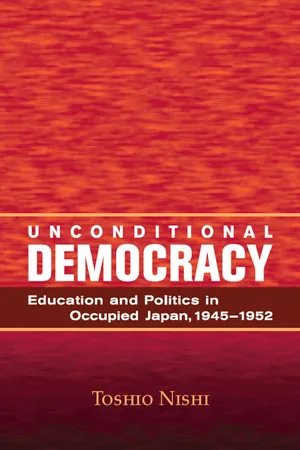
The difficult mission of a regime change: Toshio Nishi gives an account of how America converted the Japanese mindset from war to peace following World War II.
Information
PART ONE
FROM EMPIRE TO DEMOCRACY
On August 6, 1945, an atomic bomb reduced Hiroshima to debris. Fifteen minutes after dropping the bomb, an American pilot cabled to the White House Map Room: “Results clear cut successful in all respects. Visible effects greater than in any test. Conditions normal in airplane following delivery.”1 Thirty minutes later rain fell heavily upon the dying city; the closer to the core of the explosion, the greater the downpour. But it quickly evaporated. To cool their melting skins and burning lungs, many people in Hiroshima crawled to the river that ran through the middle of the city. The river eased their last pain and then carried their bodies to the sea. Two hundred thousand died.
On August 9 picturesque Nagasaki burned in a second scorching wind. One hundred twenty thousand died.
Absolute pacifism, once unthinkable and unmentionable, now became Japan's highest ideal, while nationalism and patriotism, once awe-inspiring imperial slogans, fell from grace. Japan surrendered—unconditionally. When the Americans landed in Japan under the command of General Douglas MacArthur, the Japanese people were ready to do what they were told. This readiness facilitated American efforts to convert the Japanese politically.
American policies in Japan were not isolated from the broader American postwar strategy in Asia, which closely influenced MacArthur's behavior. When the Japanese Empire collapsed, there was no indigenous power immediately capable of bringing back order and prosperity to Asia. The United States, by defeating Japan, appeared to be the only nation that could restore things to normal and lay the foundations for economic progress. The vacuum left by the fall of the Japanese Empire attracted the United States. Asians, anticipating total freedom from the slavery of both European and Japanese colonialism, welcomed the United States as a champion of human rights and fighter for liberty. The United States in turn believed that all nations could blossom into political independence and economic self-sufficiency under the aegis of American goodwill. Such idealism was inseparable from the euphoria of victory. “American goodwill,” throughout Asia, was a euphemism for American hegemony. The ever-present American military garrisons in Asia represented, in the face of equally numerous Soviet forces, the determination of the United States to protect its interests, if necessary at the cost of military confrontation.
During the nearly seven years of the Occupation the United States attempted to write into Japanese daily life such ideals as “individuality,” “liberty,” “freedom,” and “equality.” The US occupation authorities labeled this attempt the “political reorientation of Japan.” The program was directed by General MacArthur. Armed with awesome executive powers and surrounded by his devoted entourage, MacArthur from his general headquarters (GHQ) in Tokyo, tried to lead the Japanese people to the threshold of democracy. His title “Supreme Commander for the Allied Powers” (SCAP) accurately depicted the absolute supremacy with which he administered the entire Occupation. His words and whims were mightier than laws. His ideological posture, as much as any political objectives of the US government, dictated the new direction that Japan had to follow without question. Any apparent doubt in the Japanese mind about MacArthur's policies bordered on insubordination; vocal support or silent acquiescence was the safest rule of survival.
The fervor of the victor's idealistic reforms during the early stage of the Occupation mirrored the policy of unconditional surrender; the victor's ideology, it naturally followed, should now prevail just as his arms had prevailed. In MacArthur's eyes no nation, especially the defeated totalitarian Japan, had the right to negotiate such fundamental principles as “liberty” and “justice.” The new Constitution of Japan embodied MacArthur's vision of ideal parliamentary democracy and pure pacifism.
American policymakers at GHQ believed that democracy would come only after a sweeping purge of the undesirable element among the Japanese people. The undesirables were the “right wing,” the militarists and ultranationalists who had “caused and lost” the war. The magnitude of the purge caused intense fear among Japanese conservatives and serious doubts in Washington. But MacArthur was satisfied. The vacuum the purge created was readily filled by young, less experienced but enthusiastic people, including members of the “left wing”—Liberals, Socialists, and Communists. In the postwar Japanese political landscape, “war” became associated with the right wing, and “peace” with the left wing. To be sure, GHQ did not openly encourage the Japanese leftists; but it did condone their vigorous political activity. This policy of noninterference complemented the public freedom of thought and action that was one of the most cherished American means of teaching the Japanese people democracy. Despite all the rhetoric, however, it was only a guided democracy, as American press censorship showed.
Soon after the US Occupation began, communism began to make rapid gains throughout the world. Japan's new public slogans—“liberty,” “democracy,” “freedom of speech”—were sadly diluted for the sake of strategic expediency. When leftist Japanese critics accused GHQ of practicing “rationed democracy” or “American imperialism,” they were silenced. Together with the conservative Japanese government, GHQ initiated the Red Purge. The purge swept the nation, frightening the intellectuals, who were habitually on the left. It was a great success. The Japanese conservatives, with GHQ's blessing, quickly filled the vacuum that the purge created. Reinforcing the conservatives' firm grip on Japan, MacArthur permitted the Japanese government to welcome the ultranationalists and militarists back to society. Power had swiftly moved from the conservatives to the liberals and back again to the conservatives.
Japanese education was reformed along the same lines as Japanese politics. John Locke conceived the child's mind as a tabula rasa upon which a teacher could make any kind of beneficial impression; the US government nurtured similar expectations toward defeated Japan. MacArthur tried his best to mold Japanese thought and behavior; proper education, he believed, would make his dream come true. He clearly understood the classic interdependence between political indoctrination and compulsory education. The survival of democracy, he believed, could not be guaranteed without effective control of the nation's educational system. He therefore invited the US Education Mission to Japan to make recommendations for reform. “We do not come in the spirit of conquerors,” proclaimed the mission in March 1946; it went on to make various recommendations and its report became the blueprint for Japanese educational reform. Among the suggestions offered was that Japan should develop “the consciousness of a worthy national culture.”
The Japanese Ministry of Education was hard pressed to find any such thing, but nonetheless published a Guide to New Education in Japan, one of the most embarrassing documents that it had ever offered to Japanese teachers and pupils. The reason was the ministry's continuing loyalty to the definitive 1890 Imperial Rescript on Education, a personal message from the Emperor that commanded absolute loyalty on the part of subjects to the throne. The Ministry of Education as well as the entire bureaucracy of the conservative Japanese government could not abandon the rescript, with its restrictive message, and it soon became a rallying point. GHQ, seeing the Japanese government struggle to keep the rescript alive, decided it was dangerous and moved to kill it.
Though the Japanese government tried to retain as much of the ancient regime as possible, MacArthur would not tolerate such maneuvers. The government was forced to realize that the only way to secure a withdrawal of the occupation forces was full cooperation with GHQ. The Japanese government accordingly began issuing numerous instructions on democracy to Japanese teachers and pupils. Delighted, GHQ encouraged the Japanese government to become a fanatical advocate of democracy, until both GHQ and the Government were trapped in a rush to get the ideal democracy on paper. Teachers and pupils, surprised by the government's sudden about-face, now understood that a victorious America now ruled Japan, and that “democracy” was the new guidebook for their future behavior and welfare.
The quick transfer of power in Japanese politics, from the conservatives to the liberals to the conservatives, occurred in Japanese education as well. At the beginning of the Occupation, GHQ purged the ultranationalists and militarists—a move welcomed by the liberals in Japanese education, who saw it as an effective cleansing of Japan's past sins. The liberals then began to push hard for their own ideological reforms. Some of their programs were identical with those proposed by GHQ; others infuriated GHQ.
The quick and easy success of the Red Purge in Japanese politics and education convinced GHQ and the US government that Japan, cured of communism and pregnant with industrial growth potential, would remain a loyal ally in the Pacific. The American hunch proved right. Continental American reality and ideals were transfused into the island nation; occupied Japan became a microcosm of the United States.
The fall of imperial Japan in the summer of 1945 was as stunning a spectacle as its rise to world power. The United States was not blind to the Japanese people's extraordinary talents. As Secretary of War Henry Stimson informed President Truman a few weeks before the Japanese surrender, the Japanese were an “extremely intelligent people” and their nation building during the last seventy years had been “one of the most astounding feats of national progress in history.”2 Something, no doubt, went terribly wrong. An overview of imperial Japan (1868–1945), which follows this introduction, will serve as background for my lengthier account of the dramatic American experiment in Japan.
1
An Overview of Prewar Japan
The British industrial revolution of the eighteenth century precipitated the blossoming of state-supported capitalism in Europe. The American Revolution and the French Revolution triggered a profound ideological reorientation toward the governance of a nation state. But Japan under the Tokugawa Shoguns (1604–1867) chose to remain isolated from changes so drastic—and so hazardous.
The western industrial nations, believing themselves enlightened, considered it their humanitarian obligation to propagate their new perspectives throughout the world. Although their intentions may have been virtuous, their behavior in Asia and Africa degenerated into European cultural chauvinism. The Western cultural superiority complex, supported by Western military superiority, served to justify imperialistic expansion. Aggressive Western mercantile activity along the Asian coastline disfigured the face of Asia. Many Japanese intellectuals were well aware of the British exploitation of India and China. The Japanese knew that they had no choice but to physically resist the West in order to avoid a debacle similar to the one their neighbors had suffered.
The End of Isolation
As early as 1844 King William II of the Netherlands (the only Western nation with which Japan traded during the nearly two hundred fifty years of isolation) warned of imminent Western gunboat diplomacy. He urged the Tokugawa Bakufu (Warrior Administration) to open the country. The Bakufu refused. In 1844, 1845, and 1846, British and French warships visited Nagasaki and requested commercial relations; so, too, did Commodore James Biddle of the American East Indian Fleet when he came to Uraga in 1846. Each time the Bakufu refused. Finally, in July 1853, Commodore Matthew C. Perry, special envoy of US president Millard Fillmore, arrived at Uraga with his imposing naval squadron. At gunpoint he demanded trade concessions from the Tokugawa Bakufu.1 The Bakufu, frightened by its own inability to fight back, asked Perry to return in a year for a formal reply, and then for the first time solicited opinions from local lords and officials.2 This action suggested the Bakufu's serious lack of confidence in its own ability to govern.
Perry returned in January 1854 and successfully concluded the Treaty of Peace and Amity. Two ports were made accessible to American ships for fuel and provisions; and England, Russia, and the Netherlands soon acquired the same privileges. Four years later Townsend Harris, the first American consul, skillfully concluded the Treaty of Amity and Commerce with the Bakufu. This treaty introduced the concept of extraterritoriality to the Japanese people. England, the Netherlands, as well as this time France, and Russia, followed suit and concluded similar treaties.3 The Bakufu did not fully comprehend the practice of extraterritoriality. The differential treatment of foreigners, who were now immune from Japanese laws, and the resulting conflicts between Japanese and Westerners, soon caused bitter resentment among the Japanese. Extraterritoriality smacked of colonization. The Bakufu felt that the Western powers, by capitalizing upon Japanese ignorance of foreign affairs, had cheated.
The series of concessions to the foreign powers revealed the Bakufu hegemony at bay. Such signs of weakness in turn encouraged the rebellious activities of young low-ranking samurai (the warrior class) who advocated the “restoration” of imperial rule. The rebels regarded the treaties as a national disgrace. They recognized, however, the frightening difference in military might between Japan and the West. The difference compelled them to appreciate the paramount importance of military strength for national defense and foreign expansion. The Japanese rebels insisted that only a new imperial regime could remedy the disgraceful situation. However, the Imperial House during the efficient Bakufu administration possessed no political power; rather, it retained the “sacredness” associated with the continuity of “the original Japanese family.”
In 1860 the desperate Bakufu arranged the marriage of the presiding Shogun Iemochi and Princess Kazunomiya of the Imperial House. The Bakufu's reason for the marriage was to “unite the hearts of all the country” and to “clear the barbarians (Westerners) out of the country.”4 The marriage did not enhance the position of the Bakufu; instead, the Imperial House gained power, prestige, and authority at the Bakufu's expense. The marriage confirmed for the Japanese people the ultimate legitimacy of imperial governance.
While the Bakufu was compelled by crushing Western pressure to abrogate its isolationist policy, the young samurai rebels demanded the continued maintenance of national isolation. The rebels' frustration at their unanswered demands frequently exploded in the murder of foreign officials and merchants. Western naval forces retaliated by bombarding cities. While these sensational incidents publicized its impotence, the Bakufu sat paralyzed. To finalize the transition of power, the Bakufu and the rebels waged a civil war. The Bakufu's surrender, to the Imperial House, signified the “restoration” of imperial governance. The new regime was named “Meiji” or Enlightened Reign. The year was 1868.
The New Order
The fundamentally authoritarian style of national governance hardly changed after the transition from the Tokugawa Bakufu to the imperial oligarchy. The Japanese people experienced little need to alter their basic attitude toward hierarchical authority. The stability of their attitude was due to the Bakufu's successful development of a vertical class structure based upon Confucian ethics. A harmonious vertical integration, without an antagonistic dichotomy between superior and inferior, constituted the ideal order of the family, the fief, and the nation. In this society an individual independent of his group, like a farmer without his rice field, a samurai without a fief lord, or “a Japanese without Japan,” was meaningless. A superior expected loyalty and obedience from a subordinate, and his benevolence toward the subordinate implied his compassion and wisdom. This traditional homogeneity coalesced in the face of Western colonialism.
To the Japanese imperial oligarchs, industrialization was a pressing national objective. They believed that it could be accomplished by adopting Western technological skills. The imperia...
Table of contents
- Cover
- Title Page
- Copyright
- Dedication
- Contents
- Preface to the Paperback Edition
- Editor's Foreword
- Acknowledgments
- Personal Introduction
- PART ONE: FROM EMPIRE TO DEMOCRACY
- PART TWO: FROM INDOCTRINATION TO EDUCATION
- PART THREE: THE PRICE OF PEACE
- Summary and Conclusion
- Notes
- Selected Bibliography
- Index
Trusted by 375,005 students
Access to over 1.5 million titles for a fair monthly price.
Study more efficiently using our study tools.
Frequently asked questions
Yes, you can cancel anytime from the Subscription tab in your account settings on the Perlego website. Your subscription will stay active until the end of your current billing period. Learn how to cancel your subscription
No, books cannot be downloaded as external files, such as PDFs, for use outside of Perlego. However, you can download books within the Perlego app for offline reading on mobile or tablet. Learn how to download books offline
Perlego offers two plans: Essential and Complete
- Essential is ideal for learners and professionals who enjoy exploring a wide range of subjects. Access the Essential Library with 800,000+ trusted titles and best-sellers across business, personal growth, and the humanities. Includes unlimited reading time and Standard Read Aloud voice.
- Complete: Perfect for advanced learners and researchers needing full, unrestricted access. Unlock 1.5M+ books across hundreds of subjects, including academic and specialized titles. The Complete Plan also includes advanced features like Premium Read Aloud and Research Assistant.
We are an online textbook subscription service, where you can get access to an entire online library for less than the price of a single book per month. With over 1.5 million books across 990+ topics, we’ve got you covered! Learn about our mission
Look out for the read-aloud symbol on your next book to see if you can listen to it. The read-aloud tool reads text aloud for you, highlighting the text as it is being read. You can pause it, speed it up and slow it down. Learn more about Read Aloud
Yes! You can use the Perlego app on both iOS and Android devices to read anytime, anywhere — even offline. Perfect for commutes or when you’re on the go.
Please note we cannot support devices running on iOS 13 and Android 7 or earlier. Learn more about using the app
Please note we cannot support devices running on iOS 13 and Android 7 or earlier. Learn more about using the app
Yes, you can access Unconditional Democracy by Toshio Nishi in PDF and/or ePUB format, as well as other popular books in History & Japanese History. We have over 1.5 million books available in our catalogue for you to explore.