eBook - ePub
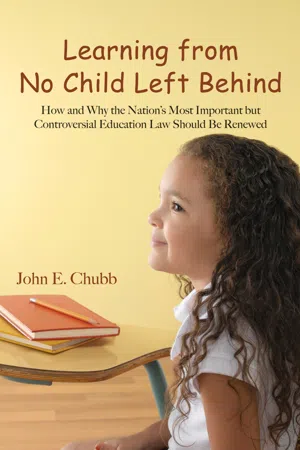
Learning from No Child Left Behind
How and Why the Nation's Most Important but Controversial Education Law Should Be Renewed
- 84 pages
- English
- ePUB (mobile friendly)
- Available on iOS & Android
eBook - ePub
Learning from No Child Left Behind
How and Why the Nation's Most Important but Controversial Education Law Should Be Renewed
About this book
The author, writing on behalf of Hoover's Koret task Force on K–12 Education, presents a convincing case that, despite the controversy it has ignited, the No Child Left Behind (NCLB) law is making a positive difference and should be renewed. He outlines ten specific lessons and recommendations that identify the strengths and weaknesses of NCLB and offers suggestions for improving the law, building on its current foundation.
Information
Topic
EducationSubtopic
Inclusive EducationLessons and Recommendations
1. Academic standards are critical to raising student achievement, but the disparities among state standards and the weakness of many state standards, unfortunately encouraged by NCLB, are simply bad for students. NCLB should be amended to promote the development and implementation of a voluntary system of national academic standards.
No Child Left Behind, as we have said, is a potentially historic act. Through NCLB the nation made what amounts to a moral commitment to the education of every American child. In the future, every student will be educated to a level of “proficiency” in reading and in math. The United States once led the world in democratizing schooling, being among the first to guarantee every child a free public education. NCLB goes a major step further, promising not only to provide education but to ensure that education works. This is unprecedented; no other nation on the planet has committed itself to universal achievement—an auspicious democratic ideal indeed.
But NCLB had to make its commitment for not only a nation, but for a nation of states. Education is not a federal responsibility in the United States; the Constitution leaves it to the states. And historically, the states have discharged the responsibility by delegating it to local school districts. Today, the states and districts provide nearly 95 percent of school funding—about 50 percent of which is provided by each of these entities—and the federal government uses its share of funds to protect civil rights and support the needs of underserved groups such as economically disadvantaged students, English language learners, and students with special needs. NCLB sought to leverage the federal government's support for economically disadvantaged students to create a national system of standards and accountability that would apply to all students, regardless of economic need. But it had to do so with the support of fifty states with disparate educational expectations and the longstanding prerogative to run their own education systems.
The result is the now notorious NCLB compromise which allowed each state to set its own academic standards and to provide its own definition of proficiency—notorious, because after eight years of NCLB, the compromise has so obviously failed to do what Congress and the president hoped it would do. Proficiency was intended in the law to provide students with the knowledge and skills to work effectively at each grade level from elementary school through high school. Proficiency was meant to prepare students to leave high school well prepared for the next step, whatever it might be. The law assumed the states would all want proficiency to accomplish the same things. But the states have not interpreted the law that way.
Very few states have established what experts agree are strong standards. To help students and schools excel—to educate for the demands of the twenty-first century—standards need to be clear and rigorous about the content as well as the skills that must be mastered. The standards should be derived from expectations about what students ultimately need when they leave high school—the ability to enter college or a demanding postsecondary training program and to succeed without remediation. Unfortunately, most state standards fall short of satisfying all or even many of these criteria. Standards are often overly general about the nature of requisite skills, open-ended about content, and vague about levels of mastery. The Thomas B. Fordham Foundation awards only three states—California, Indiana, and Massachusetts—A grades for their reading, mathematics, science, and history standards taken as whole.18 Only six states earn Bs; most earn low grades, with 21 Ds and three Fs. States have seldom written standards that match what students require for college or careers. Achieve, Inc., a highly respected national bipartisan organization launched by governors and business leaders, estimates that no more than three states have high school standards and accountability systems fully aligned with college and careers.19
Compounding the difficulty, states have been generally undemanding of student performance. Even if standards provide decent guidance regarding what should be taught and learned, states have been willing to declare students “proficient” without them scoring at high levels on their respective assessments. As with standards, a few states have set their bar—or proficiency score—high: South Carolina, Massachusetts, Missouri, and Hawaii have proficiency “cut points” at grades four and eight that yield estimates of student proficiency similar to what NAEP estimates for their states. We say “high” because NAEP rates fewer students proficient in every state than the states themselves do, meaning that NAEP has the highest proficiency bar in the nation.20
NCLB also requires that state proficiency scores be compared to, or “benchmarked” against, NAEP. This is valuable, for regardless of whether NAEP is on the mark for what America's standards and proficiency levels ought to be, it provides a common metric against which each state can be judged. Unfortunately, the metric finds the states all over the map with performance levels—and generally well below NAEP. On average, states claim proficiency percentages, gauged by their own tests, which are two to four times the levels measured by NAEP. In fourth grade math, for example, the average difference between NAEP-measured and state-measured state proficiency levels is thirty-two percentage points. The states with the lowest proficiency thresholds—Tennessee, Oklahoma, Georgia, Nebraska, West Virginia, Mississippi, and Alabama—rate their students fifty to sixty percentage points more proficient than NAEP rates them.
There is no reason why students in different American states should face such disparate expectations in school. No one would argue that students in Mississippi should be held to lower standards in reading and math than students in, say, Massachusetts—as if these basic subjects are not as important in some states as in others. Yet that is current reality. Even neighboring states have vastly different standards. North Carolina claims nearly 50 percent more proficient students in reading and math than does South Carolina, even though NAEP says the two states achieve at similar levels. The average student declared proficient on the North Carolina exam would not be proficient on the South Carolina exam.
NCLB has not helped matters. Before NCLB, states set academic standards and also set the consequences attached to them. A state could decide to set expectations high and then build an accountability system it considered fair—giving schools adequate time and resources to meet the standards. Since NCLB, states have had to consider not only the consequences they may attach to standards but the consequences NCLB attaches to them as well. Many states have decided that the consequences of NCLB are too onerous and have moved to shield their schools from them—by lowering standards, making it easier for students to be proficient and schools to make adequate yearly progress (AYP). A recent study of 2007 NAEP and state test scores shows that state proficiency standards have declined since NCLB and begun a slow process of convergence—to a lower average level.21 The pattern is not perfect; some states have raised their proficiency thresholds from low levels to moderate levels. And the process is rather slow; there is no evidence that states are racing to drop their standards to whatever level, no matter how low, necessary to declare every child proficient in 2014.22 But it is clear that, motivated in part by the NCLB requirements that every student be “proficient,” many states have decided that skills that NAEP calls “basic” are good enough to be “NCLB proficient.” This is sad, because the moral expectation of NCLB was that when students were proficient, it would mean something worthwhile.
Unless state standards and proficiency thresholds change, the nation will continually deceive itself—and the students and families who live in states with low expectations—that education progress is being made. It is time for the deception to end. The nation needs national standards if it is to make good on the commitment that NCLB expressed sincerely on behalf of a bipartisan and overwhelming majority of Congress—and the American people. Lawmakers shied from national standards when NCLB was drafted in 2001, remembering the bitter disputes among states and interest groups that attended efforts during the Clinton administration to write national standards. But eight years has changed perspectives. State standards are widely recognized as a problem, and informal efforts have begun to build consensus around what national standards might look like.
The Education Trust, a highly respected national advocacy organization for the educationally disadvantaged, has argued for “college and career ready” standards that could be written by a nonpartisan national panel. Achieve, Inc., supported by governors, business leaders, and the Gates Foundation, has enlisted thirty-four states, enrolling 85 percent of the nation's public school students, in the American Diploma Project, a voluntary effort to develop high school graduation requirements that truly prepare students for college and work. A similar consortium led by the National Governors Association recently tackled the controversial issue of how to measure high school drop-out rates. It recommended the forthright metric of four-year graduation or continued matriculation rates for all ninth graders. Even though the definition exposed drop-out rates in excess of 50 percent in numerous cities—over double the rates previously reported—the consortium was able to muster support for tightening the definition of dropouts. In 2008 the federal government embraced the definition for NCLB accountability. Most recently, the National Governors Association, the Council of Chief State School Officers, and Achieve, Inc. proposed a project to develop national academic standards explicitly benchmarked to international standards.23 Finally, we must acknowledge that the country has long had a de facto national curriculum—the content of the few major textbooks used nationwide. It is time the nation set its curriculum directly and stopped deferring to commercial publishers.
We propose that NCLB be reauthorized with two new provisions. The first would be an explicit statement of what state standards in reading and math are required to accomplish. We propose that state standards be required to specify the knowledge and skills that all students are expected to attain in order to attend college or enter a promising career without remediation. The nation should embrace the explicit idea—espoused as an aspiration by NCLB—that public education is preparing students for a workplace in which a middle-class living standard requires education to a level of college readiness or its career equivalent. States should write high school reading and math standards that, if satisfied, will ensure every high school graduate a chance of academic and career success immediately thereafter. A high school diploma would, of course, depend on passing these tests: students must be accountable for their achievement along with everyone else. States should then write standards for grades K-8 that build toward these high school exit standards. To be clear, these are standards for every student, excepting those with diagnosed impediments to satisfying them. They are standards to be set based on the empirical principle of readiness, in reading and math only, for success in college or a promising career. These are high standards given where the nation stands today, but they are not impractically high. They do not define a “world-class” education for every student or a rich liberal arts education for every student. These standards are meant to define the common core of foundation skills that are demonstrably necessary for success after high school in the twenty-first century. NCLB should be amended to be clear about these “core” standards—as we suggest they be called.
Second, NCLB should initiate and fund a process for writing core national standards and the tests to measure them. We propose that the Department of Education seek proposals for multistate consortia to develop core standards and tests, based on the principles of college and career readiness. Any consortium including at least five states would be eligible to apply. The Department would select and fund up to three consortia. Selections would need to be complete within one year of reauthorization. Standards and tests would need to be in place within two years. The new tests would need to satisfy several ongoing technical requirements. Tests would need to be based on sizable item banks that would permit all used test items to be released to the public after each test administration. Public knowledge builds public trust and also helps teachers prepare students to satisfy worthwhile standards. Tests would also need to be validated against post-high-school outcomes. NCLB would fund third-party evaluations of the relationship between high school test scores and subsequent student success in college and the labor market. The core standards must predict college and career readiness, as intended. Finally, test scores at grades twelve, eight, and four would be benchmarked against NAEP. It is vital that the core standards be calibrated against one common metric, and NAEP is the best metric available.
After reauthorization, states would have the option of joining any one of the three approved consortia and implementing their respective standards and measures. States would also have the option of going it on their own—but the incentives against doing so would be steep. States going it alone would still have to rewrite standards and tests to satisfy the new core requirements of college and career readiness. They would have to have third party validation of predictable college and labor market outcomes. They would have to maintain sizable item banks and release used items. They would have to do all of this at their expense. These are powerful disincentives.
Now, three sets of national standards may defy the term “national.” But three is far fewer than fifty. More important, there is virtue in pursuing national standards through the principles of federalism. Allowing the states to coalesce behind several different approaches should yield fewer compromises of core principles than forcing a single national solution immediately. Allowing several consortia also reduces the chances that any one group or interest will dominate or control the process. States are already showing a willingness to seek credible national standards voluntarily, as they are doing via the National Diploma Project. NCLB will be facilitating a process that has already begun.
The big question, of course, is will greater clarity about the purpose of core standards, coupled with the requirements of demonstrable validity and full transparency, raise the nation's performance? Will more students measure up against NAEP proficiency standards or international ones? There are no guarantees. Strong standards and high proficiency bars do not ensure achievement; other factors, as we shall see, also drive achievement. Indeed, some states with excellent standards still lag in performance. But it is difficult to imagine achievement without explicit expectations for it. NCLB can do much to promote higher standards and to discourage their watering down. NCLB should do this by offering states the incentive to work with like-minded states to set standards that are meaningful for all of today's students and for which states want to be accountable.
2. NCLB laudably asks that “no child” go uneducated. Yet the law gives schools no credit in adequate yearly progress (AYP) calculations for students that make academic progress below and above a state's proficiency threshold, thereby discouraging schools from paying equal attention to the education of all students. NCLB should be amended to give schools AYP credit for academic growth everywhere along the performance continuum, bottom to top, as long as it projects to proficiency by the end of high school. Schools should also receive financial rewards for students they help achieve at the highest levels. Finally, states should be provided incentive grants to develop online adaptive tests to provide the most reliable tests possible for students well below grade level and well above.
Perhaps no provision of NCLB has generated more complaints from educators than the failure of the act to credit schools for the progress of students until they cross the...
Table of contents
- Cover Page
- Title Page
- Copyright Page
- Contents
- Preface
- Learning from No Child Left Behind
- Student Achievement
- Lessons and Recommendations
- About the Author
- About the Hoover Institution Task Force on K-12 Education
- Index
Trusted by 375,005 students
Access to over 1.5 million titles for a fair monthly price.
Study more efficiently using our study tools.
Frequently asked questions
Yes, you can cancel anytime from the Subscription tab in your account settings on the Perlego website. Your subscription will stay active until the end of your current billing period. Learn how to cancel your subscription
No, books cannot be downloaded as external files, such as PDFs, for use outside of Perlego. However, you can download books within the Perlego app for offline reading on mobile or tablet. Learn how to download books offline
We are an online textbook subscription service, where you can get access to an entire online library for less than the price of a single book per month. With over 1.5 million books across 990+ topics, we’ve got you covered! Learn about our mission
Look out for the read-aloud symbol on your next book to see if you can listen to it. The read-aloud tool reads text aloud for you, highlighting the text as it is being read. You can pause it, speed it up and slow it down. Learn more about Read Aloud
Yes! You can use the Perlego app on both iOS and Android devices to read anytime, anywhere — even offline. Perfect for commutes or when you’re on the go.
Please note we cannot support devices running on iOS 13 and Android 7 or earlier. Learn more about using the app
Please note we cannot support devices running on iOS 13 and Android 7 or earlier. Learn more about using the app
Yes, you can access Learning from No Child Left Behind by John E. Chubb in PDF and/or ePUB format, as well as other popular books in Education & Inclusive Education. We have over 1.5 million books available in our catalogue for you to explore.