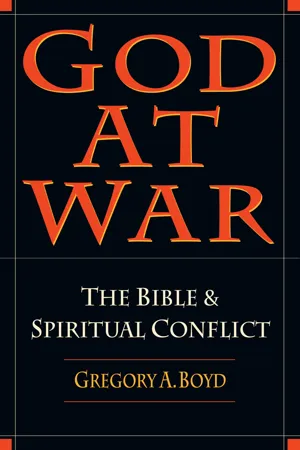
In this bold and compelling work, Gregory Boyd undertakes to reframe the central issues of Christian theodicy. By Boyd's estimate, theologians still draw too heavily on Augustine's response to the problem of evil, attributing pain and suffering to the mysterious "good" purposes of God.Accordingly, modern Christians are inclined not to expect evil and so are baffled but resigned when it occurs. New Testament writers, on the other hand, were inclined to expect evil and fight against it. Modern Christians attempt to intellectually understand evil, whereas New Testament writers grappled with overcoming evil.Through a close and sophisticated reading of both Old and New Testaments, Boyd argues that Satan has been in an age-long (but not eternal) battle against God, and that this conflict "is a major dimension of the ultimate canvas against which everything within the biblical narrative, from creation to the eschaton, is to be painted and therefore understood."No less edifying than it is provocative, God at War will reward the careful attention of scholars, pastors, students and educated laypersons alike.
- 414 pages
- English
- ePUB (mobile friendly)
- Available on iOS & Android
eBook - ePub
About this book
Information
Topic
Theology & ReligionSubtopic
Christian TheologyPART I
THE WARFARE WORLDVIEW OF THE OLD TESTAMENT
1
HEARING ZOSIA
THE PROBLEM WITH THE PROBLEM OF EVIL
AS I SAID IN THE INTRODUCTION, THE CULTURES OF THE OLD and New Testaments, like most ancient and primordial cultures, exemplify a warfare worldview: a fundamental view of the world as engulfed by spiritual beings who are, at least at times, in conflict with one another and whose behavior significantly affects our lives, for better or for worse. I maintain that this worldview accounts for the fact that biblical authors, unlike us, saw little need to wrestle with the intellectual problem of evil, while, again quite unlike us, they were passionately engaged and supernaturally empowered in confronting it. Generally speaking, these believers did not, for example, wonder why God allowed a person to be crippled with scoliosis; they simply attributed it to Satan and exercised spiritual authority in coming against the affliction (Lk 13:10-17; cf. Acts 10:38).
Three Fundamental Objections
For many, however, three fundamental considerations could disqualify this spiritual warfare perspective on evil at the outset. Therefore we need to address them before we begin to flesh out the warfare thesis.
First, the apologetic need for a warfare perspective on suffering and evil will not be seen if there is an insufficient appreciation for the radicality of evil in our world and the radical nature of the problem this poses for the classical-philosophical understanding of divine sovereignty as meticulous control. Many times this radicality is not appreciated in contemporary discussions on the problem of evil, a fact that contributes to a pervasive willingness to accept shallow explanations for why evil occurs.
Second, this thesis requires a willingness to think about the power of God, the reality of evil and the influence of Satan in some rather untraditional ways. This point is disturbing to many more traditionally minded believers.
Third, the warfare thesis requires, as a central component, a belief in angels, Satan and demons as real, autonomous, free agents, as well as a belief that the activity of these beings intersects with human affairs, for better or for worse. Many modern people, including many Christian theists, find this belief inherently implausible.1
Before discussing the biblical material, therefore, we need to address these three obstacles. Hence in this chapter I first attempt to present the problem of evil in a concrete, as opposed to an abstract, form. Evil cannot be adequately conceptualized in the abstract. It can be experienced only in particular forms. The plausibility of a warfare worldview within our naturalistically inclined culture, however, hangs upon an ability to realize the full horror of evil, which means acknowledging it on a concrete level. Radical solutions are plausible only as solutions to radical problems. When considered concretely, the classical-philosophical problem of evil is a radical, indeed an unsolvable, problem for the understanding of God’s power and providence that has prevailed within classical-philosophical theism. Though it may indeed appear radical to believers who are strongly influenced by the classical-philosophical perspective, I believe that the cosmic warfare perspective on evil constitutes the only orthodox theistic approach that avoids this unsolvable problem.
Following this discussion, in response to the second obstacle I attempt to lay the groundwork for a subsequent revision of the classical-philosophical approach to understanding evil by noting several peculiar features of its formulation of the problem of evil. These unusual features suggest that something is askew in the manner in which the problem of evil has been construed as a search for a divine reason behind each and every particular evil. This point further suggests that perhaps the understanding of providence which lies behind this formulation of the problem is mistaken.
Finally, in response to the third obstacle, I examine various features of our rapidly changing Western culture that suggest that, while many may still find a belief in angels, Satan, demons and the like to be implausible, our culture as a whole increasingly does not. The Western church, and the whole of Western culture, is now embarking on a postmodern age in which most of the features of the classical-philosophical theistic worldview, and certainly fundamental features of the rationalistic Enlightenment worldview, are being jettisoned. While this “new age” presents unique problems for the church to address, it also presents many unique positive opportunities—if the church is willing to seize them.
One of these opportunities is the chance to reappropriate and render intellectually viable a largely lost dimension of the biblical worldview: the dimension of spiritual warfare. This warfare worldview not only contributes to the resolution of the intellectual problem of evil by providing an ultimate context in which radical evil is not unexpected; it also, for this very reason, inspires believers to take on the problem of evil at a spiritual level—at the level of spiritual warfare—which is by New Testament standards where the real “problem” of evil lies.
The Concrete Problem of Evil
Historian Philip Friedman provides the following eyewitness account of what happened to a young Jewish girl living in the Warsaw ghetto during the Nazi occupation.
Zosia was a little girl . . . the daughter of a physician. During an “action” one of the Germans became aware of her beautiful diamond- like dark eyes.
“I could make two rings out of them,” he said, “one for myself and one for my wife.”
His colleague is holding the girl.
“Let’s see whether they are really so beautiful. And better yet, let’s examine them in our hands.”
Among the buddies exuberant gaiety breaks out. One of the wittiest proposes to take the eyes out. A shrill screaming and the noisy laughter of the soldier-pack. The screaming penetrates our brains, pierces our heart, the laughter hurts like the edge of a knife plunged into our body. The screaming and the laughter are growing, mingling and soaring to heaven.
O God, whom will You hear first?
What happens next is that the fainting child is lying on the floor. Instead of eyes two bloody wounds are staring. The mother, driven mad, is held by the women.
This time they left Zosia to her mother. . . .
At one of the next “actions,” little Zosia was taken away. It was, of course, necessary to annihilate the blind child.2
While philosophers argue endlessly about how precisely to define “evil” in abstract terms, none of us has difficulty recognizing this concrete nightmare as an example of it. At the very least, evil consists of the fact that for far too many people—as for Zosia and her mother, along with six million other Jews during the Holocaust—life becomes a horrifying nightmare from which they cannot awake, a nightmare as full of pain as it is devoid of meaning.
Radical evil of this sort cannot be captured in abstract definitions. Indeed, “abstractions . . . distract us from that immediate reality [of evil] and reduce evil to a statistic,” as Jeffery Burton Russell suggests.3 The essence of evil transcends words, for words are always one step removed from concrete reality. Evil cannot be adequately grasped in a detached, neutral, abstract way. It cannot be known through faceless, nameless statistics or abstract theorems. All approaches to the problem of evil that do not go beyond these will be in danger of offering cheap and trite solutions. Radical evil can be known only when incarnated and experienced concretely.
For our purposes, then, evil is the concrete picture of Zosia, her mother and a million other similarly unthinkable atrocities. We must entertain concrete pictures like this when we discuss the problem of evil, if our discussion is to be authentic. As Russell again observes: “Only when the abstractions are put aside can we see the face of the Devil gloating over suffering. The modern experience of evil is the reek of burning children. Every honest view of reality must confront the immediate, personal, physical reality of the burning child.”4
Hence when I speak of “evil” throughout this work, I am not referring primarily to some abstract “absence of goodness” (Augustine) or any other merely theoretical definition of evil. I am, rather, referring to Zosia, her mother and the unheeded cries and unpunished laughter that rose up to heaven on that day. By extension (but not abstraction!), I am referring to every concrete horrifying experience that in various ways looks and feels like this one.
The fact that real life is often demonically nightmarish is a problem for all humans on at least emotional, psychological and practical levels. It is the problem of staying sane in a world where little children can be treated as Zosia was treated. It is the problem of understanding how humans can sink to the level of the mindless Nazi pack that tortured her. And it is the problem of devising ways of protecting the Zosias of the world from the Nazis of the world.
But evil is a problem on a metaphysical level as well for people who believe that God exists, at least as “God” has been defined in the classical-philosophical tradition of the Christian church.5 This philosophical and theological tradition, represented most forcefully by such towering figures as Augustine and Aquinas, and in my view expressed with the most logical consistency by Calvin and the Reformed tradition, formally holds that God is among other things altogether above time, change and passivity (viz., the capacity to be influenced by another). Without usually intending to deny free will, this tradition also held that God exercised absolute sovereignty over the world, which entailed that he directly or indirectly exercised a meticulous control over things. Most importantly for our purposes, this view at the very least held that all things, even bad things, have a specific divine purpose for their existence.6
Now, when these divine attributes and this view of meticulous providence are combined with the biblical understanding that God is altogether loving, then a significant problem arises. For it seems that, within this sort of divine providence, innocent little children should never have to suffer as Zosia suffered. If God is all-loving and perfectly good, he must want to protect Zosia. And if God exercises total control over the world, he must be able to protect Zosia. Yet Zosia suffers an unspeakable ordeal, then is murdered. This makes no sense and constitutes, in its starkest form, the intellectual problem of evil.
The occurrence of one nightmare like Zosia’s is thus an intense intellectual problem for classical-philosophical theists. But to fully grasp the problem that evil poses to a theist, we must consider, as concretely as possible, that history is awash with unimaginable nightmares like Zosia’s. Indeed, while we believers frequently wax eloquent in declaring how the intricate design and grand beauty of the cosmos are evidence of an all-good Creator, in honesty we must also confess that the world is full of occurrences that evidence either the nonexistence of a good and all-powerful God, or the existence of a very powerful, competing, evil god.
Adrio König certainly expresses an impression shared by many: “Anyone who refuses to idealize or romanticize reality, but looks it straight in the eye, sees around him more signs of the demonic than of the true God. Indeed, there is more pain and misery, injustice and violence in this world than love, prosperity, justice and joy.”7
Hence, the intensity and scope of radical evil in the world is a significant problem for classical-philosophical Christian theists. If we consider it concretely and do not retreat to romanticized abstractions and sheltered idealizations, the macabre dimension of reality seems to require some alteration in the classical-philosophical Western understanding of God. How can we intelligently and morally believe that an altogether loving God is altogether sovereign over the world when the world he is supposedly meticulously controlling is in so many ways an obvious abomination?
Hymns of praise and screams of terror. Even this statement of the problem of evil is too abstract, however. It does not yet capture the sharpness of the antinomy created by radical suffering for belief in an all-loving, meticulously sovereign God. Like the problem of evil itself, the antimony must be made as concrete as possible to be adequately grasped.
Nothing expresses the faith and trust of the church in the controlling sovereignty of God more concretely than its traditional hymns. With a view to attaining a ruthlessly honest perception of the problem we are up against, consider the following very real possibility: While Zosia was being held down and tortured, while she was screaming and the guards were laughing and her mother was going mad, at that very moment, in other corners of the earth—and perhaps just around the block—Christians were gathered together and were singing traditional hymns of praise to the Lord, hymns that exalt the Creator for his faithfulness, his loving care for the world, and his providential tender protection of his children.
For all we know, a congregation just down the road from Zosia’s hell was singing Sandell’s famous hymn “Day by Day.”
The protection of his child and treasure
Is a charge that on himself he laid;
“As thy days, thy strength shall be in measure,”
This the pledge to me he made. . . .
Help me, Lord, when toil and trouble meeting,
E’er to take, as from a father’s hand,
One by one, the day, the moments fleeting,
Till I reach the promised Land.8
The hymn captures poignantly the church’s traditional theology of G...
Table of contents
- Cover
- Title Page
- Dedication Page
- Contents
- Abbreviations
- Introduction - The Normativity of Evil Within a Warfare Worldview
- Part I - The Warfare Worldview of the Old Testament
- Part II - The Warfare Worldview of the New testament
- Notes
- Selected Bibliography
- Author/Subject Index
- Scripture Index
- Praise for God at War: The Bible & Spiritual Conflict
- About the Authors
- More Titles from InterVarsity Press
- Copyright Page
Trusted by 375,005 students
Access to over 1.5 million titles for a fair monthly price.
Study more efficiently using our study tools.
Frequently asked questions
Yes, you can cancel anytime from the Subscription tab in your account settings on the Perlego website. Your subscription will stay active until the end of your current billing period. Learn how to cancel your subscription
No, books cannot be downloaded as external files, such as PDFs, for use outside of Perlego. However, you can download books within the Perlego app for offline reading on mobile or tablet. Learn how to download books offline
We are an online textbook subscription service, where you can get access to an entire online library for less than the price of a single book per month. With over 1.5 million books across 990+ topics, we’ve got you covered! Learn about our mission
Look out for the read-aloud symbol on your next book to see if you can listen to it. The read-aloud tool reads text aloud for you, highlighting the text as it is being read. You can pause it, speed it up and slow it down. Learn more about Read Aloud
Yes! You can use the Perlego app on both iOS and Android devices to read anytime, anywhere — even offline. Perfect for commutes or when you’re on the go.
Please note we cannot support devices running on iOS 13 and Android 7 or earlier. Learn more about using the app
Please note we cannot support devices running on iOS 13 and Android 7 or earlier. Learn more about using the app
Yes, you can access God at War by Gregory A. Boyd in PDF and/or ePUB format, as well as other popular books in Theology & Religion & Christian Theology. We have over 1.5 million books available in our catalogue for you to explore.