What is ethics?Why should Christians care?Beginning with these basic questions, Stanley Grenz masterfully leads his readers into a theological engagement with moral inquiry. In The Moral Quest he sets forth the basics of ethics, considersthe role and methods of Christian ethics in particular, and examines the ethical approaches of the Old Testament, the Gospels and Paul. He introduces the foundational theological ethics of Augustine, Thomas Aquinas, and Luther and the Reformers. Andhe concludes with an evenhanded discussion of modern and contemporary Christian ethicists, including Albert Ritschl, Walter Rauschenbusch, Karl Barth, James Gustafson, Paul Ramsey, Dietrich Bonhoeffer, Martin Luther King Jr., Gustavo Gutiérrez, Rosemary Radford Ruether, Stanley Hauerwas, Carl F. H. Henry and Oliver O'Donovan.Clear, concise, and well apprised of relevant literature, Grenz (a theologian recognized for the excellence of his own theological and ethical work) provides in this book afirst-rate introduction to Christian ethics. The Moral Quest will well serve students, pastors and interested laypersons alike.
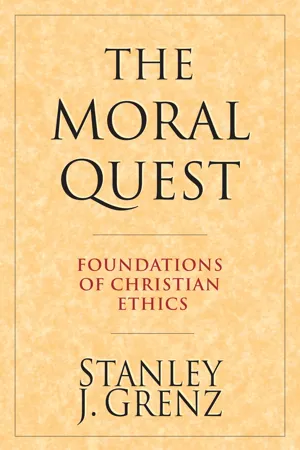
- 377 pages
- English
- ePUB (mobile friendly)
- Available on iOS & Android
eBook - ePub
About this book
Information
Topic
Theology & ReligionSubtopic
Christian TheologyChapter 1
CHRISTIAN
ETHICS & THE
ETHICAL TASK
So do not worry, saying “What shall we eat?” or “What shall we drink?” or “What shall we wear?” For the pagans run after all these things, and your heavenly Father knows that you need them. But seek first his kingdom and his righteousness, and all these things will be given to you as well.
(MATTHEW 6:31-33)
A man sits in the holding cell on death row. Once a revered teacher, he has fallen into official public disgrace, for he has been convicted of corrupting the minds of the youth of the city and of not believing in the gods the city acknowledges.1 While waiting for the day when he will be required to carry out the sentence of the court—suicide by drinking poison—the convicted felon receives a visit from a dear friend. The visitor reveals a bold rescue plan several of his supporters have hatched. The conspirators will bribe the guards, free their beloved teacher from the prison cell and whisk him off to a foreign city where he can continue his career. The visitor pleads with the condemned man to cooperate with their scheme. But the teacher remains adamant: He will not support the plan.
The deliberations of this man mark the beginning of the intellectual discipline we now call “moral philosophy” or simply “ethics.”2 And through his illustrious student, Plato, this teacher, Socrates, became perhaps the single greatest influence on the tradition of philosophical ethics that radiated out of ancient Greece.
The Ethical Task
What is ethics? Viewed from the Christian perspective, we could answer, “Ethics is the study of how humans ought to live as informed by the Bible and Christian convictions.” Yet ethics itself is a broader concept. The English word is the anglicized form of the Greek ethica, which comes from etheos, meaning “what relates to character.”3 The ancient Greek ethicist, Aristotle, suggested that ethica is derived directly from ethos, which means “custom” or “habit.”4
In its more general sense, ethics is often viewed as one major branch of the broader discipline of philosophy.5 So understood, ethics is regularly defined as “moral philosophy.” The origin of the term moral is the Latin mos (adjective moralis), which like its Greek counterpart means “custom” or “usage.”6
Some people differentiate between ethics and morality (or morals). They see the former as more theoretical or general—hence the study of the right and the good—and the latter as more specific and practical, that is, the practice or living out of what one believes to be right and good.7 Hence morality involves the actual living out of one’s beliefs that such things as lying and murder are wrong, whereas ethics entails the study of why it is that these practices are immoral. In keeping with this distinction, Wayne Meeks describes ethics as a reflective, second-order activity, as “morality rendered self-conscious.”8
Although ethics and morality may not be completely synonymous, to set up too strict a distinction between the two is probably arbitrary.9 As we noted above, the presence of two terms in our language reflects our dual Greek and Latin heritage. Most people tend to use the words somewhat interchangeably.
The tradition of philosophical ethics as we know it arose through the deliberations of Greek thinkers in the fifth century B.C., the age of Socrates, who pursued the question of the “good.”10 Specifically, they sought to determine what constitutes a good person. And in this connection they explored what ought to be considered “right.” Since Socrates’ day generations of philosophers have reflected on morality, moral problems and moral judgments.
The standard textbook definitions of ethics tend to combine these features. Jack Glickman, for example, describes “moral philosophy” as “a consideration of the various kinds of questions that arise in thinking about how one ought to live one’s life.” Glickman then explains: “We want to know, for example, which actions are right and which are wrong, which activities and goals are worthwhile and which are not, and which actions and institutions are just and which are unjust. At the same time, we especially want to find out how one can justify judgments about what is right, good, worthwhile, or just, and precisely what such judgments mean. We also want to know how all these various questions are interrelated. These are some of the main issues of moral philosophy.”11 In addition, moral philosophers throughout history have struggled with the issue of whether or not there is a universal morality that is binding on everyone. And they have sought to discover some wider principle on the basis of which we can justify the correctness of our moral judgments, especially in the face of differing opinions.
Viewed as “moral philosophy”—as the pursuit of questions such as these—ethics is not an exclusively Christian endeavor. One does not need to be a Christian to engage in philosophical reflection on morality. Nor does this endeavor necessarily draw primarily from Scripture or the Christian tradition. Rather, human reason stands at the center of the philosophical ethical enterprise. Ethics as moral philosophy seeks to develop a conception of the ethical life in which all humans (or humans in general) could participate and to which all humans could have access through the use of human reason. And it is especially concerned to provide a rational justification for morality,12 perhaps in a somewhat scientific manner.13 We call this broader project “general ethics.”
In this chapter we look more closely at general ethics. Our goal is to discover whether the philosophical approach can lead us to a satisfying ethic. Can human reason provide us with a valid conception of the ethical life? And is there a universal ethic to which all people have access through reason?
Aspects of General Ethics
Many ethicists divide general ethics into three major dimensions—empirical, normative and analytical.14 The first aspect, empirical ethics or “descriptive morals,” as the enterprise is sometimes called,15 involves the observation of the moral decision-making process with a goal of description or explanation of the phenomena. The empirical ethicist studies how people actually make ethical decisions. This program is not of great interest to us here. We must, however, take a closer look at the other two.
Normative ethics. When we hear or use the word ethics we more likely have the second dimension of the ethical enterprise—normative ethics—in view. Normative, of course, comes from the word norm, which in this context means “standard” or “principle.” So normative ethics is connected with the formulation of standards or principles for living. It involves assertions as to what is or is not worth pursuing and what is or is not to be done. We engage in normative ethics whenever we form opinions or judgments about what is right, good or obligatory, and whenever we offer reasons for such judgments. Such discussions lead us to what ethicists label theories of obligation. We also enter the realm of normative ethics when we describe persons, things or acts as “good” or “evil,” “admirable” or “despicable.” In the language of ethicists, such discussions are about theories of value.16
Each day we make judgments of various types. Many of these fall under the concern of normative ethics, for they reflect what we consider to be the norms or standards for human conduct.17
Judgments of moral obligation, for example, state what someone is morally obliged to do or be. These may be quite particular, referring to a specific person in a specific situation. Thus a counselor might say, “Because your duties repeatedly require you to violate your personal standards, as difficult as it may be, you really ought to resign your employment.” Or such judgments may be more general, encompassing a broad range of people or situations. Hence when we say, “Honesty is the best policy,” what we are likely asserting is, “People are morally obligated to tell the truth.”
Unlike judgments of moral obligation, judgments of moral value do not declare what someone ought to do or be; rather they express what we value. If in the context of ethics I say, “My father was a good man,” I am stating my conviction that he was morally upright. My declaration is an example of a particular statement of moral value. The old adage, “Cleanliness is next to godliness,” in contrast, forms a general statement of moral value. The speaker thinks that people ought to be concerned with personal hygiene and that they are morally culpable if they do not.
In addition to moral judgments like these, we all make a host of nonmoral judgments each day. They are normative; they set forth what we see as the standard. But they don’t express specifically moral sensitivities.
Some of these statements are judgments of nonmoral obligation. Repeatedly we articulate particular admonitions of this type. We tell others what movies they should view (“You just have to see Shine!”), what clothes they should buy (“Don’t wear that style; it doesn’t look good on you”) and so on. Or we offer judgments of a more general type. In teaching the game of football to a group of children, for example, the coach may announce, “When it’s fourth down and thirty-five yards to go, you ought to punt!” In each of these cases violating the norm does not entail a moral failure. Nor does slavish obedience to it merit a medal for outstanding moral conduct. Their nonmoral nature means that such statements, while perhaps interesting, are generally not germane to ethics.
Finally we also make judgments of nonmoral value. I happen to own a vintage 1966 Mustang. Were I to say, “My Mustang is a good car!” this would be particular judgment of nonmoral value. Regardless of the opinions of others, I value this car. But in contrast to the worthiness of my father, who was an example of moral uprightness, the car’s value is of a nonmoral type.
I also own a 1966 Oldsmobile convertible. Without being especially concerned about the year and make of the automobile, I might declare, “Real living is a convertible on a warm summer afternoon.” This statement is a general judgment of nonmoral value, in contrast to our earlier declaration, “Cleanliness is next to godliness.”
At first glance it appears that such statements, like judgments of nonmoral obligation, have nothing to do with ethics. However judgments of nonmoral value are of interest to us in ethics. They are connected to what people consider to be “the good life.” And as we will see, the concept of the good life is crucial in ethical decision-making.
Analytical ethics. The third aspect of the ethical discipline is analytical ethics. Analytical derives from analyze, which means “to take things apart,” “to look at the constituent pieces of something.” Analytical ethics, therefore, “takes ethics apart,” as it were. It explores the nature of morality itself. It attempts to develop a theory as to what value judgments mean and how they can be justified.18
To this end analytical ethicists pursue questions of definition: What is the distinction between moral and nonmoral? What do words such as right, good and ought mean?19 What are we asserting when we say a person is “free” or “responsible”? Hence analytical ethicists explore questions such as: What does it mean to say something is good? On what basis can I say that the judgment “X is good” is true? But they also seek to determine how such ethical judgements can be established or justified. They raise the question, What forms the foundation for making value judgments? That is, to cite one example, on what basis can we say that the Holocaust was morally reprehensible?
Constructing a Normative Ethic of Doing
With these three aspects of the ethical discipline in view, let us now return to the second, that of normative ethics. Many ethicists see the primary focus of their work as lying here. Some are even more specific. They understand ethics primarily as the attempt to develop standards of conduct. Ethics, they argue, is concerned above all with determining what we should do. Consequently they propose what we might call an “ethic of doing.”
Proponents of an ethic of doing...
Table of contents
- Cover
- Title Page
- Dedication Page
- Contents
- Preface
- Introduction: Christian Ethics in a Transitional Age
- 1 Christian Ethics & the Ethical Task
- 2 The Greek Ethical Tradition
- 3 Ethics in the Bible
- 4 Model Christian Proposals
- 5 Contemporary Christian Proposals
- 6 Christian Ethics & the Contemporary Context
- 7 Foundations of a Christian Ethic
- 8 Comprehensive Love: The Content of the Christian Ethic
- Epilogue: The Celebrative Nature of the Christian Ethic
- Notes
- Bibliography
- Author and Name Index
- Subject Index
- Scripture Index
- Praise for The Moral Quest
- About the Author
- More Titles from InterVarsity Press
- Copyright Page
Trusted by 375,005 students
Access to over 1.5 million titles for a fair monthly price.
Study more efficiently using our study tools.
Frequently asked questions
Yes, you can cancel anytime from the Subscription tab in your account settings on the Perlego website. Your subscription will stay active until the end of your current billing period. Learn how to cancel your subscription
No, books cannot be downloaded as external files, such as PDFs, for use outside of Perlego. However, you can download books within the Perlego app for offline reading on mobile or tablet. Learn how to download books offline
Perlego offers two plans: Essential and Complete
- Essential is ideal for learners and professionals who enjoy exploring a wide range of subjects. Access the Essential Library with 800,000+ trusted titles and best-sellers across business, personal growth, and the humanities. Includes unlimited reading time and Standard Read Aloud voice.
- Complete: Perfect for advanced learners and researchers needing full, unrestricted access. Unlock 1.5M+ books across hundreds of subjects, including academic and specialized titles. The Complete Plan also includes advanced features like Premium Read Aloud and Research Assistant.
We are an online textbook subscription service, where you can get access to an entire online library for less than the price of a single book per month. With over 1.5 million books across 990+ topics, we’ve got you covered! Learn about our mission
Look out for the read-aloud symbol on your next book to see if you can listen to it. The read-aloud tool reads text aloud for you, highlighting the text as it is being read. You can pause it, speed it up and slow it down. Learn more about Read Aloud
Yes! You can use the Perlego app on both iOS and Android devices to read anytime, anywhere — even offline. Perfect for commutes or when you’re on the go.
Please note we cannot support devices running on iOS 13 and Android 7 or earlier. Learn more about using the app
Please note we cannot support devices running on iOS 13 and Android 7 or earlier. Learn more about using the app
Yes, you can access The Moral Quest by Stanley J. Grenz in PDF and/or ePUB format, as well as other popular books in Theology & Religion & Christian Theology. We have over 1.5 million books available in our catalogue for you to explore.