Former Procter & Gamble Vice President for IT and Shared Services, Tony Saldanha gives you the keys to a successful digital transformation: a proven five-stage model and a disciplined process for executing it. Digital transformation is more important than ever now that we're in the Fourth Industrial Revolution, where the lines between the physical, digital, and biological worlds are becoming ever more blurred. But fully 70 percent of digital transformations fail. Why? Tony Saldanha, a globally awarded industry thought-leader who led operations around the world and major digital changes at Procter & Gamble, discovered it's not due to innovation or technological problems. Rather, the devil is in the details: a lack of clear goals and a disciplined process for achieving them. In this book, Saldanha lays out a five-stage process for moving from digitally automating processes here and there to making digital technology the very backbone of your company. For each of these five stages, Saldanha describes two associated disciplines vital to the success of that stage and a checklist of questions to keep you on track. You want to disrupt before you are disrupted—be the next Netflix, not the next Blockbuster. Using dozens of case studies and his own considerable experience, Saldanha shows how digital transformation can be made routinely successful, and instead of representing an existential threat, it will become the opportunity of a lifetime.
eBook - ePub
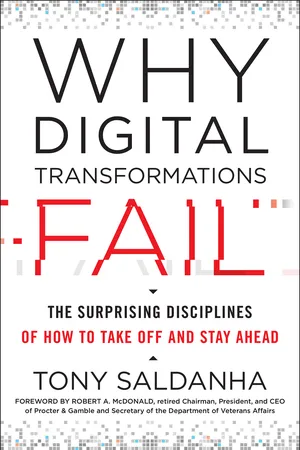
Why Digital Transformations Fail
The Surprising Disciplines of How to Take Off and Stay Ahead
- 216 pages
- English
- ePUB (mobile friendly)
- Available on iOS & Android
eBook - ePub
Why Digital Transformations Fail
The Surprising Disciplines of How to Take Off and Stay Ahead
About this book
Information
Part I
Why Digital Transformations Fail and What to Do about It
Chapter 1
How to Survive an Industrial Revolution
“I hate shopping!” I muttered to myself as I stood gazing with horror at the shuttered Macy’s store in downtown Cincinnati, my hometown. To be clear, I dislike shopping even at the best of times. However, this event was a thousand times worse. Perhaps you recall Indiana Jones’s expression in Raiders of the Lost Ark when he throws his torch into the Well of Souls in anticipation of climbing down, only to find that the floor is moving because it is covered with thousands of snakes. “Snakes,” he says. “Why’d it have to be snakes?” I suspect my face wore that exact same stricken expression that day. In the movie, Sallah, Indiana’s sidekick, adds unhelpfully, “Asps. Very dangerous. You go first.” That’s usually my approach to shopping when I nudge my wife forward, who equally dislikes the chore.
I couldn’t use the “I’m right behind you” approach that day. I was on a mission to buy her a gift for a major anniversary, which was on that day. For a change I had the whole gift-buying stuff under control, or so I thought. We had come across the gift I had in mind during a previous expedition to the downtown Cincinnati Macy’s. I knew she liked it. To make matters worse, I had even dropped some hints that this would be the anniversary gift. Today was D-day, and I had planned to pick it up on my way home.
Except that when I reached the store, it was closed. As in, closed forever. I faintly recalled the announcement a few months earlier that the Cincinnati downtown location would be among the hundred-plus stores Macy’s planned to shut down in the US. Now, hoping that other retailers would have the gift I needed, I frantically searched online. It was available, except that in today’s omnichannel world, it was not stocked in the physical stores. I would have to order it online and then visit the store to pick it up, but not for five business days. “Guaranteed on-time delivery” the website promised. As if that helped me with my last-minute shopping!
As I drove home with the printout of the order representing the anniversary gift, I pondered the irony of the “retail apocalypse,”1 a term coined by the media to describe the mass closing of brick-and-mortar retail stores in North America, coming back to bite one of the few people who had hitherto been totally indifferent to it.
Retail Apocalypse: A Symptom of the Fourth Industrial Revolution
The real estate firm Cushman & Wakefield has estimated that twelve thousand retail stores will have closed in 2018 in the US, up from nine thousand in 2017. That includes several iconic chains that filed for bankruptcy, including Sears, Mattress Factory, Brookstone, Rockport, Southeastern Grocers, Nine West, and Bon-Ton in 2018.2 That’s on top of names such as Toys “R” Us, Payless ShoeSource, hhgregg, the Limited, Aéropostale, Sports Authority, and Radio Shack in the previous two years. The retail sector continues to be among the top of the list of bankruptcies in the US along with the energy sector. Investopedia has called 2018 the year of retail bankruptcies.3
The retail sector is one of several industries being disrupted in the US and around the world. As we all know, media, telecom, hospitality, automotive, financial, health care, consumer products, education, manufacturing, and logistics are being affected, and they are not the only ones either. Zoom out further and you see a broader trend altering how we live, work, and communicate. That’s the Fourth Industrial Revolution.
The Fourth Industrial Revolution has digital technology transforming and fusing together the physical, biological, chemical, and information worlds. It’s a force for massive new opportunity in every area valued by society—everything from convenience (e.g., online shopping) and improved health (e.g., biotech) to personal security (e.g., digital homes), food security (e.g., agrotech), and so on. Digital technology frees workers from tedious tasks, allowing them the opportunity to migrate to higher value-added responsibilities. As with any new powerful technology, there is indeed the potential for destructive applications (e.g., weaponry, designer babies, loss of privacy, playing to humanity’s worst impulses on social media). To what degree the good prevails over the bad is up to us, and it is currently unknown. However, one thing is guaranteed: it will bring about dramatic change. As with the prior three industrial revolutions, individuals and societies will be affected significantly, and companies will either transform or die. That’s where this book comes in.
How to Thrive in an Industrial Revolution
This book is about understanding why digital transformations fail as a means to a more important end, which is how to thrive in an industrial revolution. It builds upon five major foundations to do this:

The battle to thrive in the Fourth Industrial Revolution isn’t going to be easy, but it is possible. We can certainly do much better than the current 70 percent failure rate,4,5 as I have learned from my Procter & Gamble experience. The goal is worth it. At stake is not just the existential threat to individual companies and their employees but the power to shape products, influence employee and consumer self-worth, uplift societies, and leave the world in a much better place than when we started. To get going, let’s elaborate on the foundations mentioned above.
Industry Turbulence Happens during All Industrial Revolutions
The current turbulence in retail and other industries is a classic trend during an industrial revolution. It has happened in prior industrial revolutions, although the technology drivers of change were different. Companies die during industrial revolutions. Obviously, they don’t die without a fight. Their demise often occurs despite the best efforts of reputable, visionary, and innovative leaders to transform their companies. This has been true of prior industrial revolutions as well, as we will see later in this chapter. A few are successful, but unfortunately most are not.
70 Percent of All Digital Transformations Fail
As mentioned earlier, digital transformation is the modern-day fight to survive the existential threat of digital disruption caused by the Fourth Industrial Revolution. Half the companies on the Fortune 500 list will turn over in the next decade. The disruption is here, it’s massive, and it’s urgent. Per Credit Suisse,6 the average life span of an S&P 500 company today is twenty years, down from sixty years in the 1950s, and falling fast. Entrepreneurs, boards, executives, and public organizations are actively consumed by this issue. However, the sad truth is that 70 percent of all digital transformations still fail today. Some have put that number as high as 84 percent.7 That’s a shocking number, given the extremely high stakes. We must do better!
Why Language Gets in the Way of Successful Digital Transformation
This explosive mix of a highly disruptive era and low transformation success rates in today’s world is fascinating. Part of the issue is terminology. Most people don’t realize that digital disruption is the Fourth Industrial Revolution. The term “digital” is very broad. We wore digital watches in the 1970s, and we have had digital telephones and thermometers for a few decades. Isn’t digital transformation old news?
To bring stronger definition to the term “digital transformation,” we need to frame it in the context of the broader change affecting our lives via the concept of industrial revolutions.
Within this context, the terms “digital disruption” and “digital transformation” become easy to define.
Armed with this definition of digital transformation, we can now go back to previous industrial revolutions for lessons on why transformations fail in general.
The Inability of the John Stephenson Company to Take Off on Its Transformation
The venerable John Stephenson Company was a leading player in the carriage industry that died in the Second Industrial Revolution. It wasn’t alone; very few carriage companies survived that era. The metamorphosis of the transportation industry from carriages to automobiles is one of the best-documented case studies of the Second Industrial Revolution and therefore serves up several fascinating insights.
The horse and carriage industry wasn’t just the personal transportation sector in the 1800s; it was the underpinning of industrial transportation (i.e., goods), info...
Table of contents
- Cover
- Title Page
- Copyright Page
- Dedication
- Contents
- Foreword
- Preface
- Part I: Why Digital Transformations Fail and What to Do about It
- Part II: The Five Stages of Digital Transformation
- Part III: Winning with Digital Transformation
- Resource A: Checklist of the Surprising Disciplines
- Resource B: How to Use the Five Most Exponential Technologies
- Notes
- Acknowledgments
- Index
- About the Author
Trusted by 375,005 students
Access to over 1.5 million titles for a fair monthly price.
Study more efficiently using our study tools.
Frequently asked questions
Yes, you can cancel anytime from the Subscription tab in your account settings on the Perlego website. Your subscription will stay active until the end of your current billing period. Learn how to cancel your subscription
No, books cannot be downloaded as external files, such as PDFs, for use outside of Perlego. However, you can download books within the Perlego app for offline reading on mobile or tablet. Learn how to download books offline
Perlego offers two plans: Essential and Complete
- Essential is ideal for learners and professionals who enjoy exploring a wide range of subjects. Access the Essential Library with 800,000+ trusted titles and best-sellers across business, personal growth, and the humanities. Includes unlimited reading time and Standard Read Aloud voice.
- Complete: Perfect for advanced learners and researchers needing full, unrestricted access. Unlock 1.5M+ books across hundreds of subjects, including academic and specialized titles. The Complete Plan also includes advanced features like Premium Read Aloud and Research Assistant.
We are an online textbook subscription service, where you can get access to an entire online library for less than the price of a single book per month. With over 1.5 million books across 990+ topics, we’ve got you covered! Learn about our mission
Look out for the read-aloud symbol on your next book to see if you can listen to it. The read-aloud tool reads text aloud for you, highlighting the text as it is being read. You can pause it, speed it up and slow it down. Learn more about Read Aloud
Yes! You can use the Perlego app on both iOS and Android devices to read anytime, anywhere — even offline. Perfect for commutes or when you’re on the go.
Please note we cannot support devices running on iOS 13 and Android 7 or earlier. Learn more about using the app
Please note we cannot support devices running on iOS 13 and Android 7 or earlier. Learn more about using the app
Yes, you can access Why Digital Transformations Fail by Tony Saldanha in PDF and/or ePUB format, as well as other popular books in Business & Business Development. We have over 1.5 million books available in our catalogue for you to explore.