Building on the success of the bestselling The SAGE Handbook of Grounded Theory (2007), this title provides a much-needed and up-to-date overview, integrating some revised and updated chapters with new ones exploring recent developments in grounded theory and research methods in general. The highly-acclaimed editors have once again brought together a team of leading academics from a wide range of disciplines, perspectives and countries. This is a method-defining resource for advanced students and researchers across the social sciences.
Part One: The Grounded Theory Method: 50 Years On
Part Two: Theories and Theorizing in Grounded Theory
Part Three: Grounded Theory in Practice
Part Four: Reflections on Using and Teaching Grounded Theory
Part Five: GTM and Qualitative Research Practice
Part Six: GT Researchers and Methods in Local and Global Worlds
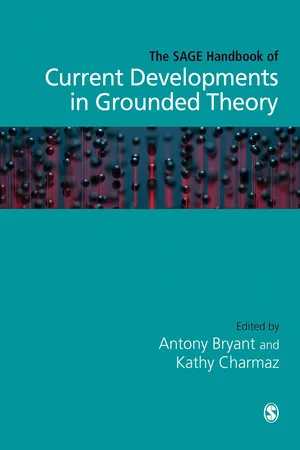
eBook - ePub
The SAGE Handbook of Current Developments in Grounded Theory
- 714 pages
- English
- ePUB (mobile friendly)
- Available on iOS & Android
eBook - ePub
The SAGE Handbook of Current Developments in Grounded Theory
About this book
Trusted by 375,005 students
Access to over 1.5 million titles for a fair monthly price.
Study more efficiently using our study tools.
Information
Part I The Grounded Theory Method: 50 Years On
1 Situating Grounded Theory and Situational Analysis in Interpretive Qualitative Inquiry
This chapter engages the common question, ‘How do grounded theory and situational analysis fit into the contemporary research methods scene?'1 Reviewing the development of qualitative inquiry since World War II, this chapter first details the modernist phase c1950-1970 including the 1960s constructionist turn. Created in 1967, grounded theory constituted the first “manifesto” in the long qualitative renaissance, posing many challenges to positivist orthodoxies. I next elaborate the era of ‘turns’ in qualitative inquiry c1970-2000, including narrative, postmodern, poststructural, etc., along with feminist, critical and other critiques integral to the interpretive turn. The Handbook of Qualitative Inquiry was another manifesto in the long qualitative renaissance, highlighting the uneven reception of the poststructural/interpretive turn in qualitative inquiry. All these developments led to the tremendous growth of qualitative methods as transdisciplinary, the wide array of approaches practiced today, and their increasing transnationalization.2
I then sketch a current genealogy of grounded theory as divergent grounded theory approaches have elaborated over the past 50 years, including the emergence of situational analysis within the grounded theory tradition. I conclude by discussing changes in qualitative inquiry in the 21st century, including the shift from distinguishing “qual vs quant” to “positivist vs interpretivist” approaches, and various pressing problems confronting interpretive methods. I end with pragmatist-inspired hopes for the future of research.3
A Note on the Traditional Era c. 1900–1950
Ethnography, the name under which most early qualitative inquiry was pursued, has a deep history, extending back centuries.4 Early contributions, often Western travelers’ accounts of non-Western locales and their peoples (e.g., Pratt 1992), were described by Said (1978) as stories of ‘the Other,’ often exoticizing or ‘orientalizing’ them. Since the late 19th century, in both anthropology and sociology, (more or less) naive realist ethnographies professionalized such accounts, the first of which was W.E.B. DuBois’ (1899) The Philadelphia Negro (Erickson 2018: 39).
Called ‘the traditional period’ of qualitative inquiry by Denzin and Lincoln (1994: 7), initial anthropological scholarship centered largely on ‘primitive’ groups in the South Seas (Malinowski 1922) and Native Americans (Kroeber 1902–1907).5 In contrast, American sociologists focused largely on the city and ‘civic others’ (Vidich & Lyman 1994: 31): minority communities (W.E.B. DuBois 1899; Frazier 1939), immigrants (Thomas & Znaniecki 1918–1920), deviants (Thrasher 1926), the poor (Sutherland & Locke 1936), and various subcultures (Cressey 1932). Such studies of ‘outsiders’ (Becker 1963), in which the Other continues to be othered, have been aptly described as ‘the ethnography of assimilation’ (Vidich & Lyman 2000). Much of this sociological work emerged from the University of Chicago and became known as the Chicago School.6
This early anthropological and sociological work, while justifiably critiqued, especially for routinely ‘studying down’ (e.g., Geertz 1973; Morris 2015), nevertheless pioneered qualitative inquiry. Moreover, it raised important civic issues of concern to democracy, including how marginalities and race and class differences ‘matter’ when racial and ethnic segregation were the norm if not the law.
While the Great Depression and World War II slowed developments, qualitative inquiry expanded in subject matter, including criminology (e.g., Sutherland 1949) and community studies (Vidich & Bensman 1958). Meanwhile, quantitative social science research was on the rise, especially at Harvard, Columbia and (surprisingly) the University of Chicago (Fine 1995; Bulmer 1997; Abbott 1999; Rawls 2018).
The Modernist Phase c. 1950–1970
Post-World War II, a new scientific era flourished and research became ‘the name of the game’ in academia and beyond – requisite not only across both the natural and social sciences but also in the professions, h...
Table of contents
- Cover
- Half Title
- Title Page
- Copyright Page
- Contents
- Illustration List
- List of Tables
- Notes on the Editors and Contributors
- Senior Editor's Introduction
- Editors’ Introduction
- Part I The Grounded Theory Method: 50 Years On
- 1 Situating Grounded Theory and Situational Analysis in Interpretive Qualitative Inquiry
- Part II Theories and Theorizing in Grounded Theory
- 2 The Pragmatism of Anselm L. Strauss: Linking Theory and Method
- 3 The Status of Theories and Models in Grounded Theory
- 4 Grounded Theory's Best Kept Secret: The Ability to Build Theory
- 5 Deductive Qualitative Analysis and Grounded Theory: Sensitizing Concepts and Hypothesis-Testing
- Part III Grounded Theory in Practice
- 6 From Intuition to Reflexive Construction: Research Design and Triangulation in Grounded Theory Research
- 7 The Nuances of Grounded Theory Sampling and the Pivotal Role of Theoretical Sampling
- 8 Coding for Grounded Theory
- 9 Coding and Translating: Language as a Heuristic Apparatus
- 10 Literature Review in Grounded Theory
- 11 Using Popular and Academic Literature as Data for Formal Grounded Theory
- 12 Rendering Analysis through Storyline
- 13 Abduction: The Logic of Discovery of Grounded Theory – An Updated Review
- 14 Grounded Theory Analysis and CAQDAS: A Happy Pairing or Remodeling GT to QDA?
- 15 Keep your Data Moving: Operationalization of Abduction with Technology
- 16 Grounded Text Mining Approach: A Synergy between Grounded Theory and Text Mining Approaches
- 17 Visual Images and Grounded Theory Methodology
- 18 Grounded Theory Methods in the Context of Masculinity and Violence
- 19 Using Constructivist Grounded Theory Methodology: Studying Suffering and Healing as a Case Example
- Part IV Reflections on Using and Teaching Grounded Theory
- 20 Teaching and Learning Grounded Theory Methodology: The Seminar Approach
- 21 Grounded Description: No No
- Part V GTM and Qualitative Research Practice
- 22 Grounded Theory and the Politics of Interpretation, Redux
- 23 Grounded Theory Methodology and Self-Reflexivity in the Qualitative Research Process
- 24 Using a Feminist Grounded Theory Approach in Mixed Methods Research
- 25 Mixed Grounded Theory: Merging Grounded Theory with Mixed Methods and Multimethod Research
- 26 Abductive Analysis and Grounded Theory
- 27 Grounded Theory and Empirical Ethics
- 28 Critical Grounded Theory
- Part VI GT Researchers and Methods in Local and Global Worlds
- 29 The Implications of Internationalization for Teaching, Learning and Practising Grounded Theory
- 30 Grounded Theory as Systems Science: Working with Indigenous Nations for Social Justice
- 31 Community-based Participatory Research and Constructivist Grounded Theory: Aligning Transformative Research with Local Ways of Being and Knowing
- Discursive Glossary of Terms
- References
- Index
Frequently asked questions
Yes, you can cancel anytime from the Subscription tab in your account settings on the Perlego website. Your subscription will stay active until the end of your current billing period. Learn how to cancel your subscription
No, books cannot be downloaded as external files, such as PDFs, for use outside of Perlego. However, you can download books within the Perlego app for offline reading on mobile or tablet. Learn how to download books offline
Perlego offers two plans: Essential and Complete
- Essential is ideal for learners and professionals who enjoy exploring a wide range of subjects. Access the Essential Library with 800,000+ trusted titles and best-sellers across business, personal growth, and the humanities. Includes unlimited reading time and Standard Read Aloud voice.
- Complete: Perfect for advanced learners and researchers needing full, unrestricted access. Unlock 1.5M+ books across hundreds of subjects, including academic and specialized titles. The Complete Plan also includes advanced features like Premium Read Aloud and Research Assistant.
We are an online textbook subscription service, where you can get access to an entire online library for less than the price of a single book per month. With over 1.5 million books across 990+ topics, we’ve got you covered! Learn about our mission
Look out for the read-aloud symbol on your next book to see if you can listen to it. The read-aloud tool reads text aloud for you, highlighting the text as it is being read. You can pause it, speed it up and slow it down. Learn more about Read Aloud
Yes! You can use the Perlego app on both iOS and Android devices to read anytime, anywhere — even offline. Perfect for commutes or when you’re on the go.
Please note we cannot support devices running on iOS 13 and Android 7 or earlier. Learn more about using the app
Please note we cannot support devices running on iOS 13 and Android 7 or earlier. Learn more about using the app
Yes, you can access The SAGE Handbook of Current Developments in Grounded Theory by Antony Bryant, Kathy Charmaz, Antony Bryant,Kathy Charmaz,Author in PDF and/or ePUB format, as well as other popular books in Social Sciences & Social Science Research & Methodology. We have over 1.5 million books available in our catalogue for you to explore.