More experienced managers can benefit, too, from examples and collected insights of other managers who were interviewed and from examples in recent and revisited literature. The author covers both "hard" business skills and "soft" people/organizational skills. We draw from books, articles, examples, and managerial experience of the author and colleagues at different organizational levels and throughout healthcare settings and professions.
eBook - ePub
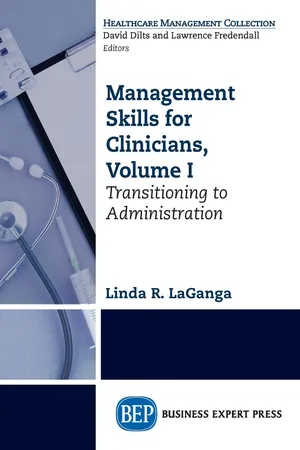
Management Skills for Clinicians, Volume I
Transitioning to Administration
- 167 pages
- English
- ePUB (mobile friendly)
- Available on iOS & Android
eBook - ePub
About this book
This book introduces new healthcare managers to the skills they need to transition and succeed in their managerial roles.
Information
CHAPTER 1
Introduction to Health Care Management
Chapter Overview
This chapter introduces the unique challenges of new health care managers, explains their importance, and provides practical guidance to help you succeed in these new situations. Insights and themes from interviews and conversations with 64 health care managers and administrators are summarized. We identify some special features of managing in health care and the particular challenges in refocusing your clinical training to succeed as a health care manager as we apply some of the lessons gleaned from interviews. Initial activities are proposed to help you get started in comprehending the scope and skills that health care managers need to learn and master.
Topics in this chapter:
- Motivation for developing management skills
- What’s so special about health care management?
- Interviews for a variety of perspectives
- Interview questions
- Themes from interviews
- Who can help? Get a mentor!
- Chapter summary and key points
- Introductory activities to get you started
Motivation for Developing Management Skills
Interviews with many health care leaders provided real-world examples and recommendations that confirmed the importance of the topics in this book. These address skills that may be particularly challenging to new managers in health care because they were not part of their professional education and may be considered at odds with traditional values associated with caring for patients. In this chapter, we introduce some of the themes and lessons gleaned from interviews, identify some particular challenges in refocusing your clinical training to succeed as a health care manager, and offer some activities to help you focus as you get started.
For example, holding staff accountable for performance metrics may feel uncomfortable and in conflict with clinical training that taught us to be nonjudgmental and emphasized support, comfort, and understanding toward patients when they were going through difficult times. Getting teams focused and moving forward on higher-level organizational goals requires teamwork and collaboration that might have been absent from highly competitive and demanding clinical programs that required mastery of complex scientific material.
On the other hand, our clinical training and experience provide valuable assets for us to build on in our journey toward being successful in management. What we learned and practiced in goal-setting with patients can teach us about setting realistic and relevant goals, which is helpful in managing teams and projects.
What’s So Special about Health Care Management?
Health care is a complex business. It is not just the patients and clients, being the direct recipients of our care and treatment services, who are considered our customers. In addition, the organizations we work for are accountable to the payers of those services, typically insurance plans, grant funding administrators, and other government entities, who also require data and reports to monitor organizational performance. Perspectives from a variety of clinicians, managers, and administrators help us understand and manage successfully in the challenging and rewarding arena of health care.
Deep Caring about the People and the Work
People who work in health care really care about the people they help and the work they do. Everyone I interviewed cares deeply about the people and communities they serve and the teams of people they lead. Paul Bretz, LCSW, DDiv, Executive Director of Centus Counseling, has a wide collection of educational degrees, has earned professional certifications in clinical practice, quality, and compliance, and has in-depth experience in clinical, spiritual, administrative, and leadership roles. He expressed this commitment vividly when he said, “In a meeting, every person who talked about a client teared up. It doesn’t get much better than that!”1
When I asked Preston Simmons, MHA, DSc, FACHE, “What is special about working in health care?” from his perspective as the administrator of one of the largest health care organizations in the United States, he explained that people working in health care want to make a difference; clinicians have a passion for patient care and pay attention to good outcomes. High integrity is particularly important.2
Rapid Change for Efficiency
Ken Bellian, MD, MBA, has a range of valuable experiences as a physician, chief medical officer, university instructor on health care innovation, entrepreneur, and advisor for organizations developing technological solutions to difficult health care problems. He describes the world of health care as changing rapidly with continuing need for efficiency to drive down costs as expectations rise for patients’ needs to be met quickly with good outcomes. This requires focus, persistence, and insistence, enveloped in the driving context of meeting patient needs. He believes an effective health care leader must communicate to the staff the process and strategy for meeting these needs.
He described change as unsettling to most people; as a leader, your ability to make your staff feel valued, heard, understood, and respected is essential to manage the change successfully. Managers can help people move forward by identifying the early adopters who figure out how to improve their patient flow to see more patients while completing their administrative requirements promptly, and supporting others in adopting effective practices, utilizing helpful technology, to improve their working lives and the experience of their patients.3
Complicated Drivers of Delivery
Indeed, the complicated operational levers that drive health care delivery can be very difficult to understand. Vonderembse and Dobrzykowski (2016) explain managerial challenges that are specific to health care. For example, supply and demand for health care services can be difficult to balance because of insurance payment systems that insulate patients from true costs of care and may lead to overutilization of services. Rapidly shifting reimbursement models can be difficult to comprehend and implement, especially when technological infrastructure for information sharing is still evolving. And, the total cost of health care is driven not only by the number of units of care delivered, but also by the price of each claim or unit of care, thereby causing increasing pressure to enhance efficiency, reduce waste, and improve collaboration and resource management.4
Ensuring Standards Are Met
In health care settings, you may find that as you rise to higher levels of management, you spend more time dealing with people and organizations outside of your own. Patients, clients, and their family members may seek a manager, someone in charge—you! —when they are dissatisfied with the care and treatment they received from a clinician. You are also likely to deal with external administrative functions involved in the payment for health care services, assurance of compliance with health and safety rules and regulations, and patient privacy laws. You will be responsible for ensuring that the work of your team or department conforms to standards of clinical care, documentation, and billing, along with internal performance targets that are needed to keep the organization running well.
Interviews for a Variety of Perspectives
More than 60 accomplished health care professionals across a wide range of health care professions and settings graciously participated in interviews and conversations with me to share their insights and recommendations about becoming an effective health care manager. All of them are listed in Appendix A along with some selected highlights of interview themes. You will meet some of these people in this chapter, and you will see others later in chapters where their advice and examples are particularly relevant. They bring valuable experience from many roles and levels, including clinicians, early-career initial supervisors and managers, through directors, vice presidents, executive directors, chief executive officers, and governing boards of directors.
You will see experiences and insights from physicians, nurses, psychologists, social workers, psychotherapists, and other providers and administrators. Their experience comes from a variety of settings from outpatient, hospital, academic medical centers, and universities, with health care focus in physical and behavioral health, home health care, physical and voice therapy, dental practice, pharmacy operations and other specialty areas. They represent different sectors such as not-for-profit, for-profit, and governmental.
I selected effective managers and leaders to interview to explore specific aspects of their experience as new and developing managers. As I have worked with many of them, I have admired their effectiveness and know the value they have contributed to their organizations and professions. I wanted to find out and share with you more about their backgrounds, perspectives, and the history and application of tools and approaches they contributed to our work practices and cultures.
Other participants were recommended by people I had selected to interview, who envisioned particular value that could be added by some of their trusted colleagues. And I sought out additional participants through my network of contacts and their contacts to broaden the field of multiple clinical perspectives and deepen the perspective constructed from multiple contributors. I chose them specifically to broaden the base of experience and perspectives from a wider variety of health care professions and settings.
And in the course of my ongoing activities, I encountered others whom I already knew or was just meeting; when I told them about this book and its purpose, they strongly agreed with the need and offered insights and examples from their experiences that can help address important issues that new health care managers face.
Many shared experiences and recommendations are collected and summarized throughout this book. To bring to life key points and illustrate how you can apply them in practical situations, some composite scenarios are drawn from interviews, conversations, and my prior experience and observations. Some details are combined and altered to highlight important principles while preserving confidentiality and privacy of interview participants and others who were involved in sensitive situations.
Interview Questions
I started with a structured form to elicit specific information from those I interviewed about their backgrounds and experience as new and evolving health care managers, along with their recommendations and advice for others starting out as new health care managers. I asked:
- When and where (in what organization) did you have your first experience as a manager?
- What were you doing before this transition to manager?
- Why did you want to be a manager?
- Why do you think you were selected to become a manager?
- How much were your initial expectations met about your new role?
- What pleasant surprises and unexpected challenges did you find?
- What do you think contributes to the success of a new manager?
- What worked well for you in getting started in your new role?
- What would you have done differently?
- What helped you get started in your new position as a manager?
- Was there particular training, support, mentoring, materials, or other resources that you found helpful?
- What else would have been helpful to you in getting started as a new manager?
- How did you fill the gaps or get these other things?
- What advice do you have for other clinicians moving into manager roles?
- What other things would you like to share about your experience?
Ad-hoc questions were used as needed to clarify and explore interesting things that came up.
The interviews were designed to start by eliciting some specific information about how people got started as new managers, what did and did not work for them, for the purpose of guiding other new managers. Later questions broadened to allow participants to expand on relevant parts of their experience and to contribute interesting insights and recommendations. Several of the later conversations and interviews were less structured to allow deeper exploration of some specific perspectives and insights that were particularly relevant to those participants’ experiences or disciplines.
Themes from Interviews
A number of experiences and suggestions emerged as commonly mentioned themes throughout ...
Table of contents
- Cover
- Half Title Page
- Title Page
- Copyright
- Contents
- Preface
- Acknowledgments
- Chapter 1 Introduction to Health Care Management
- Chapter 2 So, Now You Are in Charge! Leading Your Team and Managing When Others Report to You
- Chapter 3 Planning and Organizing
- Chapter 4 Managing Up, Down, and All Around!
- Appendix A Interview Participants and Selected Highlights
- Appendix B Meeting Agenda Form
- Appendix C Example of an SBAR
- Notes
- References
- About the Author
- Index
Trusted by 375,005 students
Access to over 1.5 million titles for a fair monthly price.
Study more efficiently using our study tools.
Frequently asked questions
Yes, you can cancel anytime from the Subscription tab in your account settings on the Perlego website. Your subscription will stay active until the end of your current billing period. Learn how to cancel your subscription
No, books cannot be downloaded as external files, such as PDFs, for use outside of Perlego. However, you can download books within the Perlego app for offline reading on mobile or tablet. Learn how to download books offline
Perlego offers two plans: Essential and Complete
- Essential is ideal for learners and professionals who enjoy exploring a wide range of subjects. Access the Essential Library with 800,000+ trusted titles and best-sellers across business, personal growth, and the humanities. Includes unlimited reading time and Standard Read Aloud voice.
- Complete: Perfect for advanced learners and researchers needing full, unrestricted access. Unlock 1.5M+ books across hundreds of subjects, including academic and specialized titles. The Complete Plan also includes advanced features like Premium Read Aloud and Research Assistant.
We are an online textbook subscription service, where you can get access to an entire online library for less than the price of a single book per month. With over 1.5 million books across 990+ topics, we’ve got you covered! Learn about our mission
Look out for the read-aloud symbol on your next book to see if you can listen to it. The read-aloud tool reads text aloud for you, highlighting the text as it is being read. You can pause it, speed it up and slow it down. Learn more about Read Aloud
Yes! You can use the Perlego app on both iOS and Android devices to read anytime, anywhere — even offline. Perfect for commutes or when you’re on the go.
Please note we cannot support devices running on iOS 13 and Android 7 or earlier. Learn more about using the app
Please note we cannot support devices running on iOS 13 and Android 7 or earlier. Learn more about using the app
Yes, you can access Management Skills for Clinicians, Volume I by Linda R. LaGanga in PDF and/or ePUB format, as well as other popular books in Business & Management. We have over 1.5 million books available in our catalogue for you to explore.