This master class on leadership, written by one of America’s most prominent and successful executives, will help you develop the professional leadership qualities that deliver personal, interpersonal, and organizational success.
?In Learning to Lead: The Journey to Leading Yourself, Leading Others, and Leading an Organization, Ron Williams provides you with practical, tested leadership advice, whether you’re searching for a new career, looking for proven management solutions, or seeking to transform your organization. Developed from Williams’s own personal and professional journey, as well as the experiences of America’s leading CEOs, these strategies emerge boldly from engaging stories, outlined with practical steps for you to accomplish goals such as—
• Launching your career quest
• Avoiding professional pitfalls, wrong turns, and wasted effort
• Overcoming interpersonal challenges and conflicts
• Building and leading an effective, high-performance team
• Prioritizing and solving problems from multiple perspectives
• Developing your leadership style and mastering communication
• Casting a vision and changing the culture of your organization
After finishing Learning to Lead, you will be well equipped to take the next step to success in your personal and professional leadership journey. Williams’s book has the potential to join other leadership development classics on your shelf—to be read repeatedly and consulted throughout the span of your career.
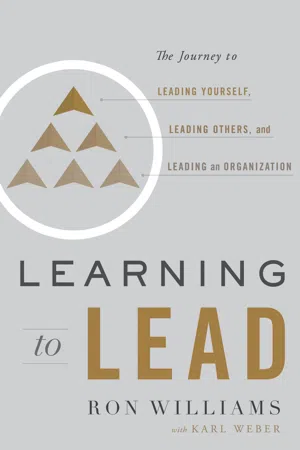
eBook - ePub
Learning to Lead
The Journey to Leading Yourself, Leading Others, and Leading an Organization
- 336 pages
- English
- ePUB (mobile friendly)
- Available on iOS & Android
eBook - ePub
Learning to Lead
The Journey to Leading Yourself, Leading Others, and Leading an Organization
About this book
Information

PART
1
LEADING YOURSELF

Find Your Challenge:
Launching Your Career Quest
Many successful people have started their careers without a plan or without even a clear objective in mind. If that describes you, here is some advice on how to transform the twists and turns of an unpredictable journey into a satisfying road to achievement.
SOME HAVE CALLED ME the least likely person ever to lead a $34 billion corporation.
I grew up in the 1960s in a working-class family in one of the poorer neighborhoods of Chicago, then one of the most segregated cities in the nation. The cultural, educational, and economic opportunities around me were sparse. But I inherited a strong work ethic from my mom and dad, and I was determined to make something of myself. After graduating from high school, I made my way to Southeast Community College of Chicago, then to Roosevelt University, where I majored in psychology. After a brief stint working in the office of Illinois Governor Richard Ogilvie, I launched a business career—first as a consultant, then as an entrepreneur, and then as an executive at Control Data Corporation, Blue Cross of California, and WellPoint Health Networks.
By the time one of America’s biggest insurance companies was foundering, I’d established a reputation as a go-to guy—someone with a knack for making things happen in tough situations where others struggled. I was recruited to help turn around Aetna in 2001. After a year as executive vice president, I was named president and a member of the board, and in 2006 I added the titles of CEO and chairman. Aetna had recorded an annual loss of $292 million in 2001. However, by the time I stepped down in 2011—thanks to a tremendous amount of hard work and creative thinking by thousands of dedicated Aetna employees—that loss had been transformed into an annual profit of $1.97 billion, and the company had become one of the most admired in the industry.
As even this brief summary shows, my background and experiences are definitely unusual for the head of a Fortune 100 company. But much more important are the philosophies, methods, and principles that helped me achieve success. I’ve tried to be both a dedicated student and a successful practitioner of the art of leadership.
I’ve practiced that approach to life challenges for a long time. At one of my early jobs, I was tested for various traits and discovered that, according to science, I am a strong introvert. At first, I assumed that my introverted personality, combined with the difficulty of crashing through the glass ceiling that keeps many black Americans (and others) from positions of leadership and authority, might rule out business as a viable career for me. But then I found myself fascinated by organizations—what makes them work, how people relate to one another, why some succeed and some fail—and I realized that my different upbringing and background presented an opportunity. The world and its people were a puzzle for me to solve. Despite the fact that I hadn’t grown up in the privileged environment of many future CEOs, my inquisitive mind and the search for understanding that it engendered gave me a chance to succeed once I had an opportunity to lead.
Along the way, I learned lessons that have helped me succeed—and that, I suspect, many other people may find valuable.
Here’s the first lesson I’d like to emphasize: Growing into leadership begins with self-leadership—which starts with discovering and nurturing the inner drive that will spur you to seemingly impossible achievements. That drive may be moving toward your passion, if you’re lucky enough to know it. Or it may be moving rapidly away from what you don’t want to do—moving out of the cold and toward the sun.
Most young people find it hard to define a career path that excites and inspires them. It’s especially challenging in tough economic times, when the opportunities that beckoned previous generations seem to have disappeared. The temptation is to seek out a well-trodden path in hopes of a comfortable route to success. Unfortunately, this is the road most people follow—and the most crowded trail is never the way to achieve extraordinary success.
The zigzag nature of my own early career demonstrates that there’s more than one path to any goal. Fortunately for me, I managed to turn every job I had into a learning experience and a stepping-stone on the route to my greatest challenge. Along the way, I discovered that my unconventional background—including a working-class family and a degree in psychology rather than business or economics—could be turned to my advantage, offering lessons about perseverance, hard work, empathy, and understanding that profoundly enhanced my leadership skills.
I also discovered some other truths about the path to leadership, including a few that you may find surprising. For example, I’ve learned that the transition from being a follower to a leader doesn’t necessarily involve any dramatic transformations or revelations. Looking back on my career, I’m hard-pressed to define any single turning point when I suddenly realized what it takes to be a success. Instead, I experienced a slow, steady growth in knowledge and understanding, fueled by a wide range of work experiences, most of them completely mundane. In the end, I found myself in a quite different place from where I started. But the ascent was so gradual that it never felt shocking or miraculous, but rather quite natural.
I’ve also learned that having an overwhelming personal passion that guides and shapes your life isn’t essential to business success. Some accomplished people know from childhood the kind of work they want to pursue—as physicians, attorneys, high-tech entrepreneurs, movie directors, bankers, or what have you. But many more are like me: interested in a wide array of topics, willing to learn a variety of skills, and ready to try their hands at a number of job assignments. My experience suggests that being flexible can lead to a career that is just as successful, rewarding, and enjoyable as climbing to the pinnacle of a selected field based on a single-minded passion and dedication. Two things are essential: a deep personal commitment to excellence in everything you do and a commitment to continual improvement.
Finally, I would suggest that rising to the top in the world of business doesn’t resemble winning a reality TV contest like Shark Tank or The Apprentice. It isn’t about being anointed by some higher authority figure who recognizes and rewards your potential. Bosses, mentors, and advocates can be helpful, of course. I worked with a huge variety of bosses over the years, some good and some bad, and I learned useful lessons from all of them. But in the end, no boss or mentor drove my success—although they did open doors for me. My success came about through a combination of hard work, continual learning, fortunate career choices, and a bit of luck—by being in the right place at the right time.
SOAKING UP LEARNING, WITH NO SPECIFIC GOAL IN MIND
I grew up in the 1950s and ’60s on the South Side of Chicago in a community called Englewood. I watched communities going through the phenomenon dubbed “white flight”: When families of color would move into a neighborhood, the older white families would begin to move out, fearful that crime and decay would erode their property values and make life unlivable. The departure of stable middle-class families would help make the dire predictions come true, and vast swaths of Chicago—along with other northern cities—experienced significant economic decline during those postwar decades.
As a result, I grew up surrounded by a fair amount of crime, violence, and gang activity. There always seemed to be a handful of crazy guys in the neighborhood everybody worried about—guys who were prone to lashing out if they felt their dignity or power had been challenged. Early in life, I learned one of the basic lessons of life in a danger zone: The best way to stay alive is to try to remain on everybody’s good side and pray you never get caught in the crossfire.
Unfortunately, that strategy doesn’t always work. One time, a buddy and I were robbed by a kid wielding a .22 pistol. He got all of fifty cents for his trouble. Another time, I went down the wrong street on my way to school and was beaten up by a gang of kids who’d taken it upon themselves to define that street as their turf. By wandering down it I had set myself up to become a victim.
As you can imagine, I made a point of never walking down that street again. But I also vowed that I would try to live my life going forward in such a way that I could gradually make a place for myself in a very different kind of environment—one in which I would be surrounded by good people, positive influences, and life-enhancing experiences.
My parents had been part of the great northern migration of black Americans that played such a transformative role in postwar US history. My mother had come from Oklahoma, while my father’s large family had come from Alabama and spread out to several midwestern cities—Detroit, St. Louis, Chicago. When I researched my family history on the Internet, I found that, around the turn of the twentieth century, my maternal grandmother and her parents were listed on the so-called Cherokee Rolls—the official register of people accepted as members of the tribe. Historians say the rolls include both some runaway slaves who became members of the tribe as well as formerly enslaved people who traveled west after emancipation. My ancestors on my father’s side, meanwhile, were enslaved people in the Carolinas. They went on to experience the kinds of tough challenges known to millions of other black Americans. Some tilled the land as sharecroppers, while others found work as domestic servants, cooks, factory hands, or railroad laborers.
By the time I came along, my father was working as a parking lot attendant and as a manager/supervisor at parking garages in some of the high-rise buildings along Chicago’s Lake Shore Drive. Later, the guys he worked for got into the automated car wash business, and my dad became a manager at one of their facilities. He didn’t even have a high school diploma. But he was willing to work hard, to take orders, and to provide the extra effort needed to become a valuable employee. This helped him become a successful supervisor until the business was sold and he was forced to find another line of work.
Dad ended up getting a job as a bus driver at the Chicago Transit Authority. He must have shown some innate leadership abilities because when he got involved in the labor union, he was elected an officer. After that, he only drove the bus around half the time. He spent the rest handling union business—representing workers when they got into trouble with management, arguing on their behalf when they became embroiled in disputes. I like to think his hard work and compassion saved the jobs of more than a handful of his fellow workers.
My mom was a manager in a local beauty shop where she worked three days a week. While I didn’t grow up in a home where big business was discussed, hard work was very much on the agenda, and it never occurred to me or my older brother that we would ever do anything but work hard, every day, for as long as we lived.
A strong work ethic wasn’t the only valuable thing I inherited from my parents. They also set the example of powerful moral values derived, in their case, from religious faith. We attended a local branch of the African Methodist Episcopal (AME) Church, which was founded in 1816 by several black Methodist congregations in the mid-Atlantic states in response to discrimination in the mainstream United Methodist Church. I remain a member of the AME Church to this day, although I’m not a regular attendee at Sunday services. The biggest impact of my religious upbringing has been on my sense of commitment to ethical behavior, which I try to express through my business-related decisions, my participation in volunteer and charitable efforts, and the ways in which I treat those I come into contact with every day.
As for my brother, the two of us had different interests. Whereas I was always an avid reader (especially of science fiction), my brother was more interested in practical pursuits—working, making money, and enjoying life. He ended up moving to Las Vegas, where, like our dad, he got a job as a bus driver. Sadly, he is no longer with us—he died of pancreatic cancer at a young age.
But I loved school, and early on I started being rewarded for my efforts. After scoring high on a standardized exam, I skipped a grade in elementary school and found myself learning advanced subjects in a class with kids who were a year older than me. Then I started going to summer school, where I had the chance to take accelerated classes like biology. I enjoyed it a lot, especially when compared with the only real alternative, which would have been to hang out on the street with the other neighborhood kids. There was no such thing as camp or summer vacation. (To this day, I smile when I hear people talk about their two-week or three-week vacations as a kind of necessity. I still think of those things as a luxury reserved for upper-class people . . . not ordinary folk like me.)
In high school, I took advantage of a program that allowed high-scoring students to transfer from their neighborhood school to a better one in a nearby district. I ended up in a high school that had fewer than a hundred black kids among a thousand white kids. (The Chicago public schools had been legally desegregated only a couple of years earlier, in 1964.) I continued to enjoy my classes and do well in them, but it was pretty obvious that there was a difference in the way the black students were treated. There were only a handful of teachers who behaved as if they cared, including the two black teachers—a history instructor and a physical education teacher. But most of the faculty seemed utterly indifferent. No one ever talked to me about going to college; the help of the guidance counselors was reserved for the white students. So I learned to find my own path, making mistakes along the way—a pattern that would continue throughout my life.
Meanwhile, the habit of working at a job had already become a regular part of my life. I never played sports or participated in clubs in high school. I used my spare time to earn money—for clothes and for anything else I might need beyond the basics of life, which my mom and dad provided. (It never occurred to me that I might be entitled to an allowance or to spending money from my parents.) When classes ended at two or three in the afternoon, I’d take the bus to my dad’s car wash/gas station and put in three hours or so pumping gas and washing cars. On weekends, I did the same thing all day Saturday and half a day on Sunday.
I worked with an interesting group of guys—grown men who didn’t have much of a future beyond pumping gas. They used their paychecks not for discretionary things but to support themselves and their families—or, in some cases, to support their bad habits. I remember one guy who would get paid every Friday, go out drinking and partying, and pic...
Table of contents
- Cover
- Title Page
- Copyright Page
- Contents
- Introduction
- Part 1: Leading Yourself
- Part 2: Leading Others
- Part 3: Leading an Organization
- Epilogue: Keep Breaking Barriers
- Acknowledgments
- Index
- About the Authors
Trusted by 375,005 students
Access to over 1.5 million titles for a fair monthly price.
Study more efficiently using our study tools.
Frequently asked questions
Yes, you can cancel anytime from the Subscription tab in your account settings on the Perlego website. Your subscription will stay active until the end of your current billing period. Learn how to cancel your subscription
No, books cannot be downloaded as external files, such as PDFs, for use outside of Perlego. However, you can download books within the Perlego app for offline reading on mobile or tablet. Learn how to download books offline
Perlego offers two plans: Essential and Complete
- Essential is ideal for learners and professionals who enjoy exploring a wide range of subjects. Access the Essential Library with 800,000+ trusted titles and best-sellers across business, personal growth, and the humanities. Includes unlimited reading time and Standard Read Aloud voice.
- Complete: Perfect for advanced learners and researchers needing full, unrestricted access. Unlock 1.5M+ books across hundreds of subjects, including academic and specialized titles. The Complete Plan also includes advanced features like Premium Read Aloud and Research Assistant.
We are an online textbook subscription service, where you can get access to an entire online library for less than the price of a single book per month. With over 1.5 million books across 990+ topics, we’ve got you covered! Learn about our mission
Look out for the read-aloud symbol on your next book to see if you can listen to it. The read-aloud tool reads text aloud for you, highlighting the text as it is being read. You can pause it, speed it up and slow it down. Learn more about Read Aloud
Yes! You can use the Perlego app on both iOS and Android devices to read anytime, anywhere — even offline. Perfect for commutes or when you’re on the go.
Please note we cannot support devices running on iOS 13 and Android 7 or earlier. Learn more about using the app
Please note we cannot support devices running on iOS 13 and Android 7 or earlier. Learn more about using the app
Yes, you can access Learning to Lead by Ron Williams in PDF and/or ePUB format, as well as other popular books in Business & Leadership. We have over 1.5 million books available in our catalogue for you to explore.