A Humanitarian Approach to a Technologically Innovative Future
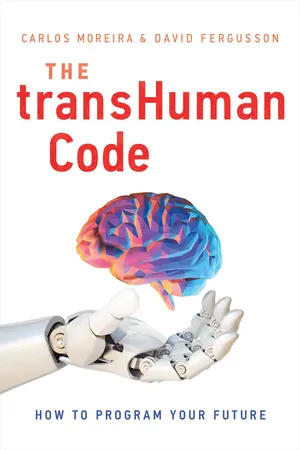
?In The transHuman Code, authors Carlos Moreira and David Fergusson ask, “Are we building a better future for humanity with the help of magnificent technology or are we instead building a better future of better technology at the expense of humanity?” We must learn to put humanity first instead of getting caught up in the promise of technological advancement. Humans have been able to adapt, morph, and compromise in every situation we have faced over the centuries and have been able to maintain dominance. We must approach the promises of technology with the same adaptability.
What the authors propose is that if we start the design of the transHuman future from a human perspective, making sure that technology will inspire revolution or evolution, then we can ensure humanity continues to thrive. The transHuman Code tries to center humanity in the emerging tension between a human-controlled or a machine-controlled world. Moreira and Fergusson examine how humans can maintain the uniqueness and the humanity in this brave new world.
- 400 pages
- English
- ePUB (mobile friendly)
- Available on iOS & Android
eBook - ePub
About this book
Information
1

THE PINNACLE AND PURPOSE OF TECHNOLOGY
Unfortunately, it’s easy to lose sight of our preeminence in the grand ecosystem—especially during an era in which it is tempting to lean on technology to lead us into the future we desire. Do we really believe that technology— technology that we created, mind you—can become more complex and necessary than we are? Can the created ever really supersede its creator?
It’s a question you have to answer for yourself. We all do. And together, we must collectively decide if we are building a better future for humanity with the help of magnificent technology . . . or building a future of better technology at the expense of humanity. There’s really no simpler way to put it. The future is still in our hands. But a future is possible in which we are not in control. There would be no one to blame but ourselves.
We’ve actually been down a similar road before, and it didn’t turn out well. We collectively chose wrong—or, better said, we didn’t choose right soon enough. We didn’t put humanity first, elevating the promises of technology instead. We let technology lead us, and it led us astray. This seemingly subtle oversight altered our lives for the worse, forever.
The year was 1895, and a German mechanical engineer named Wilhelm Roentgen discovered X-rays. His discovery was the precursor to French chemists Pierre and Marie Curie discovering radioactivity three years later. In the decade following the Curies’ discovery, New Zealand physicist Ernest Rutherford and English radiochemist Frederick Soddy discovered that the radioactivity in uranium was the result of atoms splitting. These three discoveries alone—X-rays, radioactivity, and splitting atoms—catapulted the role of technology forward throughout the world, which in turn changed the course of human history for good and, because we weren’t vigilant, for bad.
Roentgen won a Nobel Prize, as did the Curies, Rutherford, and Soddy, and Soddy’s work on radioactivity brought nuclear reactions to the attention of the world, becoming the primary inspiration for H. G. Wells’s 1914 futuristic novel, The World Set Free, which features atomic bombs dropped from planes during wartime. Twenty years later, the atomic bombs Wells imagined were becoming a reality in a secret lab in Germany. Hungarian physicist Leo Szilard penned a letter to U.S. President Franklin D. Roosevelt, apprising him of Germany’s plans and urging the U.S. to begin developing its own nuclear weapons. Szilard enlisted Albert Einstein to sign the letter as his own, to give it as much weight as possible. The Manhattan Project was born.
Six years later, on August 6 and 9, 1945, the U.S. dropped their secret weapons on Hiroshima and Nagasaki, effectively ending World War II. The human loss was stupendous, but, in truth, the lasting damage to humanity had begun well before the summer of 1945—precisely 50 years before, when we allowed a string of scientific discoveries to elevate technology above humanity.
In our imprudent excitement to race into the future, our predecessors rode the wave of technology all the way to an irreversible threat called nuclear war. This realization prompted Einstein to eventually lament, “It has become appallingly obvious that our technology has exceeded our humanity.”
The plot looks different today, but the stakes are no less momentous than they were when X-rays and atom splitting were discovered. Humanity is, once again, faced with choosing to play either the protagonist or antagonist in its own story—a story for which the conclusion has not yet been written.
The wave of advances preceding our current technological crest is just as noteworthy as the one during the turn of the 20th century— from Robert Metcalfe’s first Ethernet (1973) and Cerf and Kahn’s first Internet (1975) to Jobs and Wozniak’s first personal computer (1976) and Berners-Lee’s World Wide Web (1990). These thrilling advancements spawned the first browser, the first search engine, the first social network, the first smartphone, and the first app. Technology is now accelerating further, with developments like virtual reality, blockchain, digital currency, artificial intelligence, and robots.
Once again, we’re at a tipping point, with a decision to make before atomic damage is done. We cannot afford to be naïve again. To make the right decisions—at least at the outset—we must begin by reminding ourselves that these bodies, minds, and souls we each possess are more advanced than anything in the world. It is this very resource—the human being—that provides us with our greatest inspiration and our greatest interpretation of the best future for all.
We must remember that all technologies that currently exist, and all technologies that will exist, are products of the consummate technological system within us. If we will embrace our principal value in this vast universe, and then harvest humanity’s vast resources, we can ensure the days ahead will fulfill the deepest hopes of the greatest number of people. If we lose sight of this, we will lose more than lives: We will lose our reasons to live.
WIRED founder Kevin Kelly calls technology “humanity’s accelerant.”1 This acceleration duly excites us. We celebrate together when Apple releases its latest iPhone. We feast on news of AI robots, virtual reality, and self-driving cars. Tech is the hippest topic and hottest investment segment in the world right now, and that doesn’t look to slow down anytime soon. Many scenarios that once existed only in science fiction are reality today. This is both fascinating and promising. We can see a future of unprecedented efficiencies in industries such as education, health care, and electricity, as well as bigger victories—perhaps even lasting ones— over global afflictions like cancer and hunger.
But there remains a current conflict, as Erik Weiner points out in an op-ed piece for the LA Times. “We live in the Age of Convenience,” he writes. “That concept lies at the heart of what Silicon Valley is selling and we are so eagerly buying. We see convenience not only as a nicety but an expectation, an entitlement . . . but too often we fail to recognize the full cost of our convenient lives.”2
Today’s technological world was built, and is governed, by the minds and resources of a few hundred thousand people. As a result, we are living in a society in which the richest 1 percent—most of whom made their fortunes in technology—have now accumulated more wealth than the rest of the world put together. Through our concessions to technology, we have unknowingly authorized an economy for the 1 percent instead of creating an economy that works for the prosperity of all, for future generations, and for the planet. This imbalance will be accelerated if we don’t collectively remember the value inherent in humanity at large and begin to put the rights of people ahead of the rush to profits.
We-the-global-community have the opportunity to tap the minds and resources of 7.5 billion people, soon to be interconnected by more than 50 billion devices (by 2020) through the rapid growth of the Internet of Things (IoT)—the aggregation of all connected devices around the world. Consider the implications of this. The most efficient supercomputer in the world right now—a multibillion-dollar technological marvel from IBM and the U.S. Department of Energy’s Oak Ridge National Laboratory (ORNL) called Summit—runs on a total of 200,000 CPUs (central processing units, i.e., computer brains) capable of processing 200 petaflops, a computing term that amounts to approximately 200 quadrillion (or 1 followed by 15 zeros) calculations per second. By comparison, IBM researchers have estimated that a single human brain can process 36.8 petaflops per second, or approximately one-sixth the computing power of Summit.3 Said another way, six humans sharing resources equals one Summit. Consider what this means for humanity’s ability to create, innovate, and problem-solve in a swift manner on a massive scale. If we can use technology to access the processing capability of the entire population—the original vision of World Wide Web creator Sir Tim Berners-Lee—we can ignite the equivalent power of more than a billion Summit supercomputers. It’s no stretch to assert that the best future we can imagine for the most people is more available than we think. We just have to seek it more than short-term convenience.
The solutions and improvements we desire are within our grasp— many of them within our lifetimes, if we take the necessary steps to cement ourselves in the seat of transHuman authority and accountability, one technological advancement at a time, including those already developed and those still to come.
“At the center of every significant change in our lives today is a technology of some sort,” writes Kelly.4 The foremost matter that will determine what the world becomes is how we will use technology—not what we will use. Technology is here to stay, as a primary catalyst and dominating force. It is becoming, and will continue to become, a greater and greater part of our lives. This is very exciting news if we know that our place in the universal ecosystem is at the apex. The critical question is whether we will continue to allow technology to erode our prominence or reassert ourselves as the authors and perfectors of technology, whose job is to ensure that what is created, embraced, and proliferated always produces, first and foremost, better, healthier humans.
“We are different from our animal ancestors,” explains Kelly, “in that we are not content to merely survive . . . This discontent is the trigger for our ingenuity and growth.”5 The decision we must make is to be wise stewards of our supreme ingenuity and growth. We must constantly ask ourselves, “What is prevailing: humanity or technology?” And we must do what is necessary to ensure our answer is humanity, and always humanity, the world over.
Some believe we should unconditionally render control of our future to the machines. They base their beliefs on something called the technological singularity, which hypothesizes that the artificial intelligence already present will eventually cause an intellectual explosion, resulting in a powerful computer superintelligence that would, qualitatively, far surpass all human capabilities. Sci-fi author Vernor Vinge says in his essay “The Coming Technological Singularity” that this will signal the end of the human era, as the new superintelligence would continue to upgrade itself and advance at an incomprehensible rate.6 We would, in other words, become subservient to the machines.
The great fault in this hypothesis is that it does not account for the spiritual and moral characteristics of humanity, which set us apart from every species on the planet—characteristics like intuition, empathy, vision, conviction, and, to Kelly’s point, ingenuity, stemming from a constant desire for better. There is a critical reason why Elon Musk recently confessed that humans are underrated.7 A robot will never know how it feels to suffer from cancer or lose a child to starvation. Artificial intelligence will never comprehend the magnificence of childbirth, an ocean sunset, or the fulfillment of a decade-long dream. Computer programs will never match human complexity, with its wide range of emotions and tribal characteristics.
The best technology can do is prioritize its efforts according to our administration, our design, our programming. The key is making sure the priorities we assign to it and the governance we ascribe to it are in the best interest of all humanity. How? In general terms, the solution is to codify the core human attributes, those that set us apart from every life-form on the planet, into the technology we create; to write HI code into AI technology, so that the product serves us instead of making us subservient to it.
Technology only has the freedom to go as far as we allow it. To this point, we’ve been lethargic in managing its freedom. The manipulation of the U.S. presidential election was perhaps a turning point. In the least, it has served as a global wake-up call. But the truth we must grasp is much smaller: We’re all complicit in the Facebook platform’s capacity to manipulate. We created it and have embraced and empowered it for years, both knowingly and unknowingly.
In her article for Vanity Fair, Susan Fowler describes the conflicting human efforts that have allowed technology to initiate a swelling, covert coup against humanity. In her first weeks on the job as a programmer at Uber, a coworker, in hushed tones, encouraged her to remember the drivers when writing code. Fowler admits she didn’t quite understand the meaning of this interaction until several weeks later, when she overheard two coworkers discussing ways to manipulate driver bonuses so that they could be fooled into working longer hours. “Shortly thereafter,” writes Fowler, “a wave of price cuts hit drivers in the Bay Area. When I talked to the drivers, they described how Uber kept fares in a perfectly engineered sweet spot: just high enough for them to justify driving, but just low enough that not much more than their gas and maintenance expenses were covered.”8
For a week in January 2012, Facebook removed between 10 and 90 percent of the positive emotional content from the newsfeeds of approximately 700,000 users. The action was part of a covert study being conducted by Facebook and U.S. academics, who were both interested in whether the emotions expressed by friends via social networks influenced users’ moods. The ultimate objective was to determine if it was possible to manipulate users’ feeds to keep them happier, which would, theoretically, keep them on Facebook longer, exposing them to more ads and increasing Facebook’s revenue. According to The Guardian columnist Stuart Jeffries, the study found that “reducing the number of emotionally positive posts in someone’s newsfeed produced a statistically significant fall in the number of positive words they used in their own status updates and a slight increase in the number of negative words.”9 In other words, the study proved that Facebook can, if it so chooses, sway users’ moods to benefit the bottom line.
As you might imagine, when the news was leaked that Facebook ran the test, the response from users was less than cheerful. Explains Jeffries, “There was a disgust at the possibility that Facebook wanted to make us happier on their site so that we’d stay there longer . . . so that Mark Zuckerberg can buy more yachts.” While Jeffries deems it “a loathsome business model,” he acknowledges that the practice is nothing new in the world of technology platforms. He cites Thomas Jones from the London Review of Books, who reminds us that “the purpose of Facebook is to harvest, organize, and store as much personal information as possible to be flogged, ready-sifted and stratified, to advertisers . . . We aren’t Facebook users, we’re its product.”10
This “mediation and commodification of every aspect of everyday life,” as Jones puts it, is not the practice of Facebook alone. It is the modus operandi of nearly every technological tool you use, from cell phones and search engines to doorbells, security cameras, and voice-controlled speakers. The unveiled reality of the technologically driven world we live in can lead one to ask, as Jeffries does, whether we’ve become pawns “whose moods can be altered like lobotomised lab rats” to boost corporate revenues.11 The truth is that the handful of multibillion-dollar platform companies who are vying for control of the web—Facebook, Amazon, Google, and Twitter, to begin with—a...
Table of contents
- Cover
- Title Page
- Copyright
- Dedication
- Contents
- Introduction How to Read this Book
- 1 The Pinnacle and Purpose of Technology
- 2 Framing our Best Future
- 3 Water
- 4 Food
- 5 Security
- 6 Health
- 7 Jobs
- 8 Money
- 9 Transportation
- 10 Communication
- 11 Community
- 12 Education
- 13 Government
- 14 Innovation
- Epilogue The First Steps to a Human-Centric Future
- Conversations with the Innovators
- The Transhuman Code Manifesto
- The Transhuman Code Glossary
- Acknowledgments
- Notes
- About the Authors
- Index
Trusted by 375,005 students
Access to over 1.5 million titles for a fair monthly price.
Study more efficiently using our study tools.
Frequently asked questions
Yes, you can cancel anytime from the Subscription tab in your account settings on the Perlego website. Your subscription will stay active until the end of your current billing period. Learn how to cancel your subscription
No, books cannot be downloaded as external files, such as PDFs, for use outside of Perlego. However, you can download books within the Perlego app for offline reading on mobile or tablet. Learn how to download books offline
Perlego offers two plans: Essential and Complete
- Essential is ideal for learners and professionals who enjoy exploring a wide range of subjects. Access the Essential Library with 800,000+ trusted titles and best-sellers across business, personal growth, and the humanities. Includes unlimited reading time and Standard Read Aloud voice.
- Complete: Perfect for advanced learners and researchers needing full, unrestricted access. Unlock 1.5M+ books across hundreds of subjects, including academic and specialized titles. The Complete Plan also includes advanced features like Premium Read Aloud and Research Assistant.
We are an online textbook subscription service, where you can get access to an entire online library for less than the price of a single book per month. With over 1.5 million books across 990+ topics, we’ve got you covered! Learn about our mission
Look out for the read-aloud symbol on your next book to see if you can listen to it. The read-aloud tool reads text aloud for you, highlighting the text as it is being read. You can pause it, speed it up and slow it down. Learn more about Read Aloud
Yes! You can use the Perlego app on both iOS and Android devices to read anytime, anywhere — even offline. Perfect for commutes or when you’re on the go.
Please note we cannot support devices running on iOS 13 and Android 7 or earlier. Learn more about using the app
Please note we cannot support devices running on iOS 13 and Android 7 or earlier. Learn more about using the app
Yes, you can access The transHuman Code by Carlos Moreira,David Fergusson in PDF and/or ePUB format, as well as other popular books in Technology & Engineering & Technology & Engineering Research & Skills. We have over 1.5 million books available in our catalogue for you to explore.