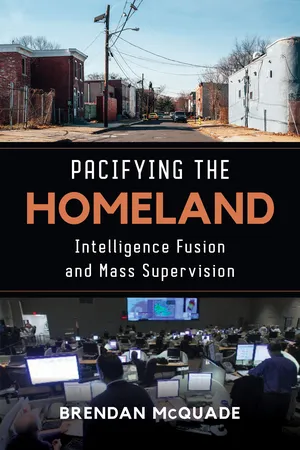
The United States has poured over a billion dollars into a network of interagency intelligence centers called “fusion centers.” These centers were ostensibly set up to prevent terrorism, but politicians, the press, and policy advocates have criticized them for failing on this account. So why do these security systems persist? Pacifying the Homeland travels inside the secret world of intelligence fusion, looks beyond the apparent failure of fusion centers, and reveals a broader shift away from mass incarceration and toward a more surveillance- and police-intensive system of social regulation.
Provided with unprecedented access to domestic intelligence centers, Brendan McQuade uncovers how the institutionalization of intelligence fusion enables decarceration without fully addressing the underlying social problems at the root of mass incarceration. The result is a startling analysis that contributes to the debates on surveillance, mass incarceration, and policing and challenges readers to see surveillance, policing, mass incarceration, and the security state in an entirely new light.
- 304 pages
- English
- ePUB (mobile friendly)
- Available on iOS & Android
eBook - ePub
About this book
Information
Publisher
University of California PressYear
2019Print ISBN
9780520299757
Edition
1eBook ISBN
9780520971349
1. Connecting the Dots beyond Counterterrorism and Seeing Past Organizational Failure
The Critique of Security
and the Prose of Pacification
and the Prose of Pacification
On September 9, 2001, a Maryland state trooper stopped Ziad Jarrah for a traffic violation. Having no reason to do otherwise, the trooper sent Jarrah on his way. Two days later, he was the hijacker-pilot of Flight 93, which crashed in rural Pennsylvania. Citing incidents like this stop, the 9/11 Commission found that the intelligence community had failed to “connect the dots.”1 In response, the new Department of Homeland Security (DHS) promised to link the entirety of domestic intelligence—from municipal police departments to the federal intelligence community—with a new National Network of Fusion Centers. At the same time, the spread of intelligence-led policing (ILP) complemented the rise of these networked intelligence hubs with a “smarter” approach that uses intelligence to preempt threats.
The resultant process of intelligence fusion starts with information: massive databases decades in the making; open-source data gleaned from the web and social media; and streams of information created by new surveillance systems like automated license plate readers. To “fuse” data into useful information, analysts often use powerful computers and specialized software to “connect the dots” and, in theory, draw out the signal from the noise of data. Different tools offer different insights. With specialized software, analysts can turn unintelligible and interminably long lists of phone calls into a pattern of use, and, from there, a social network analysis. They can map unwieldy agglomerations of information—such as geospatial data drawn from police files, the census, and other public records—to create “predictive” heat maps to anticipate where the next shooting is likely to occur. Intelligence fusion also “connects the dots” in simpler ways. Often, fusion centers operate as data brokers, providing investigative support to law enforcement partners. Data brokerage can also mean doing even less: in so-called “pass-throughs,” fusion centers simply disseminate another agency’s intelligence reports.
For the most ardent proponents, the intelligence fusion never really ends. Traditionally, there is an iterative tendency built into intelligence: a cycle in which decision-makers demand information, officers collect information, and analysts process the data into intelligence. The feedback executives provide helps orient the next turn of the intelligence cycle. Intelligence-led policing tries to transcend this reactive model with a proactive approach. It collapses intelligence collection and analysis into a conjoined and continuous activity. Intelligence producers strive to maintain the situational awareness necessary to preempt and disrupt behaviors deemed criminal and disorderly.2 Hence, their ever-creeping reach: first, government records and private data brokers; next, the integration of old surveillance systems like closed-circuit TV cameras and new ones like automated license plate readers; and, most recently, wholesale data-mining of social media and other forms of open-source intelligence.
Intelligence-led policing is also an administrative philosophy. The goal is efficiency. About three decades ago, police executives started using crime mapping to manage police departments. With crime hot spots identified, they knew where to direct patrols and investigators and which middle manager to hold accountable. Today, ILP strives for proactive crime control with increasingly individual targeting, a shift from “hot spots” to “hot people.” Under this pressure, officers target “chronic offenders.” Detectives try to refine leads out of data. Analysts work to stay ahead of events and otherwise divine the future. They collaborate with police on long-term investigations, providing a variety of services from simple database searches, to routine crime analysis and mapping, to in-depth criminal profiles and social network analyses.3 In theory, intelligence fusion and ILP will produce more proficient policing.
One decade and upwards of a billion dollars later, the results are unimpressive. In October 2012, the US Senate excoriated fusion centers. After two years of investigation, they could not identify any “reporting which uncovered a terrorist threat . . . [or any] contribution such fusion center reporting made to disrupt an active terrorist plot.”4 The report brought uncomfortable national attention to fusion centers. “DHS ‘fusion centers’ portrayed as pools of ineptitude and civil liberties intrusions” read the Washington Post’s headline.5 The New York Times had a more subdued title but opened with an equally damaging assessment: “One of the nation’s biggest domestic counterterrorism programs has failed to provide virtually any useful intelligence.”6 “It’s brutal,” one federal official involved in funding and management of fusion centers later told me. “It’s one-sided. Definitely. But it’s not totally wrong. We have some problems to work out.”7 Seven months later, the Senate’s findings were confirmed in spectacular fashion by the Boston Marathon bombing. In the preceding two years, the FBI and CIA had neglected to share information about Tamerlan Tsarnaev, the elder brother implicated in the attack, with the Boston Regional Intelligence Center. Even if they had, Boston’s fusion center was preoccupied with other matters: spying on Occupy Boston.8
The wider conversation on fusion centers reflects the major themes of the Senate report: dysfunction, mission failure, and abuse. From the very start in 2004, when DHS began encouraging state and local governments to create fusion centers, journalists criticized the new program for its ineffectiveness, the potential for mission creep, and civil liberties violations.9 By 2008, government researchers and auditors identified the factors contributing to these problems: an ill-defined, vague mission, poor coordination, over-classification, and incompatible information systems.10 Policy advocates repeated many of these concerns and recommended reform. Liberal organizations like the American Civil Liberties Union (ACLU) and the Brennan Center for Justice focused on protecting civil liberties and recommended greater oversight, while conservative groups like the American Enterprise Institute argued that centralization could reduce costs and increase information sharing.11 Only practitioners in law enforcement and a later report from the House of Representatives found that fusion centers were an effective and worthwhile addition to law enforcement.12 Some journalists, activists and civil liberties groups inverted this stance, charging that fusion centers are effective, not at counterterrorism, but at suppressing dissent.13
Despite all the criticism and bad press, neither politicians nor the public have subjected fusion centers to meaningful oversight or sustained scrutiny. Not only did all of the DHS-recognized fusion centers survive the public sector austerity that followed the Great Recession, the network expanded, increasing from seventy-two centers in 2009 to seventy-nine in 2018. The funds continue to flow: state governments increased their investment in intelligence fusion, and federal support, although reduced, has not stopped.14 Surely, there is more to the story than organizational failure? Even the sharply critical Senate report acknowledged that “[f]usion centers may provide valuable services in fields other than terrorism, such as contributions to traditional criminal investigations, public safety, or disaster response and recovery efforts.”15 Perhaps fusion centers are effective, just not at counterterrorism? Even if fusion centers have failed, it begs the question: what are the unintended consequences of this apparent institutional failure?
A wider view brings more urgency to these questions. The DHS-recognized National Network of Fusion Centers is only part of the story. In 2013, the Government Accountability Office (GAO) identified five kinds of “field-based information-sharing entities” totaling up to 268 interagency intelligence taskforces in the United States, including the then seventy-two fusion centers recognized by DHS and predecessor intelligence centers like the thirty-two investigative support centers set up under the High Intensity Drug Trafficking Program as well as the six multistate Regional Intelligence Sharing Centers administered by the Bureau of Justice Statistics. This count only includes federally funded initiatives, which leaves out, for example, at least thirteen county intelligence centers in New York State alone. The history of fusion centers, then, extends beyond DHS and the “War on Terror.” The first intelligence-sharing operation that could be labeled a “fusion center,” the Drug Enforcement Administration’s El Paso Intelligence Center, was founded in 1974. Furthermore, counterterrorism is not the mission of all these interagency intelligence centers.16 The mission of most DHS-recognized fusion centers quickly crept from a narrow focus on counterterrorism to a broader “all crimes, all threats, all hazards” mission.17 Altogether, the institutionalization of intelligence fusion cannot be explained by 9/11 and the increased emphasis on counterterrorism. The scathing Senate report should not be the final word on the subject.
Fusion centers and the related rise of ILP, I contend, provide a window into larger changes, the scope and consequences of which are obscured by the fear of terrorism, the immediate focus on policy implementation, and the apparent failure of fusion centers. To appreciate the full significance of fusion centers, it is essential to connect the dots beyond counterterrorism and see past the discourse of organizational failure. The hyperbolic concerns with terrorism and the perpetual efforts to reform fusion centers are examples of the prose of pacification—that is, the productive play of discourse that organizes and animates the state apparatus. While immediate policy questions are usually determined within these domains, these administrative discourses do not adequately explain how intelligence fusion and ILP are changing the criminal legal system and reshaping the social world. The prose of pacification obscures the materiality of power—the concrete social relations that tie the haves and have-nots together in historically enduring systems of domination and exploitation.
Quieting all this sound and fury requires some theoretical reflection on the power of language to shape social reality. To this end, this chapter first considers the meaning of the term terrorism in order to elaborate the concept of the prose of pacification, which was introduced in the prologue. From here, I demonstrate how concerns about counterterrorism, organizational dysfunction, and privacy miss the broader consequences of the long-term institutionalization of intelligence fusion. Instead, these administrative concerns are productive investments in fusion centers that shape the practice of intelligence fusion as much as they explain it. In this way, this chapter situates the larger study within the relevant literature on fusion centers while also advancing a materialist methodology that recuperates the poststructural approach of discourse analysis and explains the overarching comparative logic of this study. This approach incorporates the comparison within its constitutive historical moment. The goal is to construct a larger whole—in this case, the processes remaking the United States—not deduce causal relations (the factors that enhance information sharing at fusion centers, for example). Traditional comparative approaches define the systemic totality out of existence. It becomes a mess of complicating details to be “abstracted” away. “Incorporating” the comparison means that institutionalization of intelligence fusion in New York and New Jersey are not distinct “cases” that can be abstracted out of their time and space. Instead, they are interrelated “instances” that form and are also formed within a greater whole: our contemporary historical moment and, more specifically, the US state apparatus. This approach is less likely to lead to fraught entanglements with the prose of pacification because it focuses analysis on the larger questions other approaches tend to avoid.
THE MEANING OF TERRORISM AND THE PROSE
OF PACIFICATION
OF PACIFICATION
The language used to define reality also shapes it. Consider the term terrorism. Critical terrorism scholars like Richard Jackson and Lee Jarvis show that labeling political opponents “terrorists” places them beyond politics and beyond understanding, creating a dichotomy between irrational, barbarous “terrorists” and virtuous, civilized states. Incidents labeled “terrorism” are also defined as exceptional acts outside the normal confines of war and beyond any historical or social context. Hence, the “War on Terror” became a timeless struggle between good and evil.18 This kind of rhetoric is not just limited to public proclamations of politicians. Lisa Stampnitzky finds that the expert conversation is “continually hybridized by the moral discourse of the public sphere, in which terrorism is conceived as a problem of evil and pathology.” Instead of a “rational” and “scientific” debate, “the language of evil creates ‘a black box’ around terrorism, which creates its own explanation: terrorists commit terrorism because they are evil.”19
This understanding shapes the response to terrorism. Evil cannot be reconciled. It must be defeated. After 9/11, George W. Bush proclaimed, “No nation can negotiate with terrorists.” A decade and a half earlier Ronald Reagan insisted, “America will never make concessions to terrorism.” In 2009, Susan Rice, the then national security advisor for the Obama administration, repeated the mantra, “We don’t negotiate with terrorists.”20 With diplomacy off the table, the United States has engaged in a boundless, borderless, ceaseless “War on Terror.” After nearly two decades, an untold number of military operations in at least seventy-six countries, and some $7.6 trillion spent on a global pacification project, a grim accounting of the costs shows an immense human toll: nearly a million dead from fighting and the related predations of war and over ten million more displaced in Iraq, Afghanistan, and Pakistan, to say nothing of other affected regions.21 Importantly, this immense violence has not ended terrorism. Instead, foreign interventions have devastated Afghanistan, Iraq, Libya, Syria, and Yemen, creating the conditions for intensified conflict and more terrorism. For the United States, this massive investment in security has led to loose monetary policy, and increased indebtedness. It has diverted resources from pressing social problems like health care and infrastructure, helping to create the conditions for the Great Recession. As economists Joseph Stiglitz and Linda Bilmes explain, “With more spending at home, and without the need for such low interest rates and such soft regulation to keep the economy going in its absence, the bubble would have been smaller, and the consequences of its breaking therefore less severe.”22 This situation created the political opportunity to direct economic anxieties toward refugees. The resulting dynamics are destabilizing both the United States and Europe, where the far-right, including its paramilitary fringe, is ascendant. Despite the failure of the “...
Table of contents
- Title Page
- Copyright
- Dedication
- Contents
- Acknowledgments
- Prologue: Policing Camden’s Crisis
- 1. Connecting the Dots beyond Counterterrorism and Seeing Past Organizational Failure
- 2. The Rise and Present Demise of the Workfare-Carceral State
- 3. The Institutionalization of Intelligence Fusion
- 4. Policing Decarceration
- 5. Beyond Cointelpro
- 6. Pacifying Poverty
- Conclusion: The Camden Model and the Chicago Challenge
- Appendix: Research and the World of Official Secrets
- Notes
- Works Cited
- Index
Trusted by 375,005 students
Access to over 1.5 million titles for a fair monthly price.
Study more efficiently using our study tools.
Frequently asked questions
Yes, you can cancel anytime from the Subscription tab in your account settings on the Perlego website. Your subscription will stay active until the end of your current billing period. Learn how to cancel your subscription
No, books cannot be downloaded as external files, such as PDFs, for use outside of Perlego. However, you can download books within the Perlego app for offline reading on mobile or tablet. Learn how to download books offline
Perlego offers two plans: Essential and Complete
- Essential is ideal for learners and professionals who enjoy exploring a wide range of subjects. Access the Essential Library with 800,000+ trusted titles and best-sellers across business, personal growth, and the humanities. Includes unlimited reading time and Standard Read Aloud voice.
- Complete: Perfect for advanced learners and researchers needing full, unrestricted access. Unlock 1.5M+ books across hundreds of subjects, including academic and specialized titles. The Complete Plan also includes advanced features like Premium Read Aloud and Research Assistant.
We are an online textbook subscription service, where you can get access to an entire online library for less than the price of a single book per month. With over 1.5 million books across 990+ topics, we’ve got you covered! Learn about our mission
Look out for the read-aloud symbol on your next book to see if you can listen to it. The read-aloud tool reads text aloud for you, highlighting the text as it is being read. You can pause it, speed it up and slow it down. Learn more about Read Aloud
Yes! You can use the Perlego app on both iOS and Android devices to read anytime, anywhere — even offline. Perfect for commutes or when you’re on the go.
Please note we cannot support devices running on iOS 13 and Android 7 or earlier. Learn more about using the app
Please note we cannot support devices running on iOS 13 and Android 7 or earlier. Learn more about using the app
Yes, you can access Pacifying the Homeland by Brendan McQuade in PDF and/or ePUB format, as well as other popular books in Social Sciences & Cyber Security. We have over 1.5 million books available in our catalogue for you to explore.