- 169 pages
- English
- ePUB (mobile friendly)
- Available on iOS & Android
eBook - ePub
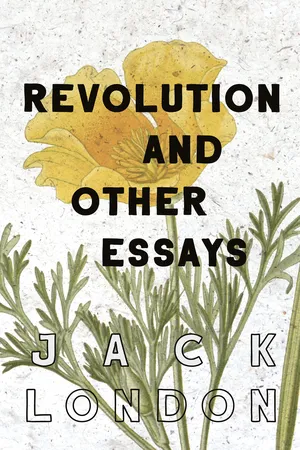
Revolution and Other Essays
About this book
John Griffith London (1876 – 1916), commonly known as Jack London, was an American journalist, social activist, and novelist. He was an early pioneer of commercial magazine fiction, becoming one of the first globally-famous celebrity writers who were able to earn a large amount of money from their writing. First published in 1910, this volume contains a collection of essays written by London, including his famous "Revolution". The essays include: "Revolution", "The Somnabulists", "The Dignity of Dollars", "Goliah", "The Golden Poppy", "The Shrink Age of the Planet", "The House Beautiful", "The Gold Hunters of the North", "These Bones Shall Rise Again", etc. Other notable works by this author include: "The Cruise of the Dazzler" (1902), "The Kempton-Wace Letters" (1903), and "The Call of the Wild" (1903). Many vintage books such as this are increasingly scarce and expensive. We are republishing this volume now in an affordable, modern, high-quality edition complete with a specially-commissioned new biography of the author.
Information
Topic
PhilosophySubtopic
Philosophical EssaysREVOLUTION
“The present is enough for common souls,
Who, never looking forward, are indeed
Mere clay, wherein the footprints of their age
Are petrified for ever.”
Who, never looking forward, are indeed
Mere clay, wherein the footprints of their age
Are petrified for ever.”
I received a letter the other day. It was from a man in Arizona. It began, “Dear Comrade.” It ended, “Yours for the Revolution.” I replied to the letter, and my letter began, “Dear Comrade.” It ended, “Yours for the Revolution.” In the United States there are 400,000 men, of men and women nearly 1,000,000, who begin their letters “Dear Comrade,” and end them “Yours for the Revolution.” In Germany there are 3,000,000 men who begin their letters “Dear Comrade” and end them “Yours for the Revolution”; in France, 1,000,000 men; in Austria, 800,000 men; in Belgium, 300,000 men; in Italy, 250,000 men; in England, 100,000 men; in Switzerland, 100,000 men; in Denmark, 55,000 men; in Sweden, 50,000 men; in Holland, 40,000 men; in Spain, 30,000 men—comrades all, and revolutionists.
These are numbers which dwarf the grand armies of Napoleon and Xerxes. But they are numbers not of conquest and maintenance of the established order, but of conquest and revolution. They compose, when the roll is called, an army of 7,000,000 men, who, in accordance with the conditions of to-day, are fighting with all their might for the conquest of the wealth of the world and for the complete overthrow of existing society.
There has never been anything like this revolution in the history of the world. There is nothing analogous between it and the American Revolution or the French Revolution. It is unique, colossal. Other revolutions compare with it as asteroids compare with the sun. It is alone of its kind, the first world-revolution in a world whose history is replete with revolutions. And not only this, for it is the first organized movement of men to become a world movement, limited only by the limits of the planet.
This revolution is unlike all other revolutions in many respects. It is not sporadic. It is not a flame of popular discontent, arising in a day and dying down in a day. It is older than the present generation. It has a history and traditions, and a martyr-roll only less extensive possibly than the martyr-roll of Christianity. It has also a literature a myriad times more imposing, scientific, and scholarly than the literature of any previous revolution.
They call themselves “comrades,” these men, comrades in the socialist revolution. Nor is the word empty and meaningless, coined of mere lip service. It knits men together as brothers, as men should be knit together who stand shoulder to shoulder under the red banner of revolt. This red banner, by the way, symbolizes the brotherhood of man, and does not symbolize the incendiarism that instantly connects itself with the red banner in the affrighted bourgeois mind. The comradeship of the revolutionists is alive and warm. It passes over geographical lines, transcends race prejudice, and has even proved itself mightier than the Fourth of July, spread-eagle Americanism of our forefathers. The French socialist working-men and the German socialist working-men forget Alsace and Lorraine, and, when war threatens, pass resolutions declaring that as working-men and comrades they have no quarrel with each other. Only the other day, when Japan and Russia sprang at each other’s throats, the revolutionists of Japan addressed the following message to the revolutionists of Russia: “Dear Comrades—Your government and ours have recently plunged into war to carry out their imperialistic tendencies, but for us socialists there are no boundaries, race, country, or nationality. We are comrades, brothers, and sisters, and have no reason to fight. Your enemies are not the Japanese people, but our militarism and so-called patriotism. Patriotism and militarism are our mutual enemies.”
In January 1905, throughout the United States the socialists held mass-meetings to express their sympathy for their struggling comrades, the revolutionists of Russia, and, more to the point, to furnish the sinews of war by collecting money and cabling it to the Russian leaders. The fact of this call for money, and the ready response, and the very wording of the call, make a striking and practical demonstration of the international solidarity of this world-revolution:
“Whatever may be the immediate results of the present revolt in Russia, the socialist propaganda in that country has received from it an impetus unparalleled in the history of modern class wars. The heroic battle for freedom is being fought almost exclusively by the Russian working-class under the intellectual leadership of Russian socialists, thus once more demonstrating the fact that the class-conscious working-men have become the vanguard of all liberating movements of modern times.”
Here are 7,000,000 comrades in an organized, international, world-wide, revolutionary movement. Here is a tremendous human force. It must be reckoned with. Here is power. And here is romance—romance so colossal that it seems to be beyond the ken of ordinary mortals. These revolutionists are swayed by great passion. They have a keen sense of personal right, much of reverence for humanity, but little reverence, if any at all, for the rule of the dead. They refuse to be ruled by the dead. To the bourgeois mind their unbelief in the dominant conventions of the established order is startling. They laugh to scorn the sweet ideals and dear moralities of bourgeois society. They intend to destroy bourgeois society with most of its sweet ideals and dear moralities, and chiefest among these are those that group themselves under such heads as private ownership of capital, survival of the fittest, and patriotism—even patriotism.
Such an army of revolution, 7,000,000 strong, is a thing to make rulers and ruling classes pause and consider. The cry of this army is, “No quarter! We want all that you possess. We will be content with nothing less than all that you possess. We want in our hands the reins of power and the destiny of mankind. Here are our hands. They are strong hands. We are going to take your governments, your palaces, and all your purpled ease away from you, and in that day you shall work for your bread even as the peasant in the field or the starved and runty clerk in your metropolises. Here are our hands. They are strong hands.”
Well may rulers and ruling classes pause and consider. This is revolution. And, further, these 7,000,000 men are not an army on paper. Their fighting strength in the field is 7,000,000. To-day they cast 7,000,000 votes in the civilized countries of the world.
Yesterday they were not so strong. To-morrow they will be still stronger. And they are fighters. They love peace. They are unafraid of war. They intend nothing less than to destroy existing capitalist society and to take possession of the whole world. If the law of the land permits, they fight for this end peaceably, at the ballot-box. If the law of the land does not permit, and if they have force meted out to them, they resort to force themselves. They meet violence with violence. Their hands are strong and they are unafraid. In Russia, for instance, there is no suffrage. The government executes the revolutionists. The revolutionists kill the officers of the government. The revolutionists meet legal murder with assassination.
Now here arises a particularly significant phase which it would be well for the rulers to consider. Let me make it concrete. I am a revolutionist. Yet I am a fairly sane and normal individual. I speak, and I think, of these assassins in Russia as “my comrades.” So do all the comrades in America, and all the 7,000,000 comrades in the world. Of what worth an organized, international, revolutionary movement if our comrades are not backed up the world over! The worth is shown by the fact that we do back up the assassinations by our comrades in Russia. They are not disciples of Tolstoy, nor are we. We are revolutionists.
Our comrades in Russia have formed what they call “The Fighting Organization.” This Fighting Organization accused, tried, found guilty, and condemned to death, one Sipiaguin, Minister of Interior. On April 2 he was shot and killed in the Maryinsky Palace. Two years later the Fighting Organization condemned to death and executed another Minister of Interior, Von Plehve. Having done so, it issued a document, dated July 29, 1904, setting forth the counts of its indictment of Von Plehve and its responsibility for the assassination. Now, and to the point, this document was sent out to the socialists of the world, and by them was published everywhere in the magazines and newspapers. The point is, not that the socialists of the world were unafraid to do it, not that they dared to do it, but that they did it as a matter of routine, giving publication to what may be called an official document of the international revolutionary movement.
The...
Table of contents
- Jack London
- REVOLUTION
- THE SOMNAMBULISTS
- THE DIGNITY OF DOLLARS
- GOLIAH
- THE GOLDEN POPPY
- THE SHRINKAGE OF THE PLANET
- THE HOUSE BEAUTIFUL
- THE GOLD HUNTERS OF THE NORTH
- FOMÁ GORDYÉEFF
- THESE BONES SHALL RISE AGAIN
- THE OTHER ANIMALS
- THE YELLOW PERIL
- WHAT LIFE MEANS TO ME
Trusted by 375,005 students
Access to over 1.5 million titles for a fair monthly price.
Study more efficiently using our study tools.
Frequently asked questions
Yes, you can cancel anytime from the Subscription tab in your account settings on the Perlego website. Your subscription will stay active until the end of your current billing period. Learn how to cancel your subscription
No, books cannot be downloaded as external files, such as PDFs, for use outside of Perlego. However, you can download books within the Perlego app for offline reading on mobile or tablet. Learn how to download books offline
Perlego offers two plans: Essential and Complete
- Essential is ideal for learners and professionals who enjoy exploring a wide range of subjects. Access the Essential Library with 800,000+ trusted titles and best-sellers across business, personal growth, and the humanities. Includes unlimited reading time and Standard Read Aloud voice.
- Complete: Perfect for advanced learners and researchers needing full, unrestricted access. Unlock 1.5M+ books across hundreds of subjects, including academic and specialized titles. The Complete Plan also includes advanced features like Premium Read Aloud and Research Assistant.
We are an online textbook subscription service, where you can get access to an entire online library for less than the price of a single book per month. With over 1.5 million books across 990+ topics, we’ve got you covered! Learn about our mission
Look out for the read-aloud symbol on your next book to see if you can listen to it. The read-aloud tool reads text aloud for you, highlighting the text as it is being read. You can pause it, speed it up and slow it down. Learn more about Read Aloud
Yes! You can use the Perlego app on both iOS and Android devices to read anytime, anywhere — even offline. Perfect for commutes or when you’re on the go.
Please note we cannot support devices running on iOS 13 and Android 7 or earlier. Learn more about using the app
Please note we cannot support devices running on iOS 13 and Android 7 or earlier. Learn more about using the app
Yes, you can access Revolution and Other Essays by Jack London in PDF and/or ePUB format, as well as other popular books in Philosophy & Philosophical Essays. We have over 1.5 million books available in our catalogue for you to explore.