- 124 pages
- English
- ePUB (mobile friendly)
- Available on iOS & Android
eBook - ePub
The Human Drift
About this book
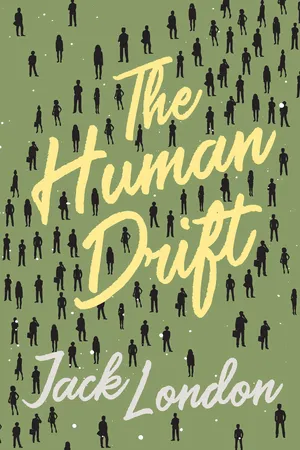
First published in 1917, "The Human Drift" is a collection of essays and short sketches by Jack London, also including a number of plays and his introduction to Richard Henry Dana's "Two Years Before the Mast". The titular essay, "The Human Drift", explores humankind's spread across the continents throughout history and the predicted results and eventual end of this 'drift'. John Griffith London (1876 – 1916), commonly known as Jack London, was an American journalist, social activist, and novelist. He was an early pioneer of commercial magazine fiction, becoming one of the first globally-famous celebrity writers who were able to earn a large amount of money from their writing. London is famous for his contributions to early science fiction and also notably belonged to "The Crowd", a literary group an Francisco known for its radical members and ideas. Other notable works by this author include: "Martin Eden" (1909), "The Kempton-Wace Letters" (1903), and "The Call of the Wild" (1903). Many vintage books such as this are increasingly scarce and expensive. We are republishing this volume now in an affordable, modern, high-quality edition complete with a specially-commissioned new biography of the author.
Information
SIX.
A CLASSIC OF THE SEA
Introduction to “Two Years before the Mast.”
Once in a hundred years is a book written that lives not alone for its own century but which becomes a document for the future centuries. Such a book is Dana’s. When Marryat’s and Cooper’s sea novels are gone to dust, stimulating and joyful as they have been to generations of men, still will remain “Two Years Before the Mast.”
Paradoxical as it may seem, Dana’s book is the classic of the sea, not because there was anything extraordinary about Dana, but for the precise contrary reason that he was just an ordinary, normal man, clear-seeing, hard-headed, controlled, fitted with adequate education to go about the work. He brought a trained mind to put down with untroubled vision what he saw of a certain phase of work-a-day life. There was nothing brilliant nor fly-away about him. He was not a genius. His heart never rode his head. He was neither overlorded by sentiment nor hag-ridden by imagination. Otherwise he might have been guilty of the beautiful exaggerations in Melville’s “Typee” or the imaginative orgies in the latter’s “Moby Dick.” It was Dana’s cool poise that saved him from being spread-eagled and flogged when two of his mates were so treated; it was his lack of abandon that prevented him from taking up permanently with the sea, that prevented him from seeing more than one poetical spot, and more than one romantic spot on all the coast of Old California. Yet these apparent defects were his strength. They enabled him magnificently to write, and for all time, the picture of the sea-life of his time.
Written close to the middle of the last century, such has been the revolution worked in man’s method of trafficking with the sea, that the life and conditions described in Dana’s book have passed utterly away. Gone are the crack clippers, the driving captains, the hard-bitten but efficient foremast hands. Remain only crawling cargo tanks, dirty tramps, greyhound liners, and a sombre, sordid type of sailing ship. The only records broken to-day by sailing vessels are those for slowness. They are no longer built for speed, nor are they manned before the mast by as sturdy a sailor stock, nor aft the mast are they officered by sail-carrying captains and driving mates.
Speed is left to the liners, who run the silk, and tea, and spices. Admiralty courts, boards of trade, and underwriters frown upon driving and sail-carrying. No more are the free-and-easy, dare-devil days, when fortunes were made in fast runs and lucky ventures, not alone for owners, but for captains as well. Nothing is ventured now. The risks of swift passages cannot be abided. Freights are calculated to the last least fraction of per cent. The captains do no speculating, no bargain-making for the owners. The latter attend to all this, and by wire and cable rake the ports of the seven seas in quest of cargoes, and through their agents make all business arrangements.
It has been learned that small crews only, and large carriers only, can return a decent interest on the investment. The inevitable corollary is that speed and spirit are at a discount. There is no discussion of the fact that in the sailing merchant marine the seamen, as a class, have sadly deteriorated. Men no longer sell farms to go to sea. But the time of which Dana writes was the heyday of fortune-making and adventure on the sea—with the full connotation of hardship and peril always attendant.
It was Dana’s fortune, for the sake of the picture, that the Pilgrim was an average ship, with an average crew and officers, and managed with average discipline. Even the hazing that took place after the California coast was reached, was of the average sort. The Pilgrim savoured not in any way of a hell-ship. The captain, while not the sweetest-natured man in the world, was only an average down-east driver, neither brilliant nor slovenly in his seamanship, neither cruel nor sentimental in the treatment of his men. While, on the one hand, there were no extra liberty days, no delicacies added to the meagre forecastle fare, nor grog or hot coffee on double watches, on the other hand the crew were not chronically crippled by the continual play of knuckle-dusters and belaying pins. Once, an...
Table of contents
- Jack London
- ONE.
- TWO.
- THREE.
- FOUR.
- FIVE.
- SIX.
Trusted by 375,005 students
Access to over 1.5 million titles for a fair monthly price.
Study more efficiently using our study tools.
Frequently asked questions
Yes, you can cancel anytime from the Subscription tab in your account settings on the Perlego website. Your subscription will stay active until the end of your current billing period. Learn how to cancel your subscription
No, books cannot be downloaded as external files, such as PDFs, for use outside of Perlego. However, you can download books within the Perlego app for offline reading on mobile or tablet. Learn how to download books offline
Perlego offers two plans: Essential and Complete
- Essential is ideal for learners and professionals who enjoy exploring a wide range of subjects. Access the Essential Library with 800,000+ trusted titles and best-sellers across business, personal growth, and the humanities. Includes unlimited reading time and Standard Read Aloud voice.
- Complete: Perfect for advanced learners and researchers needing full, unrestricted access. Unlock 1.5M+ books across hundreds of subjects, including academic and specialized titles. The Complete Plan also includes advanced features like Premium Read Aloud and Research Assistant.
We are an online textbook subscription service, where you can get access to an entire online library for less than the price of a single book per month. With over 1.5 million books across 990+ topics, we’ve got you covered! Learn about our mission
Look out for the read-aloud symbol on your next book to see if you can listen to it. The read-aloud tool reads text aloud for you, highlighting the text as it is being read. You can pause it, speed it up and slow it down. Learn more about Read Aloud
Yes! You can use the Perlego app on both iOS and Android devices to read anytime, anywhere — even offline. Perfect for commutes or when you’re on the go.
Please note we cannot support devices running on iOS 13 and Android 7 or earlier. Learn more about using the app
Please note we cannot support devices running on iOS 13 and Android 7 or earlier. Learn more about using the app
Yes, you can access The Human Drift by Jack London in PDF and/or ePUB format, as well as other popular books in Social Sciences & Social Science Biographies. We have over 1.5 million books available in our catalogue for you to explore.