- 499 pages
- English
- ePUB (mobile friendly)
- Available on iOS & Android
eBook - ePub
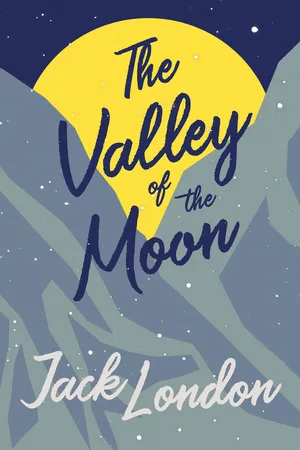
The Valley of the Moon
About this book
Jack London's "The Valley of the Moon" is a 1913 novel about a valley situated in the north of the San Francisco Bay Area in Sonoma County, California where Jack London himself lived on his ranch in Glen Ellen. It tells the story of Billy and Saxon Roberts, a working-class couple who decide to leave the big city in search of a very different life in the rural countryside. John Griffith London (1876 – 1916), commonly known as Jack London, was an American journalist, social activist, and novelist. He was an early pioneer of commercial magazine fiction, becoming one of the first globally-famous celebrity writers who were able to earn a large amount of money from their writing. London is famous for his contributions to early science fiction and also notably belonged to "The Crowd", a literary group an Francisco known for its radical members and ideas. Other notable works by this author include: "Martin Eden" (1909), "The Kempton-Wace Letters" (1903), and "The Call of the Wild" (1903). Many vintage books such as this are increasingly scarce and expensive. We are republishing this volume now in an affordable, modern, high-quality edition complete with a specially-commissioned new biography of the author.
Information
Print ISBN
9781528712224
BOOK III
CHAPTER I
The car ran as far as Hayward's, but at Saxon's suggestion they got off at San Leandro.
"It doesn't matter where we start walking," she said, "for start to walk somewhere we must. And as we're looking for land and finding out about land, the quicker we begin to investigate the better. Besides, we want to know all about all kinds of land, close to the big cities as well as back in the mountains."
"Gee!—this must be the Porchugeeze headquarters," was Billy's reiterated comment, as they walked through San Leandro.
"It looks as though they'd crowd our kind out," Saxon adjudged.
"Some tall crowdin', I guess," Billy grumbled. "It looks like the free-born American ain't got no room left in his own land."
"Then it's his own fault," Saxon said, with vague asperity, resenting conditions she was just beginning to grasp.
"Oh, I don't know about that. I reckon the American could do what the Porchugeeze do if he wanted to. Only he don't want to, thank God. He ain't much given to livin' like a pig often leavin's."
"Not in the country, maybe," Saxon controverted. "But I've seen an awful lot of Americans living like pigs in the cities."
Billy grunted unwilling assent. "I guess they quit the farms an' go to the city for something better, an' get it in the neck."
"Look at all the children!" Saxon cried. "School's letting out. And nearly all are Portuguese, Billy, NOT Porchugeeze. Mercedes taught me the right way."
"They never wore glad rags like them in the old country," Billy sneered. "They had to come over here to get decent clothes and decent grub. They're as fat as butterballs."
Saxon nodded affirmation, and a great light seemed suddenly to kindle in her understanding.
"That's the very point, Billy. They're doing it—doing it farming, too. Strikes don't bother THEM."
"You don't call that dinky gardening farming," he objected, pointing to a piece of land barely the size of an acre, which they were passing.
"Oh, your ideas are still big," she laughed. "You're like Uncle Will, who owned thousands of acres and wanted to own a million, and who wound up as night watchman. That's what was the trouble with all us Americans. Everything large scale. Anything less than one hundred and sixty acres was small scale."
"Just the same," Billy held stubbornly, "large scale's a whole lot better'n small scale like all these dinky gardens."
Saxon sighed. "I don't know which is the dinkier," she observed finally, "—owning a few little acres and the team you're driving, or not owning any acres and driving a team somebody else owns for wages."
Billy winced.
"Go on, Robinson Crusoe," he growled good naturedly. "Rub it in good an' plenty. An' the worst of it is it's correct. A hell of a free-born American I've been, adrivin' other folkses' teams for a livin', a-strikin' and a-sluggin' scabs, an' not bein' able to keep up with the installments for a few sticks of furniture. Just the same I was sorry for one thing. I hated worse in Sam Hill to see that Morris chair go back—you liked it so. We did a lot of honeymoonin' in that chair."
They were well out of San Leandro, walking through a region of tiny holdings—"farmlets," Billy called them; and Saxon got out her ukulele to cheer him with a song.
First, it was "Treat my daughter kind-i-ly," and then she swung into old-fashioned darky camp-meeting hymns, beginning with:
"Oh! de Judgmen' Day am rollin' roan', Rollin', yes, a-rollin', I hear the trumpets' awful soun', Rollin', yes, a-rollin'."
A big touring car, dashing past, threw a dusty pause in her singing, and Saxon delivered herself of her latest wisdom.
"Now, Billy, remember we're not going to take up with the first piece of land we see. We've got to go into this with our eyes open—"
"An' they ain't open yet," he agreed.
"And we've got to get them open. ''Tis them that looks that finds.' There's lots of time to learn things. We don't care if it takes months and months. We're footloose. A good start is better than a dozen bad ones. We've got to talk and find out. We'll talk with everybody we meet. Ask questions. Ask everybody. It's the only way to find out."
"I ain't much of a hand at askin' questions," Billy demurred.
"Then I'll ask," she cried. "We've got to win out at this game, and the way is to know. Look at all these Portuguese. Where are all the Americans? They owned the land first, after the Mexicans. What made the Americans clear out? How do the Portuguese make it go? Don't you see? We've got to ask millions of questions."
She strummed a few chords, and then her clear sweet voice rang out gaily:
"I's g'wine back to Dixie,
I's g'wine back to Dixie,
I's g'wine where de orange blossoms grow,
For I hear de chillun callin',
I see de sad tears fallin'—
My heart's turned back to Dixie,
An' I mus'go."
I's g'wine back to Dixie,
I's g'wine where de orange blossoms grow,
For I hear de chillun callin',
I see de sad tears fallin'—
My heart's turned back to Dixie,
An' I mus'go."
She broke off to exclaim: "Oh! What a lovely place! See that arbor—just covered with grapes!"
Again and again she was attracted by the small places they passed. Now it was: "Look at the flowers!" or: "My! those vegetables!" or: "See! They've got a cow!"
Men—Americans—driving along in buggies or runabouts looked at Saxon and Billy curiously. This Saxon could brook far easier than could Billy, who would mutter and grumble deep in his throat.
Beside the road they came upon a lineman eating his lunch.
"Stop and talk," Saxon whispered.
"Aw, what's the good? He's a lineman. What'd he know about farmin'?"
"You never can tell. He's our kind. Go ahead, Billy. You just speak to him. He isn't working now anyway, and he'll be more likely to talk. See that tree in there, just inside the gate, and the way the branches are grown together. It's a curiosity. Ask him about it. That's a good way to get started."
Billy stopped, when they were alongside.
"How do you do," he said gruffly.
The lineman, a young fellow, paused in the cracking of a hard-boiled egg to stare up at the couple.
"How do you do," he said.
Billy swung his pack from his shoulders to the ground, and Saxon rested her telescope basket.
"Peddlin'?" the young man asked, too discreet to put his question directly to Saxon, yet dividing it between her and Billy, and cocking his eye at the covered basket.
"No," she spoke up quickly. "We're looking for land. Do you know of any around here?"
Again he desisted from the egg, studying them with sharp eyes as if to fathom their financial status.
"Do you know what land sells for around here?" he asked.
"No," Saxon answered. "Do you?"
"I guess I ought to. I was born here. And land like this all around you runs at from two to three hundred to four an' five hundred dollars an acre."
"Whew!" Billy whistled. "I guess we don't wan...
Table of contents
- Jack London
- BOOK I
- BOOK II
- BOOK III
Trusted by 375,005 students
Access to over 1.5 million titles for a fair monthly price.
Study more efficiently using our study tools.