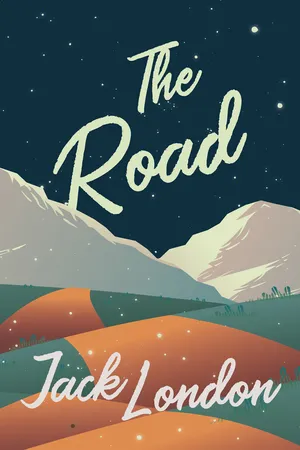
eBook - ePub
The Road
About this book
"The Road" is a 1907 autobiographical memoir by American writer Jack London. Within it, London recounts his experience of being homeless during the 1890 depression in the United States. He tells of his having to hop freight trains, beg to survive, his various run-ins with the police, and much more in an interesting and insightful account of life during an economic depression. This volume will appeal to those with an interest in the depression of the late nineteenth century, and it is not to be missed by fans and collectors of London's seminal work. John Griffith London (1876 – 1916), commonly known as Jack London, was an American journalist, social activist, and novelist. He was an early pioneer of commercial magazine fiction, becoming one of the first globally-famous celebrity writers who were able to earn a large amount of money from their writing. London is famous for his contributions to early science fiction and also notably belonged to "The Crowd", a literary group an Francisco known for its radical members and ideas. Many vintage books such as this are increasingly scarce and expensive. We are republishing this volume now in an affordable, modern, high-quality edition complete with a specially-commissioned new biography of the author.
Information
Confession
There is a woman in the state of Nevada to whom I once lied continuously, consistently, and shamelessly, for the matter of a couple of hours. I don't want to apologize to her. Far be it from me. But I do want to explain. Unfortunately, I do not know her name, much less her present address. If her eyes should chance upon these lines, I hope she will write to me.
It was in Reno, Nevada, in the summer of 1892. Also, it was fair-time, and the town was filled with petty crooks and tin-horns, to say nothing of a vast and hungry horde of hoboes. It was the hungry hoboes that made the town a "hungry" town. They "battered" the back doors of the homes of the citizens until the back doors became unresponsive.
A hard town for "scoffings," was what the hoboes called it at that time. I know that I missed many a meal, in spite of the fact that I could "throw my feet" with the next one when it came to "slamming a gate" for a "poke-out" or a "set-down," or hitting for a "light piece" on the street. Why, I was so hard put in that town, one day, that I gave the porter the slip and invaded the private car of some itinerant millionnaire. The train started as I made the platform, and I headed for the aforesaid millionnaire with the porter one jump behind and reaching for me. It was a dead heat, for I reached the millionnaire at the same instant that the porter reached me. I had no time for formalities. "Gimme a quarter to eat on," I blurted out. And as I live, that millionnaire dipped into his pocket and gave me just precisely a quarter. It is my conviction that he was so flabbergasted that he obeyed automatically, and it has been a matter of keen regret ever since, on my part, that I didn't ask him for a dollar. I know that I'd have got it. I swung off the platform of that private car with the porter manoeuvring to kick me in the face. He missed me. One is at a terrible disadvantage when trying to swing off the lowest step of a car and not break his neck on the right of way, with, at the same time, an irate Ethiopian on the platform above trying to land him in the face with a number eleven. But I got the quarter! I got it!
But to return to the woman to whom I so shamelessly lied. It was in the evening of my last day in Reno. I had been out to the race-track watching the ponies run, and had missed my dinner (i.e. the mid-day meal). I was hungry, and, furthermore, a committee of public safety had just been organized to rid the town of just such hungry mortals as I. Already a lot of my brother hoboes had been gathered in by John Law, and I could hear the sunny valleys of California calling to me over the cold crests of the Sierras. Two acts remained for me to perform before I shook the dust of Reno from my feet. One was to catch the blind baggage on the westbound overland that night. The other was first to get something to eat. Even youth will hesitate at an all-night ride, on an empty stomach, outside a train that is tearing the atmosphere through the snow-sheds, tunnels, and eternal snows of heaven-aspiring mountains.
But that something to eat was a hard proposition. I was "turned down" at a dozen houses. Sometimes I received insulting remarks and was informed of the barred domicile that should be mine if I had my just deserts. The worst of it was that such assertions were only too true. That was why I was pulling west that night. John Law was abroad in the town, seeking eagerly for the hungry and homeless, for by such was his barred domicile tenanted.
At other houses the doors were slammed in my face, cutting short my politely and humbly couched request for something to eat. At one house they did not open the door. I stood on the porch and knocked, and they looked out at me through the window. They even held one sturdy little boy aloft so that he could see over the shoulders of his elders the tramp who wasn't going to get anything to eat at their house.
It began to look as if I should be compelled to go to the very poor for my food. The very poor constitute the last sure recourse of the hungry tramp. The very poor can always be depended upon. They never turn away the hungry. Time and again, all over the United States, have I been refused food by the big house on the hill; and always have I received food from the little shack down by the creek or marsh, with its broken windows stuffed with rags and its tired-faced mother broken with labor. Oh, you charity-mongers! Go to the poor and learn, for the poor alone are the charitable. They neither give nor withhold from their excess. They have no excess. They give, and they withhold never, from what they need for themselves, and very often from what they cruelly need for themselves. A bone to the dog is not charity. Charity is the bone shared with the dog when you are just as hungry as the dog.
There was one house in particular where I was turned down that evening. The porch windows opened on the dining room, and through them I saw a man eating pie—a big meat-pie. I stood in the open door, and while he talked with me, he went on eating. He was prosperous, and out of his prosperity had been bred resentment against his less fortunate brothers.
He cut short my request for something to eat, snapping out, "I don't believe you want to work."
Now this was irrelevant. I hadn't said anything about work. The topic of conversation I had introduced was "food." In fact, I didn't want to work. I wanted to take the westbound overland that night.
"You wouldn't work if you had a chance," he bullied.
I glanced at his meek-faced wife, and knew that but for the presence of this Cerberus I'd have a whack at that meat-pie myself. But Cerberus sopped himself in the pie, and I saw that I must placate him if I were to get a share of it. So I sighed to myself and accepted his work-morality.
"Of course I want work," I bluffed.
"Don't believe it," he snorted.
"Try me," I answered, warming to the bluff.
"All right," he said. "Come to the corner of blank and blank streets"—(I have forgotten the address)—"to-morrow morning. You know where that burned building is, and I'll put you to work tossing bricks."
"All right, sir; I'll be there."
He grunted and went on eating. I waited. After a couple of minutes he looked up with an I-thought-you-were-gone expression on his face, and demanded:—
"Well?"
"I ... I am waiting for something to eat," I said gently.
"I knew you wouldn't work!" he roared.
He was right, of course; but his conclusion must have been reached by mind-reading, for his logic wouldn't bear it out. But the beggar at the door must be humble, so I accepted his logic as I had accepted his morality.
"You see, I am now hungry," I said still gently. "To-morrow morning I shall be hungrier. Think how hungry I shall be when I have tossed bricks all day without anything to eat. Now if you will give me something to eat, I'll be in great shape for those bricks."
He gravely considered my plea, at the same time going on eating, while his wife nearly trembled into propitiatory speech, but refrained.
"I'll tell you what I'll do," he said between mouthfuls. "You come to work to-morrow, and in the middle of the day I'll advance you enough for your dinner. That will show whether you...
Table of contents
- Jack London
- Confession
- Holding Her Down
- Pictures
- "Pinched"
- The Pen
- Hoboes That Pass in the Night
- Road-Kids and Gay-Cats
- Two Thousand Stiffs
- Bulls
Trusted by 375,005 students
Access to over 1.5 million titles for a fair monthly price.
Study more efficiently using our study tools.
Frequently asked questions
Yes, you can cancel anytime from the Subscription tab in your account settings on the Perlego website. Your subscription will stay active until the end of your current billing period. Learn how to cancel your subscription
No, books cannot be downloaded as external files, such as PDFs, for use outside of Perlego. However, you can download books within the Perlego app for offline reading on mobile or tablet. Learn how to download books offline
We are an online textbook subscription service, where you can get access to an entire online library for less than the price of a single book per month. With over 1.5 million books across 990+ topics, we’ve got you covered! Learn about our mission
Look out for the read-aloud symbol on your next book to see if you can listen to it. The read-aloud tool reads text aloud for you, highlighting the text as it is being read. You can pause it, speed it up and slow it down. Learn more about Read Aloud
Yes! You can use the Perlego app on both iOS and Android devices to read anytime, anywhere — even offline. Perfect for commutes or when you’re on the go.
Please note we cannot support devices running on iOS 13 and Android 7 or earlier. Learn more about using the app
Please note we cannot support devices running on iOS 13 and Android 7 or earlier. Learn more about using the app
Yes, you can access The Road by Jack London in PDF and/or ePUB format, as well as other popular books in Social Sciences & Literary Biographies. We have over 1.5 million books available in our catalogue for you to explore.