- 66 pages
- English
- ePUB (mobile friendly)
- Available on iOS & Android
eBook - ePub
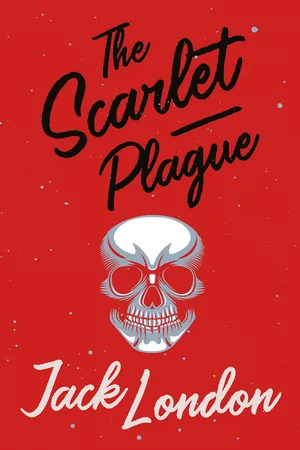
The Scarlet Plague
About this book
Originally published in "London Magazine" in 1912, "The Scarlet Plague" is a post-apocalyptic novel by American writer Jack London. The year is 2073 and its sixty years after the 'Red Death' decimated the population of the earth. A survivor called James Smith lives in the San Francisco area, travelling around with his grandsons who live as primeval hunter-gatherers. One day, he recounts his life before the epidemic and tells of how the 'Scarlet Death' came to be. This volume will appeal to lovers of early science fiction and is not to be missed by fans and collectors of London's fantastic work. John Griffith London (1876 – 1916), commonly known as Jack London, was an American journalist, social activist, and novelist. He was an early pioneer of commercial magazine fiction, becoming one of the first globally-famous celebrity writers who were able to earn a large amount of money from their writing. London is famous for his contributions to early science fiction and also notably belonged to "The Crowd", a literary group an Francisco known for its radical members and ideas. Many vintage books such as this are increasingly scarce and expensive. We are republishing this volume now in an affordable, modern, high-quality edition complete with a specially-commissioned new biography of the author.
Information
I
THE way led along upon what had once been the embankment of a railroad. But no train had run upon it for many years. The forest on either side swelled up the slopes of the embankment and crested across it in a green wave of trees and bushes. The trail was as narrow as a man's body, and was no more than a wild-animal runway. Occasionally, a piece of rusty iron, showing through the forest-mould, advertised that the rail and the ties still remained. In one place, a ten-inch tree, bursting through at a connection, had lifted the end of a rail clearly into view. The tie had evidently followed the rail, held to it by the spike long enough for its bed to be filled with gravel and rotten leaves, so that now the crumbling, rotten timber thrust itself up at a curious slant. Old as the road was, it was manifest that it had been of the mono-rail type.
An old man and a boy travelled along this runway. They moved slowly, for the old man was very old, a touch of palsy made his movements tremulous, and he leaned heavily upon his staff. A rude skull-cap of goat-skin protected his head from the sun. From beneath this fell a scant fringe of stained and dirty-white hair. A visor, ingeniously made from a large leaf, shielded his eyes, and from under this he peered at the way of his feet on the trail. His beard, which should have been snow-white but which showed the same weather-wear and camp-stain as his hair, fell nearly to his waist in a great tangled mass. About his chest and shoulders hung a single, mangy garment of goat-skin. His arms and legs, withered and skinny, betokened extreme age, as well as did their sunburn and scars and scratches betoken long years of exposure to the elements.
The boy, who led the way, checking the eagerness of his muscles to the slow progress of the elder, likewise wore a single garment—a ragged-edged piece of bear-skin, with a hole in the middle through which he had thrust his head. He could not have been more than twelve years old. Tucked coquettishly over one ear was the freshly severed tail of a pig. In one hand he carried a medium-sized bow and an arrow.
On his back was a quiverful of arrows. From a sheath hanging about his neck on a thong, projected the battered handle of a hunting knife. He was as brown as a berry, and walked softly, with almost a catlike tread. In marked contrast with his sunburned skin were his eyes—blue, deep blue, but keen and sharp as a pair of gimlets. They seemed to bore into aft about him in a way that was habitual. As he went along he smelled things, as well, his distended, quivering nostrils carrying to his brain an endless series of messages from the outside world. Also, his hearing was acute, and had been so trained that it operated automatically. Without conscious effort, he heard all the slight sounds in the apparent quiet—heard, and differentiated, and classified these sounds—whether they were of the wind rustling the leaves, of the humming of bees and gnats, of the distant rumble of the sea that drifted to him only in lulls, or of the gopher, just under his foot, shoving a pouchful of earth into the entrance of his hole.
Suddenly he became alertly tense. Sound, sight, and odor had given him a simultaneous warning. His hand went back to the old man, touching him, and the pair stood still. Ahead, at one side of the top of the embankment, arose a crackling sound, and the boy's gaze was fixed on the tops of the agitated bushes. Then a large bear, a grizzly, crashed into view, and likewise stopped abruptly, at sight of the humans. He did not like them, and growled querulously. Slowly the boy fitted the arrow to the bow, and slowly he pulled the bowstring taut. But he never removed his eyes from the bear.
The old man peered from under his green leaf at the danger, and stood as quietly as the boy. For a few seconds this mutual scrutinizing went on; then, the bear betraying a growing irritability, the boy, with a movement of his head, indicated that the old man must step aside from the trail and go down the embankment. The boy followed, going backward, still holding the bow taut and ready. They waited till a crashing among the bushes from the opposite side of the embankment told them the bear had gone on. The boy grinned as he led back to the trail.
"A big un, Granser," he chuckled.
The old man shook his head.
"They get thicker every day," he complained in a thin, undependable falsetto. "Who'd have thought I'd live to see the time when a man would be afraid of his life on the way to the Cliff House. When I was a boy, Edwin, men and women and little babies used to come out here from San Francisco by tens of thousands on a nice day. And there weren't any bears then. No, sir. They used to pay money to look at them in cages, they were that rare."
"What is money, Granser?"
Before the old man could answer, the boy recollected and triumphantly shoved his hand into a pouch under his bear-skin and pulled forth a battered and tarnished silver dollar. The old man's eyes glistened, as he held the coin close to them.
"I can't see," he muttered. "You look and see if you can make out the date, Edwin."
The boy laughed.
"You're a great Granser," he cried delightedly, "always making believe them little marks mean something."
The old man manifested an accustomed chagrin as he brought the coin back again close to his own eyes.
"2012," he shrilled, and then fell to cackling grotesquely. "That was the year Morgan the Fifth was appointed President of the United States by the Board of Magnates. It must have been one of the last coins minted, for the Scarlet Death came in 2013. Lord! Lord!—think of it! Sixty years ago, and I am the only person alive to-day that lived in those times. Where did you find it, Edwin?"
The boy, who had been regarding him with the tolerant curiousness one accords to the prattlings of the feeble-minded, answered promptly.
"I got it off of Hoo-Hoo. He found it when we was herdin' goats down near San José last spring. Hoo-Hoo said it was money. Ain't you hungry, Granser?"
The ancient caught his staff in a tighter grip and urged along the trail, his old eyes shining greedily.
"I hope Har-Lip 's found a crab... or two," he mumbled. "They're good eating, crabs, mighty good eating when you've no more teeth and you've got grandsons that love their old grandsire and make a point of catching crabs for him. When I was a boy—"
But Edwin, suddenly stopped by what he saw, was drawing the bowstring on a fitted arrow. He had paused on the brink of a crevasse in the embankment. An ancient culvert had here washed out, and the stream, no longer confined, had cut a passage through the fill. On the opposite side, the end of a rail projected and overhung. It showed rustily through the creeping vines which overran it. Beyond, crouching by a bush, a rabbit looked across at him in trembling hesitancy. Fully fifty feet was the distance, but the arrow flashed true; and the transfixed rabbit, crying out in sudden fright and hurt, struggled painfully away into the brush. The boy himself was a flash of brown skin and flying fur as he bounded down the steep wall of the gap and up the other side. His lean muscles were springs of steel that released into graceful and efficient action. A hundred feet beyond, in a tangle of bushes, he overtook the wounded creature, knocked its head on a convenient tree-trunk, and turned it over to Granser to carry.
"Rabbit is good, very good," the ancient quavered, "but when it comes to a toothsome delicacy I prefer crab. When I was a boy—"
"Why do you say so much that ain't got no sense?" Edw...
Table of contents
- Jack London
- I
- II
- III
- IV
- V
- VI
Trusted by 375,005 students
Access to over 1.5 million titles for a fair monthly price.
Study more efficiently using our study tools.
Frequently asked questions
Yes, you can cancel anytime from the Subscription tab in your account settings on the Perlego website. Your subscription will stay active until the end of your current billing period. Learn how to cancel your subscription
No, books cannot be downloaded as external files, such as PDFs, for use outside of Perlego. However, you can download books within the Perlego app for offline reading on mobile or tablet. Learn how to download books offline
Perlego offers two plans: Essential and Complete
- Essential is ideal for learners and professionals who enjoy exploring a wide range of subjects. Access the Essential Library with 800,000+ trusted titles and best-sellers across business, personal growth, and the humanities. Includes unlimited reading time and Standard Read Aloud voice.
- Complete: Perfect for advanced learners and researchers needing full, unrestricted access. Unlock 1.5M+ books across hundreds of subjects, including academic and specialized titles. The Complete Plan also includes advanced features like Premium Read Aloud and Research Assistant.
We are an online textbook subscription service, where you can get access to an entire online library for less than the price of a single book per month. With over 1.5 million books across 990+ topics, we’ve got you covered! Learn about our mission
Look out for the read-aloud symbol on your next book to see if you can listen to it. The read-aloud tool reads text aloud for you, highlighting the text as it is being read. You can pause it, speed it up and slow it down. Learn more about Read Aloud
Yes! You can use the Perlego app on both iOS and Android devices to read anytime, anywhere — even offline. Perfect for commutes or when you’re on the go.
Please note we cannot support devices running on iOS 13 and Android 7 or earlier. Learn more about using the app
Please note we cannot support devices running on iOS 13 and Android 7 or earlier. Learn more about using the app
Yes, you can access The Scarlet Plague by Jack London in PDF and/or ePUB format, as well as other popular books in Literature & Science Fiction. We have over 1.5 million books available in our catalogue for you to explore.