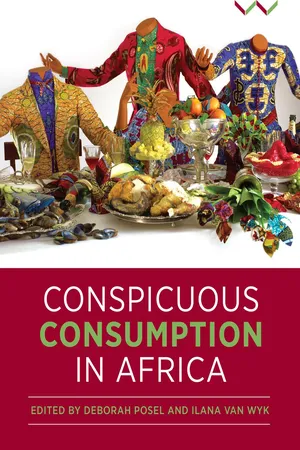
A collection of essays examining cultures of consumption on the African continent
From early department stores in Cape Town to gendered histories of sartorial success in urban Togo, contestations over expense accounts at an apartheid state enterprise, elite wealth and political corruption in Angola and Zambia, the role of popular religion in the political intransigence of Jacob Zuma, funerals of big men in Cameroon, youth cultures of consumption in Niger and South Africa, queer consumption in Cape Town, middle-class food consumption in Durban and the consumption of luxury handcrafted beads, this collection of essays explores the ways in which conspicuous consumption is foregrounded in various African contexts and historical moments.
The essays in Conspicuous Consumption in Africa put Thorstein Veblen's concept under robust critical scrutiny, delving into the pleasures, stresses and challenges of consuming in its religious, generational, gendered and racialised aspects, revealing conspicuous consumption as a layered set of practices, textures and relations. This volume shows how central and revealing conspicuous consumption can be to fathoming the history of Africa's projects of modernity, and their global lineages and legacies. In its grounded, up-close case studies, it is likely to feed into current public debates on the nature and future of African societies – South African society in particular.
eBook - ePub
Conspicuous Consumption in Africa
- English
- ePUB (mobile friendly)
- Available on iOS & Android
eBook - ePub
About this book
Information
Subtopic
African HistoryIndex
History1 THINKING WITH VEBLEN: CASE STUDIES FROM AFRICA’S PAST AND PRESENT
Thorstein Veblen (2003 [1899]) coined the phrase ‘conspicuous consumption’ in his critique of nineteenth-century American society, as an indictment of the extent to which the need for personal recognition – or ‘honour,’ as he put it – was vested in public displays of material acquisition. The phrase immediately caught on, infiltrating vocabularies of social commentary and popular conversation in the United States of America (USA) and beyond. In the present moment, more than a century later, it has self-evident resonance with experiences of ostentatious accumulation across the world.
There are some striking resemblances between the USA of the late nineteenth century, about which Veblen was writing, and many parts of the world today – including Africa: buoyant if uneven economic growth; rampant and loosely regulated accumulation; rapid upward mobility in the higher reaches of society coupled with abiding or deepening poverty and marginality for most; insufficient government action to manage or ameliorate the inequalities. The ‘Africa Rising’ narrative informs some of these trends on the continent. From the early 2000s, a number of influential authors, publications and institutions, including The Financial Times, The Economist, the BBC and The International Monetary Fund,1 have reported that growing access to the Internet and mobile phones (Mutiga & Flood 2016), an increase in consumer spending and growth in entrepreneurship have marked a new epoch of rapid economic growth across the African continent (Mahajan 2009; Taylor 2014). Combined with the rise of a new middle class, there has been much optimism that this unprecedented growth would translate into increasing incomes across the continent. Critics have pointed out, however, that Africa’s ‘rise’ has not translated into economic democracy, and the small ‘middle class’ appears more interested in its own meteoric rise and conspicuous consumption than in economic justice (Akwagyiram 2013; Fabricius 2015; Johnson 2015; Wadongo 2014).
As inequalities on the continent deepen, conspicuous consumption has become both the sign of such differentiation and the symbolic register within which much political, social and cultural criticism is couched (Dosekun 2015; Iqani 2016; Mbembe 2004; Spronk 2014). In global news on Africa, conspicuous consumption is often central to the ways in which controversial public figures and events are construed. Consider, for example, the ousting of former Zimbabwean president Robert Mugabe in 2017. Countless articles and commentaries have focused on his, and his family’s, opulent lifestyle. ‘Gucci Grace’ – the satirical name given to his wife – has come under particular scrutiny for her infamous international shopping trips, lavishly expensive jewellery, imported Rolls Royces as well as for the substantial sums she spends on ‘spoiling’ her two party-loving adult sons (Allison 2017). The alarm over excessive conspicuous consumption in Africa also spills over into trends in popular culture. International media articles on sapeurs in West Africa (Doig 2014), mobile phones across Africa (Mutiga & Flood 2016) and elaborate coffins in Ghana (Jansen 2016), for example, are centrally about conspicuous consumption in contexts of extreme poverty.
Under these conditions, then, boldly extravagant consumption, across gender and generation, is read as an emphatic – sometimes hyperbolic – assertion of social, economic and/or political status. Framing African conspicuous consumption in this way is not unique, of course, and as in other cases, reactions and judgements vary. Yet, in the case of Africa, the moral outrage and political scorn that attach to conspicuous consumption seem especially intense. There is no comparably intense public anxiety about the conspicuous consumption of elites in the West who are in many cases far wealthier, often spending money as conspicuously, if not more so, than their African counterparts. This was powerfully illustrated in the recent Paradise Papers exposé, in which international journalists revealed the extent to which the world’s super-rich invested money offshore in order to avoid paying domestic taxes.2 The British monarch, often cited as one of the richest people in the United Kingdom (UK) (see Sherman 2016), was among those on the list (Osborne 2017). However, despite considerable coverage, journalists soon bemoaned the fact that the Paradise Papers did not seem to generate the level of public outrage that they had expected. As one article pointed out, the general public in the UK, Europe and America were more concerned about low-income groups legally exploiting the system than with the dubious tax arrangements and suspiciously lavish lifestyles of the elite (De Vries & Reeves 2017).
The disproportionate moral disdain that attaches to material excess in Africa is not new, having been a prominent and revealing feature of African history from the nineteenth century onwards. Early missionaries and European traders on the continent wrote with alarm about the locals’ material demands and excesses (Comaroff 1996: 19–38; Etherington 1978; Ross 1990), especially when it came to local chiefs, kings and other local elites (Collins & Burns 2007: 142–158). As a consequence of such anxieties, a large part of missionaries’ ‘civilising mission’ revolved around teaching locals proper, restrained consumption (Comaroff & Comaroff 1990: 195–216; Etherington 2002: 422–439; Meyer 2002: 753–757). Such patterns of negative framing continued into the twentieth century, as the consolidation of African elites in the post-independence era produced spectacles of wealth and consumerism hitherto unseen on the continent. In many instances, such spectacles became intimately connected with the exercise of power (Bayart 1993; Fanon 1961), with controversial and brutal leaders such as Mabuto Sese Seko (Smith 2013), Uhuru Kenyatta and Joseph Kabila as prime examples.
Conspicuous consumption, therefore, is as much an argument, as it is a public conversation, about ‘honour’ and power – the factors originally, and famously, posited by Veblen as the primary drivers of such material performances and their effects. Yet, these varied geographies and politics of conspicuous consumption suggest the need for a nuanced engagement with issues of context and history. This collection is an effort to make sense of contemporary versions of conspicuous consumption in Africa and their histories, which, in turn, provides an opportunity to revisit Veblen’s early and influential analysis. Contributors engage with varieties of consumerism in a range of specific places and times on this continent, and how they intersect with global genealogies of aspiration, acquisition, status, and conspicuous display.
The collection arose out of a symposium on Conspicuous Consumption in Africa, held at the Institute for Humanities in Africa (HUMA) at the University of Cape Town in December 2014. This symposium posed a number of central questions that undergird the volume as a whole. How do we explain the varied repertoires of conspicuous consumption on this continent, now and in the past? What do these repertoires reveal about the modalities and limits of global and transnational linkages? How have economic, technological, political and social factors articulated with the scale and scope of conspicuous consumption? Why do some variants of conspicuous consumption ignite more argument than others? What are the arguments really about? What are their cultural registers and effects, and how do the dynamics of local and global markets shape these collisions and their impact on political life?
These questions, while grounded in specific case studies, lead back to the concept of conspicuous consumption itself. If the meaning and application of the term seems uncomplicated in everyday parlance, its analytic usage is more elusive, if also powerfully suggestive. So we invited our contributors to grapple with conceptual and theoretical questions too. How is ‘conspicuous consumption’ usefully and coherently defined? What analytical work do we want the concept to do, and how? In what ways do questions about conspicuous consumption engage with, and contribute to, theories of modernity and its counter assertions in Africa? More broadly, what are the productive theoretical horizons of debate concerning conspicuous consumption in Africa – in particular, the articulations between these processes, and the familiar wirings of power and inequality along lines of class, race, gender, status, religion and generation? Since the concept of conspicuous consumption was produced at the heart of Veblen’s The Theory of the Leisure Class, which has had a powerful imprint in many historical and contemporary studies of material excess,3 we invited the contributors to engage these questions by way of the Veblenian conceptualisation, and to consider if and how it helped in making sense of their empirical material.4
The chapters in this volume engage with these questions in variegated ways, from the standpoint of different disciplines, geographies and histories, and with varying degrees of engagement with the details of Veblen’s writings. No doubt there are several gaps and omissions in the collection. The geographic focus is largely on sub-Saharan Africa, with a concentration on South Africa. Historically too, the volume opens up a few windows, rather than shedding a comprehensive light, on its animating questions. To some extent, this is a consequence of the offerings at the symposium itself. But as editors, we have not set out to produce a geographically or historically complete selection of chapters. Our aim is far more modest: to assemble a selection of empirically diverse renditions of material ‘excess’, with a unifying conceptual thread deriving from an effort to think with Veblen, and the uses and/or limits of the notion of conspicuous consumption associated with his corpus of work.
In the remainder of this chapter, we provide a brief introduction to some of the key tenets of Veblen’s thinking about conspicuous consumption. We then discuss the ways in which the individual chapters advance our understanding of the multifaceted dynamics of conspicuous consumption in Africa’s heterogeneous past and present, and finally, summarise the collective verdict on the relevance and utility of the Veblenian conceptualisation.
VEBLEN ON CONSPICUOUS CONSUMPTION
Born in 1857, Thorstein Veblen was the son of Norwegian immigrants to the USA. He grew up on a farm in Minnesota in a financially comfortable but not affluent home. His father, who loomed large in his life, extolled and performed the virtues of hard work and self-reliance, underpinned by a commitment to the authenticity and creativity of manual labour. (The house that Thomas Veblen built is still standing.) These were values that would stay with Thorstein throughout his life (carpentry was one of his abiding hobbies) and would permeate the substance of his arguments – particularly in his valorisation of productive work as the antithesis of leisure and the nemesis of ‘the leisure class’.
While originally trained in philosophy, Veblen’s first academic job was in economics, at the University of Chicago, where he wrote The Theory of the Leisure Class (first published in 1899). He was writing in the midst of huge economic ferment and upheaval, triggered by very rapid industrialisation in the USA, notably in heavy industries, such as coal mining and steel production. The last three decades of the nineteenth century saw a huge increase in the number of mines, factories, machines and the construction of miles of railroads in the USA, which produced gargantuan fortunes for the men who owned them (Spindler 2002: 4–5). This was the period in which multimillionaires, such as Andrew Carnegie, John D Rockefeller, Solomon Guggenheim, Cornelius Vanderbilt and others, accumulated extraordinary sums of money (Holbrook 2010). Their lifestyles evinced their success; America’s rich founded their own elite schools and private clubs, and lived in vast mansions filled with rare art and decorative objects and serviced by ornately dressed butlers and footmen. (In 1895, George Vanderbilt built a 250-room Renaissance-style palace, which remains the largest house ever built in the USA.) For Veblen, this was the archetypal ‘leisure class’: people who made extravagantly good, very quickly and brazenly, and who were intent on declaring their material success as ostentatiously as possible.
At the same time, greater proportions of American people were becoming ever poorer. Chicago was one of the cities in which the brutal inequalities of modernising America were painfully apparent. Alongside the excesses of the rich, the familiar features of extreme poverty, such as disease, overcrowding and premature death, were ubiquitous. Things were particularly bad during a bout of economic depression in 1893–4, with unusually high rates of unemployment and popular disaffection. Veblen was deeply troubled by the poverty around him and vented his spleen by writing satirically about what he saw as the vanities of the leisure class, their absurd and hyperbolic displays of wealth, their cultural pretensions to arcane and useless knowledge, their ostentatious architecture and their deliberately expensive works of art.
While the late nineteenth-century American condition triggered Veblen’s critique, he intended his analysis to have a far wider historical and geographical reach, and presented it as a general theory of conspicuous consumption. Theoretically, his writings engaged centrally with both Charles Darwin and Karl Marx – two major thinkers of the day. Veblen treated practices of consumption as unfolding across the longue durée, as historical processes that evolved incrementally, without any abiding telos. Here, the influence of Darwin’s evolutionism was keenly apparent, rendering Veblen’s philosophy of history very different from that of Marx. For Veblen, history did not move through radical revolutionary ruptures, with an emancipatory momentum driving it forward; rather, history had a cumulative but directionless dynamic, with the residues of ‘archaic elements’ retained long beyond their first manifestation, and without any normative progression.
Within this long history, since the onset of what Veblen satirically calls ‘barbarian society’ (marked by the introduction of property), repertoires of consumption had been a decisive force, rather than something secondary and epiphenomenal, á la Marx. According to Veblen (2003: 8), the primary human motivation, which had not changed, was the pursuit of ‘esteem’ or ‘honour’ in the eyes of others. (Veblen speaks generically about honour, but in fact the discussion is tacitly more specific, concerning the honour of men.) Honour, in turn, had a profoundly material register. During the initial peaceable phase of human evolution, the so-called primitive savagery phase, honour was secured through productive work. During this phase, where individual ownership was not a dominant feature of economic life, social hierarchies were relatively flat, and social distinctions between classes and employment were inconsistent (4). With the violent and predatory transition to ‘barbarism’ (Veblen’s deliberately counterintuitive term for the advent of property), the basis of esteem shifted to ownership, associated with demonstrable wealth (4–5). Veblen (12–13) explained the transition to private ownership as the result of the male quest for honour during war, a quest that resulted in both private ownership and forms of marriage that survived into the modern industrial era.
The practice of seizing women from the enemy as trophies gave rise to a form of ownership-marriage, resulting in a household with a male head. This was followed by an extension of slavery to other captives and inferiors, besides women, and by an extension of a system of ownership-marriage to women other than those seized from the enemy.
Once established, ‘the possession of wealth’, he said, ‘confer[red] honour’ (Veblen 2003: 14), in a hierarchy of social and personal value rooted in hierarchies of material acquisition. As he asserted, ‘The end sought by accumulation is to rank high in comparison with the rest of the community in point of pecuniary strength’ (16).
In Veblen’s view, wealth per se was insufficient to confer and retain honour; the possession of wealth had to be visible and public, ‘for esteem is awarded only on evidence’ (Veblen 2003: 131). The point of ‘pecuniary strength’ was to make it conspicuous, to show it off to selected others. This happened in two ways. The first was through exemption from work (productive work) – that is, in becoming leisurely. ‘Conspicuous abstention from labour therefore becomes the conventional mark of pecuniary achievement and the conventional index of reputability’ (19). The second was through the conspicuous consumption of material goods – a ‘waste...
Table of contents
- COVER
- TITLE
- CONTENTS
- ACKNOWLEDGEMENTS
- LIST OF ILLUSTRATIONS
- 1 THINKING WITH VEBLEN: CASE STUDIES FROM AFRICA’S PAST AND PRESENT
- 2 CHANGES IN THE ORDER OF THINGS: DEPARTMENT STORES AND THE MAKING OF MODERN CAPE TOWN
- 3 CONSPICUOUSLY PUBLIC: GENDERED HISTORIES OF SARTORIAL AND SOCIAL SUCCESS IN URBAN TOGO
- 4 ETIENNE ROUSSEAU, BROEDERTWIS AND THE POLITICS OF CONSUMPTION WITHIN AFRIKANERDOM
- 5 RECYCLING CONSUMPTION: POLITICAL POWER AND ELITE WEALTH IN ANGOLA
- 6 CHILUBA’S TRUNKS: CONSUMPTION, EXCESS AND THE BODY POLITIC IN ZAMBIA
- 7 JACOB ZUMA’S SHAMELESSNESS: CONSPICUOUS CONSUMPTION, POLITICS AND RELIGION
- 8 PRECARIOUS ‘BIGNESS’: A ‘BIG MAN’, HIS WOMEN AND HIS FUNERAL IN CAMEROON
- 9 YOUNG MEN OF LEISURE? YOUTH, CONSPICUOUS CONSUMPTION AND THE PERFORMATIVITY OF DRESS IN NIGER
- 10 BOOTY ON FIRE: LOOKING AT IZIKHOTHANE WITH THORSTEIN VEBLEN
- 11 CONSPICUOUS QUEER CONSUMPTION: EMULATION AND HONOUR IN THE PINK MAP
- 12 THE POLITICS AND MORAL ECONOMY OF MIDDLE-CLASS CONSUMPTION IN SOUTH AFRICA
- 13 MARIGOLD BEADS: WHO NEEDS DIAMONDS?!
- CONTRIBUTORS
- INDEX
Trusted by 375,005 students
Access to over 1.5 million titles for a fair monthly price.
Study more efficiently using our study tools.
Frequently asked questions
Yes, you can cancel anytime from the Subscription tab in your account settings on the Perlego website. Your subscription will stay active until the end of your current billing period. Learn how to cancel your subscription
No, books cannot be downloaded as external files, such as PDFs, for use outside of Perlego. However, you can download books within the Perlego app for offline reading on mobile or tablet. Learn how to download books offline
Perlego offers two plans: Essential and Complete
- Essential is ideal for learners and professionals who enjoy exploring a wide range of subjects. Access the Essential Library with 800,000+ trusted titles and best-sellers across business, personal growth, and the humanities. Includes unlimited reading time and Standard Read Aloud voice.
- Complete: Perfect for advanced learners and researchers needing full, unrestricted access. Unlock 1.5M+ books across hundreds of subjects, including academic and specialized titles. The Complete Plan also includes advanced features like Premium Read Aloud and Research Assistant.
We are an online textbook subscription service, where you can get access to an entire online library for less than the price of a single book per month. With over 1.5 million books across 990+ topics, we’ve got you covered! Learn about our mission
Look out for the read-aloud symbol on your next book to see if you can listen to it. The read-aloud tool reads text aloud for you, highlighting the text as it is being read. You can pause it, speed it up and slow it down. Learn more about Read Aloud
Yes! You can use the Perlego app on both iOS and Android devices to read anytime, anywhere — even offline. Perfect for commutes or when you’re on the go.
Please note we cannot support devices running on iOS 13 and Android 7 or earlier. Learn more about using the app
Please note we cannot support devices running on iOS 13 and Android 7 or earlier. Learn more about using the app
Yes, you can access Conspicuous Consumption in Africa by Ilana van Wyk,Deborah Posel,Joni Brenner,Sophie Chevalier,Claudia Gastrow,Pamila Gupta,Adeline Masquelier,Jabulani Mnisi,Rogers Orock,Bradley Rink,Nina Sylvanus,Karen Tranberg Hansen,Stephen Sparks, Deborah Posel,Ilana van Wyk in PDF and/or ePUB format, as well as other popular books in History & African History. We have over 1.5 million books available in our catalogue for you to explore.