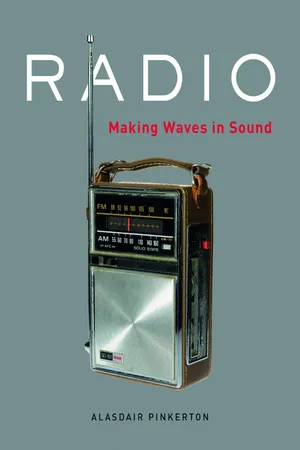
Radio is a medium of seemingly endless contradictions. Now in its third century of existence, the technology still seems startling modern; despite frequent predictions of its demise, radio continues to evolve and flourish in the age of the internet and social media. This book explores the history of the radio, describing its technological, political and social evolution, and how it emerged from Victorian experimental laboratories to become a near-ubiquitous presence in our lives. The book is shaped by radio's multiple characters and characteristics – radio waves occur in nature, but have been harnessed and moulded by human beings to bridge oceans and reconfigure our experience of space and time.
This is an informative and thought-provoking book for all enthusiasts of an old technology that still has the capacity to enthuse, entertain, entice and enrage today.
Published in association with the Science Museum, London.
- English
- ePUB (mobile friendly)
- Available on iOS & Android
eBook - ePub
About this book
Information
1
WIRELESS WORLDS
Radio has been described as the ‘everywhere’ medium.1 It is the world’s most ubiquitous means of mass communication. It surrounds us almost every minute of every day, carried through the air from transmitter masts to the most remote places on Earth and even beyond our own atmosphere. It has a global audience of millions – even billions – located everywhere from the most advanced and developed cities in the Global North to the poorest communities in the developing world. Radios are relatively cheap to buy or build (although they can also be very expensive indeed) and unlike television, which has traditionally been consumed in a fixed place within the home, radio is a remarkably mobile accompaniment to our daily lives. We listen in our cars as we travel to and from the workplace, at our desks and on the factory floor, and on personal devices as we cycle, walk or go running. We listen within sports arenas, in the garden, and in the kitchen as we prepare the evening meal. For many, radio is the first thing they hear in the morning and the last thing they hear before falling asleep at night. The world over, radio’s messages drift on the air from open car windows and shop doorways in momentary competition, occupying our soundscapes and connecting us briefly with familiar and unfamiliar radio worlds. Radio brings us our daily news, music of every conceivable variety, comedy and drama, but equally may deliver essential information about maritime conditions, crop reports, immunization programmes or the location of essential food supplies. Radio has the capacity to support in times of plenty and sustain in moments of crisis. It is, for many, a ‘portable friend’.
 | The UN distributes radios to support returning communities in Darfur, Sudan, in 2012. |
From the moment that radio waves were first harnessed to carry messages through the air during the late nineteenth century, their capacity to traverse space and to bring people and places into close contact intrigued, fascinated and was widely celebrated. The widely acknowledged father of long-distance radio communications, Guglielmo Marconi (1874–1937), was particularly attuned to the geographical opportunities of these burgeoning technologies. Marconi was, first and foremost, an entrepreneur set on exploiting the commercial and military opportunities that would come from enhanced ship-to-ship and ship-to-shore communications. Nonetheless, he also displayed an almost missionary zeal in the quest to ‘annihilate’ space and time, and to defeat the strictures of distance. It was Marconi’s obsession with the bridging of oceans by electromagnetic means that drove his investment into ever more powerful transmitting stations on both sides of the Atlantic Ocean during the early 1900s, including the Marconi stations near Poldhu in Cornwall (1901) and Caernarfon in North Wales (1914) and, correspondingly, transmitter stations near St John’s, Newfoundland and the New Brunswick Marconi Station in the U.S. state of New Jersey (1913). Other stations dotted the coastlines of Canada, the United States, Ireland and the United Kingdom in order to create multiple points of connection across the Atlantic. Marconi’s single-mindedness was not without its casualties or controversies, and yet no one played a more important part in shaping the radio’s early iconography. Radio was to be consumed on a gargantuan scale – from the power it consumed and the physical size of its engineering and infrastructure, to the global reach of its message. In much the same way as the tea clipper, the steamship and telegraph cable had accelerated communications during the course of the nineteenth century, radio was bound up in a glorious technological project to bring distant points on the Earth’s surface into close, even immediate, contact.
But if radio has become ‘the everywhere medium’ it also remains ‘somewhere’, rooted in place and reliant on (even interdependent with) specific sites of production, transmission, relay and reception. In a world that is increasingly littered with communications masts, electricity pylons, mobile phone towers and other workaday bits of apparatus, radio’s infrastructure may often appear (or not appear at all) as somewhat unremarkable features in our everyday lives – even when that infrastructure is of historical or cultural importance. And yet, some of radio’s sites have acquired iconic status, entering popular culture and public awareness, while others have the potential to reveal something of radio’s physical and geographical extremes.
LOCATING ‘THE EVERYWHERE MEDIUM’
According to UNESCO, 95 per cent of the world’s population (including 75 per cent of households in the developing world) are able to receive radio broadcasts, and the vast majority of us come to know radio as listeners to a range of local, national and possibly even international radio stations. We are surrounded by radios. In the industrialized world, there are 2.2 radio receivers for each individual person. That equates to 2.6 billion radio receivers owned by some 480 million households – with radio being accessible, at least statistically, to every man, woman and child. In the developing world, radio can be heard in almost all households that have an electricity supply, and an increasing number of households that don’t, thanks to old and new technologies that can power radios using kinetic and renewable energy sources. There are, it is suggested, 0.2 radios per person (1.5 per household) in the developing world, an estimated total of 1.4 billion radio receivers and a total audience of 3.14 billion listeners.
Statistics reveal that in 1992 there were 576.5 million radios in the United States, split across nearly 97 million households; $2.6 billion was spent on the purchase of radio sets during that year alone. Radios can be found in 95 per cent of all cars and 172 million bedrooms across the United States – perhaps unsurprisingly given that radio receivers have been integrated into another great invention, the alarm clock, since the mid-1940s. More intriguingly, perhaps, 14.7 million American bathrooms contained a radio – a statistic that discloses rather more than we may care to know about the listening habits of a significant number of American citizens. While these statistics uncover something of the saturation of radio in the lives and homes of developed and developing world economies, they also represent a very particular understanding of radio. This is radio as a material commodity – an object that can be bought, sold or traded, placed on the shelves or in the showers of dwellings the world over.
But radio is much more than just a domestic appliance. Unlike with dishwashers or toasters, radio is both material and immaterial. It is at once that metal, wooden or plastic box that we intermittently interact with, but also something extra, something more. The radio set is, in itself, a somewhat worthless assembly of electronic components (albeit with an important history of invention and development); its real value comes from the capacity of those components to pluck signals out of the air and then turn them into something audible. Radio isn’t therefore only an object, it is also a technology of transmission and reception that is itself built on systems, processes, infrastructures and networks of highly trained professionals – from engineers to producers and presenters – who are, in turn, subject to the priorities of commercial or public service broadcasters and, in most cases, strict regulations imposed by national government and international agreements. But even this doesn’t begin to capture the complexity or diversity of radio as a spatial medium that has changed and challenged our experience of the modern world.
In the United States, ‘national’ radio broadcasting during the 1920s and 1930s became focused on New York City, with the emergence of the National Broadcasting Corporation and their occupation of a large portion of 30 Rockefeller Plaza, the centrepiece of the strikingly modern and Art Deco-styled Rockefeller Center when it was completed in 1933. Not only did NBC occupy eleven floors of the new Radio Corporation of America building (as it was then known), but their sound engineers worked in close collaboration with the building’s architects to ensure that the new broadcasting facilities were truly state of the art and attuned to the specific requirements of a national radio broadcaster. Insulation and isolation were critical qualities. ‘The studio complex was structurally isolated from the rest of the building’, notes Emily Thompson, ‘to prevent the transmission of noise and vibration. Each individual studio was further isolated to ensure a totally soundproof environment, and a quieted air-conditioning system ventilated the entire windowless complex.’2 This was an architectural and engineering feat so singular in its devotion to radio and the sound medium that it came to be celebrated after its inauguration in purposefully sacred tones. Popular magazines of the day dubbed the studios a ‘temple to glorify the radio voice’ and a ‘gigantic cathedral of sound’.3 Others simply came to know it as New York’s ‘Radio City’. More than eighty years later and NBC still broadcasts live radio from the Rockefeller Center, although much of the studio space has been turned over to the production of live television shows, including the Tonight Show (the world’s longest-running television talk show) and Morning Joe (MSNBC network). The importance of the Rockefeller Center site in the history and heritage of U.S. radio (and vice versa) is not forgotten. Visitors taking the NBC studio tour will still see ‘Radio City’ on their tickets and radio’s legacy is preserved in the official name of Rockefeller Center’s internationally renowned entertainment venue, the Radio City Music Hall.
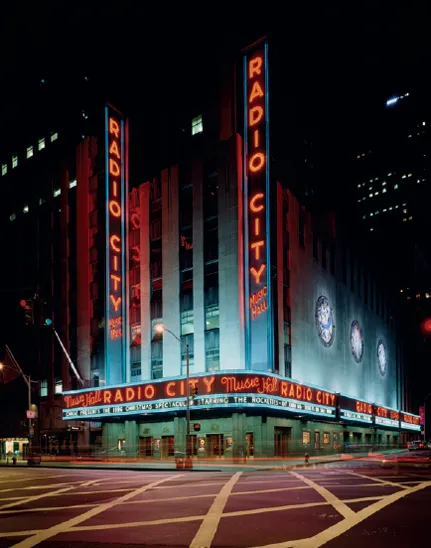 | Radio City Music Hall in New York City is often referred to as the ‘Showplace of the Nation’. |
New York’s Art Deco radio masterpiece was pre-empted by the BBC’s own (if rather more modest) Art Deco headquarters – Broadcasting House on Portland Place in central London. The Architectural Review (1932) saw this building as ‘a new Tower of London’, whereas an inscription within the atrium proclaimed it to be ‘a temple of the arts and muses’. This first purpose-built broadcasting facility in the United Kingdom continues to function as the corporation’s headquarters and primary radio studio complex to the present day, having been overhauled and extended during a £1 billion redevelopment completed in 2013.4
Other iconic radio sites are less well preserved. The now-iconic Wardenclyffe Tower, designed by the Serbian American radio pioneer Nikola Tesla (1856–1943), was lost from the skyline of Shoreham, Long Island, in 1917 – demolished on the grounds of wartime ‘national security’. Recent efforts to have the site designated as a U.S. national monument have so far failed to gain political support. The equally iconic hyperboloid structure of the Shabolovka Tower in central Moscow (designed by pioneering Russian architect Vladimir Shukhov, 1853–1939) nearly met a similar end when it was scheduled for demolition in 2014, only for Moscow city authorities to grant a preservation notice following an international campaign to have it saved. In the absence of any restoration plans, the tower’s long-term survival remains uncertain, although a 1:30 scale model of Shukhov’s radio tower can now be seen in the Science Museum in London. These and other losses (or near-misses – hardly a trace remains of Marconi’s pioneering radio infrastructures, f...
Table of contents
- Front Cover
- Half Title
- Title Page
- Copyright
- CONTENTS
- INTRODUCTION: MYTHOLOGY AND MAGNETISM
- 1 WIRELESS WORLDS
- 2 MAKING WAVES
- 3 RADIO AND THE NATION
- 4 EMPIRES OF THE AIR
- 5 RADIO WARS
- 6 RADIO AND POPULAR CULTURE
- REFERENCES
- SELECT BIBLIOGRAPHY
- ACKNOWLEDGEMENTS
- PHOTO ACKNOWLEDGEMENTS
- INDEX
Trusted by 375,005 students
Access to over 1.5 million titles for a fair monthly price.
Study more efficiently using our study tools.
Frequently asked questions
Yes, you can cancel anytime from the Subscription tab in your account settings on the Perlego website. Your subscription will stay active until the end of your current billing period. Learn how to cancel your subscription
No, books cannot be downloaded as external files, such as PDFs, for use outside of Perlego. However, you can download books within the Perlego app for offline reading on mobile or tablet. Learn how to download books offline
Perlego offers two plans: Essential and Complete
- Essential is ideal for learners and professionals who enjoy exploring a wide range of subjects. Access the Essential Library with 800,000+ trusted titles and best-sellers across business, personal growth, and the humanities. Includes unlimited reading time and Standard Read Aloud voice.
- Complete: Perfect for advanced learners and researchers needing full, unrestricted access. Unlock 1.5M+ books across hundreds of subjects, including academic and specialized titles. The Complete Plan also includes advanced features like Premium Read Aloud and Research Assistant.
We are an online textbook subscription service, where you can get access to an entire online library for less than the price of a single book per month. With over 1.5 million books across 990+ topics, we’ve got you covered! Learn about our mission
Look out for the read-aloud symbol on your next book to see if you can listen to it. The read-aloud tool reads text aloud for you, highlighting the text as it is being read. You can pause it, speed it up and slow it down. Learn more about Read Aloud
Yes! You can use the Perlego app on both iOS and Android devices to read anytime, anywhere — even offline. Perfect for commutes or when you’re on the go.
Please note we cannot support devices running on iOS 13 and Android 7 or earlier. Learn more about using the app
Please note we cannot support devices running on iOS 13 and Android 7 or earlier. Learn more about using the app
Yes, you can access Radio by Alasdair Pinkerton in PDF and/or ePUB format, as well as other popular books in History & Social History. We have over 1.5 million books available in our catalogue for you to explore.