At the end of his long, prolific life, Titian was rumoured to paint directly on the canvas with his bare hands. He would slide his fingers across bright ridges of oil paint, loosening the colours, blending, blurring, and then bringing them together again. With nothing more than the stroke of a thumb or the flick of a nail, Titian's touch brought the world to life. The clinking of glasses, the clanging of swords, and the cry of a woman's grief. The sensation of hair brushing up against naked flesh. The sudden blush of unplanned desire, and the dry taste of fear in a lost, shadowy place.
Titian's art was a synaesthetic experience. To see was at once to hear, to smell, to taste, and to touch. But while Titian was fully attached to the world around him, he also held the universe in his hands. Like a magician, he could conjure appearances out of thin air. Like a philosopher, his exploration into the very nature of things channelled and challenged the controversial ideas of his day. But as a painter, he created the world. Dogs, babies, rubies and pearls. Falcons, flowers, gloves and stone. Shepherds, mothers, gods and men. Paint, canvas, blood, sweat and tears. In a series of close visual investigations, Maria H. Loh guides the reader through the lush, vibrant world of Titian's touch.
- English
- ePUB (mobile friendly)
- Available on iOS & Android
eBook - ePub
About this book
Information
Topic
ArtSubtopic
Art GeneralONE
Touch Me!
Touch Me Not!

HISTORY AND ISTORIE
The years around 1510 were tremendous, marked by years of terror, war and humiliation for Venice: the economy slowed to a trickle; merchants were put out of business; printers closed shop and decamped. Having survived the millennarian anxieties surrounding the year 1500, the first decades of the new century were dominated by the War against the League of Cambrai, a political coalition formed by the Emperor Maximilian I, Pope Julius II, Louis XII and Ferdinand II of Aragon. These forces had come together in order to curb the expansion of the Venetian State and to carve up its territories for their own enrichment. In the spring of 1508, Titian’s father, Gregorio di Conte Vecellio, fought with the victorious forces of General Bartolomeo d’Alviano against the imperial armies at Valle; a year later, however, Venice would be defeated in the Battle of Agnadello. ‘At twenty-two hours [after sunset] Piero Mazaruol, a secretary, came running in with letters in his hand from the battlefield . . . our forces had been routed,’ Sanudo recorded on 15 May. ‘And there began a great weeping and lamentation and, to put it better, a sense of panic.’1 A few months into the autumn of 1510 another tragedy occurred when Giorgione died unexpectedly from plague. The young painter had been Titian’s former collaborator; they had just completed a series of large-scale frescoes on the facade of the Fondaco dei Tedeschi (the German trading post) by the Rialto Bridge. Titian’s sense of loss must have been incredible, but in this dark moment, a silver lining appeared in the weeks just before Christmas. On 1 December 1510, the young painter was paid an advance of 24 lire by Nicola da Stra to undertake the most important commission of his budding career: the fresco cycle for the Scuola del Santo.
The ‘Scoletta’, as it was called, was a confraternity dedicated to St Anthony in the town of Padua on the Venetian terraferma (mainland). In the upstairs meeting room, the Sala Capitolare, Titian inserted three scenes into the existing decorative scheme dedicated to the miracles attributed to St Anthony of Padua: the Miracle of the Speaking Babe, the Miracle of the Reattached Foot and the Miracle of the Jealous Husband. While Renaissance women could be members of this charitable organization, only the male members had open access to this space.2 It is interesting, therefore, that all three frescoes depicted scenes of cruelty and violence inflicted by horrific men upon innocent women: a man who falsely accuses his wife of adultery; a man who shamefully beats his mother; and a man who stabs his wife to death in a fit of unfounded jealousy. St Anthony’s miracle in this last story, upon which I will focus, was to resuscitate the lifeless woman and reunite her with her husband. From a modern feminist perspective, this might not seem like such a happy ending for the wife, but from an early modern point of view it represented a vindication of her innocence. In the continuous narrative in the background on the right-hand side of the fresco, the repentant man pleads with St Anthony to intervene, but it is her gruesome murder that takes centre stage.
How does Titian construct this visual lesson? Let us turn to the image for answers. We begin with verticality. Against a looming, craggy hill, a man holds a dagger above the fallen body of a woman. She is dressed in a fiery golden dress, which spreads out in the foreground as if it contained her last flickering breath. The fresco is situated in the corner of the northeast wall of the Sala opposite to a window. For a brief moment every day, the dress is lit up dramatically as the weak rays of evening light stretch across the room before the skies from the south-facing window slip into darkness outside. In the picture, the wife’s stockings have already gone the lifeless colour of the earth into which she seems to be sinking. The blood drains from the wound on her white chemise. Her head is pulled back, and she reaches up to stop the next blow that has been suspended by the stillness of the fresco. Her husband glances down, his facial expression as cold and steely as his weapon. His violent state of mind is made visible instead by the repeated verticality of red and white stripes that rain down upon the woman like a storm of blows still to come. The flash of green inside the husband’s open sleeve binds him chromatically to the jagged bluff. His anger externalizes itself in the prickly broken branches that burst forth at the top of the mound, tying him in another associative gesture to an inanimate form beyond himself. The roiling layers of blue, green, ochre, sienna and umber that sink and bind into the plaster wall reflect his sense of inchoate madness.
Most of the literature about this painting focuses on Titian’s stylistic sources and on the contractual documents, for the December 1510 commission is the first time that Titian’s profession appears in a written record.3 In my opinion, however, the most exciting observation about the Jealous Husband has to do with the actual surface of the work. In looking carefully at the fresco, it was noticed that the intonaco (or plaster preparation on the wall) was unusually built up almost 5 centimetres (2 in.) around the wife’s extended arm.4 As a result, the raised surface of the wall cast an actual shadow upon itself.
Again, as with La Famigliare, painted back in Venice in the months after this commission, it is not simply a matter of arguing that painting was ‘better’ than sculpture. On this occasion, Titian employed sculptural techniques to enhance the rhetorical force of his image. It is as if the foreshortened body of the wife is literally trying to break free from the site of her death – kicking, pushing and punching out into the viewer’s space on the other side of the picture plane. This special effect pre-dates the technology of 3D cinema by several centuries, but achieves a similar result by creating an immersive field of vision, confounding the eyes and soliciting the touch. Three-dimensional surfaces in Venetian painting were not an uncommon thing; Carlo Crivelli often used carved and gilded wood to pick out gems, jewels, beads and keys to enhance the presence of divine figures in his altarpieces. Titian, however, deployed this old trick for very modern purposes: to maximize the emotional drama within the scene and the synaesthetic experience of the audience.
By rendering the wife’s arm in this projective manner, Titian tempts the spectator to touch the very body in the scene that is the subject of assault. In this way, he cleverly sutures the spectator into the pov (point of view) of the abusive husband. At the same time, the viewer reaching up to touch the surface of the wall enacts the same gesture as the wife, suturing the viewer into her pov and heightening the pathos quotient through this unexpected double identification. But it was even more complicated than this. On the one hand, the psychological ambivalence of this beautifully painted image of horrible injustice served as a moral lesson to the men who occupied the Sala Capitolare. On the other hand, despite the conflicted desire generated by this image to touch and to not touch, there was little room for the Venetian or Paduan male viewer of the time to see himself in the place of the husband. For one, in the historical account of St Anthony’s life, it was noted that the insane spouse was a knight from the rival region of Tuscany.5 On top of that, Titian dressed the husband in the distinctive red and white colours associated in those years with Maximilian’s imperial soldiers who had only recently ravaged the lands around the city, and this symbolism would not have been lost on the patriotic men of the Scuola.6
Compelling visual dramas such as the Jealous Husband were often described as istorie. Deemed by Leon Battista Alberti to be the pinnacle of an artist’s work, istorie involved the narration of events (historical, religious, mythological and so on) and were composed with efficiency and concision so as to move, instruct and delight the mind and soul of the spectator.7 Titian would return to grand violent thrillers of this kind some decades later in the Martyrdom of St Peter of Verona (see illus. 45), but he also had the ability to convey the psychological stress and physical intensity of such situations even in a small picture of a street mugging.
In the work known as the Bravo (illus. 12), painted some years after the Paduan frescoes, a young man with a wreath on his head (possibly a poet or musician?) is about to be assaulted by a shadowy figure. Both figures are seen from behind. The assailant’s costume and weapon identify him as a Landsknecht mercenary. With his right hand, he grabs the young man’s left shoulder, while in his left hand we see the flat pommel of his katzbalger dagger. The fiery colour and rippling forms of his puff-and-slashed sleeve heighten the sense of brute force.8 At the same time, the slits read almost like gaping wounds underlying the sense of vulnerability for both parties involved in the confrontation, and if we look in the shadows to the left we can see that the youth, far from being a passive victim, is reaching for a blunt item with his right hand (his instrument or his own sword?). It takes the viewer more than just a moment to distinguish, identify and connect arms, hands and weapons to their owners, and in this moment of emergent discernability, the image manages to recreate the sensation of confusion and panic experienced by the figures. Titian’s art grappled with the extensive and expansionary power of the image. It was not simply about the subject matter depicted, but about what the image could do beyond itself – equal measures of drama and philosophy – and this applied to quiet devotional scenes as well.
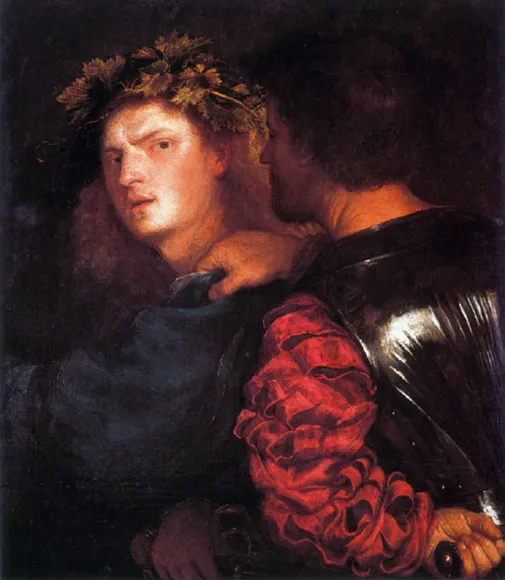
12 Titian, Bravo, c. 1516–17, oil on canvas.
THE TEARS OF GRASS AND PLANTS
Goodbyes can be awkward. What do you do when you unexpectedly run into someone to whom you have already bidden farewell? How long does one linger after the verbal exchanges have drifted into the air before physically separating from each other? Once you have walked away, how does one resist the desire to turn around for one last glimpse? If the other person does not reciprocate the gesture, how is one to take this? The emotional drama of such instances is beautifully enacted in Titian’s Noli me tangere (illus. 13), based on a scene from the Gospel of St John (20:17) and painted in the years after the frescoes at the Scoletta.
On Easter Monday, Mary Magdalene arrived at Christ’s tomb to discover that the body was gone. Fearful that his corpse had been stolen, she began to cry in the early morning light: ‘They have taken away my Lord, and I do not know where they have laid him.’ She then encountered a man in a garden and begged him to tell her where ...
Table of contents
- Front Cover
- Half Title
- Title Page
- Copyright
- Contents
- Introduction: Abracadabra
- 1 Touch Me! Touch Me Not!
- 2 Possessing Nature
- 3 Babies and Fur
- 4 Lightness and Weight
- 5 The Sense of Things
- 6 Blood, Sweat and Tears
- Coda: Gold Dust
- REFERENCES
- BIBLIOGRAPHY
- ACKNOWLEDGEMENTS
- PHOTO ACKNOWLEDGEMENTS
- INDEX
Trusted by 375,005 students
Access to over 1.5 million titles for a fair monthly price.
Study more efficiently using our study tools.
Frequently asked questions
Yes, you can cancel anytime from the Subscription tab in your account settings on the Perlego website. Your subscription will stay active until the end of your current billing period. Learn how to cancel your subscription
No, books cannot be downloaded as external files, such as PDFs, for use outside of Perlego. However, you can download books within the Perlego app for offline reading on mobile or tablet. Learn how to download books offline
Perlego offers two plans: Essential and Complete
- Essential is ideal for learners and professionals who enjoy exploring a wide range of subjects. Access the Essential Library with 800,000+ trusted titles and best-sellers across business, personal growth, and the humanities. Includes unlimited reading time and Standard Read Aloud voice.
- Complete: Perfect for advanced learners and researchers needing full, unrestricted access. Unlock 1.5M+ books across hundreds of subjects, including academic and specialized titles. The Complete Plan also includes advanced features like Premium Read Aloud and Research Assistant.
We are an online textbook subscription service, where you can get access to an entire online library for less than the price of a single book per month. With over 1.5 million books across 990+ topics, we’ve got you covered! Learn about our mission
Look out for the read-aloud symbol on your next book to see if you can listen to it. The read-aloud tool reads text aloud for you, highlighting the text as it is being read. You can pause it, speed it up and slow it down. Learn more about Read Aloud
Yes! You can use the Perlego app on both iOS and Android devices to read anytime, anywhere — even offline. Perfect for commutes or when you’re on the go.
Please note we cannot support devices running on iOS 13 and Android 7 or earlier. Learn more about using the app
Please note we cannot support devices running on iOS 13 and Android 7 or earlier. Learn more about using the app
Yes, you can access Titian’s Touch by Maria H. Loh,Loh, Maria H. in PDF and/or ePUB format, as well as other popular books in Art & Art General. We have over 1.5 million books available in our catalogue for you to explore.