The passages in this Study Book have been taken directly from KThe passages in this Study Book have been taken directly from Krishnamurti's talks and books from 1933 through 1967. The compilers began by reading all the passages from this period which contained the phrase choiceness awareness the theme of this book. This would not have been possible without the use of a searchable full-text database, the 'Krishnamurti Text Collection', produced by the Krishnamurti Foundation Trust, England.Over 600 passages were studied in all, and the aspects of choiceness awareness most frequently addressed by Krishnamurti were noted. These aspects thenformed the outline for the contents of this book.The material selected has not been altered from the way it was originally printed except for limited correction of spelling, punctuation, and missing words. The only other change to the text is the use of ellipses. Ellipses introducing a passage, or ending it, indicate that the passage begins or ends in mid-sentence. Ellipses in the course of a passage indicate words or sentences omitted.Krishnamurti spoke from such a large perspective that his entire vision was implied in any extended passage. If one wishes to see how a statement flows out of his whole discourse, one can find the full context from the references at the foot of each passage. These refer primarily to talks which have been published in The Collected Works of J. Krishnamurti. This seventeen-volumeset covers the entire period from which this Study Book has been drawn.A complete bibliography is included at the end of this book.Albion W. Patterson, Editorrishnamurti's talks and books from 1933 through 1967. The compilers began by reading all the passages from this period which contained the phrase choiceless awareness—the theme of this book. This would not have been possible without the use of a searchable fulltext database, the 'Krishnamurti Text Collection', produced by the Krishnamurti Foundation Trust, England. Over 600 passages were studied in all, and the aspects of choiceless awareness most frequently addressed by Krishnamurti were noted. These aspects then formed the outline for the contents of this book.
The material selected has not been altered from the way it was originally printed except for limited correction of spelling, punctuation, and missing words. The only other change to the text is the use of ellipses. Ellipses introducing a passage, or ending it, indicate that the passage begins or ends in midsentence. Ellipses in the course of a passage indicate words or sentences omitted.
Krishnamurti spoke from such a large perspective that his entire vision was implied in any extended passage. If one wishes to see how a statement flows out of his whole discourse, one can find the full context from the references at the foot of each passage. These refer primarily to talks which have been published in The Collected Works of J. Krishnamurti. This seventeenvolume set covers the entire period from which this Study Book has been drawn. A complete bibliography is included at the end of this book.
- English
- ePUB (mobile friendly)
- Available on iOS & Android
eBook - ePub
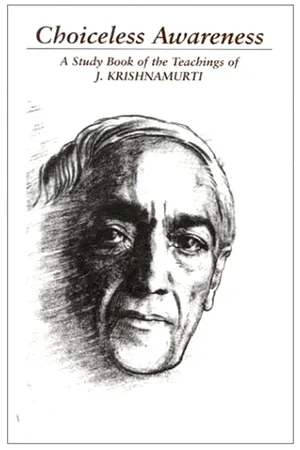
Choiceless Awareness
About this book
Information
Topic
PhilosophySubtopic
Philosophy History & TheoryTable of contents
- Title & Copyright page
- Foreword
- Introduction
- I. An Overview
- II. The Nature of Choiceless Awareness
- III. Understanding the Self
- IV. Consciousness, Thought, and Time
- V. Awareness and Transformation
- Awareness and Human Problems
- VI. Meditation and the Quiet Mind
- VII. In Summation
- Bibliography
Trusted by 375,005 students
Access to over 1.5 million titles for a fair monthly price.
Study more efficiently using our study tools.
Frequently asked questions
Yes, you can cancel anytime from the Subscription tab in your account settings on the Perlego website. Your subscription will stay active until the end of your current billing period. Learn how to cancel your subscription
No, books cannot be downloaded as external files, such as PDFs, for use outside of Perlego. However, you can download books within the Perlego app for offline reading on mobile or tablet. Learn how to download books offline
Perlego offers two plans: Essential and Complete
- Essential is ideal for learners and professionals who enjoy exploring a wide range of subjects. Access the Essential Library with 800,000+ trusted titles and best-sellers across business, personal growth, and the humanities. Includes unlimited reading time and Standard Read Aloud voice.
- Complete: Perfect for advanced learners and researchers needing full, unrestricted access. Unlock 1.5M+ books across hundreds of subjects, including academic and specialized titles. The Complete Plan also includes advanced features like Premium Read Aloud and Research Assistant.
We are an online textbook subscription service, where you can get access to an entire online library for less than the price of a single book per month. With over 1.5 million books across 990+ topics, we’ve got you covered! Learn about our mission
Look out for the read-aloud symbol on your next book to see if you can listen to it. The read-aloud tool reads text aloud for you, highlighting the text as it is being read. You can pause it, speed it up and slow it down. Learn more about Read Aloud
Yes! You can use the Perlego app on both iOS and Android devices to read anytime, anywhere — even offline. Perfect for commutes or when you’re on the go.
Please note we cannot support devices running on iOS 13 and Android 7 or earlier. Learn more about using the app
Please note we cannot support devices running on iOS 13 and Android 7 or earlier. Learn more about using the app
Yes, you can access Choiceless Awareness by J Krishnamurti in PDF and/or ePUB format, as well as other popular books in Philosophy & Philosophy History & Theory. We have over 1.5 million books available in our catalogue for you to explore.