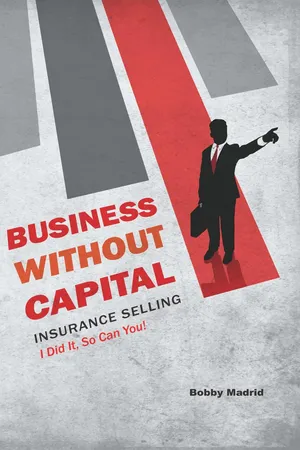
The Philippine insurance industry's Bobby Madrid leads the reader through the simple process of engaging in a business that needs no capital but dedication and determination. As he himself has continuously undertaken, Madrid outlines the steps that lead to success—including the "triggers" needed to turn challenges into incentives.
- English
- ePUB (mobile friendly)
- Available on iOS & Android
eBook - ePub
About this book
Information
Subtopic
Bookkeeping & BudgetsIndex
BusinessAn Excellent Business
Selling insurance is a business that can give you the life that you have dreamed of — for yourself and your family!
It is a business, and I say it’s an excellent business, because the monetary rewards have no limits. It does not require much training. It does not require tenure.
You can be a millionaire in an instant!
The only investment it requires is your commitment, dedication, and discipline. No cash, no capital is required!
Some people may think of life insurance as death insurance, and they do not like the thought of dying.
But it is correctly called life insurance because it gives “life” to the people who are left behind when a breadwinner passes away.
The basic necessities of life — which are food, clothing, shelter and education — will still be given to a family even if the breadwinner is no longer there.
In other words, he still gives life even after he’s gone. And, what is that life? That life is security for the family.
The dreams and aspirations of parents for their children can still be fulfilled even though they’re no longer around, because of this wonderful product called life insurance.
So if we look at insurance as not being related to death but rather related to life, then we view it from a different perspective.
Looking at life insurance from this point of view will erase whatever negative impression some people may have of it.
Educating the insurance agent
The first thing I tell any insurance agent is never to go out to meet clients without being prepared. They should know the product very well. And they must have carefully studied and reviewed the financial advice they will give clients.
It’s the marketing side that’s important, the selling part of it. If the person who is selling or offering this wonderful product has studied the product well and what it can do, then he is a professional in a real sense.
It’s like telling a quack doctor from a real doctor, or distinguishing a real musician from someone who is just doing it through oido.
It’s all marketing, it’s how you know and present your product. It’s all in the presentation. That is because the product itself is good. There’s nothing wrong with the product.
If they want to be called Financial Advisers, they should have the knowledge and the professionalism required of one.
Securing the future
When I started as an agent in Manulife in 1971, we had a sales presentation called the “paper close.” We put a paper on the table and drew a T account as in accounting (debit and credit). And the first question we asked was: “Had you died last night and were taken out of the picture, who would pay for your burial?”
That was then, but we don’t do that anymore.
Now we ask them: “Why do they work very hard?”
People work very hard so they can secure their future and afford retirement. They work hard so that their dreams and plans for their children can be fulfilled. And the only thing that can prevent them from achieving all of these is sickness or untimely death.
Well, we have the product that can help them when this unfortunate event happens in their life.
There must be a reason why you work so hard. Is it only for yourself and the moment? No, you do it for the future, whether it’s for your future or that of your family’s or your children’s future. That’s the reason you’re working very hard.
You also work very hard so that whatever plans you may have for the kind of life you would like to give yourself and your family will be met.
Now, what will stop you, or what’s the worst thing that can happen to you, so that you will not be able to achieve your goals?
Normally, they’ll say, “Well, if I lose my job, or if I lose my business.”
Then we ask further, “What if you don’t lose your job, or you don’t lose your business, what’s the worst thing that can happen to you?
And then they’ll say, “When I get sick.”
Because when you get sick, there it goes. If you were like a machine, and there’s no gasoline, or there’s a malfunction, you don’t work. And there goes your desired output.
So there’s a risk, a major risk. As an intelligent person, how are you going to make sure that when that happens, your plan for the future is still achieved?
Then they’ll say, “I don’t know, maybe someone should take care of me.”
It used to be that the way to sell was to frighten people. “You will die, how will you prepare for that…?” That was why people ran away and made sure to avoid insurance agents.
The life insurance products of today are more linked to investments. We call them Unit Link Products.
When we sell insurance today, we emphasize instead the life benefits rather than death benefits, thus making it easier to sell, i.e., retirement funds.
The questions we pose are so much different now.
“What if they live too long? How do they support themselves when they retire?”
On the other hand, if they die too soon, or they get sick or disabled — all these predicaments can be covered by the product that the agents sell.
We can then say: “Well, what will take care of you is what we call insurance.”
Now, if you were a financial planner, if you were a strategist, then you would know that any barriers to your goals should and can be addressed, and be taken care of.
You just have to educate people about insurance. You’re not there to scare them; you’re there to help.
And that’s what I call the mission.
The mission
This is the mission — the mission of helping people.
Insurance also indirectly helps the nation.
Because of insurance, children who would’ve been uneducated, or might have grown up illiterate, will be educated and literate.
People who would’ve remained poor, or might have been mendicants who depend on everyone else, could actually even become business leaders helping the country. And all this can be due to the insurance business.
If you look at it from that perspective, that’s how important this business is. So maybe it’s just a negative impression of an agent that makes a product look bad.
The perception of what makes an agent is the crux of the whole thing. If the agent is something less than professional, if the agent is more of a “whisky salesman” — one who’s only interested in the commission, and the heck with whether you’re given the right product or not — then that brings the whole thing to a negative perspective.
So it is not the product per se, but it is the person selling or offering the product.
It is not the product that gives a negative impression. It is the person selling it, if this is done unprofessionally!
Professionalism is the key. It is a matter of Financial need selling vs. Commission selling.
Are you more concerned about the financial need of your client as the basis for your advice, or are you more interested in the commission?
Always remember, the financial advice you give does not only secure the future of your client and his family, but will also contribute to nation-building.
The more intrinsic and profound purpose of insurance is protection and security. And so it doesn’t only mean money for the person, but also benefits for the entire community. If everyone is insured, when something happens to them, nobody remains poor.
Our products help secure the education of our children who are the future leaders of our country.
This is your mission!
And as what has been taught in all insurance seminars, “Focus more on your mission and the commission will just follow!”
Learning the Insurance Business
As you go through your career selling life insurance, you learn along the way. But what makes your learning more intense is your hunger for success. The pursuit of excellence should always be first and foremost in your mind.
I listened and learned from the experiences of successful insurance career agents. I read books on insurance, etc.
I was aware that mediocrity is not acceptable, and I had a very strong fear of failure.
But to have a positive craving for success, you must have a “trigger” that you can pull to push you into this action.
The fundamental trigger for me was my quest for financial stability to be able to fulfill my dreams. The thought of financial instability and dependence on other people scared the hell out of me.
I strongly believe that to be happy, one must have freedom of action and peace of mind. And to achieve this, you must have financial stability to do what you want.
And the values of integrity, fairness, and equality should always be the principles that you follow in whatever you do, to have peace of mind.
The first “trigger”
Looking back at it now, I did not come from a rich family. My parents were hardworking professionals. My father was a doctor of medicine and a professor at the University of Santo Tomas (UST). My mother was also a professor at UST. They were both in the academe.
I so admired their professionalism and dedication to their career. I loved and respected them very much! The best gift and inheritance they gave me was my education.
My parents worked so hard to make sure that we had a good life, and I knew I could not afford to fail them. I did not want their sacrifices to be just in vain.
I had to have a good job, with good pay, in one of the best companies in the country. I could not fail and disappoint my parents.
That was my first trigger: the fear of failing my parents. I wanted them to be proud of me!
My first job
I was lucky enough to land a job with Procter and Gamble even before I graduated from college. As early as February 1969, a month before I graduated from De La Salle College with a Bachelor of Science in Commerce degree, I was fortunate enough to be taken as a management trainee in sales assigned in Cebu.
As luck would have it, my oldest brother Ramon was also assigned to Cebu two months after I was sent there. He headed Filipinas Life for Visayas and Mindanao.
I started as a management trainee but was promoted to section manager in Cebu City after six months.
It became quite a challenge for me. First of all, I am not a Cebuano. I did not speak the language, and I did not have a single relative in Cebu in my first two months there.
But when my brother came, I stayed with him and his family. Before that, I was on my own.
I sold soap and detergent products in Carbon, a public market in C...
Table of contents
- Cover
- Title Page
- Copyright Page
- Contents
- The “I Did It, So Can You” book series
- Acknowledgments
- Part 1 An Excellent Business
- Part 2 Learning the Insurance Business
- Part 3 Understanding the Business
- Part 4 Succeeding as a Businessman
- Part 5 The Three Virtues
- Part 6 Inspiration and Insight
- Part 7 Business Without Capital
- Part 8 Getting into Business Without Capital
- Part 9 Selling Professionally
- Part 10 Why Invest in Insurance?
- Part 11 Cinderella Stories
- Part 12 From Mediocrity to Excellence
Trusted by 375,005 students
Access to over 1.5 million titles for a fair monthly price.
Study more efficiently using our study tools.
Frequently asked questions
Yes, you can cancel anytime from the Subscription tab in your account settings on the Perlego website. Your subscription will stay active until the end of your current billing period. Learn how to cancel your subscription
No, books cannot be downloaded as external files, such as PDFs, for use outside of Perlego. However, you can download books within the Perlego app for offline reading on mobile or tablet. Learn how to download books offline
Perlego offers two plans: Essential and Complete
- Essential is ideal for learners and professionals who enjoy exploring a wide range of subjects. Access the Essential Library with 800,000+ trusted titles and best-sellers across business, personal growth, and the humanities. Includes unlimited reading time and Standard Read Aloud voice.
- Complete: Perfect for advanced learners and researchers needing full, unrestricted access. Unlock 1.5M+ books across hundreds of subjects, including academic and specialized titles. The Complete Plan also includes advanced features like Premium Read Aloud and Research Assistant.
We are an online textbook subscription service, where you can get access to an entire online library for less than the price of a single book per month. With over 1.5 million books across 990+ topics, we’ve got you covered! Learn about our mission
Look out for the read-aloud symbol on your next book to see if you can listen to it. The read-aloud tool reads text aloud for you, highlighting the text as it is being read. You can pause it, speed it up and slow it down. Learn more about Read Aloud
Yes! You can use the Perlego app on both iOS and Android devices to read anytime, anywhere — even offline. Perfect for commutes or when you’re on the go.
Please note we cannot support devices running on iOS 13 and Android 7 or earlier. Learn more about using the app
Please note we cannot support devices running on iOS 13 and Android 7 or earlier. Learn more about using the app
Yes, you can access Business without Capital by Bobby Madrid in PDF and/or ePUB format, as well as other popular books in Business & Bookkeeping & Budgets. We have over 1.5 million books available in our catalogue for you to explore.